Cause of Death
Citizen investigators have largely concluded that Charlie Kirk was killed by an explosive at his RØDE lavalier microphone — the Exploding Mic — not by a .30-06 rifle round. The .30-06 / Mauser account is the government's narrative. The large majority view among the investigators working this case on X is an explosive, and this page sets out why. Full evidence hub: Microphone — The Exploding Mic Theory.
Satirical LEGO-animated music video referencing Charlie Kirk's RØDE mic, via @RickyTheGuido, July 24, 2026. IPFS CID Qmd6zPTaBkhDSqCA9nEVrx1e7JsgAEUV7qSDu1pGELiPZJ.
- .30-06 Did Not Kill Charlie
- .30-06 Energy Mismatch
- Wound Trajectory & Angle
- ATF Fragment Inconclusive
- Barrel Dust & Bullet Diameter
- Explosive in Mic Killed Charlie
- Exploding Mic Theory (Hub)
- Mic Explosion Video Analysis
- Chest-Shot Witnesses
- Explosive Residue Removed
- The Autopsy Is Not Public
Video: The DoD Contract for Miniaturized-XS Anti-Personnel Charges
AES contract walkthrough (2m35s). Originally posted by @mistressdivy on X, 2 July 2026; re-shared by @irlandarra2019, 28 September 2026 (credited to @theleahfiles). Mirrored to IPFS by this investigation.
Speaking as someone who says she has run DoD procurements, the narrator pulled every Accurate Energetic Systems contract from USASpending.gov. She found one award to the company's Tennessee address for "miniature XS demolition devices, anti-personnel": $440,494, signed April 22, 2025, with performance running May to August 2025. She says it stands out on four counts: it is the only AES award shorter than a year, it went through simplified acquisition, it had a single bidder, and it sits outside the indefinite-delivery vehicles that carry AES's other federal work. She describes the devices as made for special operations forces. The contract details are on The DoD Contract.
She then notes that the plant at that address exploded about a month after the assassination, killing the workers inside. She says "correlation doesn't mean causality," and she asks others to help verify or correct her findings. The clip also names a serving Defense Department official. That is the narrator's own speculation, offered without evidence. This site makes no claim that he or any other named person knew of, or had any involvement in, Charlie Kirk's death.
Cause of death: the Exploding Mic
- Exploding Mic — the conclusion of the large majority of citizen investigators: a small explosive in or at the microphone assembly, not a rifle round, killed Charlie Kirk. See Explosive in Mic Killed Charlie, the video frame analysis, and the chest-shot witnesses.
Why Investigators Conclude It Was the Exploding Mic
Citizen investigators have largely concluded that Charlie Kirk was killed by an explosive at his microphone, not by the government's .30-06 rifle narrative. The main reasons:
- The shirt and fabric move first — video frame analysis shows the shirt expanding outward, spherically, before the neck wound appears.
- The audio separates two blasts — the Canon XA55 recording reportedly shows a louder detonation at the tent distinct from a distant muzzle report.
- Eyewitness veterans called it an explosion — Rob O'Neill and Gen. Blaine Holt said it looked like an explosion, not a rifle wound.
- No exit wound, and an energy mismatch — a .30-06 at that range would be expected to exit and destroy tissue; see six forensic physics phenomena.
- The mic was routed under the shirt — unlike prior events, placing the transmitter against his chest and neck.
- Physical debris — a burnt object in the SUV and a neck fragment that may be charred plastic.
- The residue evidence was removed, not tested — dirt, clothing, the SUV and the necklace were hauled, cleaned or seized with no public residue test.
- Means existed — an AES contract for miniaturized anti-personnel charges sits on the same timeline.
Full evidence hub: Microphone — The Exploding Mic Theory.
The AES DoD contract for miniaturized anti-personnel charges is documented separately. Nothing indicates anyone on the security or AV team knew of any device.
The government's narrative: the .30-06
The government's narrative holds that a single .30-06 round fired from a Mauser Model 98 on the Losee Center rooftop was the cause. Investigators have taken that account apart point by point:
- .30-06 Bullet Did Not Kill Charlie — the central argument that the wound, trajectory, and energy do not fit a distant high-power rifle kill.
- .30-06 Energy Mismatch — why the energy a .30-06 delivers at that range is inconsistent with what was observed.
- Wound Trajectory & Angle — the geometry problem between the claimed firing position and the reported wound.
- ATF Fragment Inconclusive — the state's own ballistics work could not tie the recovered fragment to the recovered rifle.
- Gun & Bullet (full section) — the complete ballistics record.
Tyler Robinson is charged, not convicted, and is presumed innocent. See Proof Not Tyler.
Why this section exists
The cause of death is the hinge of the entire case. If a .30-06 round fired from a rooftop killed Charlie Kirk, the official account would be coherent and the remaining questions would be about motive and process. Because investigators conclude it did not, the charged suspect's alleged weapon did not do it, the rooftop firing position does not explain the death, and every element built on that foundation — the confession, the timeline, the evidence handling — needs to be re-examined from the beginning. That is why this question is separated out and stated directly rather than left distributed across a dozen pages.
The evidence that led investigators to the explosive is convergent. The state's own ATF examination could not match the recovered fragment to the recovered rifle. The reported wound geometry and the claimed firing position cannot be reconciled. Witnesses close to the stage described a chest event. Video frame analysis shows an outward rupture at the body rather than an incoming projectile. The mic was routed under the shirt, debris consistent with a burnt transmitter surfaced, and the ground, clothing, and vehicle that could have carried explosive residue were removed or cleaned without any public residue test. Together these are why the large majority of investigators concluded it was the Exploding Mic.
The autopsy has not been released. See the Autopsy section. Readers new to this question should start with the Mic hub, then .30-06 Did Not Kill Charlie.
Scope of this page — no allegation against TPUSA, security, or the AV team
We are not making the allegation that anybody at TPUSA, on the security team, or among the audio and visual people involved had any knowledge of, or committed, any unethical or criminal act. No such claim is made or implied anywhere on this page or on the pages it links to.
The people who built the stage, ran the sound, clipped on the microphone, and handled security that day were doing their jobs. Nothing documented here suggests otherwise. Where these pages discuss the microphone, the staging, the truss, or the site, they are discussing equipment and physical evidence — not the conduct of the people who worked with that equipment. A theory about a device is not an accusation against the person who supplied it.
This page exists to document what the majority of citizen investigators were concluding on X as of July 2026 — nothing more. It is a record of the state of independent analysis at a point in time, not a finding of fact, not a legal conclusion, and not an accusation against any person or organization. The conclusions summarized here are those of third-party investigators and are reported as such. The central document — the autopsy — remains sealed.
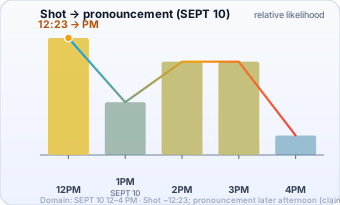
Best understanding of when this happened
Best understanding: the fatal event at ~12:23 PM; pronouncement later the same afternoon at Timpanogos (exact minute disputed across reports).
Date range (working model): SEPT 10 12–4 PM · Fatal event ~12:23 → pronouncement later PM
The chart below is not a government finding. Bar height is relative likelihood from public claims. Domain is trimmed to non-trivial likelihood.
Video: Erika Kirk's Name Searched in Hebrew While Egyptian Jets Sat on the Ground
Stew Peters claims Hebrew-language searches for "Erika Lane Frantzve" — Erika Kirk's maiden name — plus Tyler Robinson's apartment address, the Losee Center, and preloaded Orem SIM cards, cluster on dates an Egyptian military jet was on the ground in the United States. Search-trend data cannot show who searched or why, and being the subject of a search is not participation in anything — the same data would be consistent with her being looked up by strangers. Recorded as an attributed claim. Full framing: Planes and Google Searches.
Stew Peters, 5 August 2026 (3m40s). Source: @realstewpeters on X. Mirrored to IPFS by this investigation so it survives deletion.
Interesting In Other Areas
- Two cameras reportedly show shirt fabric expanding outward before any wound appears.
Elsewhere In The Investigation
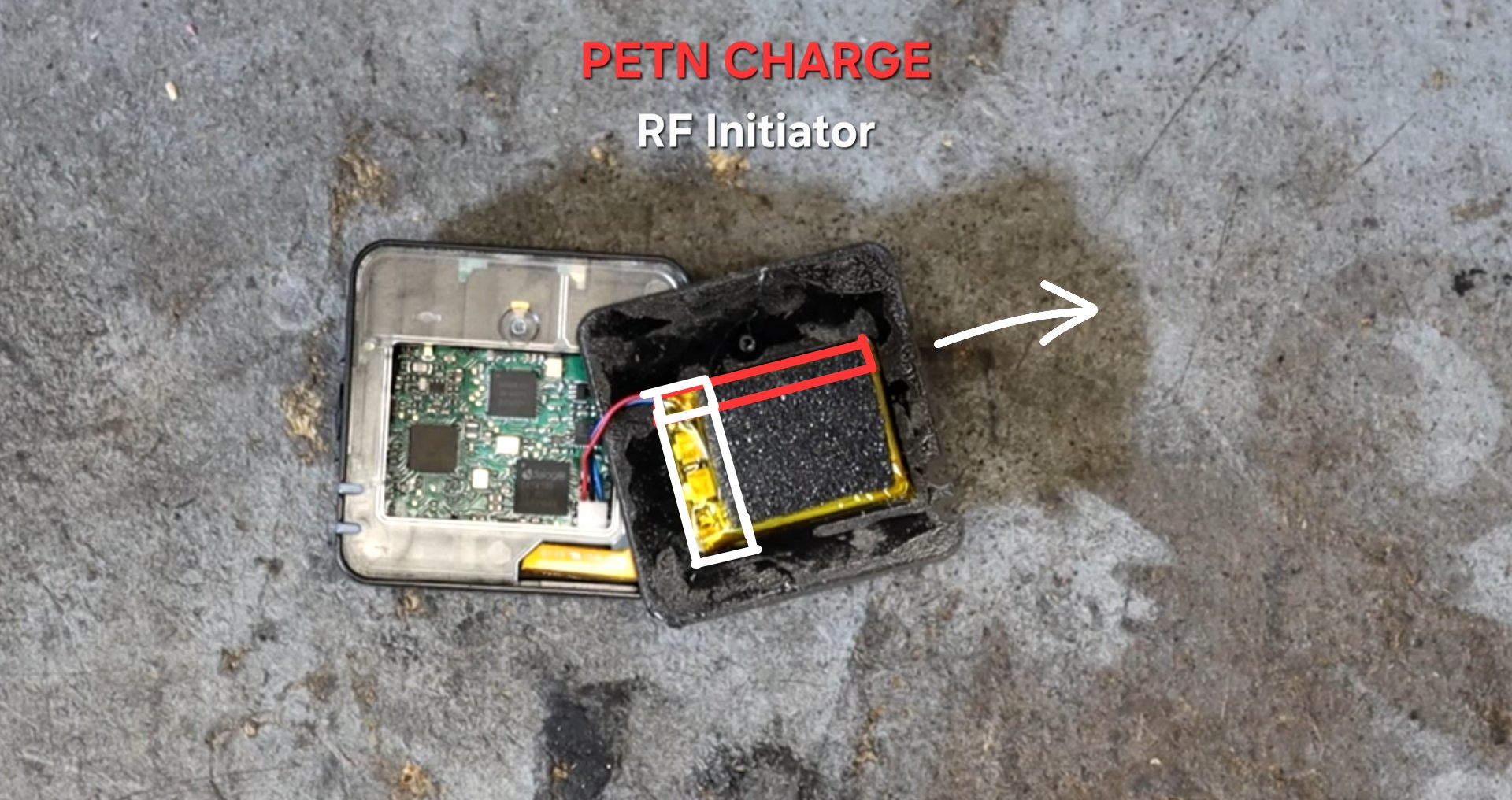
Microphone — The Exploding Mic Theory
The lavalier clipped to his shirt may have concealed a small explosive — the leading conclusion among citizen investigators, and the thread that runs through video, audio, procurement, and post-event debris.
Read thisThis website's author is @HolonCitizen on X and YouTube/@HolonCitizen. Follow me there.
Interesting
- A duty to log destroyed evidence exists because videos and tail numbers went missing.
- Agencies would have to name every system they actually searched, not just say "no records."
- Records can be dumped while nobody is assigned to follow the leads inside them.
X.com posts:
- Stew Peters: Hebrew searches for Erika Kirk during Egyptian jet visits
- Navy SEAL Rob O'Neill: the ballistics don't make sense
- AES DoD contract for anti-personnel XS charges, re-shared
Video: Navy SEAL Rob O'Neill — "The More I Look At It, The Less It Makes Sense"
This is the clip most directly on this section's subject. Rob O'Neill, former Navy SEAL, states from combat experience that a .30-06 round to the neck "would blow his head off", that he saw no exit wound, and that the shirt movement suggested "an impact nearby". He then notes that the official explanation changed — first a ricochet off body armor, then no body armor — which cannot both be true. His account is an experience claim, not a forensic finding, and it is no substitute for the autopsy that has not been released. See the Exploding Mic hub. Full write-up: Navy SEAL O'Neill Questions.
Rob O'Neill on Redacted, 17 August 2026 (4m37s). Identified on screen as "Fmr. US Navy Seal, The man who killed Bin Laden". Source: @RedactedNews on X. Mirrored to IPFS by this investigation so it survives deletion. Full write-up: Navy SEAL O'Neill Questions.
Related Areas
- The autopsy section
- Ballistics and wound analysis
- Signs of a cover-up
- Other theories of the killing
- The tent and the ground beneath it
- Court and trial
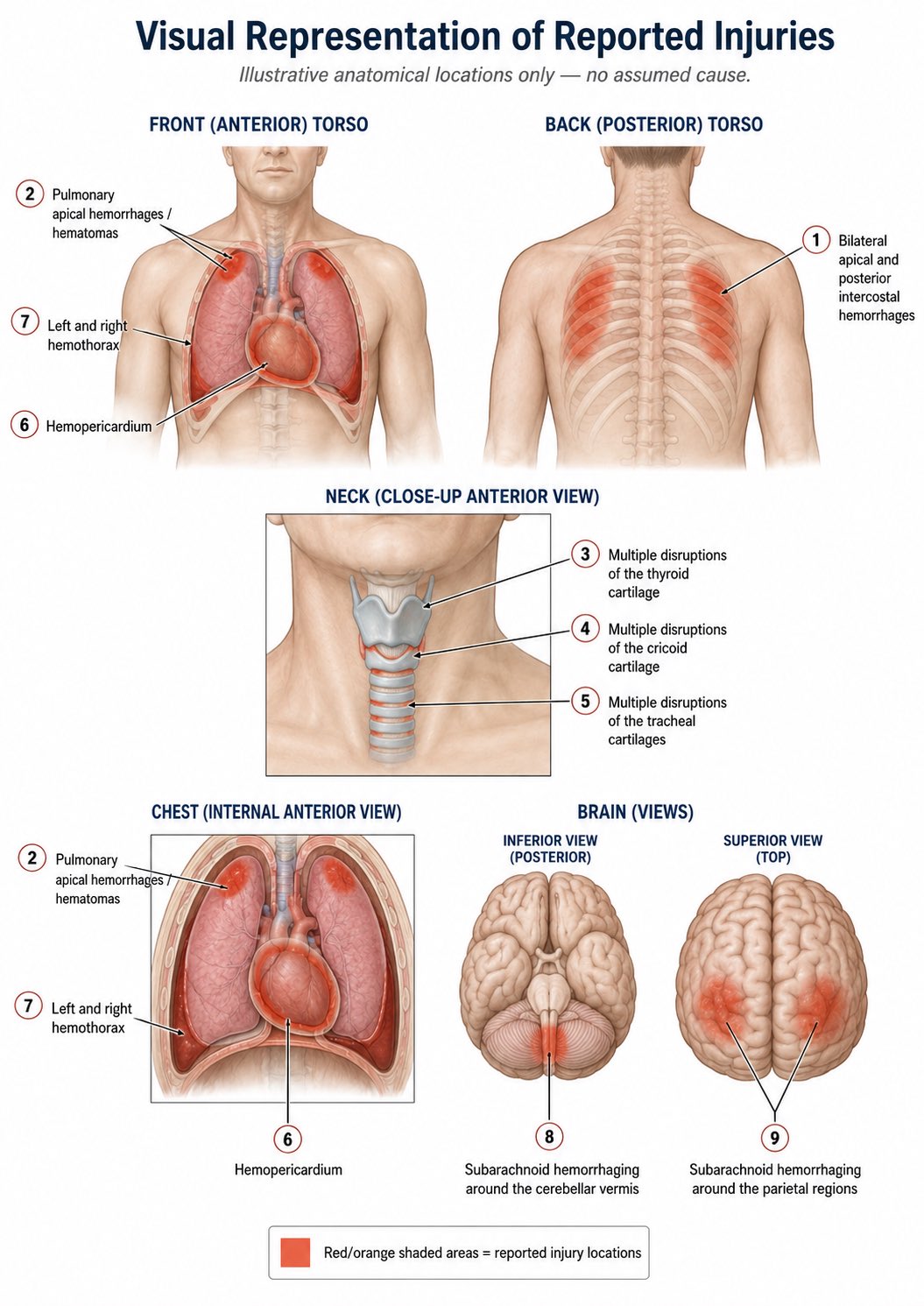
The shape charge is what killed Charlie Kirk.