The Exploding Microphone Theory (Claims)
Satirical LEGO-animated music video referencing Charlie Kirk's RØDE mic, via @RickyTheGuido, July 24, 2026. IPFS CID Qmd6zPTaBkhDSqCA9nEVrx1e7JsgAEUV7qSDu1pGELiPZJ.
:::caution Legal Disclaimer Nothing on this page is a claim of fact that any living person or organization knew of, planned, participated in, or covered up any crime, or acted illegally, immorally, or unethically. We make no claim that anyone named here knew anything beforehand or did anything wrong. This page documents questions and allegations raised in public commentary — not findings of fact. All persons and organizations named are presumed innocent; the allegations referenced are unproven and have not been established in any court. :::
This page documents the majority conclusion of citizen investigations on X: that Charlie Kirk died by an explosive, not a rifle bullet. It is presented as a set of reported claims and counterarguments. The government's narrative holds that Kirk was killed by a single rifle shot to the neck at Utah Valley University on September 10, 2025 — an account the evidence below appears to disprove. Readers should weigh both.
The theory
A growing number of online commentators argue that an explosive device — concealed in or near Charlie Kirk's lapel microphone, a wireless transmitter (battery) pack, or his crucifix pendant — was a likely cause of his fatal wound, rather than (or in addition to) a rifle round fired from a distance. Proponents commonly describe the alleged device as a miniaturized shaped charge or EFP-style ("explosively formed penetrator") device that produces an inward-directed penetrating effect mimicking a rifle wound while creating outward pressure and shrapnel effects. The alleged cover-up angle is that this possibility is, according to proponents, being suppressed in favor of a clean "lone rifle shooter" narrative naming Tyler Robinson.
Some versions hold that a small shaped charge (proponents reference the explosive PETN) was meant to fire into Kirk's chest to simulate a heart shot, and that "something went wrong" so the charge instead struck his neck. Others describe a remote-detonated or acoustically triggered device in which the audible "rifle crack" served as the detonation signal or as cover for the blast. These are reported interpretations from social-media analysts, not findings of any official forensic body.
How proponents say the device would work
Proponents who favor a device over a sniper round generally describe an Explosively Formed Penetrator (EFP) — a miniaturized cousin of the shaped charge — rather than a conventional bomb. An unsigned technical write-up circulated under the banner "Who Killed Charlie Kirk?" (whokilledck.com) lays out the proposed engineering in detail. It is an amateur analysis, not a forensic or peer-reviewed finding, and is reproduced here as a reported claim.
- Shaped charge versus EFP. A traditional shaped charge uses a deep copper cone that collapses into a high-speed jet to punch through armor. According to the write-up, an EFP instead uses a shallow, almost-flat metal dish that inverts under detonation into a single coherent slug travelling roughly 1,000–2,000 m/s. The flat profile, proponents say, is what would make such a device concealable inside something the size of a lavalier mic.
- Proposed dimensions. The analysis describes a copper dish about 9 mm across and under a millimetre thick, backed by roughly 2 grams of PETN pressed to 1.77 g/cm³, with a microdetonator "the size of a pencil eraser" fired by a few volts from a small lithium battery. The finished device is likened to "two stacked quarters" and is said to add under 10 grams to the mic's weight.
- Low signature in tiny amounts. Proponents note that PETN is a high explosive with a relative effectiveness of about 1.66 versus TNT and a detonation velocity near 8,400 m/s, and that in micro-quantities it produces far less visible smoke and flash than gun propellant — which they offer as a reason no obvious fireball appears in the footage. Skeptics dispute that a contact charge would leave no signature at all.
- Claimed lethality match. Proponents present a side-by-side comparison arguing the device would replicate a .30-06 hunting round at 150 yards despite weighing about half as much, with higher velocity said to compensate for lower mass:
| Parameter | .30-06 @ 150 yd | Miniaturized EFP (claimed) |
|---|---|---|
| Impact energy | ~2,180 J | ~2,500 J |
| Penetration depth | 45–55 cm | 45–50 cm |
| Permanent wound track | ~10 mm | 9–12 mm |
| Lethality | Immediately incapacitating | Immediately incapacitating |
- Contact-range mechanism. Because the explosive would sit directly against the body, proponents argue only a few grams are needed: the copper slug fires inward to mimic a bullet wound while the detonation pushes outward — the claimed source of the shirt "balloon," the lifted magnetic clasp, and the clasp-turned-shrapnel they say lacerated the neck.
These figures originate from an anonymous proponent analysis and have not been tested, replicated, or confirmed by any forensic authority. A prominent skeptic (see Why this is contested below) notes that a promised physical demonstration of the theory has reportedly gone unproduced for many months.
Key proponents and their analyses
The theory does not come from one source. It has been built up across many threads, video breakdowns, and podcast segments from late 2025 into mid-2026. Two figures are repeatedly credited as early or prominent voices, and both are public commentators speaking in their own name.
Jon Bray — "vector flow" / pixel-mapping analysis
Posts attributed to Jon Bray (@jonaaronbray) are among the earliest detailed articulations of the theory.
- September 20, 2025. In a post that drew high early engagement, Bray wrote that his "vector flow analysis is complete" and that, in his interpretation, "Charlie Kirk was assassinated by a hidden shape charge" — claiming "the battery of his RØDE Wireless mic exploded via detonation." He urged followers to share the analysis quickly. This is his stated conclusion, presented here as a reported claim.
- September 24, 2025 follow-up. Bray posted a more detailed pixel-flow mapping of multiple high-resolution angles. He claimed to find "not a single linear kinetic vector consistent with a supersonic .30-06 round impacting flesh, fabric, or air," and instead described omnidirectional micro-vibrations radiating outward from the chest (the microphone position), which he interpreted as blast overpressure from an internal source. He argued the footage lacks the directional "shock plume" or cavitation he would expect from a high-velocity bullet, and characterized the "bullet stopped by dense bone" account as inconsistent with how a ~2,700-fps round would behave. He also advanced the idea that the audible rifle crack functioned as an acoustic detonator signal for a remote device synced to the "shot" sound, and demanded raw footage, independent ballistics, and autopsy vectors.
- June 21, 2026 amplification. A widely shared 4K close-up posted by @matt82704417 (Matthew St Baker), crediting Bray's tracking, claimed to follow the alleged device frame-by-frame: starting at the mic receiver pack on Kirk's left belt, driven upward under the shirt, "pinched" and "yanked" violently over his left shoulder toward the neck, then falling back and tracking diagonally under the fabric to the lower-right of his shirt. The poster framed it as visual proof of "an INTERNAL EXPLOSION" from a PETN device rather than a .30-06 round. This is a reported social-media interpretation of footage, not an authenticated forensic finding.
Bray's work is later referenced in 2026 interviews, podcasts, and YouTube deep-dives. These are one analyst's interpretations of video and acoustics; they have not been independently confirmed or peer-reviewed by any forensic authority, and skeptics dispute the methodology (see Why this is contested below).
Stew Peters — priority claim and SUV "glass shards"
Commentator Stew Peters (@realstewpeters) has publicly claimed to be among the first to articulate the theory, stating he "called it first" on September 24, 2025, that "the mic killed Charlie Kirk," and that he was ridiculed at the time. He has continued to press the claim through 2026.
- January 10, 2026. In a widely shared post, Peters pointed to what he described as "shards of glass in the SUV" that transported Kirk to Timpanogos Regional Hospital, arguing that Kirk wore a "tempered glass lav mic" and that glass can be seen "flying everywhere" in footage of the moment he was struck. He used this to dispute the suspect narrative ("Stop the Tyler Robinson bullshit"). Follow-ups argued that glass and residue in the grass would be "almost impossible to completely clean up" without excavating and paving over the area, that the SUV's carpet was removed and the vehicle quickly sold rather than preserved, and that clothing was discarded.
These are Peters' stated opinions and allegations, reproduced as reported claims. The underlying images and footage are social-media material that has not been independently authenticated, and ordinary explanations (lighting, compression artifacts, unrelated debris, routine vehicle cleaning) have not been ruled out.
Candace Owens — "chest shot that never happened"
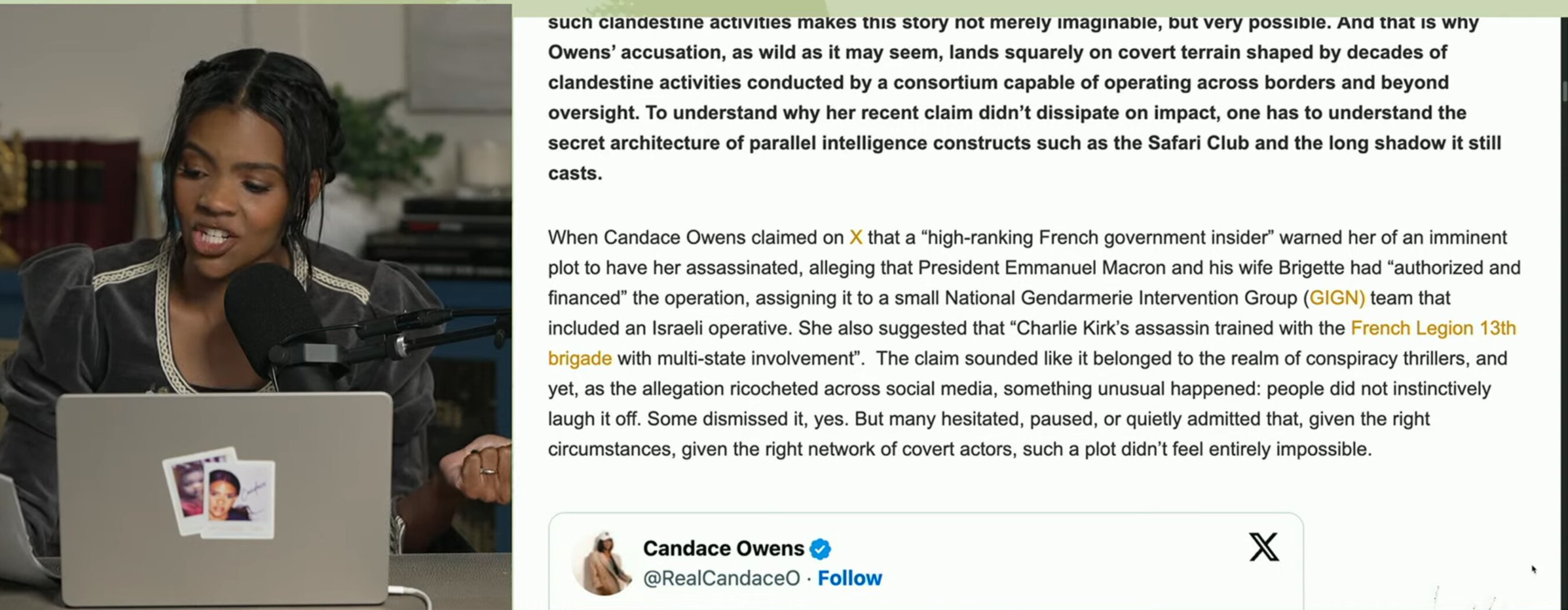
Commentator Candace Owens has reportedly highlighted early witnesses who described blood erupting from Kirk's chest "right where his heart is." She argues these descriptions match a planned chest hit that "never happened," and frames this as evidence of a pre-scripted narrative. Photos attributed to an Owens broadcast are also cited by proponents as showing debris on the SUV floor (see below). In a later segment she said she intended to look into whether the early on-camera witnesses who described a heart/chest shot were unusually "politically connected," and referenced emails claiming a "rigged mic" could have been assembled at a military signals facility (she named Fort Huachuca, an Army intelligence post). She framed the sequence as a planned "shape charge" to the chest that "went wrong" and struck the neck because of how Kirk was crouched. These are her stated opinions and lines of inquiry, presented here as reported claims, not as proven fact; this site names no witness as having done anything wrong.
What proponents point to
Proponents cite several categories of circumstantial material, all of which remain reportedly unverified and open to ordinary explanations.
- Audio timing. Analysts of a professional broadcast camera (variously described as a Canon XA55 recording uncompressed audio roughly 46 meters from the tent) claim the recording shows three separate acoustic events: an early Mach-cone signature (
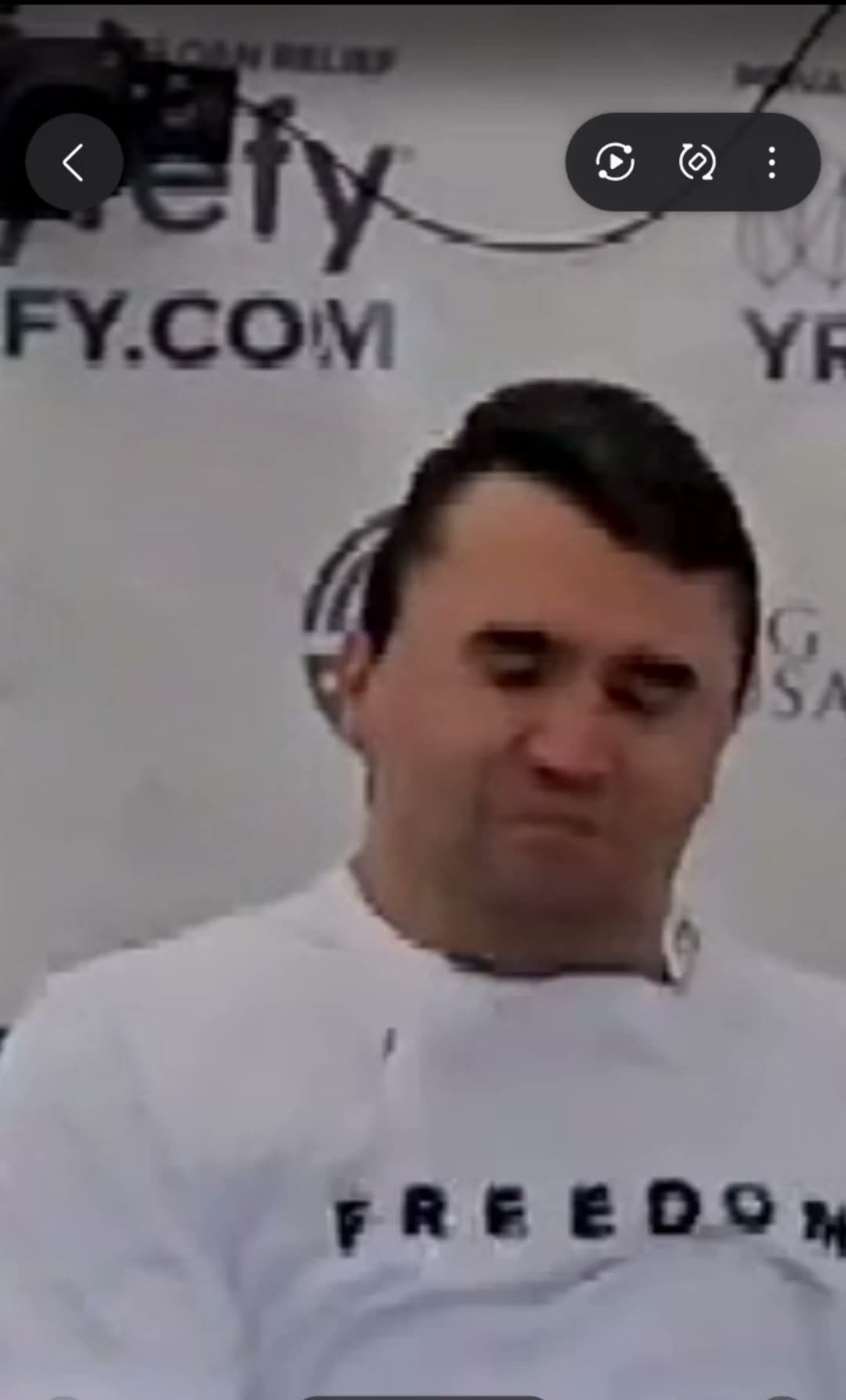
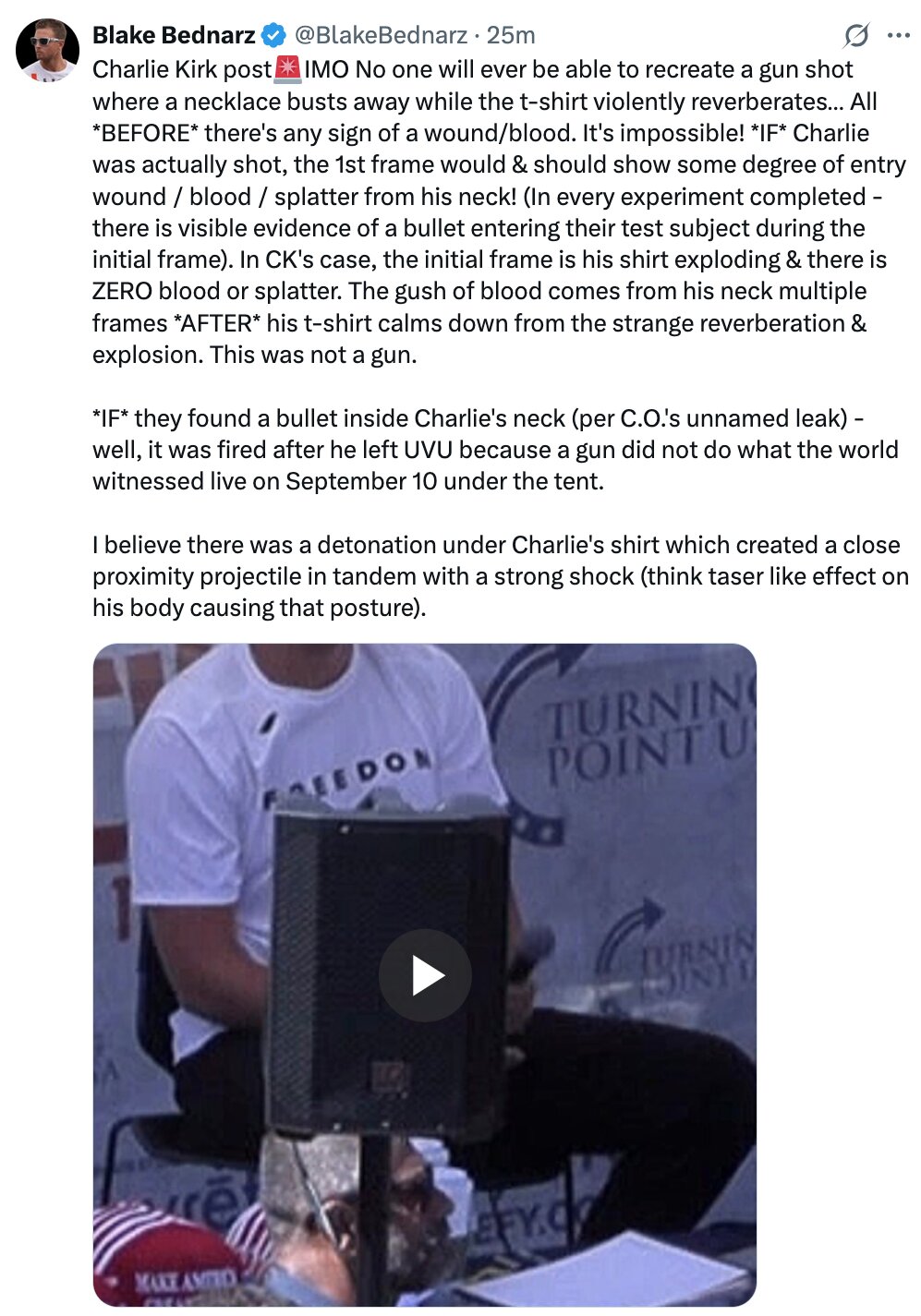
+114ms), a muzzle blast (+202ms) placing a rifle120 meters away, and a third, loudest low-frequency peak (+321ms) that they argue originates at the stage itself — described by proponents as a possible "stage detonation." They argue a single distant rifle shot cannot produce a separate blast under the tent. Skeptics note this is one analyst's interpretation of acoustics and has not been independently confirmed by forensic authorities. - Shirt and fabric movement. Proponents (crediting Jon Bray and others) claim 4K close-ups show fabric being "pinched," "yanked," or ballooned outward and upward over Kirk's left shoulder toward the neck, and that the magnetic lapel clasp lifts upward and outward. They interpret this as a pressure wave pushing fabric away from the torso — a mechanism they say a bullet (whose energy stays inside the wound channel) cannot produce. These are reported visual interpretations, not authenticated findings; skeptics offer alternative readings of the same frames.
- Fragments and debris. Proponents describe black specks, glass, or plastic visible in the air at the moment of impact (some say striking the tent roof), material on the clothing, an apparent cut to the left hand, and shattered glass on the SUV floor (citing photos attributed to a Candace Owens broadcast). They argue a fragmenting wireless transmitter or a "tempered glass" lapel mic would scatter such debris while a single rifle round would not. The images are reported social-media material, not independently authenticated, and ordinary explanations have not been ruled out.
- Wound and ballistics mismatch. Proponents argue the reported wound and body reaction do not fit a distant .30-06 rifle shot — for example, disputing accounts that a high-velocity round was "stopped by the spine" or recovered intact under the skin, and reading the neck injury as a laceration (possibly from the clasp or secondary shrapnel) rather than a clean ballistic channel. Skeptics counter that a single clean traversing neck channel is, in fact, classic for a high-velocity rifle round (see below).
- Scene and evidence handling. Proponents tie the theory to cover-up concerns documented elsewhere on this site: rapid paving and soil excavation near the tent and tunnel area, removal of the SUV carpet and quick sale of the vehicle, discarded clothing, and removed SD cards or cameras. They argue these steps would be consistent with concealing explosive residue and glass. These same handling concerns are examined on the Cover-Up overview and related pages, where counterarguments (routine cleanup, active capital case) are also noted.
The microphone itself
A recurring thread is the equipment Kirk was wearing and what it should have captured.
- Proponents identify the device as a RØDE Wireless PRO (or similar) lavalier system with a magnetic lapel mount. They note that such systems can record internally (proponents describe 32-bit float recording that begins when the unit is removed from its charging case and can typically only be stopped remotely via the receiver, app, or Bluetooth within range).
- From this, proponents ask: if the device recorded internally, where is the audio? They argue it should have captured the moment of the shooting and possibly events afterward, and that TPUSA or its production staff would hold the files. The absence of a public release is treated by proponents as suspicious. Skeptics respond that internal media could have been destroyed if the device fragmented, that no release does not imply concealment, and that an active prosecution routinely withholds evidence.
The missing-audio question is unresolved on the public record; it is presented here as a proponent argument, not a proven fact.
The RØDE transmitter and the "missing bulge"
A detailed proponent write-up (published at followtheepicenter.com) builds the theory around the specific transmitter Kirk wore and what allegedly happened to it. Every element below is a reported claim from that analysis, not an authenticated forensic finding.
- The device. Proponents identify a RØDE Wireless PRO transmitter measuring about 44 × 45.3 × 18.5 mm, worn under Kirk's white "FREEDOM" shirt and held by a MagClip GO — a magnetic mount where an external clip sandwiches the fabric against a neodymium magnet behind it.
- A bulge before, no bulge after. Proponents say multiple pre-event cameras show a clear rectangular bulge on Kirk's upper-right chest from the roughly 18.5 mm-deep housing, and that after the event the bulge is gone while the same external clasp remains. They argue this means the housing underneath was no longer intact: "You cannot lose that bulge without losing the object causing it," the analysis states.
- Internal parts found outside the case. The write-up claims the transmitter's blue-solder-mask PCB was caught in the left side of Kirk's collar, that the LiPo battery (wired to that PCB by a 3-wire JST connector) followed a path to the left lateral side of his neck, and that glass front-face and case fragments were photographed both on the table where he had been seated and across the floorboard of the SUV that drove him to the hospital. Proponents argue a sealed device cannot scatter its internals across two separate locations unless it was "catastrophically compromised."
Skeptics respond that a "missing bulge" can reflect body position, camera angle, or the device simply shifting, and that none of the fragment claims rests on authenticated chain-of-custody evidence.
Why was the microphone worn under the shirt?
A recurring proponent question concerns how Kirk was mic'd that day. According to social-media posts, the wireless microphone was placed under Kirk's shirt even though it carried a furry windscreen of the kind normally used on an externally mounted mic, and proponents contrast this with other outdoor-debate footage they say shows the same rig worn on the outside of his shirt. They name the staffer reported to have mic'd him (Phillip Goldsberry Jr.) and ask why the placement differed on this occasion. This is raised here strictly as an unanswered logistical question, not as evidence of wrongdoing by any individual. We make no claim that Mr. Goldsberry — or anyone else who handled the microphone — placed any device, knew of any device, or did anything improper; performing a routine mic'ing task is not alleged to be wrong in any way. No person has been charged in connection with the microphone, and ordinary explanations — wind, wardrobe, or audio preference — have not been ruled out.
Precedent and motive that proponents cite
Proponents frequently compare the alleged device to the September 2024 Lebanon pager and walkie-talkie explosions — widely attributed in reporting to an Israeli operation — as a precedent for remotely activated, targeted micro-explosives concealed in everyday devices. Some connect this to broader claims, examined elsewhere on this site, about Kirk's reportedly shifting public posture on Israel and alleged pressure surrounding donors. A related thread points to a Defense Department munitions contract and a later explosives-plant explosion in Tennessee, which some proponents fold into the same narrative; that specific claim is documented separately on the AES Tennessee Explosion page. These are speculative associations, not established links, and are included to show how proponents frame plausibility and motive — not as confirmed connections.
What the official account says
The official and most widely reported account is that Charlie Kirk was killed by a single .30-06 rifle shot to the neck, fired from the roof of the Losee Center approximately 120–127 meters away. A Mauser Model 98 bolt-action rifle was reportedly recovered in a wooded area near campus. A law-enforcement narrative records that Kirk "appeared to have been hit in the neck" with "blood... coming out of the left side of his neck" while he was speaking into a microphone. Authorities have charged a suspect and have not, in public filings, described any explosive device.
The acoustic angle: a "super close" sound and a silenced-witness claim
Beyond the professional-camera waveform analysis noted above, proponents raise other sound-based arguments — all reported claims, none independently confirmed.
- Speakers and the "super close" report. One analyst argues the venue's four large speakers can be heard humming or struggling as the prior speaker began, and speculates either that a gunshot sound was cued through the PA from a separate source or that the lavalier mic was turned up so a blast under Kirk's shirt would carry over the speakers. Proponents note that many on-scene witnesses described the sound as "super close," which they argue better fits an at-stage event than a shot fired from roughly 120 meters away. This is one analyst's interpretation, not an authenticated finding.
- A junior employee's account. Proponents claim a junior TPUSA staffer, identified in posts as Cooper Brown, reportedly said he heard the microphone "explode" and could place the direction of the sound, and they allege he was discouraged from repeating that on camera. This is an unverified secondhand claim; the individual has not, on the public record, confirmed it, and it should be read as an allegation rather than established fact.
Competing device-location theories
Even among those who favor a device, there is no agreement on where it was. The disagreement is over the device's location, not over the conclusion itself, and it is reproduced here as a set of rival hypotheses.
- Lapel/mic version. The most common version places the charge in or behind the lavalier microphone clipped to the shirt near the chest.
- Crucifix-pendant version. A self-described former USMC explosive breacher (posting as @cletus_jethro) argues an unanchored lapel mic would be pushed away by its own blast, and instead proposes a cone charge built into Kirk's crucifix pendant, anchored by a heavy silver chain so the force drives a penetrator toward the neck. He references PETN and the "Munroe effect." He further argues the charge could be triggered by electrocution using the target's own body as the circuit initiator — a design he says builds in redundancy, since any failure in the electrical path would prevent detonation, and synchronizes the blast with a cover sound. This is one commentator's unproven hypothesis.
- Earpiece/IEM version. Another proponent argues the charge was in Kirk's in-ear monitor, not the mic — suggesting a "low-flash, no-smoke" explosive detonated in the right ear could travel the ear canal toward the throat, and pointing to the IEM wire recoiling violently in a few frames as the first thing to move. Also an unverified hypothesis.
That proponents place the alleged device in three different locations — chest mic, neck pendant, or ear — underscores that no physical device has been recovered, identified, or confirmed by any authority.
The anomalies proponents say the theory "explains"
In a 2026 broadcast widely recirculated online and attributed to Candace Owens, proponents argue the device theory accounts for a cluster of day-of and aftermath anomalies that they say a simple rifle shot does not. These are her stated opinions and the posters' framing, presented as reported claims; innocent explanations are noted afterward.
- Bomb dogs reportedly kept away from the stage area — which proponents argue would otherwise have alerted on an explosive.
- Rapid paving and roughly 8–10 inches of soil excavation, which proponents tie to PETN's high soil absorption and low water solubility, claiming a second government team dug out the soil days later.
- Federal interest in Kirk's necklace, which proponents say rested on his chest at the moment of detonation and could therefore carry residue.
- No standard GSR (gunshot-residue) test reportedly run on the suspect after a long manhunt in the same clothing.
- No ambulance on standby, which proponents call unusual for such events and argue would otherwise have put paramedics in front of "shattered mic" evidence.
- Early SD-card and camera handling at the scene, which proponents argue would have shown no round passing through Kirk.
- No eyewitness reports of a shot from the Losee rooftop, which proponents read as consistent with no shot being fired from there.
Each of these points is contested and has ordinary explanations the proponents do not rule out — routine cleanup, an active capital prosecution that withholds evidence, and standard scene handling. None has been confirmed by any official body, and several rest on disputed secondhand accounts.
Two-stage blast and the brain-injury reading
Some proponents propose not one device but two coordinated explosive events — a first to create "standoff" distance and a second to deliver the shaped charge — and they connect the blast to Kirk's observed body reaction. They argue a chest blast wave could transmit energy through fluid-filled tissue to the central nervous system, and they read the decorticate posturing (rigid, flexed arms and clenched fists) and the abnormal "doll's-eyes" reflex visible in footage as signs of brainstem or midbrain trauma consistent with blast injury rather than a neck gunshot. This is a proponent interpretation of clinical signs seen on video; no autopsy, medical examiner, or neurologist has publicly endorsed it, and the same neurological signs can follow catastrophic injury of several different kinds.
Why this is contested
The theory has prominent critics, including some who are sympathetic to other questions about the case. Proponents and skeptics openly disagree, and even some proponents disagree with each other about the mechanism.
- No explosive/thermal signature. Critics argue a genuine shaped charge or EFP detonating at a lapel-mounted device would produce visible charring, melting, scorched or shredded fabric at the attachment point, local skin burns or bruising, and a flash, smoke, or fireball — none of which, they say, clearly appears in the UVU footage. A commentator posting as @Trillion0x argues the "exploding RODE mic" claim "is wrong," noting the absence of a smoke signature and that a promised simulated test of the theory has reportedly gone unproduced for many months. Some skeptical replies (including AI-assistant replies quoted in threads) make the same point: a chest-pack charge would be expected to leave obvious charring at the attachment point.
- An unanchored mic points the wrong way. A self-described former USMC explosive breacher (posting as @cletus_jethro) argues that an explosive in an unanchored lapel microphone "makes no sense," because the blast force would push the mic away rather than drive a penetrator inward. He offers an alternative "anchored crucifix pendant" version — itself an unproven hypothesis — illustrating that proponents do not agree on the mechanism.
- The wound fits a bullet. Skeptics note that a single, clean, traversing neck channel is the classic signature of a high-velocity rifle round, not of jagged shrapnel or a radial blast, and that intact ribs/collarbone and a backward-left body reaction are consistent with a distant shot. Some also argue the microphone appears intact in certain close-ups, or that selective frames were used in the proponent analyses.
- No official finding. No public autopsy, ballistics report, or forensic authority has identified an explosive device. The supporting material is overwhelmingly social-media imagery and audio analysis that has not been independently authenticated or peer-reviewed.
Ongoing discussion in 2026
Through the first half of 2026, the theory has continued to circulate — in podcast and YouTube interviews referencing Jon Bray's work, in repeated calls for TPUSA to release any microphone audio, and in threads debating "shirt poof versus bullet" frame by frame. Among those seriously investigating the case on X, an explosive device is by far the majority conclusion on cause of death — the only explanation they believe fits the video physics, fragment claims, cleanup anomalies, and mic capabilities at once; skeptics remain vocal and dispute each pillar. There is no court-adjudicated confirmation — the government's narrative remains a .30-06 rifle round, an account the evidence assembled by citizen investigators appears to disprove. The theory is documented here both on its merits and because suppression of cause-of-death questions is itself part of the cover-up concerns this section examines.
Sources
- Posts attributed to Jon Bray (@jonaaronbray) on "vector flow" / pixel-mapping analysis, September 20 and September 24, 2025 (analyst interpretation; not independently confirmed).
- Post by @matt82704417 (Matthew St Baker), June 21, 2026, amplifying Jon Bray's 4K shirt-tracking as a claimed frame-by-frame device path — https://x.com/matt82704417/status/2068506485420892470 (reported social-media interpretation; not authenticated).
- Skeptic shaped-charge demonstration circulated by @troofevades quote-tweeting @Trillion0x ("that's a lot of smoke that I don't see at the CK event"), offered as evidence a real shaped charge leaves a large smoke/blast signature — https://x.com/troofevades/status/2071072788132118610 (proponents counter that any device would be a micro-charge/EFP, not a breaching charge).
- Posts attributed to Stew Peters (@realstewpeters), including the priority claim (dated by him to September 24, 2025) and the January 10, 2026 SUV "glass shards" post (reported claims; underlying media not independently authenticated).
- Professional-camera ("Canon XA55") acoustic analysis circulated on social media (analyst interpretation; not independently confirmed).
- Candace Owens broadcast segments and SUV-interior photographs (reported social-media material; images not independently authenticated).
- Candace Owens "crisis actors / chest shot" segment, via @realhonestash and @DiligentDenizen: https://x.com/DiligentDenizen/status/2070615710003589174
- Skeptic counterargument by @Trillion0x: https://x.com/Trillion0x/status/2070699686961520802
- "Exploding pendant" thread by @cletus_jethro (skeptic of the lapel-mic version, proponent of a pendant version).
- "Who Killed Charlie Kirk?" / whokilledck.com unsigned EFP engineering write-up, including the .30-06-vs-EFP performance comparison and the "magic t-shirt" pressure-wave analysis (anonymous amateur analysis; not forensic or peer-reviewed).
- followtheepicenter.com RØDE Wireless PRO "physical evidence summary" — the "missing bulge," PCB/battery/glass-fragment chain (proponent analysis; not authenticated).
- Posts questioning why the wireless mic was worn under Kirk's shirt, naming staffer Phillip Goldsberry Jr. (raised as an open question; no wrongdoing established).
- Claim that junior TPUSA staffer Cooper Brown reportedly heard the mic "explode" (unverified secondhand allegation).
- "Speakers: loud sound / exploding mic?" PA-and-lav-mic acoustic thread (analyst interpretation; not confirmed).
- "Possible exploding ear piece" IEM-variant thread, and the two-explosive-event / blast-brain-injury analysis (unproven proponent hypotheses).
Citizen Investigator Claims on X (2026 research)
:::note Attribution The claims below come from public X/Twitter posts, hearing notes, and citizen-investigator commentary captured in mid-2026 research. They are not court findings. Living persons are presumed innocent. The site does not assert that any living person planned or carried out Charlie Kirk's death. :::
Focus of this page
A contested social-media theory alleging an explosive device hidden in or near Charlie Kirk's microphone caused his fatal wound and that this possibility is being suppressed.
Claims and discussions circulating (do not treat as proven)
- According to @FurkanGozukara (Jun 17, 2026), Candace Owens–linked commentary claims bomb dogs were kept off the seating area to hide a rigged explosive microphone — an unverified theory competing with the rooftop-rifle charging narrative.
- According to @FurkanGozukara (Jun 24, 2026; ~23k views), the same ecosystem claims enhanced photos show shattered glass from a rigged mic on an SUV floorboard and that authorities framed an "innocent patsy." The site records this as public commentary, not a forensic finding; Tyler Robinson is charged, not convicted.
- According to @peterstopp3 (Jul 4, 2026), some users restate the theory as a remote transmitter + PETN lapel charge rather than a gunshot — still internet theory, not trial proof.
- Counter-side: July 2026 preliminary-hearing press and citizen notes emphasize ballistics and DNA fights under a firearm theory; many accounts treat mic-explosion as a distraction. Present both without converting either into site fact.
Cross-cutting X signals that touch this topic
- Pre-event donor pressure (as reported): Candace Owens publicized private messages (authenticity discussed with TPUSA spokesman Andrew Kolvet in mainstream commentary) in which Charlie reportedly wrote ~48 hours before Sept 10 that donor pressure was "leaving me no choice but to leave the pro-Israel cause," and that he had lost a major donor after refusing to cancel Tucker Carlson. These are private-text claims, not a formal public policy renunciation, and they do not establish who fired any shot.
- July 2026 preliminary hearing: Citizen live-notes and press describe defense challenges to FBI DNA methods and ATF ballistics (including inconclusive comparisons widely discussed online), plus multi-agency testimony on the Sept 11 surrender chain.
- Information control: Threads continue on gag orders, Ryne Simmons video, platform deboosting, and rapid crime-scene paving (Lead Investigator Hull reportedly learned of paving via news, per circulating hearing notes).
- Counter-claims: Other accounts insist surveillance, DNA, texts, and admissions support a lone-actor charging narrative and treat foreign-intel theories as unsubstantiated. Present both sides; Tyler Robinson is charged, not convicted.
Open questions raised by investigators
- What primary documents (GRAMA, work orders, unredacted orders, bodycam) would resolve disputes on this page's core claims?
- Which circulating posts have independent corroboration vs single-source amplification?
- How do July 2026 hearing exhibits (when unsealed or accurately transcribed) change the weight of earlier X threads?
Deeper related reading: After overview · CoverUp overview · FBI overview · Fix Laws.
This website's author is @HolonCitizen on X and YouTube/@HolonCitizen. Follow me there.
Interesting
- Foreign leads were reportedly answered with blood-libel branding instead of on the merits.
- Plain dead drops and cut-outs already manufacture the appearance of a lone shooter.
- U.S. intelligence funded remote viewing for 23 years, according to declassified program records.
Related Areas
Images

Videos
Footage related to this page. Each card opens that clip's own page, with the video, the full write-up, and its source.