Utah Law Banning Public Sharing of Autopsy Photos & Video (Claims)
:::caution Legal Disclaimer Nothing on this page is a claim of fact that any living person or organization knew of, planned, participated in, or covered up any crime, or acted illegally, immorally, or unethically. We make no claim that anyone named here knew anything beforehand or did anything wrong. This page documents questions and allegations raised in public commentary — not findings of fact. All persons and organizations named are presumed innocent; the allegations referenced are unproven and have not been established in any court. :::
A Utah statute that took effect about four months before the September 10, 2025 shooting at Utah Valley University made it a crime to publicly share autopsy photographs and videos that are part of a medical examiner's record and not already in the public domain. The specific law is Utah S.B. 82, the Autopsy Photo Amendments of the 2025 General Session, which amends Utah Code § 26B-8-217. Some commentators connect the timing and reach of this law to the absence of publicly released autopsy materials in the Charlie Kirk case, arguing it conveniently keeps forensic imagery out of public scrutiny. Others note that such laws are common nationwide, that this one moved through the legislature on an ordinary timeline, and that it exists to protect the dignity of the deceased and the privacy of grieving families. This page lays out the statute factually and then presents both interpretations.
What the law is
S.B. 82 is titled the Autopsy Photo Amendments and was passed in Utah's 2025 General Session. It amends Utah Code § 26B-8-217 ("Records of medical examiner — Confidentiality"), a statute that was itself last amended in 2024. It took effect on May 7, 2025, under Utah's standard 60-day rule following the close of the legislative session on March 7, 2025. The bill carried "Other Special Clauses: None," meaning there was no delayed or accelerated implementation beyond that default rule.
Bill timeline and passage
The bill moved through the regular 45-day general session (roughly January–March) without special fast-tracking beyond the normal pace for its category. According to the Utah Legislature record and summaries circulated online:
- Introduced: January 9, 2025 (the date it was publicly numbered; drafting requests for legislation are often filed earlier).
- Senate passage: February 19, 2025 (reported 25–1–3 vote).
- House passage: February 26, 2025 (reported near-unanimous, on the order of 64–0–11).
- Signed by Gov. Spencer Cox: March 26, 2025.
- Effective date: May 7, 2025 (standard 60-day post-adjournment rule).
- Chief Senate Sponsor: Sen. Stephanie Pitcher.
- House Sponsor: Rep. Nicholeen P. Peck.
These are matters of public legislative record. Sponsoring or signing a bill is a routine official act and is not, by itself, evidence of any wrongdoing. Investigation notes also reference unverified online claims that the bill's drafting attorney was the subject of unusual web-search activity around the bill's introduction and effective date. Those search-pattern claims are unverified speculation circulating in conspiracy threads, are not tied here to any named individual, and are noted only because they recur in the discussion — not because this site asserts them as fact.
The reported "Google Trends" search-pattern claim
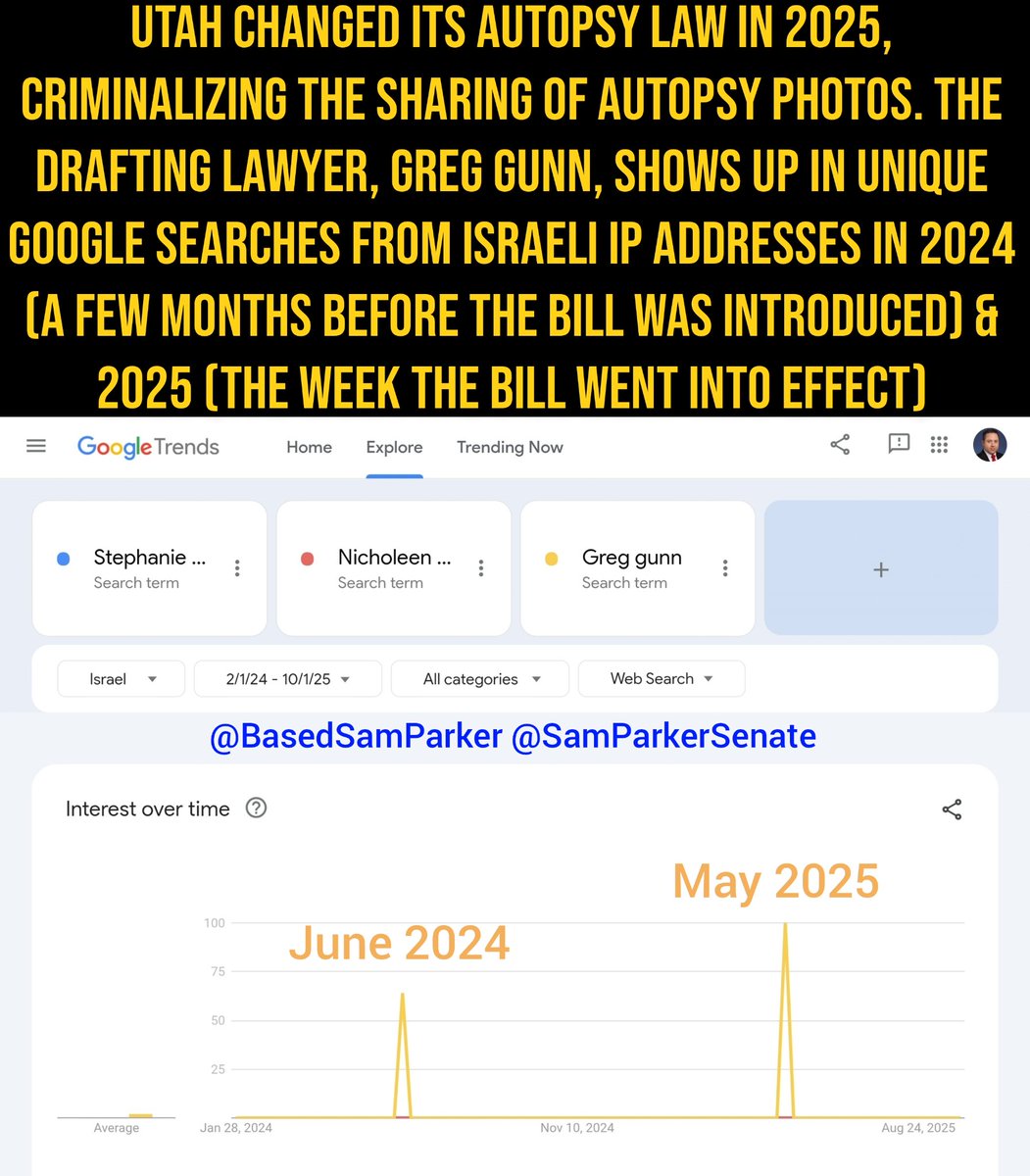
The single most-circulated hook attaching S.B. 82 to the case is a search-pattern claim advanced in X threads under the banner "Google Trends strikes again." According to those posts (paraphrased), the drafting attorney associated with the bill was the subject of unusual, targeted web searches at two specific moments:
- Once around August 2024, a few months before the bill was publicly introduced on January 9, 2025.
- Again in May 2025, reportedly the same week the new law took effect on May 7, 2025.
Posters further claim those searches originated from foreign (described as Israeli) IP addresses. The implied argument is that someone with foreknowledge was tracking the people behind an autopsy-secrecy statute before it existed publicly and again as it activated — months before the September 10, 2025 shooting.
This site treats that claim as unverified speculation only. Several cautions apply:
- The underlying data (who searched, from where, and when) is not independently published or confirmed in the source material; it is asserted in social-media posts.
- Naming or scrutinizing a private attorney who simply drafted a bill is not evidence that person did anything wrong. Drafting legislation is ordinary legal work, and being the subject of a search is not a culpable act. Nothing here should be read as an accusation against any private individual.
- "Search activity from a foreign IP" — even if true — has many innocent explanations and proves nothing about intent.
The claim is documented because it recurs prominently in the discussion of item #11, not because the evidence supports it. Readers should treat it as an allegation to be verified, not a finding.
What the law actually does
S.B. 82 builds on pre-existing confidentiality rules in § 26B-8-217. Medical examiner records — autopsy reports, toxicology, lab results, and investigative documents — were never public records in Utah. Access has long been limited to defined categories of people, reportedly including:
- Immediate family and relatives.
- Legal representatives.
- The attending physician (for a defined prior period).
- Prosecutors, defense attorneys, and law enforcement, upon written request for professional duties.
- Certain government and public-health entities, with restrictions.
- Researchers, under strict de-identification, supervision, destruction, and review rules.
The new element S.B. 82 adds (reportedly in a new subsection of the amended statute) is a criminal penalty targeting visual evidence specifically. It is now a class B misdemeanor — up to six months in jail and/or a fine — for a person who receives a photograph or video of a decedent under authorized access and then knowingly shares, publishes, distributes, or makes it available when both of these are true:
- The image or video is part of the medical examiner's record, and
- It is not already in the public domain.
This targets the actual autopsy photographs and videos — the visual record that, in modern autopsies, can show wounds, trajectory, and internal findings. Textual reports remain accessible to authorized parties such as family and the attorneys in the case.
Reported exceptions include:
- Official medical-examiner duties.
- De-identified use for law-enforcement training or research.
- Court proceedings, subpoenas, and GRAMA (Government Records Access and Management Act) requests.
- Certain other authorized disclosures.
The change relative to prior law: before S.B. 82, while the reports were confidential, an authorized recipient (for example, a family member or defense team) who shared photos or videos was not specifically criminalized under this statute. Now that act carries penalties. Independent confirmation of the exact bill text and scope should be checked against the official Utah Legislature record (le.utah.gov) and the post–May 7, 2025 version of § 26B-8-217, since the summary here is drawn in part from investigation notes and online discussion rather than the codified statute alone.
Timing relative to the case
The detail that draws attention is the sequence of dates. Utah uses a statewide Office of the Medical Examiner rather than county coroners, and medical examiner reports are typically withheld from the public during an active criminal case — especially a capital homicide investigation. Investigation notes describe that withholding as standard procedure, not unique to this case.
What some observers find notable is that S.B. 82 took effect on May 7, 2025, only about four months before the September 10, 2025 event, and that the law was allowed to go live at the earliest possible date under the default rule. To critics, that combination — a fresh criminal penalty on sharing autopsy visuals, locked in shortly before a high-profile killing — is the suspicious part.
How S.B. 82 fits Utah's wider records-secrecy framework
S.B. 82 does not stand alone. It plugs into a layered set of Utah records restrictions that already keep most death-investigation material out of public view, which is part of why supporters call the new law incremental rather than novel. According to investigation notes summarizing Utah practice:
- No coroner system. Utah uses a statewide Office of the Medical Examiner, not elected county coroners, so a single state office controls autopsy records.
- Active-case withholding. Medical examiner reports are routinely withheld from the public during a criminal case, especially an active capital homicide investigation — described as standard procedure, not unique to this case.
- Death certificates. Certified copies are restricted, and the records reportedly do not become public for about 50 years — a long-standing rule independent of S.B. 82.
- Ballistics and GRAMA. Ballistics and similar forensics are treated as private during an active investigation under Utah's GRAMA (Government Records Access and Management Act), the same statute that governs public-records requests and exemptions.
Against that backdrop, the specific thing S.B. 82 changes is narrow but pointed: it adds a criminal penalty aimed at the visual record — the autopsy photographs and videos — for an authorized recipient who leaks them. In other words, it does not create the secrecy (that already existed); it adds teeth against anyone inside the authorized circle who might otherwise release the imagery. Whether that hardening is read as routine privacy housekeeping or as a conveniently timed lock on the most verifiable forensic evidence is exactly the dispute below.
The cover-up interpretation
Some commentators connect these facts into a single narrative. The argument, prominent in investigative threads on X (notably from the account @HolonCitizen and supporters of radio host Baron Coleman), runs roughly as follows, paraphrasing their posts:
- A law criminalizing public release of autopsy photographs and video, arriving months before a high-profile shooting, would be "critical in a cover up" if anyone wanted to keep a doctored or non-truthful autopsy from being caught.
- The emphasis on video matters to this view because modern autopsies are recorded, and proponents argue an "intelligence-style killing cannot survive a public autopsy" — that a video record is far harder to alter than a written summary.
- The public, in this reading, gets "a summary they cannot verify, with the images sealed."
- Posters draw a JFK 1963 parallel, arguing that in that case the disputed handling occurred at the autopsy, and citing books on the JFK assassination as their source for the comparison.
- They highlight the speed and timing of passage and that the law went live "roughly four months before the assassination."
- They claim the autopsy photographs taken September 10, 2025 were, per the defense, not produced to the defendant's team, and characterize the new law as the legal mechanism that keeps them sealed.
This view is an interpretation, not a documented finding. There is no public evidence in the source material that the law was written, timed, or applied to conceal anything related to this specific case. Bills move through state legislatures over many months for reasons unrelated to events that have not yet occurred, and a January introduction with a May effective date is an ordinary legislative timeline.
Counterarguments (debunking and privacy rationale)
Detailed rebuttals appear in equally long X threads. Their main points, paraphrased:
- The statute is routine. The bill passed during Utah's annual 45-day general session, and many states already have comparable laws. The underlying statute was amended in 2024, and posters say the recent changes grew out of a real-world complaint — reportedly a woman who discovered that old autopsy photographs of a family member were being used without her knowledge — rather than any sinister plot.
- It protects records from leaks, not evidence from court. Critics of the cover-up theory stress that prosecutors have said they plan to introduce autopsy findings at the probable-cause hearing, and that images shown in open court during a public hearing become part of the public proceeding. In this view S.B. 82 governs unauthorized distribution of sensitive visual records, not the use of forensic evidence in the trial.
- The defense has the evidence. Posters argue the defense possesses the full evidence set, including the autopsy and medical-examiner materials, and has already drawn on autopsy information in its filings — undercutting the claim that the law is "censoring evidence."
- Timing is coincidence, not design. Because the final changes to the bill were made in February 2025, debunkers argue the cover-up theory would require plotters to have known months in advance that a killing would occur in Utah — which they call implausible.
- Privacy precedent. One thread cites video testimony from Summit County Attorney Margaret Olson describing a prior case in which a consulting expert's data was later reused for marketing years afterward — offered as an example of the legitimate privacy motive behind such laws.
Layered on top are the well-established, non-conspiratorial reasons for laws like S.B. 82:
- Family dignity. Autopsy photographs and videos are graphic; restricting their public circulation protects relatives from seeing a loved one's remains spread across social media.
- Preventing exploitation. Such images can fuel shock content, harassment, or fraud. Many states enacted similar protections after high-profile leaks.
- National pattern. Restrictions on releasing autopsy imagery exist in numerous U.S. states and predate this case by years.
- Access is not eliminated. The law reportedly still permits family, legal counsel, physicians, law enforcement, and qualified researchers to obtain the records, so legitimate review channels remain open even where public posting is restricted.
Broader case context
Several facts about the autopsy itself help frame the debate, drawn from charging documents, press statements, and court filings as summarized in the investigation notes:
- An autopsy was performed — required for a homicide or suspicious death under Utah law, handled by the statewide Office of the Medical Examiner.
- Official summaries describe a single gunshot wound to the neck, with a bullet fragment recovered during the autopsy, and the manner of death stated publicly as homicide. Some summaries note no exit wound; defense filings have contested certain ballistics language.
- No autopsy photographs or videos have been released publicly — consistent with both prior practice and the new law. Textual findings and summaries have appeared in court documents and official statements.
- In the proceedings against the charged defendant, Tyler Robinson — before Judge Tony Graf — prosecutors have indicated they intend to introduce autopsy findings and forensics, and the defense has referenced autopsy details in its motions. The court has ruled on camera access, sealed exhibits, and gag orders case by case, but core evidence including autopsy information is being used in the proceedings. No graphic autopsy visuals have been publicly broadcast or leaked.
Tyler Robinson has been charged, not convicted; the allegations against him remain to be tested at trial, and nothing here should be read as a finding of guilt. A recurring open question raised online is whether autopsy photographs have, in practice, been withheld from the defense, and whether S.B. 82 affects that — a question the trial record is the proper place to resolve.
Who performed and signed the autopsy
Because S.B. 82 keeps the autopsy imagery sealed, added scrutiny has fallen on who performed and signed the autopsy report — the textual record the public is left to rely on. The following are drawn from investigation notes and unverified online commentary, and are presented as open questions, not findings:
- The chief medical examiner. Utah's autopsies are handled by the statewide Office of the Medical Examiner. Investigation notes identify Dr. Deirdre Amaro as Utah's chief medical examiner and state that she reportedly "started working full-time as Utah's chief medical examiner on July 1," 2025 — roughly two months before the shooting. Holding a state medical-examiner post is an ordinary official role and implies no wrongdoing.
- An unverified "second appointee" claim. Separate, uncorroborated posts assert that a person named Angela Hammond was "newly appointed as the Utah Medical Examiner in September 2025, shortly before the incident." Investigation notes flag that "no official records or news confirm this appointment or her role in the case," and that the name "only appears in unverified X posts." It is recorded here only because it recurs; it is not established fact.
- The "signed off by someone else" claim. A private, secondhand account preserved in the investigation file alleges that Charlie Kirk's autopsy was "signed off" by a "young woman that [the medical examiner] had never met before," and notes that such a report "is considered a draft until it is signed," a window during which "changes can be made." This is an unverified personal claim relayed through a private message, not a documented finding, and no named individual is accused here of anything improper.
The relevance to this page is narrow: if the visual record is sealed by statute, then the identity of, and process behind, the written report carries more weight than usual — which is why these unverified questions keep resurfacing alongside the S.B. 82 discussion. None of them has been substantiated, and each should be treated as an allegation to verify against primary records.
Bottom line
The statute is real and verifiable: Utah S.B. 82, the Autopsy Photo Amendments, amending § 26B-8-217, effective May 7, 2025, creating a class B misdemeanor for publicly sharing non-public autopsy photographs and videos. Everything beyond those facts — that the timing, the video provision, or the four-month gap reflects an intent to conceal anything in this case — is an interpretation advanced by some commentators, not a proven fact. No court has found the law unconstitutional or tied it to misconduct in this case. Readers should weigh the documented privacy rationale and routine legislative timeline alongside the timing concerns, and treat the unverified search-pattern claims as allegations only.
Sources
- Charlie Kirk investigation master file — "Autopsy Utah Law" / "Autopsy Law" sections (S.B. 82, Autopsy Photo Amendments; § 26B-8-217; introduced Jan 9, 2025; Senate Feb 19, 2025; House Feb 26, 2025; signed Mar 26, 2025; effective May 7, 2025; class B misdemeanor for sharing non-public photos and videos; access limitations and exceptions).
knowledge/FULL_WRITE_UP.md— summary of the S.B. 82 Autopsy Photo Amendments.- X/Twitter discussion threads — cover-up framing (e.g., @HolonCitizen and supporters of Baron Coleman) and point-by-point debunking threads (privacy origin of the 2024 amendment, defense access to evidence, open-court exhibit rules). Presented as competing allegations and interpretations, not established fact.
- Utah State Legislature official record for S.B. 82 and Utah Code § 26B-8-217 at le.utah.gov — recommended for primary-source verification of the enrolled bill text, vote counts, sponsors, dates, and the post–May 7, 2025 statute.
- Charlie Kirk investigation master file — "Hospital / Medical Examiner" section (Dr. Deirdre Amaro reportedly began full-time as Utah's chief medical examiner on July 1, 2025), the unverified "Angela Hammond newly appointed" claim (flagged in the notes as uncorroborated), and the "Mystery woman signed off on medical examiner report" note (an unverified secondhand claim that a person the medical examiner "had never met before" signed the report). Presented as unverified commentary and open questions, not established fact.
Citizen Investigator Claims on X (2026 research)
:::note Attribution The claims below come from public X/Twitter posts, hearing notes, and citizen-investigator commentary captured in mid-2026 research. They are not court findings. Living persons are presumed innocent. The site does not assert that any living person planned or carried out Charlie Kirk's death. :::
Focus of this page
Utah S.B. 82 (Autopsy Photo Amendments, amending 26B-8-217) took effect May 7 2025, about four months before September 10 2025, criminalizing public sharing of non-public autopsy photos and videos; so
Claims and discussions circulating (do not treat as proven)
SB 82 autopsy photo amendments May 7 2025.
Cross-cutting X signals that touch this topic
- Pre-event donor pressure (as reported): Candace Owens publicized private messages (authenticity discussed with TPUSA spokesman Andrew Kolvet in mainstream commentary) in which Charlie reportedly wrote ~48 hours before Sept 10 that donor pressure was "leaving me no choice but to leave the pro-Israel cause," and that he had lost a major donor after refusing to cancel Tucker Carlson. These are private-text claims, not a formal public policy renunciation, and they do not establish who fired any shot.
- July 2026 preliminary hearing: Citizen live-notes and press describe defense challenges to FBI DNA methods and ATF ballistics (including inconclusive comparisons widely discussed online), plus multi-agency testimony on the Sept 11 surrender chain.
- Information control: Threads continue on gag orders, Ryne Simmons video, platform deboosting, and rapid crime-scene paving (Lead Investigator Hull reportedly learned of paving via news, per circulating hearing notes).
- Counter-claims: Other accounts insist surveillance, DNA, texts, and admissions support a lone-actor charging narrative and treat foreign-intel theories as unsubstantiated. Present both sides; Tyler Robinson is charged, not convicted.
Open questions raised by investigators
- What primary documents (GRAMA, work orders, unredacted orders, bodycam) would resolve disputes on this page's core claims?
- Which circulating posts have independent corroboration vs single-source amplification?
- How do July 2026 hearing exhibits (when unsealed or accurately transcribed) change the weight of earlier X threads?
Deeper related reading: After overview · CoverUp overview · FBI overview · Fix Laws.
This website's author is @HolonCitizen on X and YouTube/@HolonCitizen. Follow me there.
Interesting
- An Army ISR jet circled the campus corridor, yet its tasking records stay withheld.
- The federal push to recover Kirk's cross necklace is read as a residue hunt.
- Video, audio, SUV debris and a federal micro-charge contract converge in the exploding-mic hub.
Related Areas
Images