Victim Family Rights
Overview
This page sketches a policy concept referenced throughout the research corpus: strengthening the rights of families affected by serious crimes to receive timely information, meaningful participation, and appropriate support in major investigations and prosecutions. It is not legal advice, and it does not assume that any specific family has been treated improperly in the Charlie Kirk case. It summarizes ideas from commentators who believe that families are sometimes caught between the investigative system's need for confidentiality and their own legitimate need for information and voice.
These questions are not abstract for a family whose husband and father was assassinated in public: relatives of Charlie Kirk have had to follow the state's court case against the accused, Tyler Robinson, largely through the same filings and hearing calendars available to any member of the press.
The basic goal is to explore how a statutory framework might:
- Guarantee timely, structured briefings for immediate family members on major investigative developments.
- Provide meaningful participation rights in decisions that affect the family, consistent with investigative integrity.
- Ensure appropriate practical support during prolonged investigations and prosecutions.
Problems this proposal is trying to address (as described)
Commentators in the research corpus raise several concerns about how families experience major-case investigations:
- Information asymmetry — Families often learn about developments through press reports before they receive official briefings, which can be both hurtful and practically disorienting.
- Inconsistent participation — Family participation rights vary across jurisdictions, and the practical experience depends heavily on the individual prosecutors and investigators handling the case.
- Delayed autopsy and forensic information — Families can wait months for formal forensic findings, often without a clear timeline for when they will learn more.
- Media pressure — Families face intense media attention, sometimes including speculation about their own conduct, with limited resources to respond constructively.
- Decision-making pressure — Families can face pressure to make public statements, participate in interviews, or support particular theories before they have had time to process the loss.
- Economic strain — Prolonged investigations can impose significant financial costs on families whose working lives are disrupted.
These themes are presented here as concerns about the experience of families, not as adjudicated findings about any specific case.
Core ideas for a victim-family rights law
Commentators sketch various possible reforms, which can be grouped into themes:
1. Structured family liaison
The statute could require that, for covered cases, each investigating agency designate a family liaison officer with defined responsibilities:
- Provide structured briefings on a regular cadence (for example, every two weeks).
- Deliver advance notice of public-facing milestones where compatible with investigative integrity.
- Respond to family inquiries within a defined time window.
- Coordinate with counterparts at other involved agencies so that the family is not whipsawed between inconsistent communications.
2. Timely forensic briefings
For forensic findings (autopsy, ballistics, digital forensics), the framework could require:
- Private briefings to next-of-kin and designated counsel before any public release.
- A defined process by which families can request clarifications or receive additional detail through appropriate channels.
- Clear expectations about the timeline for final reports.
See also Medical Examiner Transparency.
3. Participation in charging decisions
Where the family wishes, the framework could ensure structured participation in charging decisions:
- Advance notice of planned charges and any plea offer.
- A defined opportunity to provide input consistent with the prosecutor's independent responsibility.
- The ability to attend and address relevant court proceedings.
4. Access to evidence for family counsel
Designated family counsel could have structured access to:
- Non-sensitive investigative materials on a timeline that allows meaningful participation.
- Appropriately protected access to sensitive materials where participation requires it.
- Court-authorized access to independent expert review of forensic evidence.
5. Public statement protections
Families should have the ability to make public statements without inadvertent legal exposure:
- Clarification that good-faith statements reflecting their own experience are protected against retaliatory defamation suits where they involve matters of public concern.
- Access to pro bono or public-interest legal advice on statements they are considering making.
- Protection against contractual provisions — for example, in settlement or cooperation agreements — that would silence them on matters of public concern.
6. Media coordination
The framework could provide practical support for families navigating media attention:
- Access to a media liaison through the family liaison structure, without any expectation that the family engage.
- Protections against invasive conduct at private residences and funerals.
- Clear expectations about what agencies will and will not share publicly, so the family knows what to expect.
7. Economic support
For prolonged investigations, practical support could include:
- Coordination with existing crime-victim funds.
- Standardized expense reimbursement for participation in proceedings (travel, childcare, counsel).
- Employer-protection guidance so that time away from work for participation does not jeopardize employment.
8. Counseling and mental-health support
Long-running high-profile cases impose cumulative stress on families. The framework could facilitate:
- Access to counseling services with clinicians familiar with the demands of public cases.
- Peer-support networks with families of other public cases who have volunteered to share their experience.
- Practical guidance on managing children and extended family through a prolonged public process.
9. Participation in after-action review
Where a covered case leads to a public after-action review, affected families could have structured opportunities to provide input, consistent with appropriate confidentiality protections.
10. Review and transparency
Annual reporting by each participating agency could document compliance with family-participation duties at an aggregate level, identifying patterns where expectations are or are not being met.
Safeguards and limits
Several safeguards are central to any victim-family rights framework:
- Investigative integrity — Family participation must be structured so that it does not compromise investigations or prosecutions.
- Proportionality — Requirements should be calibrated to case seriousness; the full framework would apply to homicide cases rather than routine matters.
- Family autonomy — Participation rights are options for families, not mandates; families may decline engagement without penalty.
- Protection of other participants — The rights of witnesses, defendants, and others must be balanced with family rights; participation should not become a tool for pressure.
- Due process for those accused — Structured family participation does not alter the criminal-procedure protections owed to the accused.
These safeguards are at least as important as the rights the framework would create.
How this connects to other pages
This plan ties into other reform-oriented topics:
- Medical Examiner Transparency — forensic briefings for families.
- Law 1 — records-disclosure statutes that shape what agencies can share.
- Law 3 — mandatory investigation that families have a legitimate interest in observing.
- Discovery Rights Reform — procedural reforms that affect family participation in court proceedings.
- Fix Overview — broader summaries of reform themes.
As with all pages in this section, the purpose here is to organize ideas and claims that have been raised — not to assert that any named individual, agency, or institution has treated any family improperly.
Why Citizen Investigators Say This Reform Matters (X Context)
X and independent coverage of the Kirk case repeatedly surface gaps this page's policy concept would address:
- Family viewing restricted hearing video while public remains locked out—dual privacy/transparency tension.
- Erika Kirk counsel motion for timely ruling after preliminary hearing adjournment (@CrimeTalkNet reporting).
- Family rights to forensic briefings without being forced into institutional narrative channels only.
These are policy responses to documented transparency gaps, not findings that any living person committed a crime.
Interesting In This Area
- Medical transparency supplies the forensic briefings this proposal promises, and Law 1 the documents.
- Media reform protects subjects of coverage; churches carry the grieving part.
- Family counsel access to evidence overlaps discovery reform and Law 4 access rules.
- After-action review participation links this to event security and TSUSA governance.
Interesting In Other Areas
- Relatives followed the state's case largely through the same filings reporters read.
Images
Other Pages In This Section
Disclosure reform fails if the people closest to the evidence cannot speak. Protected channels, a rebuttable presumption of retaliation, mandatory reinstatement and treble damages — extended to intelligence contractors, who are usually left out.
Read this
Ask Churches to Ensure Justice Happens
What a congregation can actually do when a public killing goes unanswered — grieve, ask hard questions, and refuse both cynicism and reckless speculation. It names roles for faith communities without naming any church as complicit.
Read this
Media and Journalism Transparency
Most of the work on this case was done by citizen investigators with no shield law behind them. The proposal gives them standing, adds anti-SLAPP protection, and forces platforms to disclose how reach is throttled.
Read thisLaw 1: Force Information Disclosure
The earlier working draft of the disclosure law: categories of covered information, hard timelines, and a duty to log evidence that is missing or destroyed. The current text lives at Law 1.
Read thisElsewhere In The Investigation
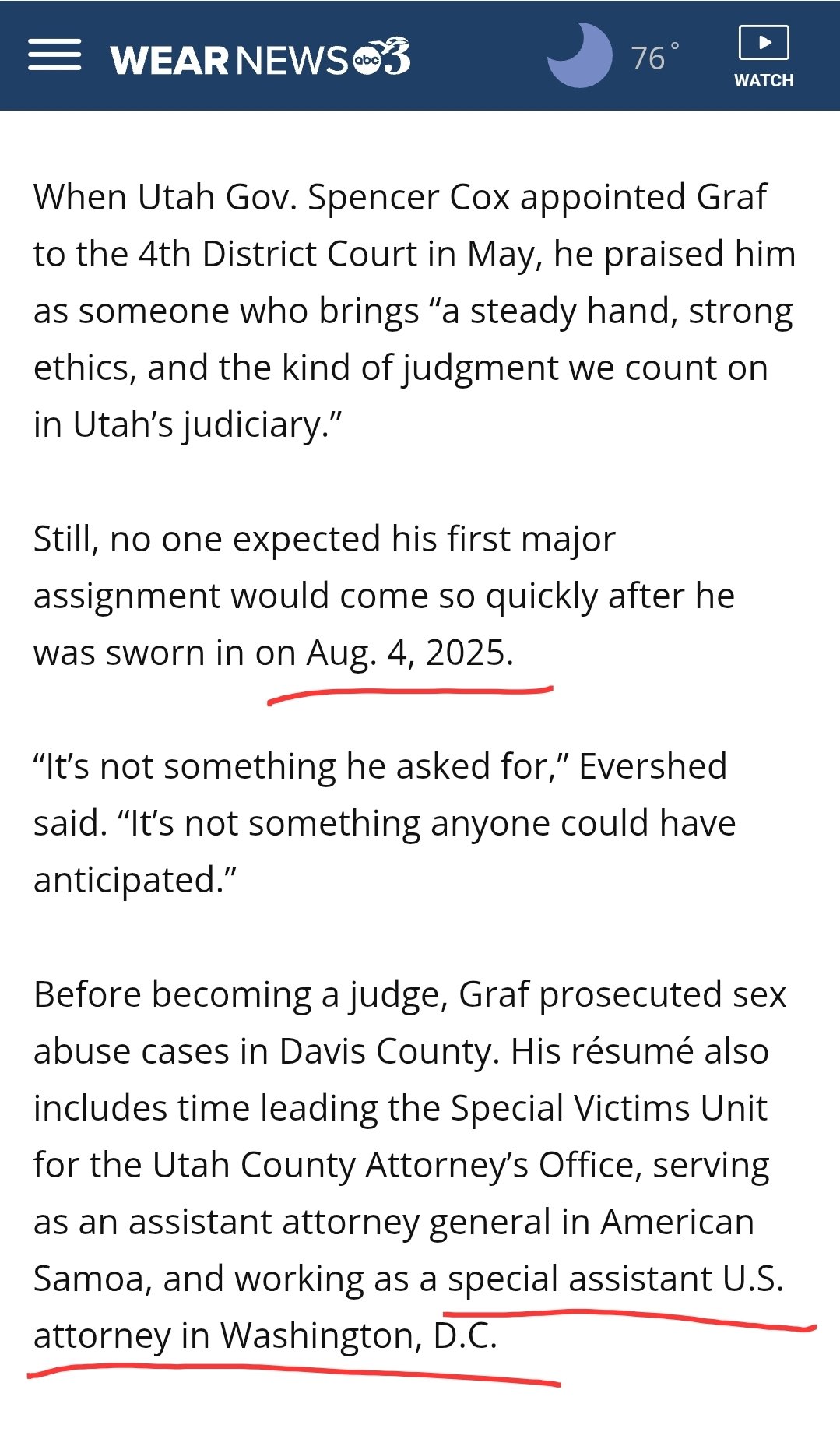
State of Utah v. Tyler Robinson in one place — judges, both teams, discovery fights, gag orders, ballistics disputes and Miranda timing. He is charged, not convicted.
Read thisThis website's author is @HolonCitizen on X and YouTube/@HolonCitizen. Follow me there.
Interesting
- Camera memory cards were allegedly pulled before police secured them.
- Charred debris is matched callout-by-callout to a beltpack transmitter.
- A .30-06 carries about 3,950 joules — compare what that does to game animals.
Related Areas
- People
- Charlie Kirk
- Medical
- Legal Investigation
- Government Evidence
- Vote