Law 3: Mandate the Investigation
Overview
This page sketches a policy concept referred to in the research corpus as "Law 3 — Mandate the Investigation." It is not legal advice, and it does not assume that any particular agency or official has failed to investigate the Charlie Kirk case properly. It summarizes ideas from commentators who believe that disclosure statutes, on their own, are not sufficient: agencies can comply with a disclosure mandate by releasing what they already have while declining to actively pursue leads those records reveal.
The premise behind it is narrow: Charlie Kirk was assassinated in public, and citizen investigators argue that whole categories of lead — foreign, financial, and forensic — were never worked at all, a gap traced on the cover-up page.
The basic goal is to explore how a statute might:
- Require designated agencies to open and actively pursue a thorough, good-faith investigation into a covered incident, with dedicated teams and protected budgets.
- Build in structural independence so that investigation teams cannot be directed, starved of resources, or quietly wound down by the same leadership whose conduct may be under review.
- Provide for regular public reporting so that the public can see whether each identified lead is being pursued.
Problems this proposal is trying to address (as described)
Commentators in the research corpus argue that several structural failures can prevent a real investigation even when records are technically available:
- Disclosure without investigation — Agencies may release boxes of records while assigning almost no personnel to actively follow the leads those records reveal.
- Conflict of interest — When an agency's own personnel or practices are among the questions to be investigated, that agency's leadership has an obvious incentive to constrain the inquiry.
- Budget starvation — An investigation that depends on discretionary funding from the host agency can be slowed to a crawl by denied requests, slow procurement, or administrative barriers.
- Personnel rotation — Short-term assignments and high turnover can cause institutional knowledge to leak away before the investigation produces findings.
- Narrow mandates — Investigations can be quietly scoped so that the most sensitive categories of leads are outside their jurisdiction.
These themes are presented here as concerns about agency incentives and historical patterns, not as adjudicated findings about any specific investigation.
Core ideas for a "mandate the investigation" law
Commentators sketch various possible reforms, which can be grouped into themes:
1. Multi-agency structure with independence
Rather than relying on a single agency, a statute could require parallel investigations by several agencies with complementary jurisdictions — for example, the FBI for law enforcement leads, the CIA for foreign-intelligence leads, the NSA for signals-intelligence leads, and the broader Intelligence Community (coordinated by the Director of National Intelligence) for cross-domain leads. The structural logic is that no single agency can unilaterally suppress inquiry into its own potential involvement if other agencies are independently pursuing the same questions.
2. Dedicated teams with protected budgets
To prevent soft budget starvation, a statute could require:
- A minimum team size (for example, at least 20 agents per agency) drawn from personnel with no prior involvement in the case.
- A dedicated budget (for example, $10 million per team) held in a separate Treasury account controlled by the team leader, not by the host agency's finance office.
- Independent procurement authority so that contracts, forensic services, and outside expert engagements can be executed without host-agency approval.
3. Protected investigator selection and leadership
Commentators propose that team leaders be senior investigators with relevant experience and no prior involvement in the case, defined broadly to exclude anyone who has received briefings on the case, participated in decisions about the existing investigation, or has close professional relationships with persons under inquiry. An external oversight body should have authority to vet and approve these selections.
4. Defined scope tied to a public list of items
The statute can incorporate, by reference, the list of items commentators believe require investigation — often described as a "Schedule A" of disclosure items. The investigation team is then obligated to produce specific findings on each item, not merely to "look into things generally." Public reporting can be benchmarked against the list so that inaction on a particular item is visible.
5. Independent external monitor
An external independent oversight board — appointed by Congress rather than by the executive branch — could:
- Approve team leader selections and investigate allegations of interference.
- Direct investigators to pursue specific neglected leads.
- Receive monthly financial reports and flag patterns of budget underutilization.
- Remove compromised personnel at will, with a documented reason supplied after the fact.
6. Conflict-of-interest transfer
If credible evidence emerges during the investigation that a covered agency was itself involved in the events under review, investigation authority could transfer to an independent congressional commission with its own staff and resources. This is similar in spirit to the structure used for special counsel investigations but with a stronger, statutory trigger.
7. Non-interference protections
A recurring idea is that interference with a statutorily mandated investigation should carry specific criminal penalties — not merely administrative consequences — and that whistleblower protections should apply to any employee or contractor who, in good faith, reports attempts at interference.
8. Mandatory database queries
Some commentators propose a specific duty: that a mandated investigation must actually run targeted queries against the analytical and signals-intelligence databases already available to the host agency, and that a response of "no responsive records exist" is not permissible unless the responsive queries have been documented. The obligation, in this view, is to do the search, not merely to report on what the agency already knew.
9. Regular public disclosure reports
To make progress visible, the statute can require public reports on a set cadence (for example, every 90 or 180 days) that document:
- All findings to date, in redacted form.
- All output documents discovered.
- Every Schedule A item, with a status note for each.
- Every request for records or cooperation that has been denied, and by whom.
10. Minimum investigation duration
To prevent premature wind-downs, team members can be committed to the investigation for a minimum period (for example, two years), with the option to continue for a defined additional period if the investigation remains productive. Teams cannot be terminated by any government official during the minimum period.
Safeguards and limits
Several safeguards are central to any "mandate the investigation" approach:
- Due process — Individuals under inquiry retain full legal protections; an investigation mandate is not an assumption of guilt.
- Protection of active operations — Investigative steps must be coordinated with intelligence and law-enforcement equities so that ongoing operations are not inadvertently compromised.
- Source protection — Active human sources and currently used technical methods remain protected under narrow, reviewable exceptions.
- Oversight, not partisanship — The oversight board should be structured to include members who are credible across the political spectrum to prevent the investigation from being characterized as a partisan exercise.
These safeguards are at least as important as the mandate itself.
How this connects to other pages
This conceptual law ties into other reform-oriented topics:
- Law 1 — law-enforcement records disclosure.
- Law 2 — intelligence-community records disclosure.
- Law 4 — independent civilian investigator oversight to verify that the investigation is complete.
- Discovery Rights — extending Brady-style disclosure obligations to federal agencies as custodial parties.
- Fix Overview — broader summaries of reform themes from the research corpus.
As with all pages in this section, the purpose here is to organize ideas and claims that have been raised — not to assert that any named individual, agency, or country is guilty of a crime or a cover-up.
Interesting In This Area
- Disclosure alone releases what someone already wrote down, which is why Law 1 needs this.
- Mandatory database queries only work if digital evidence survived and discovery reaches it.
- A conflict-of-interest transfer clause answers the worry Law 4 solves with outside civilians.
- Minimum investigation duration guards against quiet closure, also raised for event security reviews.
Interesting In Other Areas
- The live statute is Law 3, sitting beside the other three.
Other Pages In This Section
Civilians embedded inside the agencies with full access to files and personnel, a confidential volunteer channel, and their own authority to publish. The point is that nobody inside gets to decide what the public sees.
Read thisA nationally known speaker was killed on an open campus plaza in daylight. This framework would publish baseline standards, force transparent contracting and vetting, and require an after-action review someone outside the contractor can read.
Read this
Kirk's relatives have followed the state's case largely through the same filings any reporter can read. This proposal gives families a named liaison, timely forensic briefings, and a voice in charging decisions.
Read this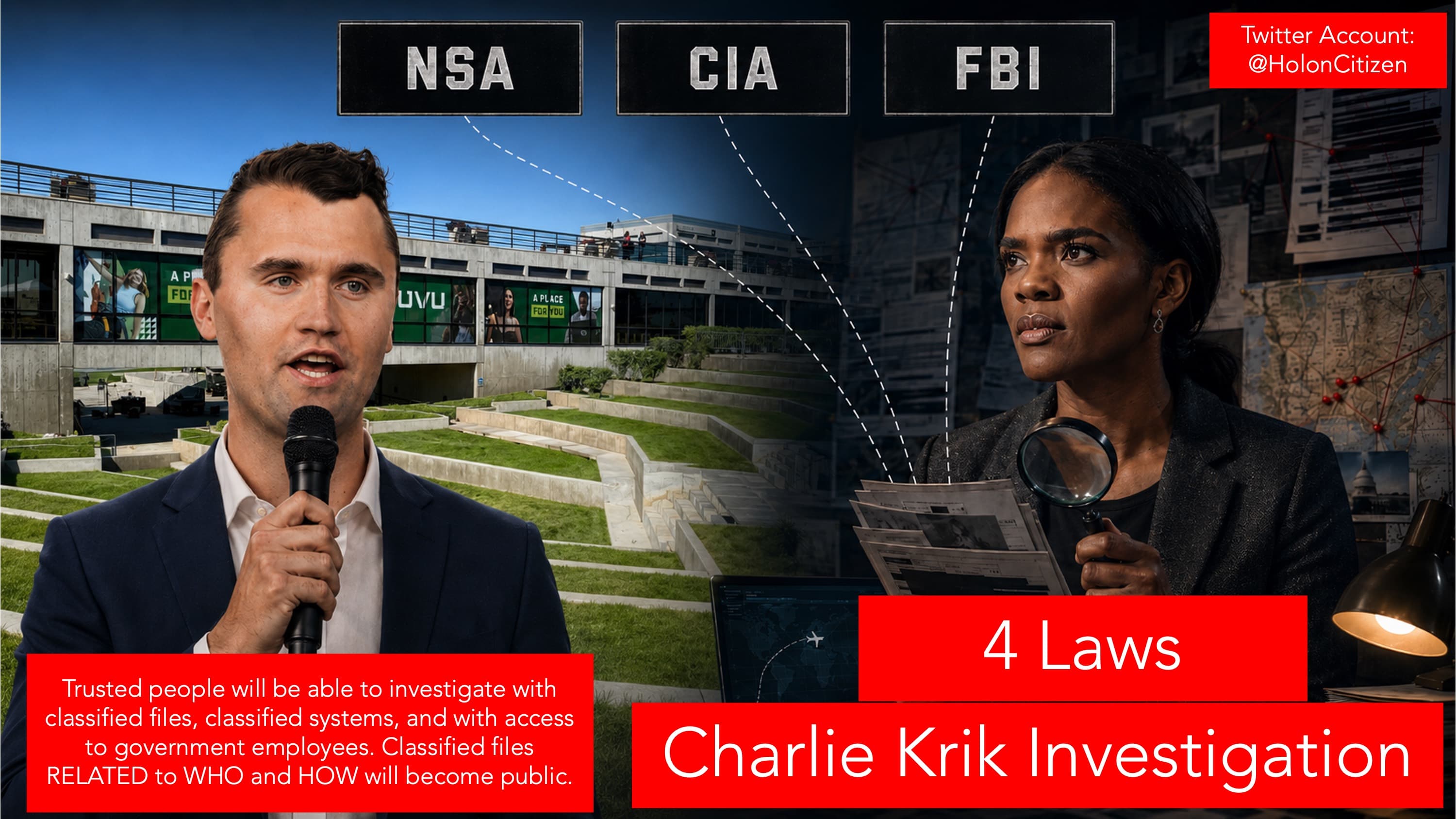
Four proposed federal laws plus twelve companion reforms — disclosure, mandatory investigation, trusted civilian investigators, and the practical fixes underneath them. Start here to see how the pieces fit together.
Read thisElsewhere In The Investigation
Law 3: Charlie Kirk Investigation - Mandatory Investigation Act
Full text of the mandatory investigation act — the statute that pairs release of the files with a duty to actually investigate them.
Read thisThis website's author is @HolonCitizen on X and YouTube/@HolonCitizen. Follow me there.
Interesting
- Congregations reportedly cannot reach the sealed paving and ballistics record.
- The "confession" Discord posts reportedly appear about ninety minutes after the Miranda warning.
- A U.S. patent describes beaming words into a skull by pulsed microwave.
Related Areas
- Charlie Kirk Assassination — Forced Disclosure
- FBI
- U.S. Intelligence
- Government Evidence
- Proof Intel Services
- Legal Investigation