ATF Fragment — Inconclusive Match
The prosecution must connect Exhibit 6A (autopsy projectile evidence) to Exhibit 1 (the seized Mauser). The state's own ATF laboratory report (September 17, 2025), summarized in court filings, says that connection is inconclusive.
An inconclusive lab result on the one piece of metal supposed to prove how Charlie Kirk was killed is not a technicality — it is the reason so much of the independent work has moved toward an explosive at the podium instead of a rooftop rifle.
Exhibit 6A vs Exhibit 1
| Exhibit | Description |
|---|---|
| 6A | Deformed bullet jacket fragment from autopsy (+ related lead fragments) |
| 1 | Mauser Model 98 .30-06 recovered near UVU |
ATF result (as reported in filings):
- Cannot identify or exclude Exhibit 1 as the source of Exhibit 6A
- Rifling on the fragment matches "numerous makes and models"
- Neither sufficient agreement nor sufficient disagreement to assign a unique source rifle
The operative sentence quoted from the report in the investigation file is blunt: "The fragment could not be identified or excluded as having been fired from the Exhibit 1 Mauser rifle." A related summary explains the forensic logic: "The jacket fragment shared class characteristics with Tyler Robinson's Mauser 98 rifle, so the rifle couldn't be excluded as having fired the bullet. But the fragment lacks individual characteristics permitting identification of one rifle to the exclusion of all others in the class."
Calling the fragment ".30-caliber class" is generic — it does not uniquely implicate the attributed Mauser.
Deeper Tyler-section treatment: Proof Not Tyler — ATF.
Defense framing — exculpatory state science
Commentary cites Trombetta / Youngblood — arguing an inconclusive match is exculpatory when the state still pursues a single-rifle theory. A March 2026 news-media coalition (Deseret News, Salt Lake Tribune, AP, NYT, Fox, CBS, and others) filed to unseal a defense motion discussing a four-page ATF report comparing the jacket fragment to the recovered rifle. The defense reportedly characterizes the comparison as exculpatory.
Case reference in file: 251403576 (filed 3/10/26).
FBI Virtual Comparison Microscopy (VCM)
Because ATF could not match, the fragment reportedly moved to the FBI for Virtual Comparison Microscopy. Contested points in the investigation file:
- FBI described fragment as fragile; examination may require pliers, risking new tool marks
- ATF may have detached a portion before FBI receipt
- Defense requested observation or videotaped exam — policies reportedly denied both
See FBI Ballistics & Forensics.
CBLA — discontinued "junk science" allegation
Commentary alleges the FBI may resurrect Comparative Bullet Lead Analysis (CBLA) — compositional lead matching the FBI abandoned in 2005 after scientific validity challenges.
| Historical note | Detail |
|---|---|
| Jimmy Yates (1991) | Convicted partly on CBLA; later exonerated when FBI conceded flaws |
| 2005 FBI position | Manufacturers/scientists could not attest to definitive bullet-source accuracy |
We document the allegation that CBLA may be used to manufacture a match after ATF failure. We do not assert the FBI has committed fraud without court findings.
Discovery withholding
Investigation-file notes: Tyler Robinson's defense sought continuance because ATF and FBI had not produced files held since September; Erika Kirk's lawyers reportedly opposed delay. Commentary frames this as rushing a case while DNA, chain of custody, and video discovery remain incomplete.
Key questions
- Will the full ATF report remain sealed if defense calls it exculpatory?
- What did VCM actually conclude — if anything public?
- Was any CBLA-style lead analysis performed on fragment or recovered rounds?
Citizen Investigator Claims on X (Attributed)
Ballistics is one of the most active Kirk threads on X.
- ATF inconclusive: @TheQuartering notes defense filings cite ATF experts "unable to identify" the fragmented bullet to the specific Mauser—not a finding the bullet "wasn't .30-06." @ShekandaPeoples explains jacket suitable / lead unsuitable / insufficient individual characteristics.
- Counter: @misfitpatriot_ argues soft-point .30-06 should fragment and that non-match is being overclaimed; @OfVoice35353 cites hearing testimony that fragments measure ~.286–.301" and fit the .30 cal family.
- Energy / trajectory skeptics recirculate charts comparing ~3950 J rifle energy to observed wound and argue Losee roof angles (5–9°) and C2 path problems—see sibling pages.
Media unseal fights (March 2026 class) and CBLA 'junk science' allegations continue in commentary; focus remains Exhibit 6A vs Mauser Exhibit 1.
All ballistics claims await full public exhibits and independent review. No living examiner is accused of crime as site fact.
Interesting In This Area
- An examiner testified to dust inside the seized barrel of the attributed Mauser.
- A .30-06 carries roughly 3,950 joules, which the described wound does not match.
- If the fragment proves nothing, the proposed alternatives become the live question.
- A separate claim says a bullet in the stage wood was removed before independent documentation.
Interesting In Other Areas
- The same non-match anchors the Proof Not Tyler ballistics page and the federal handling record.
- Nobody has published who found the rifle, when, or after which K-9 passes.
- The filing quotes injuries far wider than a neck wound — hemopericardium and bilateral hemothorax.
- Commentary alleges a lead-analysis method abandoned in 2005 may be revived after the failed comparison.
Other Pages In This Section
Alternative Calibers & Weapons
If the Mauser chain fails on the lab report, the energy, or the geometry, what fired instead? This page holds the proposed answers — a 9mm CornerShot from the tent, a suppressed small-bore, or no bullet at all, as in the exploding-mic theory.
Read this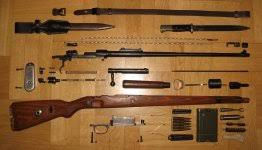
Mauser .30-06 Rifle — Official Narrative
The state's weapon: a scoped Mauser Model 98 in .30-06, tied to a grandfather and a World War I story. Commentators note the recovered rifle is a commercial 98 rather than a K98, and that M98 Mausers were not factory-chambered in .30-06 in that era.
Read this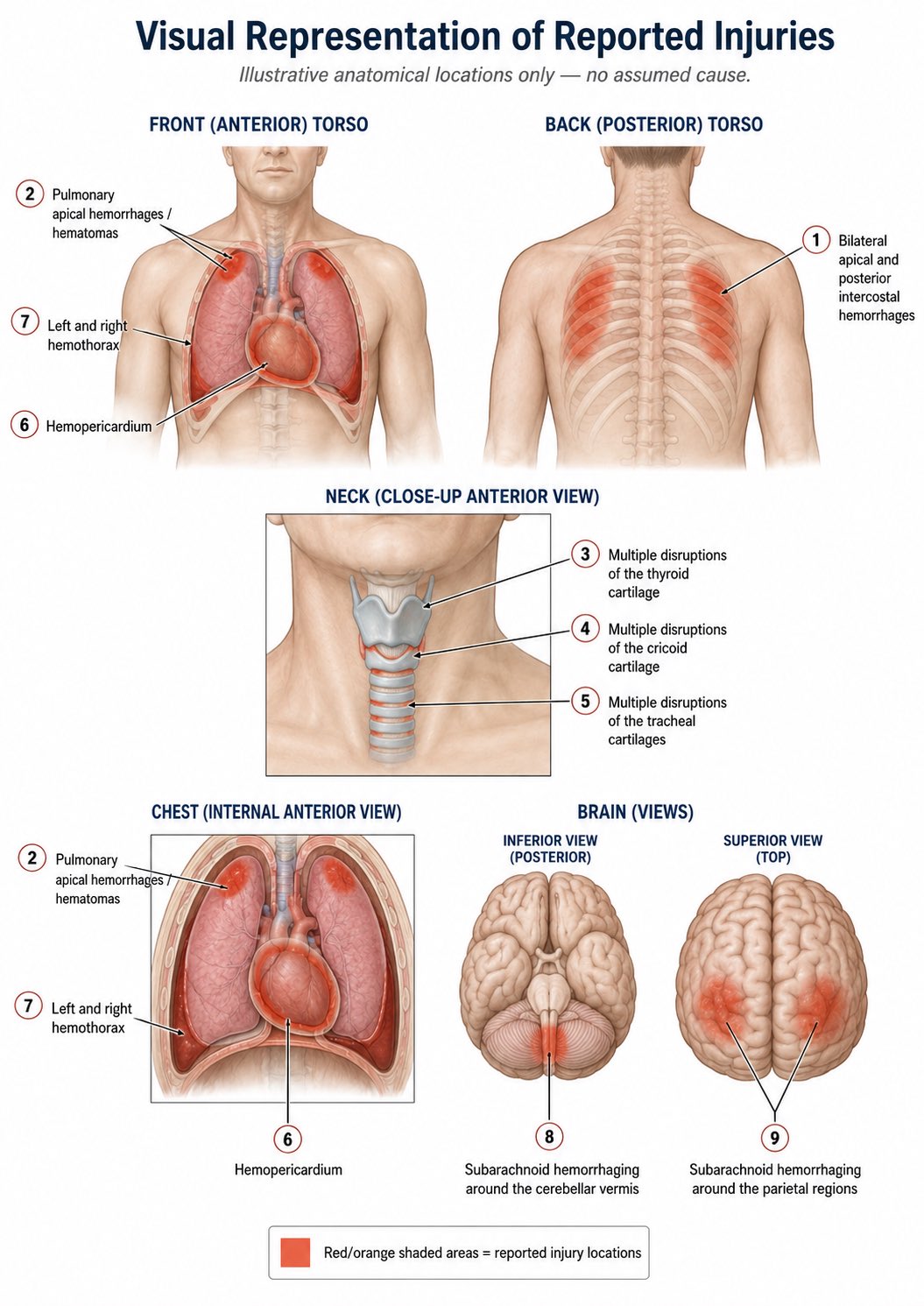
Weapon and ammunition analysis in one place — the Mauser narrative, the inconclusive ATF comparison, the energy gap, the trajectory problem, and the alternatives proposed when those fail. Start here before judging any single ballistics claim.
Read thisGun & Bullet Investigation Index
The government's kill chain needs three links — Mauser, Losee rooftop, fatal wound. This memo routes each link to the page that tests it, and lists the disclosure targets that would settle the whole argument in an afternoon.
Read thisElsewhere In The Investigation
The prosecution's physical case needs the autopsy fragment tied to the seized rifle, and the state's own lab could not do it. Rifling consistent with numerous makes and models is a class description, not an identification.
Read this
One jacket fragment, four lead pieces, and a .30-caliber class call that critics say names a category rather than a rifle. The page tracks the federal testing and the transparency fights around it, including a reported integrity concern over Exhibit 6A.
Read thisWho found the rifle, when, after which K-9 passes, and how the towel-wrapped bundle was photographed and sealed. These are ordinary evidence-handling questions, and on the public record they are unanswered.
Read this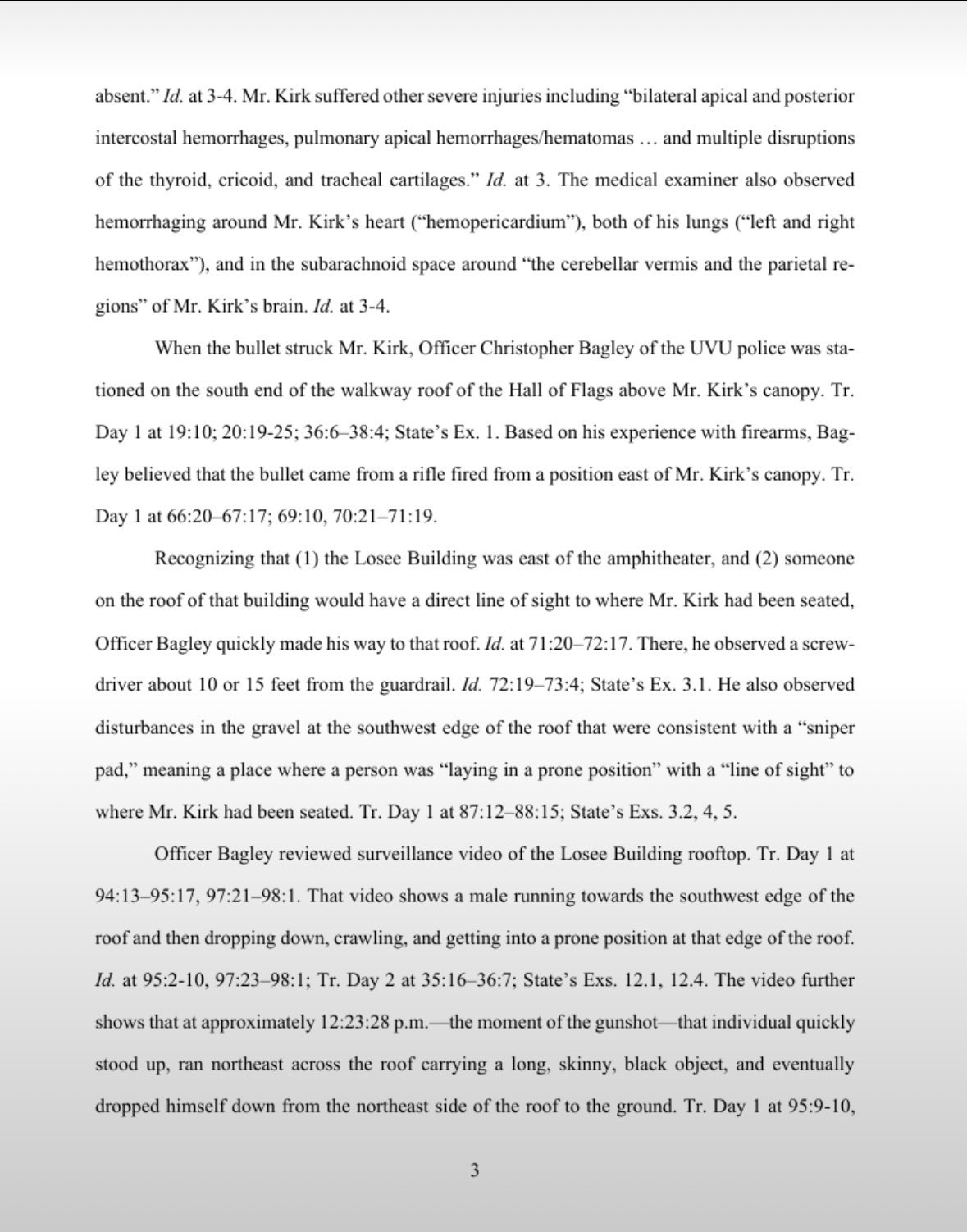
Shape Charge vs Bullet: from Medical Examiner results
The July 2026 filing quotes the Medical Examiner directly, and the injuries run far wider than a neck wound: hemopericardium, bilateral hemothorax, subarachnoid hemorrhaging. The page asks which mechanism predicts that pattern without extra assumptions.
Read thisThis website's author is @HolonCitizen on X and YouTube/@HolonCitizen. Follow me there.
Interesting
- Some investigators point instead to a hinged CornerShot-style 9mm system fired from the tent.
- FARA summaries allege roughly 523 geofenced US churches had worshippers' phone data harvested.
- A filing eight days after the killing reportedly named messaging integration into Salem Media, Kirk's own pipeline.