Evidence Sealing 2026
Much of the physical and digital evidence in the Charlie Kirk case remains outside public view while pretrial proceedings continue. Research notes and court commentary describe certain digital-forensics materials as sealed until March 2026, alongside broad gag orders and closed hearings that restrict what lawyers, witnesses, and media can say. This page summarizes those restrictions as reported and claimed — not as a finding that any official acted unlawfully. What the sealing withholds is the raw material that would settle how Charlie Kirk was actually killed, a question the cover-up record argues has been narrowed prematurely to the government's rifle account.
What Has Been Reported as Sealed
Public commentary and investigative notes reference several categories of withheld material:
- Digital forensics from devices — search history, communications, and location data tied to the accused, described in research materials as sealed until March 2026.
- Discovery under protective orders — prosecutors told Utah's Fourth District Court there is a large volume of discovery being produced to the defense under standard pretrial confidentiality (Media Censorship court update).
- Autopsy and hospital records — Utah law and case practice limit public autopsy release; the full autopsy report is not public (The Autopsy Report Is Not Public).
- FBI Form 302 interview reports — repeatedly cited across the site as unreleased primary records (FBI Investigation).
Some materials have been partially unsealed in 2026. For example, an ATF ballistics report was unsealed and reported as inconclusive on the autopsy bullet jacket fragment (Fox News coverage; Trial and Autopsy Report). That release did not automatically open the full digital-evidence file.
Volume, not just sealing, is part of the access dispute. Citizen investigators allege the state is "drowning" the defense in a reported 600,000 document files while the specific contested items — ballistics scans, DNA-mixture data, and chain-of-custody logs — remain hard to isolate (Discovery & Access Delays). The defense has reportedly sought a six-month continuance to bring independent forensic biologists, genetic-systems engineers, and statisticians to test whether the FBI and ATF applied correct procedures. Large discovery volume in a capital case is ordinary; the claim here is that scale is being used to obscure rather than disclose — a characterization that only the docket and production index can confirm or refute.
Gag Orders and Closed Hearings
Legal commentators and local journalists describe Judge Tony F. Graf Jr. as having issued a broad gag order on the court's own motion, restricting public statements by parties, counsel, and — indirectly — some media discussion (Legal Process, Gag Orders, and Hearing Secrecy).
Court coverage by Ben Winslow and Michael Martin (September 2025) reported that:
- Thousands of potential eyewitnesses are still being identified, and the gag order bars associated individuals from speaking to the media (Media Censorship).
- Certain preliminary hearings have been closed to the press, limiting real-time public knowledge of what evidence has been presented (Tyler Robinson Trial).
Supporters of gag orders frame them as protecting fair-trial rights and the jury pool in a nationally visible capital case (Media Censorship).
March 2026 Timeline and Pretrial Disputes
March 2026 appears in multiple contexts:
- Research notes cite March 2026 as a referenced release window for sealed digital-forensics warrants.
- Defense filings in March 2026 cited the inconclusive ATF report and moved to delay the preliminary hearing for further review — a filing widely amplified online as suggesting exoneration (Trial and Autopsy Report).
- The preliminary hearing was reportedly rescheduled toward July 2026 given the volume of evidence (Trial and Autopsy Report).
The timing matters because sealed material may overlap with election-year political debate and ongoing media litigation over what can be published while the case is pending.
June 2026: Contempt and Publicity Restrictions
In June 2026, Judge Graf found Deputy Utah County Attorney Christopher Ballard in civil contempt for media statements describing "ample evidence" of guilt despite inconclusive ballistics — statements found to violate pretrial-publicity restrictions (AP News; Trial and Autopsy Report). The death-penalty exposure remained in place; prosecutors were ordered to pay defense fees tied to the motion.
Christopher Ballard and Judge Tony Graf are not accused of wrongdoing on this site; the contempt finding is a documented court action, while online interpretations of its meaning are commentary.
Transparency Debates
Observers raise several recurring arguments:
- Due process vs. public right to know — capital cases often seal sensitive discovery, but the combination of gag orders, closed hearings, and unreleased autopsy and FBI interview records leaves citizen investigators dependent on secondary reporting (Government Evidence).
- Evidence preservation — separate claims allege witness footage deletion or remote wipes (FBI Asked a Witness to Delete Their Video); those allegations are unverified and are not proof that sealing orders themselves were improper.
- Legislative response — proposed transparency statutes in the Charlie Kirk Investigation Laws seek compulsory production of sealed indexes, gag-order rulings, and digital-forensics authorization records.
Laws (Charlie Kirk)
- The sealed digital-forensics and device evidence, who authorized the March 2026 sealing, and the classified national-security material being withheld are not public yet; the Charlie Kirk Investigation Laws could bring these powerful truths out.
Citizen Investigator Claims on X — Public Access Fights
March 14, 2026 saw a wave of posts celebrating a Utah judge rejecting efforts to keep records sealed and allowing cameras at a Robinson hearing. @DerrickEvans4WV and @GuntherEagleman framed the ruling as slamming the door on a "hide everything" strategy and granting public access to key documents.
June 2026 contempt coverage (prosecutor media comments; TMZ/Fox/USA Today threads) is tracked on Trial Press. Citizen investigators read the tug-of-war as: open courtroom optics vs speech and document locks that still hide forensics the public most wants (autopsy, full ballistics appendices, unredacted warrants).
Interesting In This Area
- A prosecutor was held in civil contempt in June 2026 over media statements about evidence.
- The DOJ page records over-classification claims that no released document has yet confirmed.
- An alibi claim in Panguitch was reportedly never tested by either side — see Legal.
- Witness-handling allegations sit beside the gag order but are legally a different question.
Interesting In Other Areas
- The gag order and sealing rulings decide when any of this becomes public.
Other Pages In This Section
Federal agents secured the scene about thirteen minutes after the first call. What the Bureau and the Utah agencies then agreed about witness access is the part no released document covers.
Read thisDOJ Prosecution and Evidence Secrecy
The public record on the charges and evidence handling, plus the sealing questions commentators raise. Digital-forensics warrants were reportedly sealed well into 2026, limiting outside review.
Read this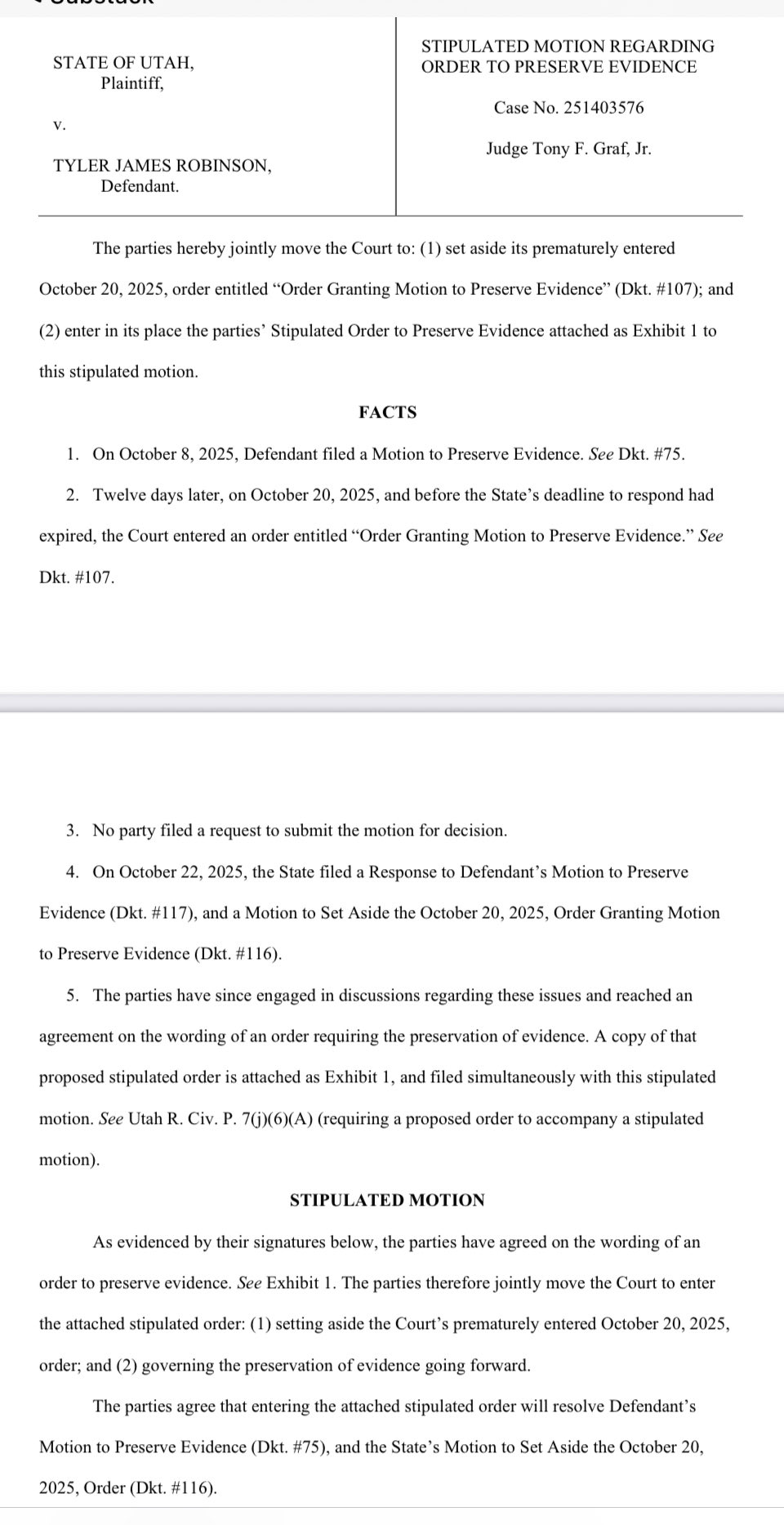
A ledger of what officials said and when, including the custody announcement made at 4:21 PM and corrected at 5:59. Reading them side by side is how you separate ordinary first-day error from something else.
Read thisElsewhere In The Investigation
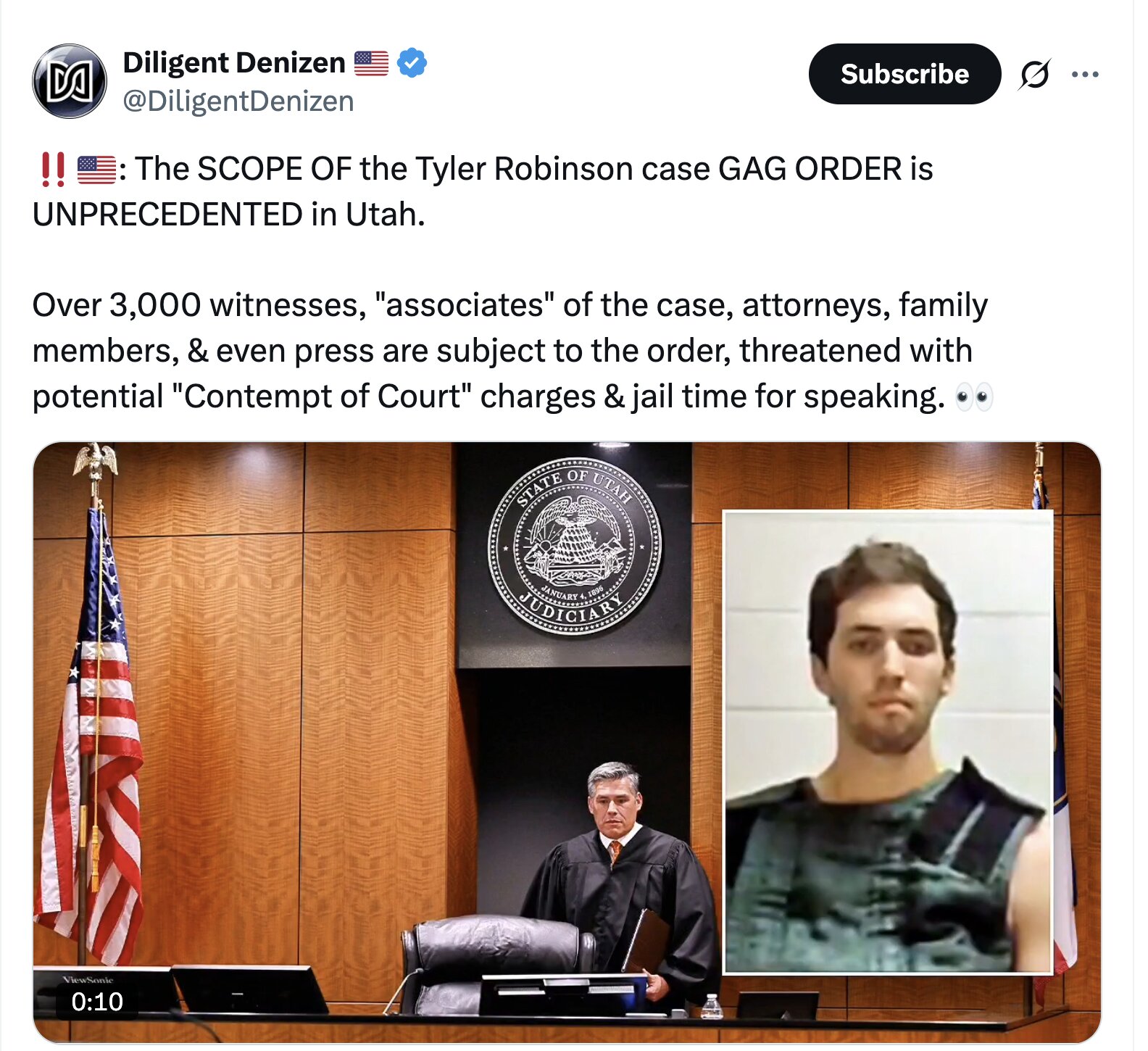
A December 2025 gag order, closed hearings, and a March 2026 motion to seal the inconclusive ATF report — opposed by a media coalition. The public record narrows in stages.
Read thisThis website's author is @HolonCitizen on X and YouTube/@HolonCitizen. Follow me there.
Interesting
- Commentators allege over-classification of the prosecution file while foreign theories went unexplored.
- A GRAMA request returned 112 heavily redacted pages holding two pre-event warnings.
- The affidavit admits UVU's own cameras never captured the act of firing.
Related Areas
- Legal Process and Gag Orders
- Media Censorship
- Trial and Autopsy Report
- Government Evidence
- FBI Investigation
- Charlie Kirk Laws