The 24 Search Warrants
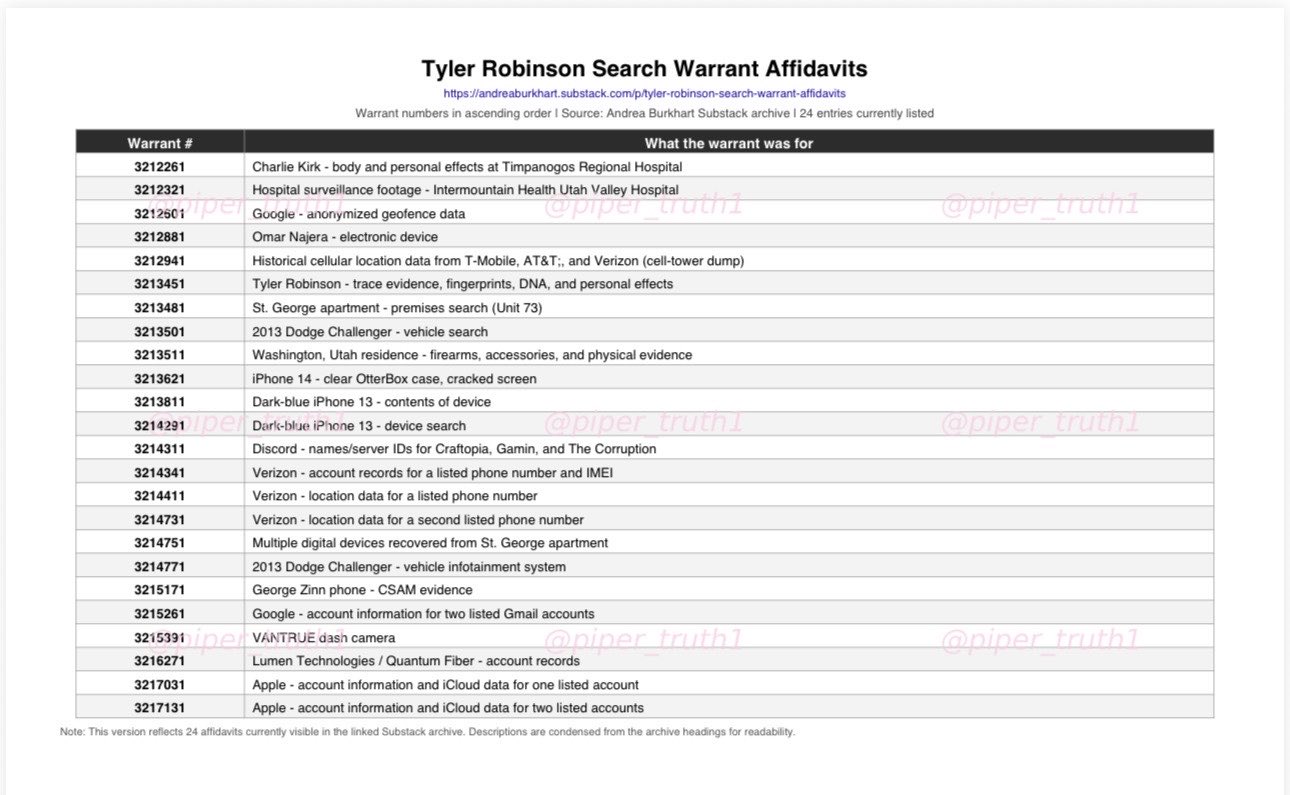
The 24 Tyler Robinson search warrant affidavits, indexed by warrant number. Compiled from the Andrea Burkhart Substack archive. Source: @Piper_truth1 on X, August 19, 2026.
Twenty-four search warrant affidavits have been filed and made public in State of Utah v. Tyler Robinson. Attorney and legal commentator Andrea Burkhart obtained the affidavits and published them to her Substack archive; the researcher @Piper_truth1 then indexed them into the single reference table shown here — each warrant by number, with a one-line summary of what it sought.
The value of the index is that it shows the shape of the investigation in one view. What investigators asked a judge for, and in what order, is a record of what they believed they needed. Tyler Robinson is charged, not convicted, and is presumed innocent; nothing on this page is a finding of guilt against him or against any other person named in a warrant. A warrant is a request to search, granted on probable cause — it is not evidence that anything was found.
The Index — 24 Warrants by Number
Reproduced from the table. Descriptions are condensed from the archive headings.
| Warrant # | What the warrant was for |
|---|---|
| 3212261 | Charlie Kirk — body and personal effects at Timpanogos Regional Hospital |
| 3212321 | Hospital surveillance footage — Intermountain Health Utah Valley Hospital |
| 3212501 | Google — anonymized geofence data |
| 3212881 | Omar Najera — electronic device |
| 3212941 | Historical cellular location data from T-Mobile, AT&T, and Verizon (cell-tower dump) |
| 3213451 | Tyler Robinson — trace evidence, fingerprints, DNA, and personal effects |
| 3213481 | St. George apartment — premises search (Unit 73) |
| 3213501 | 2013 Dodge Challenger — vehicle search |
| 3213511 | Washington, Utah residence — firearms, accessories, and physical evidence |
| 3213621 | iPhone 14 — clear OtterBox case, cracked screen |
| 3213811 | Dark-blue iPhone 13 — contents of device |
| 3214291 | Dark-blue iPhone 13 — device search |
| 3214311 | Discord — names/server IDs for Craftopia, Gamin, and The Corruption |
| 3214341 | Verizon — account records for a listed phone number and IMEI |
| 3214411 | Verizon — location data for a listed phone number |
| 3214731 | Verizon — location data for a second listed phone number |
| 3214751 | Multiple digital devices recovered from St. George apartment |
| 3214771 | 2013 Dodge Challenger — vehicle infotainment system |
| 3215171 | George Zinn phone — CSAM evidence |
| 3215261 | Google — account information for two listed Gmail accounts |
| 3215391 | VANTRUE dash camera |
| 3216271 | Lumen Technologies / Quantum Fiber — account records |
| 3217031 | Apple — account information and iCloud data for one listed account |
| 3217131 | Apple — account information and iCloud data for two listed accounts |
The compiler's own note on the table reads: "This version reflects 24 affidavits currently visible in the linked Substack archive. Descriptions are condensed from the archive headings for readability." That is a limit worth carrying forward — 24 is the count of affidavits visible in one public archive, not a certified count of every warrant issued in the case.
What the Pattern Shows
Digital evidence dominates. Of the 24 warrants, roughly seventeen target phones, cloud accounts, carrier records, a chat platform, an ISP, a dash camera, or a car's infotainment system. Only a handful — the body and personal effects, the trace-evidence warrant, the residence, the apartment, the vehicle — are conventional physical searches. This is consistent with what the Robinson phone and devices record describes, and with prosecutors' reported position on what they intend to offer at trial.
The same device was warranted more than once. The dark-blue iPhone 13 appears twice — warrant 3213811 for the contents of the device and 3214291 for a device search. A second warrant against the same phone usually means the first authority was thought too narrow, or expired, or that a new probable-cause theory was needed to go further into the same handset. Which of those it was is not answerable from an index alone; it is answerable from the affidavits themselves.
Three separate Verizon warrants and two Google warrants. Warrants 3214341, 3214411, and 3214731 hit Verizon for account records, then location data for one number, then location data for a second number. Two numbers were being tracked. Alongside the cell-tower dump (3212941) and the anonymized geofence request to Google (3212501), the location-data effort here is substantial and was still expanding after the earliest warrants were served.
The first warrant is for Charlie Kirk's body. Warrant 3212261 covers Charlie Kirk's body and personal effects at Timpanogos Regional Hospital, and 3212321 covers hospital surveillance footage. Those two sit at the front of the sequence. Whatever was recorded under them is the material that would bear directly on the cause-of-death question — the question the independent analysis says the rifle account settles too quickly, and much of the underlying record remains restricted under the 2026 evidence sealing.
What the Index Does Not Tell You
An index of warrants is not the warrants. Reading the affidavits themselves is what would answer:
- What probable cause was sworn for each one, and by which affiant.
- What was actually seized under each warrant, and what returns were filed.
- Whether any warrant was denied, narrowed, or later challenged — a returned-and-refiled warrant looks identical to a first-time warrant in a number list.
- Why the numbers are not contiguous. The sequence runs 3212261 to 3217131 with wide gaps. Those gaps are almost certainly other Utah district warrants unrelated to this case rather than missing Robinson warrants — but "almost certainly" is an inference, not a verified fact, and only the court's own index settles it.
- Whether 24 is the complete set. Sealed warrants would not appear in a public archive at all. Given the sealing posture in this case, a complete public list should not be assumed.
Two of the listed warrants name people other than the defendant. Warrant 3212881 lists an electronic device belonging to Omar Najera, and 3215171 lists George Zinn's phone in connection with CSAM evidence. Being named in a search warrant is not an accusation of involvement in Charlie Kirk's death, and neither listing should be read as one — Zinn was detained and cleared the same day as the shooter, and the matter attached to his phone in this warrant is a separate one from the assassination.
Why This Belongs in the Disclosure Fight
A public, numbered index is exactly the artifact that makes a forced-disclosure law enforceable. Without it, "release the warrants" is an unbounded request that an agency can answer with a partial production and no one can audit. With it, every warrant has a number, and a missing number is a visible gap. The Charlie Kirk Investigation Laws turn on precisely this: disclosure obligations that can be checked against a list, rather than trust in a voluntary release.
That this index exists because a private attorney obtained the documents and a private researcher tabulated them — rather than because a court or agency published it — is itself part of the record on how much of this case has stayed out of public view.
Sources
- Tyler Robinson Search Warrant Affidavits — Andrea Burkhart Substack archive (primary documents)
- @Piper_truth1 index table — X, August 19, 2026
X.com posts:
Related Areas
- Robinson's Phone and Devices
- Andrea Burkhart
- George Zinn
- Cause of Death
- Prosecution and Court Proceedings
- Charlie Kirk Laws