Charlie Trip to Hospital
After Charlie Kirk was shot at Utah Valley University on September 10, 2025, he was not loaded into an ambulance. According to multiple accounts, he was carried into a private vehicle and driven to a nearby hospital — a detail investigators have repeatedly flagged. By the time that vehicle reached Timpanogos, Charlie Kirk had already been fatally wounded by whatever mechanism actually killed him, so the transport window is less about rescue than about who controlled his body and the evidence on it.
Transport by SUV, Not Ambulance
According to eyewitness accounts, in the seconds after the shot Charlie Kirk was carried by his bodyguards — reportedly around six men — and placed into a black SUV rather than an ambulance. Reports describe no sirens accompanying the vehicle as it left the scene.
Author and apologist Frank Turek was reportedly inside the SUV and was said to be performing CPR during the drive. These transport details are drawn from eyewitness and secondhand reports and are presented as reported, not confirmed.
It is worth stating plainly: using a vehicle that is already on hand during a chaotic, active-shooter scene is not by itself evidence of wrongdoing. First responders and security teams sometimes move a critically injured person immediately rather than wait. The questions raised below concern the surrounding circumstances, not any single person's conduct.
Reconstructed Timeline
The following timeline is reconstructed from video and eyewitness reports. Times are approximate and use relative video time, not wall-clock time.
- ~00:43–01:05 — The SUV reportedly departs the UVU scene for the hospital.
- ~1 minute — Approximate time from the shot to the vehicle leaving for the hospital.
- ~7–10 minutes — Estimated drive time to the hospital.
- ~5–10 minutes (minimum) — Estimated time to unload Charlie and move him into the operating room (OR).
- ~20–30 minutes later — A surgeon reportedly emerged and pronounced Charlie Kirk deceased.
A separate timing concern raised in public commentary: reports and announcements of his death circulated very quickly. The Jerusalem Post reportedly published an announcement of his death around a time when, by the reconstructed timeline above, he would still have been in transit or in the OR. This is presented as a reported timeline anomaly attributed to those accounts, not as an established fact.
Which Hospital — and How Far
Charlie Kirk was reportedly taken to Timpanogos Regional Hospital in Orem. One eyewitness account described a "mad dash 5 miles to Timpanogos Regional."
The distance figures below are inconsistent across sources and are presented exactly as reported. They should be treated as claims, not as verified measurements.
| Hospital | Reported distance from UVU | Note |
|---|---|---|
| Timpanogos Regional Hospital (Orem) | ≈ 2.6 miles (one account says ≈ 5 miles) | Reported destination — figures conflict across sources |
| Intermountain Health Utah Valley Hospital | ≈ 3.4 miles | Cited as a nearby alternative |
| Utah Valley Hospital (Provo) | ≈ 12.3 miles | Described in reports as the hospital Charlie was NOT taken to |
Because the distance figures conflict, the exact mileage of each route is unsettled. What the sources agree on is the destination name — Timpanogos Regional — and that a closer-or-farther alternative existed.
The Bomb-Scare Claim
One unverified account, attributed to @TheLFLounge (Pia Varma) citing anonymous sources (described as 911 dispatchers, hospital security, and a senior hospital member), claims there was a bomb scare or lockdown at the closer Intermountain Utah Valley Regional Hospital at roughly the time of the shooting, which allegedly forced the detour to Timpanogos — and that staff were made to sign NDAs. @ProjectConstitu discussed the claim in detail but flagged skepticism, noting it does not appear in the police dispatch audio, and called for verification from hospital staff. This site treats it as an unconfirmed claim, not a finding; no NDA, dispatch record, or hospital statement has been produced to substantiate it.
A separate complaint from @DanSeemiller alleges the SUV "drove Charlie around for ~15 minutes when the hospital was under 5 minutes away," tying it to later questions about the vehicle being cleaned and sold. This, too, is an attributed claim and conflicts with the shorter drive-time estimates above.
Conflicting Transport Accounts
The accounts of what happened inside the SUV conflict with each other, which several commentators have highlighted:
- Frank Turek reportedly said he performed CPR in the SUV. Security figure Brian Harpole reportedly described no CPR, saying he was focused on the neck bleeding and "jumped atop" the gurney to cut Charlie's "Freedom" shirt.
- Candace Owens publicly called both accounts inconsistent, arguing CPR would have been physically difficult given the described positioning (Charlie across the seats, legs out the door). Accounts also reference shattered black glass or plastic fragments in SUV photos and a claim of "36 feet of gauze" (@PaulyRubino, @BasedSamParker). The glass/plastic fragments are cited by some to support an exploding-microphone theory — that alternative is examined on the Lapel Mic & Audio Theories page, not here.
These are competing, attributed recollections, not established facts, and the differences may simply reflect chaos and imperfect memory among people in a traumatic scene.
Counterpoint / denial worth noting: Brian Harpole later sued Candace Owens for defamation over conspiracy claims implicating him — a reminder that the people described in these transport accounts dispute the characterizations, and that naming them is not an accusation of wrongdoing. None of the individuals here is accused by this site of any crime.
Open Questions
- Why was a private SUV used instead of an ambulance, and were emergency medical services available on scene?
- Why were there reportedly no sirens during the transport?
- Which hospital was the correct or fastest choice, given the conflicting distance figures, and on what basis was Timpanogos Regional selected?
- How could a death announcement circulate while, per the reconstructed timeline, Charlie may still have been in transit or in surgery?
- Are there official records — dispatch logs, hospital intake times, OR records — that can resolve the timeline and route?
For the dedicated analysis of the hospital choice and transport decision, see /Medical/Hospital/hospital_choice_transport. For what happened after arrival, see /Medical/events_at_hospital.
Laws (Charlie Kirk)
- Hospital intake and OR timestamps versus the early death announcement and the removed hospital camera footage and any NDAs signed by hospital staff over the bomb-scare detour are things that the Charlie Kirk Investigation Laws may result in powerful truths coming out that aren't out yet.
Citizen Investigator Claims on X (Transport)
(Attributed public claims — not findings of this site.)
- @ProjectConstitu (Nov 10, 2025; ~242k views) posted an “exclusive witness” video claiming: six bodyguards rushed Kirk into a black SUV (no ambulance); Frank Turek performed CPR en route; a second SUV driven by Mikey McCoy went to physician parking, picked up an unidentified person, and left without (per the poster) visiting Kirk’s body. The poster attributes the account to a hospital contractor. Unverified; no court has adopted these characterizations of intent.
- Follow-up by the same account (Nov 13, 2025): the witness allegedly went silent, TikTok profile wiped, planned interview cancelled — framed by the poster as possible intimidation. Alternative explanations (privacy, legal advice, hoax) are not ruled out.
- @NateNewsNow (July 6, 2026) reported hearing notes that Agent Hull described “hasty transport” in a vehicle to Timpanogos, death pronounced at hospital, and a medical examiner who told Hull that Kirk had died.
- @realstewpeters / @aldamu_jo (Jan 2026) emphasize glass shards visible in the transport SUV and link them to a tempered-glass lav mic — a mechanism claim disputed by rifle-shot proponents. See SUV Transporting Charlie.
No living person is accused here of criminal wrongdoing as a site finding.
Best understanding of when this happened
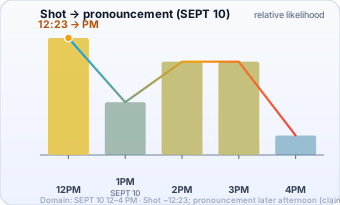
Best understanding: shot ~12:23 PM; pronouncement later the same afternoon at Timpanogos (exact minute disputed across reports).
Date range (working model): SEPT 10 12–4 PM · Shot ~12:23 → pronouncement later PM
The chart below is not a government finding. Bar height is relative likelihood from public claims. Domain is trimmed to non-trivial likelihood.
This website's author is @HolonCitizen on X and YouTube/@HolonCitizen. Follow me there.
Interesting
- A contractor says a governor-and-FBI Monday deadline drove the paving of the scene.
- Thousands of pagers detonated at once after months of supply-chain prep in Operation Grim Beeper.
- PETN slivers can hide in a battery compartment without changing how a device looks.
Related Areas
Related
Images