Charlie's Injuries
A court filing circulated in late July 2026 quotes the medical examiner's findings directly, and the list of injuries it recites is substantially longer than the single neck wound the public narrative described. The filing text below is quoted as it appears in the screenshot shared on X; this page does not assert a cause for any of the listed injuries, and the full autopsy report remains non-public. The breadth of the damage is precisely why so many readers reject the idea that Charlie Kirk was killed by one rifle bullet and look instead to the exploding-microphone thesis.
Source
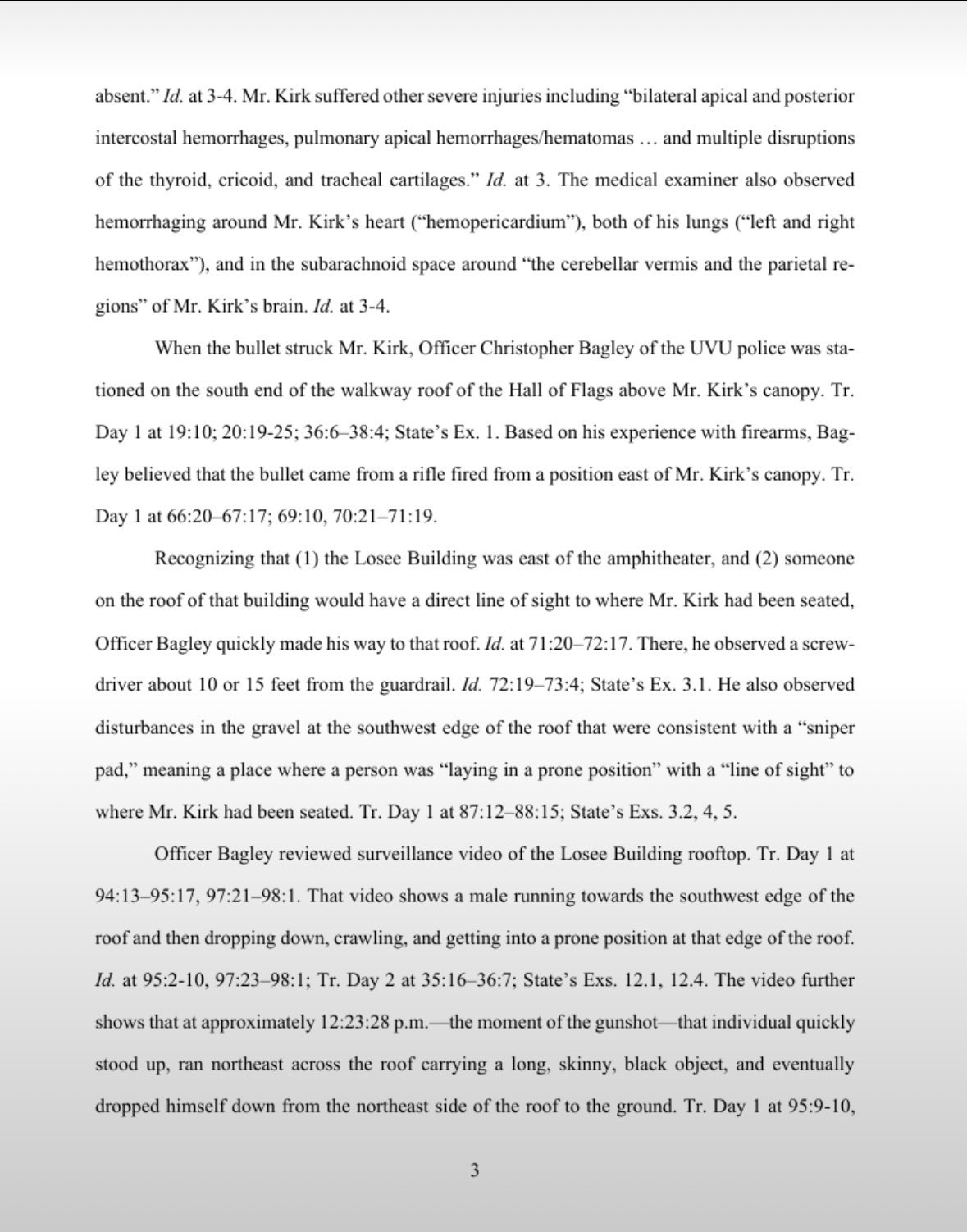
Court filing page quoting the medical examiner's findings. Source: @thisauthentic on X, July 30, 2026. IPFS CID QmNfnhc3XCLGJUnrP6jqZ8NrVsphfQU6jAHSFDxLrbi7sF.
Posted by @thisauthentic on X on July 30, 2026 (271 likes, 65 reposts, ~8,400 views). The post consists of a summary list plus two images: a screenshot of the filing page itself, and an anatomical infographic the poster built from the filing's wording.
According to @thisauthentic:
A new court filing reveals Charlie Kirk suffered far more extensive injuries than the public was told:
• Hemorrhaging around the brain • Blood around the heart • Blood in both sides of the chest • Lung hemorrhages/hematomas • Multiple disruptions of the thyroid, cricoid, and tracheal cartilages • Bilateral intercostal hemorrhaging
Here's the uncomfortable question:
Why was the public given a "neck of steel" narrative while the extent of Charlie's injuries remained intentionally buried in court records?
This FED SLOP stinks to high hell. Release the complete autopsy, imaging, medical records, and forensic analysis.
Until then, the "official story" is not a complete story!
The characterizations in that post — "intentionally buried," "FED SLOP" — are the poster's opinion, not a finding by this website. What follows is the filing text itself.
The filing text
Transcribed from the screenshot. Internal citations (Id. at 3, Tr. Day 1, State's Ex.) are
the filing's own references to the autopsy report and trial transcript.
absent." Id. at 3-4. Mr. Kirk suffered other severe injuries including "bilateral apical and posterior intercostal hemorrhages, pulmonary apical hemorrhages/hematomas ... and multiple disruptions of the thyroid, cricoid, and tracheal cartilages." Id. at 3. The medical examiner also observed hemorrhaging around Mr. Kirk's heart ("hemopericardium"), both of his lungs ("left and right hemothorax"), and in the subarachnoid space around "the cerebellar vermis and the parietal regions" of Mr. Kirk's brain. Id. at 3-4.
What each term means
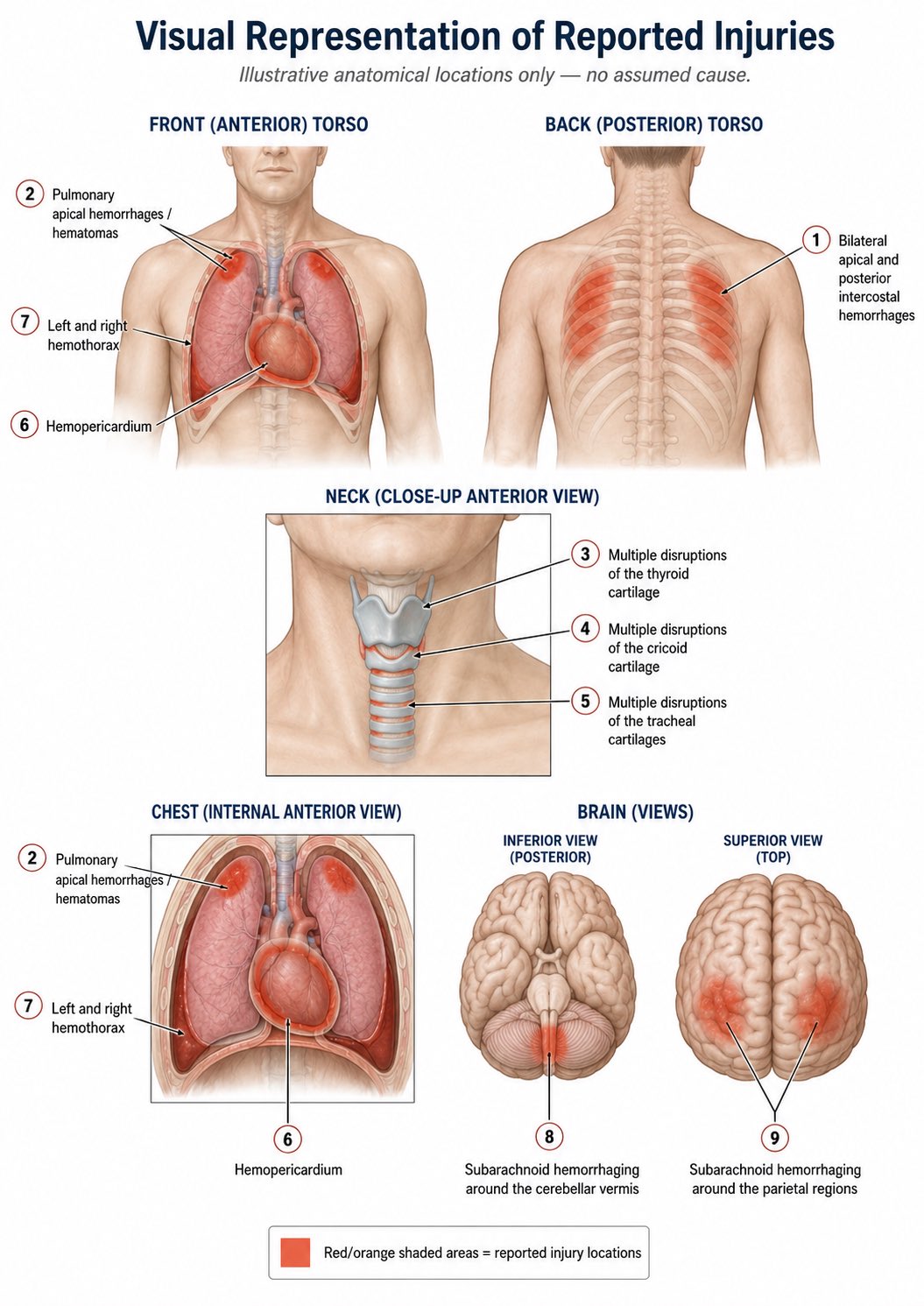
Infographic mapping the filing's listed injuries onto anatomical diagrams — labeled by its author "Illustrative anatomical locations only — no assumed cause." Source: @thisauthentic on X, July 30, 2026. IPFS CID QmYmTtksQt3bNKmYKMrNhrwVvo8mNUn47R6XJyuUDyH57r.
- Hemopericardium — blood in the sac surrounding the heart.
- Left and right hemothorax — blood in the chest cavity on both sides, around both lungs.
- Pulmonary apical hemorrhages / hematomas — bleeding and blood pockets at the tops of the lungs.
- Bilateral apical and posterior intercostal hemorrhages — bleeding between the ribs, on both sides, at the top and toward the back.
- Subarachnoid hemorrhage around the cerebellar vermis and parietal regions — bleeding beneath the membrane covering the brain, at the base of the cerebellum and over the upper brain.
- Multiple disruptions of the thyroid, cricoid, and tracheal cartilages — the cartilage structures of the voice box and windpipe were broken in more than one place.
The second image is the poster's own visual mapping of those terms onto anatomical diagrams — anterior torso, posterior torso, internal chest, and two brain views. Its own caption reads "Illustrative anatomical locations only — no assumed cause." It is an interpretation aid, not a medical document, and it does not come from the medical examiner.
Why this matters to the case
Bilateral findings — blood on both sides of the chest, bleeding between ribs on both sides, brain hemorrhaging in two separate regions — are the part readers have focused on, because they sit uneasily against a description of a single localized neck wound. Blast overpressure, secondary cavitation from a high-velocity round, resuscitation efforts, and simple post-injury blood tracking are all offered as competing explanations, and the filing itself assigns no cause. That question connects directly to the ballistics and wound analysis debate and to the exploding mic theory, which argues the chest was involved before the neck was.
The airway cartilage findings are also cited in the chest-versus-neck witness conflict: several early witnesses described chest trauma before the public account settled on the neck.
None of this can be resolved from a quoted excerpt. The underlying autopsy report, imaging, and forensic analysis remain non-public — the central complaint of the post and the reason the autopsy secrecy pages exist. Full document and naming context: Charlie Kirk Autopsy Report, Charlie Kirk Medical Examiner Report, Charlie Kirk Medical Examiner Name.
The same filing page also states the rooftop account
The screenshot's lower portion is the state's narrative, and it belongs on the record alongside the injury list rather than cropped out of it. Per the filing:
When the bullet struck Mr. Kirk, Officer Christopher Bagley of the UVU police was stationed on the south end of the walkway roof of the Hall of Flags above Mr. Kirk's canopy. ... Based on his experience with firearms, Bagley believed that the bullet came from a rifle fired from a position east of Mr. Kirk's canopy.
The filing goes on to describe Officer Bagley proceeding to the Losee Building roof, where he reportedly observed a screwdriver 10 to 15 feet from the guardrail and disturbances in the gravel at the southwest edge consistent with a "sniper pad" — a position where someone had been "laying in a prone position" with a line of sight to the canopy. It states that surveillance video shows a male running to that southwest edge, dropping into a prone position, then at approximately 12:23:28 p.m. — the moment of the gunshot — standing, running northeast carrying "a long, skinny, black object," and dropping off the northeast side of the roof to the ground.
That account is the prosecution's, presented in its own filing. Tyler Robinson is the accused and has not been convicted. Readers weighing the injury list should note it arrives inside a document arguing the state's case, which is part of why the underlying medical records — not excerpts of them — are what the post demands.
Open questions
- Which filing is this, in which docket, and on what date was it entered?
- Does the full autopsy report characterize the bilateral findings as primary injuries or as secondary/post-injury effects?
- Were any of the listed findings caused or aggravated by resuscitation at the scene or in transit to Timpanogos?
- Why did no public statement mention findings beyond the neck wound?
X.com posts:
This website's author is @HolonCitizen on X and YouTube/@HolonCitizen. Follow me there.
Interesting
- No vendor, driver, or photo backs the alleged 11:30 AM patient shuttle.
- An infrared laser reportedly traced back to a grey van whose hatch opened seconds early.
- A sheriff's suspect photo shown to workers allegedly did not match the FBI's public image.