Doctors Question the Medical Examiner's Report
On July 30, 2026, Candace Owens posted two screenshots of comments left under her show by viewers who identify themselves as medical professionals — one a surgeon, one a retired cardiologist. Both had just read the Medical Examiner findings quoted in the July 2026 court filing, and both said the same thing from different specialties: the injury list does not fit a single rifle round fired downward from the Losee Center rooftop.
Her post read:
Interesting comments coming in regarding the medical examiner's report on Charlie.
Things are certainly going to get interesting.
Just how magical was this bullet?
— @RealCandaceO on X, July 30, 2026
Both commenters are anonymous YouTube handles. Their stated credentials are unverified — this website has not confirmed that either person is a physician. What follows is reproduced as posted, as public commentary, not as expert testimony. Tyler Robinson is the accused, not convicted, and nothing on this page is a finding by this website.
The surgeon: the rooftop trajectory is "not possible"
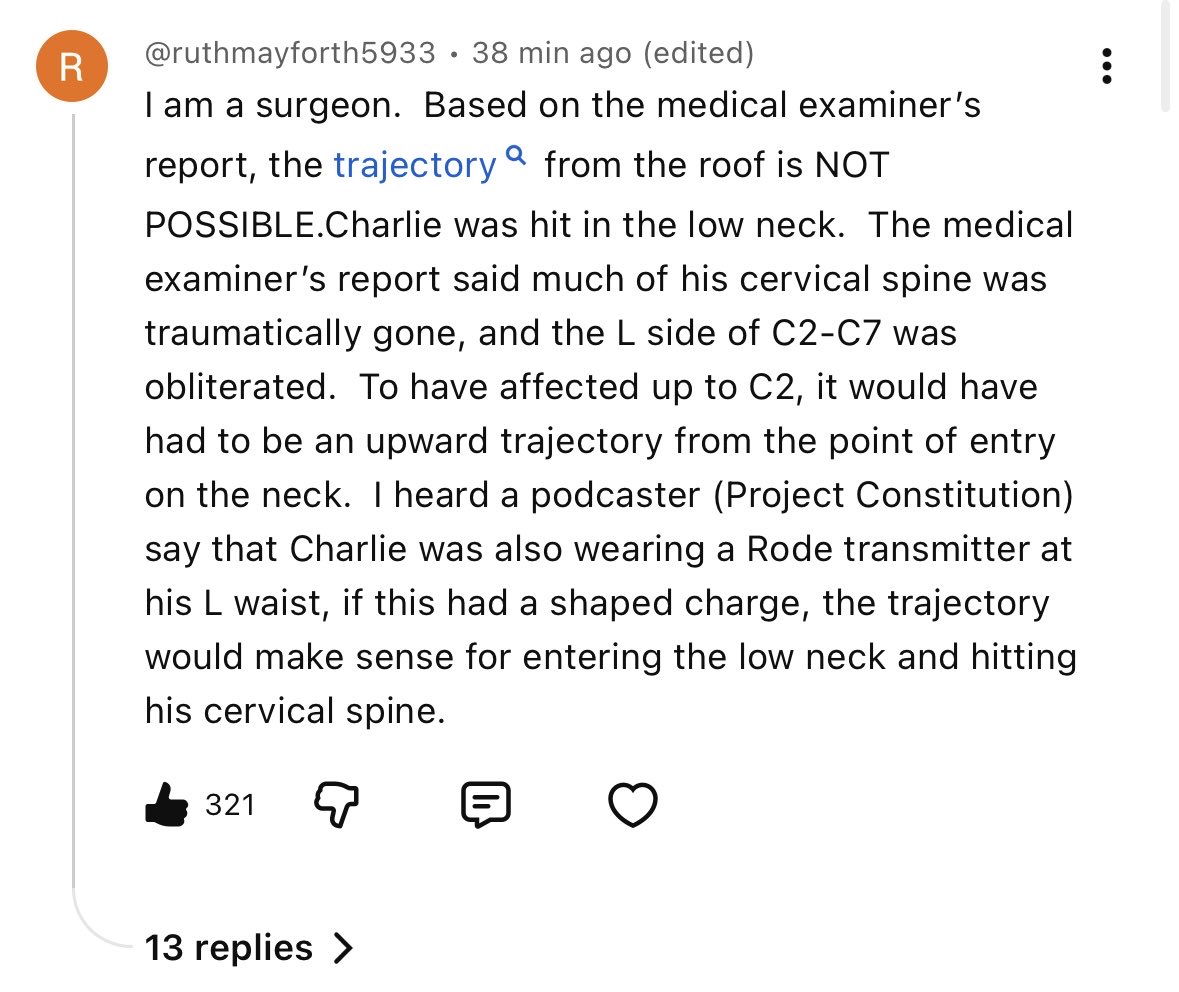
Comment by @ruthmayforth5933, 321 likes, 13 replies. Source: @RealCandaceO on X, July 30, 2026.
The first commenter, @ruthmayforth5933, posted (transcribed from the screenshot):
I am a surgeon. Based on the medical examiner's report, the trajectory from the roof is NOT POSSIBLE. Charlie was hit in the low neck. The medical examiner's report said much of his cervical spine was traumatically gone, and the L side of C2–C7 was obliterated. To have affected up to C2, it would have had to be an upward trajectory from the point of entry on the neck. I heard a podcaster (Project Constitution) say that Charlie was also wearing a Rode transmitter at his L waist, if this had a shaped charge, the trajectory would make sense for entering the low neck and hitting his cervical spine.
The argument is geometric. C2 sits high in the neck, just below the skull; C7 sits at the base of the neck, at shoulder level. If the entry wound is at the low neck and the damage runs all the way up to C2, the destructive path travelled upward through the body. A round fired from an elevated rooftop roughly 200 yards away arrives on a downward path — the opposite direction. The State's own brief states the trajectory was "front to back, slightly left to right, and downward" on the same page it quotes the C2–C7 obliteration; those two sentences are placed side by side on Trajectory vs C2–C7 Damage.
The commenter's proposed alternative is the same one this site tracks on Shape Charge vs Bullet: a device at the left waist — the position where a Rode wireless transmitter pack is worn — firing upward into the low neck. That claim about the transmitter position is attributed to the podcast Project Constitution; this site has not independently confirmed it.
The cardiologist: "an explosion that went off inside of him"
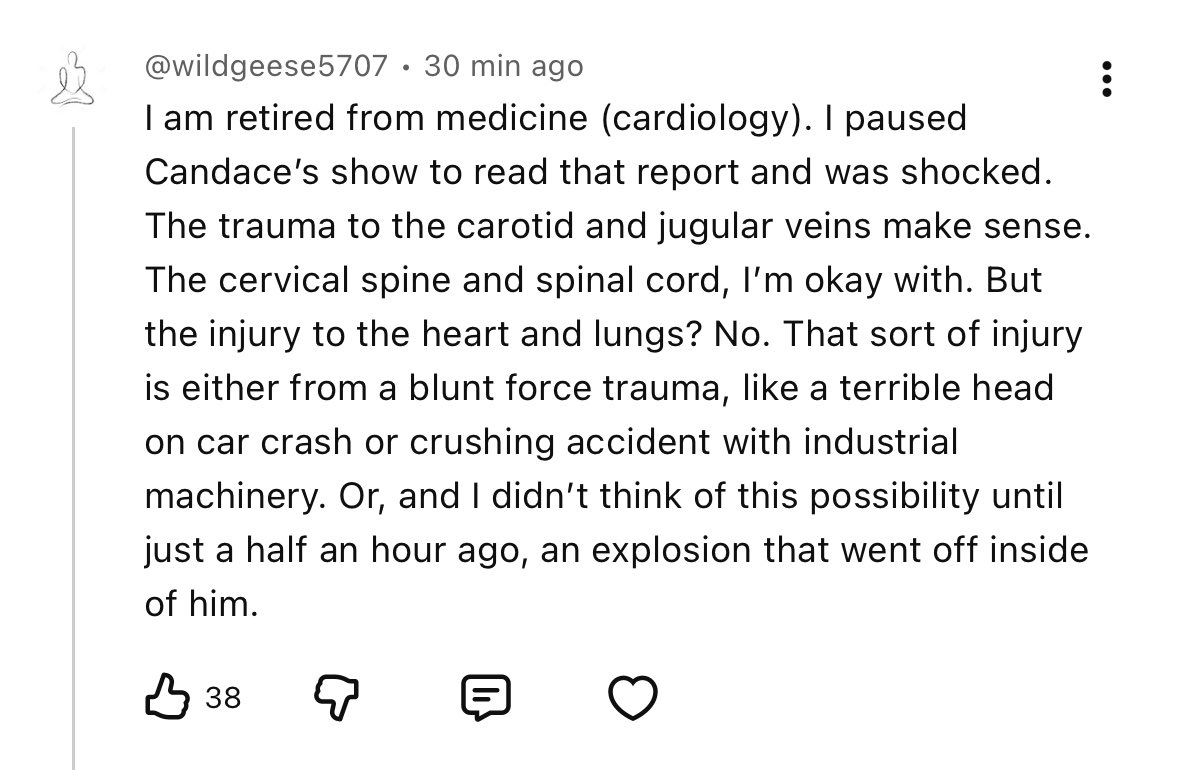
Comment by @wildgeese5707, 38 likes. Source: @RealCandaceO on X, July 30, 2026.
The second commenter, @wildgeese5707, posted (transcribed from the screenshot):
I am retired from medicine (cardiology). I paused Candace's show to read that report and was shocked. The trauma to the carotid and jugular veins make sense. The cervical spine and spinal cord, I'm okay with. But the injury to the heart and lungs? No. That sort of injury is either from a blunt force trauma, like a terrible head on car crash or crushing accident with industrial machinery. Or, and I didn't think of this possibility until just a half an hour ago, an explosion that went off inside of him.
This objection is about a different part of the body. The commenter accepts the neck findings — carotid, jugular, cervical spine, spinal cord — as consistent with a wound in that region. What they reject is the thoracic damage listed in the same report: hemopericardium (blood around the heart), bilateral hemothorax (blood in both chest cavities), and pulmonary apical hemorrhages in both lung apices.
In their reading, that pattern belongs to a crush or overpressure mechanism — a head-on collision, industrial machinery, or a blast — not to a projectile that passed through the neck.
Why these two comments matter together
The two commenters do not appear to be coordinating. They wrote 8 minutes apart, from different specialties, and each objected to a different part of the report:
| Commenter | Stated specialty | Objection | Body region |
|---|---|---|---|
| @ruthmayforth5933 | Surgeon | Path had to run upward to reach C2 | Neck / cervical spine |
| @wildgeese5707 | Cardiology (retired) | Heart and lung damage fits blunt force or blast | Chest |
Taken together, they describe the same shortfall this site's Shape Charge vs Bullet page scores formally: a single downward .30-06 round explains a neck wound, but leaves the upward cervical destruction and the bilateral chest findings unaccounted for.
Counterpoints
Fair objections to reading too much into these comments:
- Neither commenter is identified or verified. Anonymous handles claiming credentials are not expert testimony, and neither has examined the body, the imaging, or the full report.
- Neither has read the full ME report. No autopsy report is public — see Autopsy Report Not Public. Both are reasoning from the excerpts quoted in the July 2026 court filing, which are partial by nature.
- Excerpted findings can mislead. A filing quotes selectively. Findings that would contextualize the chest injuries — cavitation, secondary fragment paths, resuscitation trauma from CPR and chest compressions during transport — may exist in the full report and simply not be quoted.
- CPR itself causes chest trauma. Rib fractures and intrathoracic bleeding are common consequences of aggressive chest compressions, which is a competing explanation for at least part of the thoracic picture.
- High-velocity rifle rounds do cause remote injury. Temporary cavitation and hydrostatic shock can produce damage well away from the wound track, which is the standard rebuttal to "a bullet can't do that."
The unresolved fact underneath all of it: the full Medical Examiner report is still not public, so no one outside the case — these commenters included — can settle the question. See Charlie Kirk Medical Examiner Report, Charlie Kirk Autopsy Report, Trial & Autopsy Report, and Utah Autopsy Law (SB0082).
X.com posts:
This website's author is @HolonCitizen on X and YouTube/@HolonCitizen. Follow me there.
Interesting
- Owens was reportedly told no 911 call ever reached the hospital.
- Even the overhead concrete beside the tent was reportedly mudded or repainted afterward.
- Several on-scene witnesses said Kirk was hit in the chest before that language vanished.