Shape Charge vs Bullet: from Medical Examiner results
A July 2026 court filing in State of Utah v. Tyler Robinson quotes the Medical Examiner's report directly. The injuries it lists are far wider than the neck wound the public was told about. This page sets those quoted findings beside the two competing explanations — a single .30-06 rifle round fired from the Losee Center rooftop, and a shaped charge detonating at chest level — and asks which one predicts the injury pattern without needing extra assumptions. Framed plainly, the question is whether Charlie Kirk was killed by a bullet or by a device, and the broader cause-of-death record has moved steadily toward the device.
Tyler Robinson is the accused, not convicted. Nothing on this page is a finding by this website.
What the filing quotes the Medical Examiner as reporting
The filing quotes the ME report at pages 3–4. Beyond the neck wound, it lists:
| Finding | Where |
|---|---|
| Bilateral apical and posterior intercostal hemorrhages | Chest wall, both sides |
| Pulmonary apical hemorrhages / hematomas | Both lung apices |
| Multiple disruptions of the thyroid, cricoid, and tracheal cartilages | Neck |
| Hemopericardium (hemorrhaging around the heart) | Chest |
| Left and right hemothorax (blood in both chest cavities) | Chest, both sides |
| Subarachnoid hemorrhaging around the cerebellar vermis | Brain |
| Subarachnoid hemorrhaging around the parietal regions | Brain |
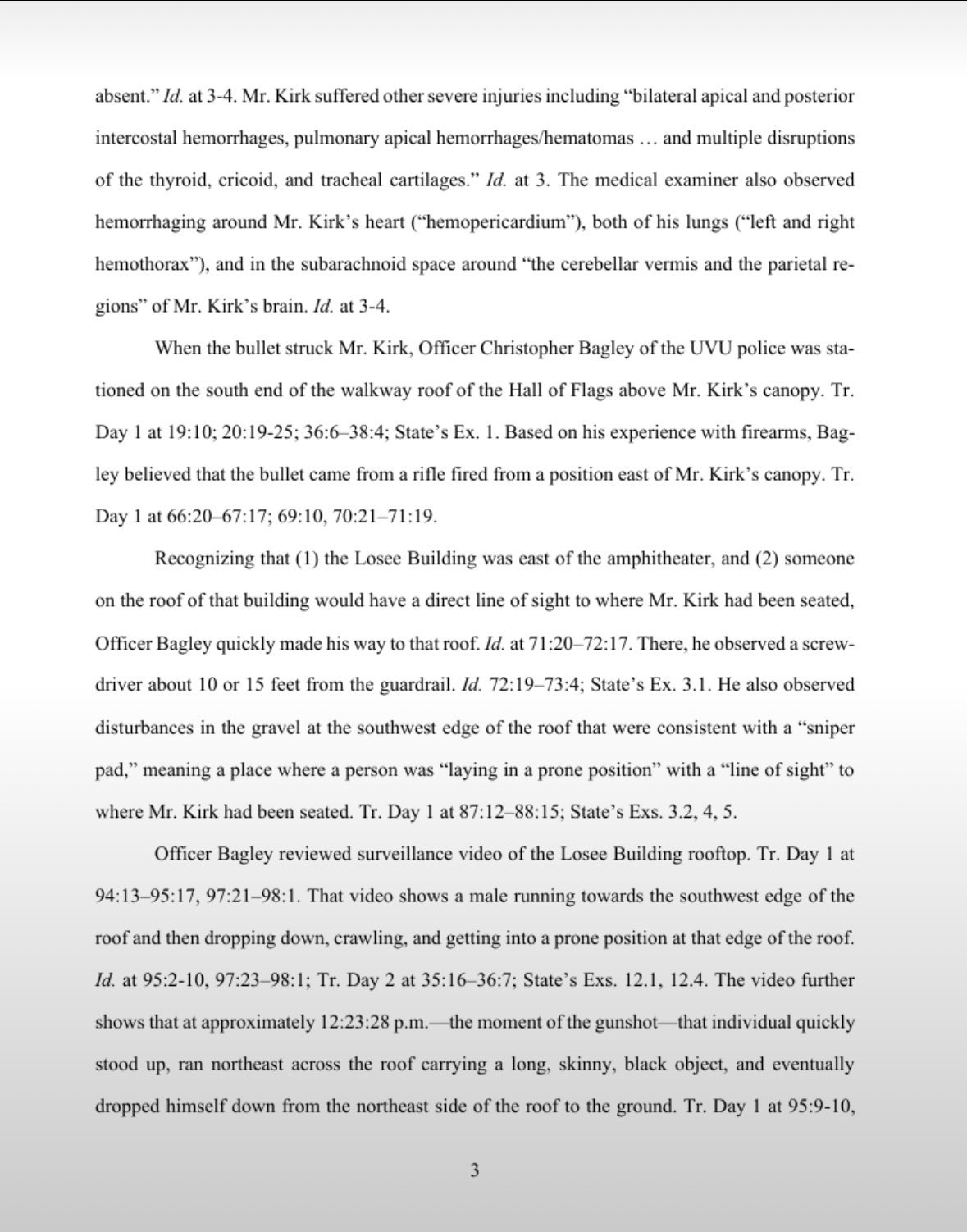
Page 3 of the court filing. The same page continues into Officer Christopher Bagley's rooftop account. Posted by @thisauthentic on X, July 30, 2026.
The same page then records Officer Christopher Bagley of UVU police, stationed on the Hall of Flags walkway roof, believing from experience that the shot came from a rifle east of the canopy — and finding a screwdriver and gravel disturbance consistent with a "sniper pad" on the Losee rooftop. Both threads are in the filing together: the injuries, and the rooftop.
The injuries, mapped
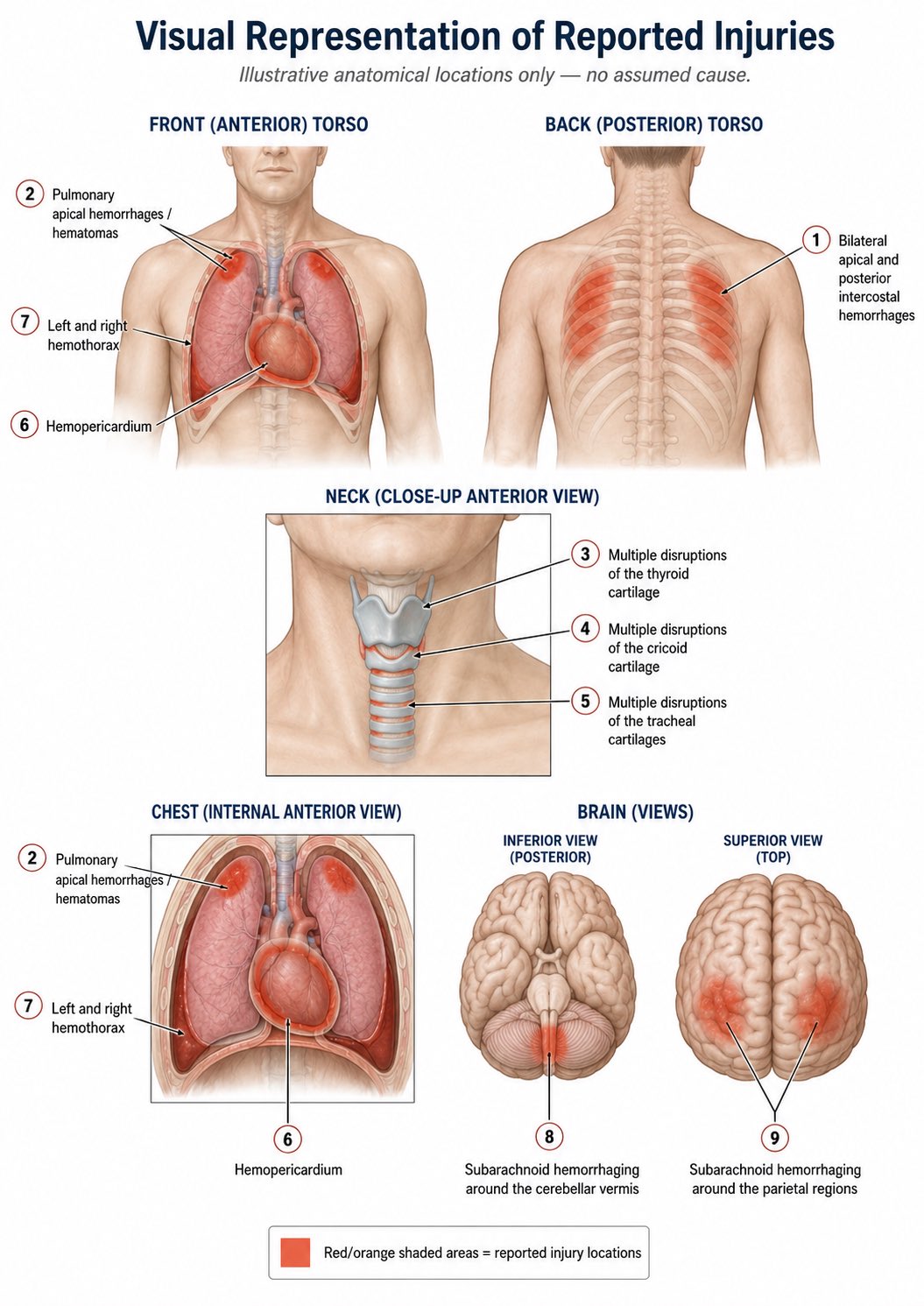
"Visual Representation of Reported Injuries." The chart's own caption reads: Illustrative anatomical locations only — no assumed cause. It maps the nine findings quoted above onto torso, neck, chest and brain views. Posted by @thisauthentic on X, July 30, 2026.
The chart makes the geometric problem visible. A single wound track through the neck has to account for hemorrhaging in both pleural spaces, around the heart, in both lung apices, along both sides of the rib cage, and in two separate vascular territories of the brain — the cerebellar vermis (vertebrobasilar) and the parietal regions (carotid/MCA).
The scorecard
A forensic-hypothesis comparison published by @jonaaronbray on July 30, 2026 scores each ME finding, each acoustic finding, and each published blast-physics mechanism from 0 to 5 on how directly it follows from each hypothesis:
| .30-06 rifle | Shaped charge | |
|---|---|---|
| Total | 28 / 65 (avg 2.2) | 57 / 65 (avg 4.4) |
| Aggregate explanatory fit | 33% | 67% |
Where the two hypotheses split, per that analysis:
| Finding | Rifle | Shaped charge |
|---|---|---|
| Bilateral hemothorax (left and right) | 2/5 — needs a secondary mechanism to breach both pleural spaces | 5/5 — a jet on any front-to-back thoracic path transits both |
| Hemopericardium | 2/5 — needs a ~35 cm track from neck to T2–T3 | 5/5 — pericardium sits 5–8 cm behind the anterior chest wall |
| Bilateral intercostal hemorrhages | 2/5 — indirect, needs bilateral pressure-wave propagation | 5/5 — textbook blast lung / chest-wall overpressure finding |
| Subarachnoid — parietal regions | 1/5 — parietal lobes are carotid-supplied, not vertebrobasilar | 4/5 — thoracic vascular surge reaches the whole cerebral vasculature |
| 104 µs rise time (4.9× faster than PETN) | 1/5 — no ballistic mechanism produces it | 4/5 — consistent with a high-VOD, shock-focused geometry |
| Cooper acoustic coupling (foam on thorax) | 0/5 — not applicable, no surface detonation | 5/5 — chest-worn padding acts as Cooper's foam coupler |
| Multiple cartilage disruptions | 4/5 — a single left-to-right track through Zone 2 | 3/5 — would need scattered fragments travelling upward |
| Bilateral apical pulmonary hemorrhage | 4/5 — a 10° downward track enters the thoracic inlet at midline | 4/5 — blast overpressure at the lung apices |
Note the row where the rifle scores higher: the sequential thyroid–cricoid–tracheal cartilage disruptions read more naturally as one object crossing one axis. The analysis does not claim a clean sweep.
What this is and is not
- It is a scoring of published findings against two hypotheses, not a forensic conclusion, and not a substitute for the full ME report.
- The ratings are the author's judgments of explanatory fit. Reasonable analysts weight them differently.
- The underlying acoustic inputs — the 53 Hz cavity mode, the +14.1 dB cavity-to-structural ratio, the 104 µs rise time — come from citizen analysis of UCCU Center recordings, not from a government lab. See Canon XA55 Audio.
- The full autopsy report, imaging, and forensic analysis remain non-public. Every hypothesis on this page is testable the moment they are released. See Autopsy Report Not Public.
The literature the shaped-charge column leans on is real and predates the case by decades: Cooper's 1991 and 1996 work on thoracic stress waves and foam decouplers, and Courtney & Courtney's 2009 and 2011 work on a thoracic mechanism for blast-induced brain injury. Whether it applies here is exactly what the sealed record would settle.
X.com posts
- Court filing lists injuries far beyond the neck wound — @thisauthentic, July 30, 2026
- "Here's the score" — Injury Pattern Analysis scorecard — @jonaaronbray, July 30, 2026
This website's author is @HolonCitizen on X and YouTube/@HolonCitizen. Follow me there.
Interesting
- The court-filed injury list goes far beyond a single neck wound.
- The exploding microphone theory leads the eight categories one proposed law would force open.
- Agencies reportedly stopped investigating once a suspect was in custody.