The State's Brief: Downward Trajectory vs C2–C7 Damage
On July 30, 2026, X user @matt82704417 (Matthew St Baker, bio: "Currently Investigating: Who Really Killed Charlie Kirk!") posted two pages of a court document alongside a claim attributed to leaked Timpanogos Hospital staff commentary. He underlined passages in red and asked what they mean for the official account.
The point being made is narrow and worth stating precisely: the State's own filing contains two statements that critics say pull in opposite directions — that the bullet travelled downward, and that it obliterated the left side of the vertebrae from C7 all the way up to C2.
Two corrections surfaced in the replies within two hours, and both are carried on this page below. Neither the leak nor the inference is verified. Tyler Robinson is the accused, not convicted, and nothing here is a finding by this website.
What the two document pages actually say
These are not the Medical Examiner's report. The post originally described them that way, but X user @a_slick_dog corrected it in the replies and the poster accepted the correction — see Corrections from the reply thread below. They are two pages from the State's brief arguing probable cause, which quotes the ME report selectively.
The red underlining was added by the poster, not by the court.
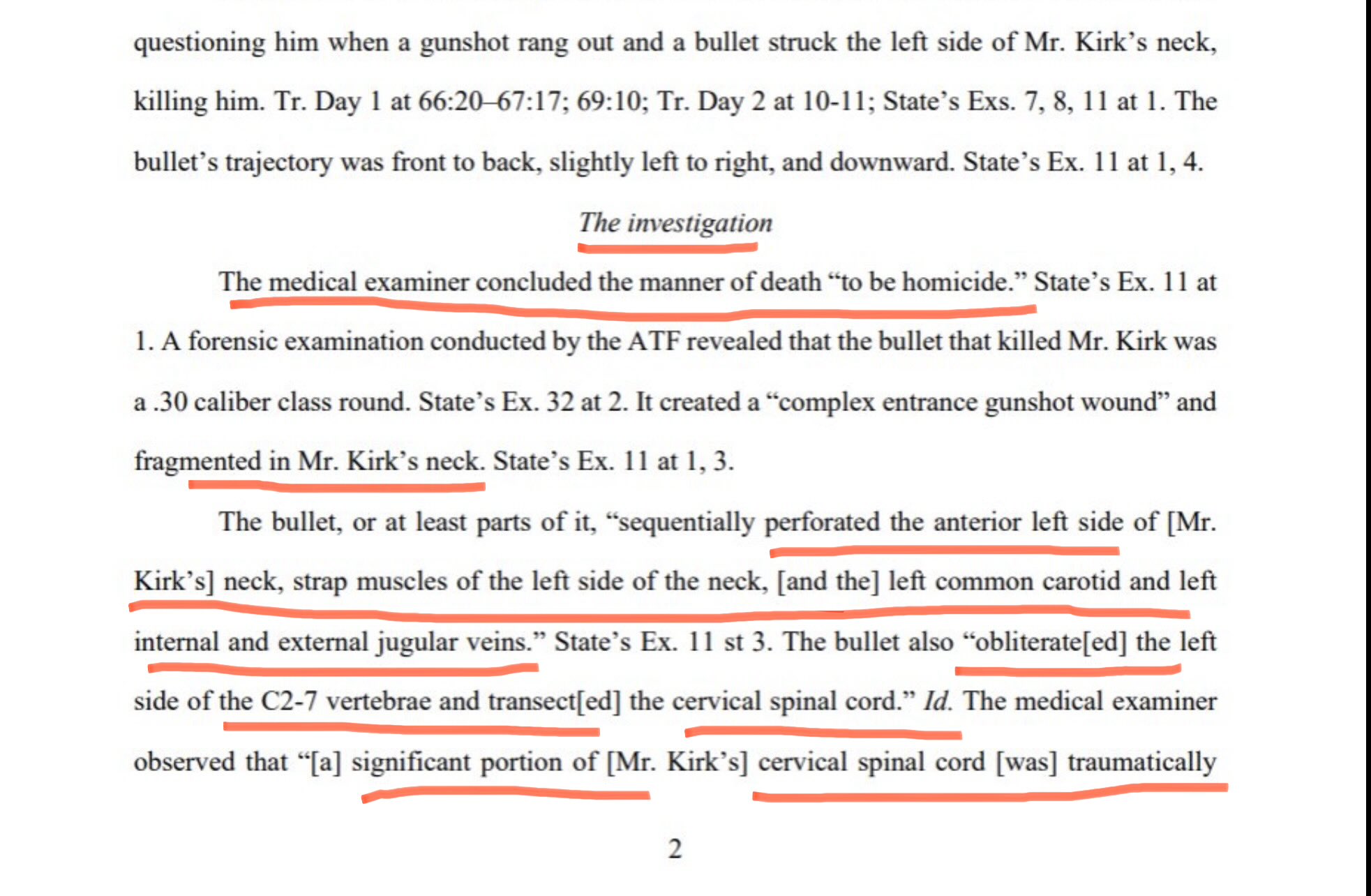
Page 2, transcribed
questioning him when a gunshot rang out and a bullet struck the left side of Mr. Kirk's neck, killing him. Tr. Day 1 at 66:20–67:17; 69:10; Tr. Day 2 at 10-11; State's Exs. 7, 8, 11 at 1. The bullet's trajectory was front to back, slightly left to right, and downward. State's Ex. 11 at 1, 4.
The investigation
The medical examiner concluded the manner of death "to be homicide." State's Ex. 11 at 1. A forensic examination conducted by the ATF revealed that the bullet that killed Mr. Kirk was a .30 caliber class round. State's Ex. 32 at 2. It created a "complex entrance gunshot wound" and fragmented in Mr. Kirk's neck. State's Ex. 11 at 1, 3.
The bullet, or at least parts of it, "sequentially perforated the anterior left side of [Mr. Kirk's] neck, strap muscles of the left side of the neck, [and the] left common carotid and left internal and external jugular veins." State's Ex. 11 st 3. The bullet also "obliterate[ed] the left side of the C2-7 vertebrae and transect[ed] the cervical spinal cord." Id. The medical examiner observed that "[a] significant portion of [Mr. Kirk's] cervical spinal cord [was] traumatically
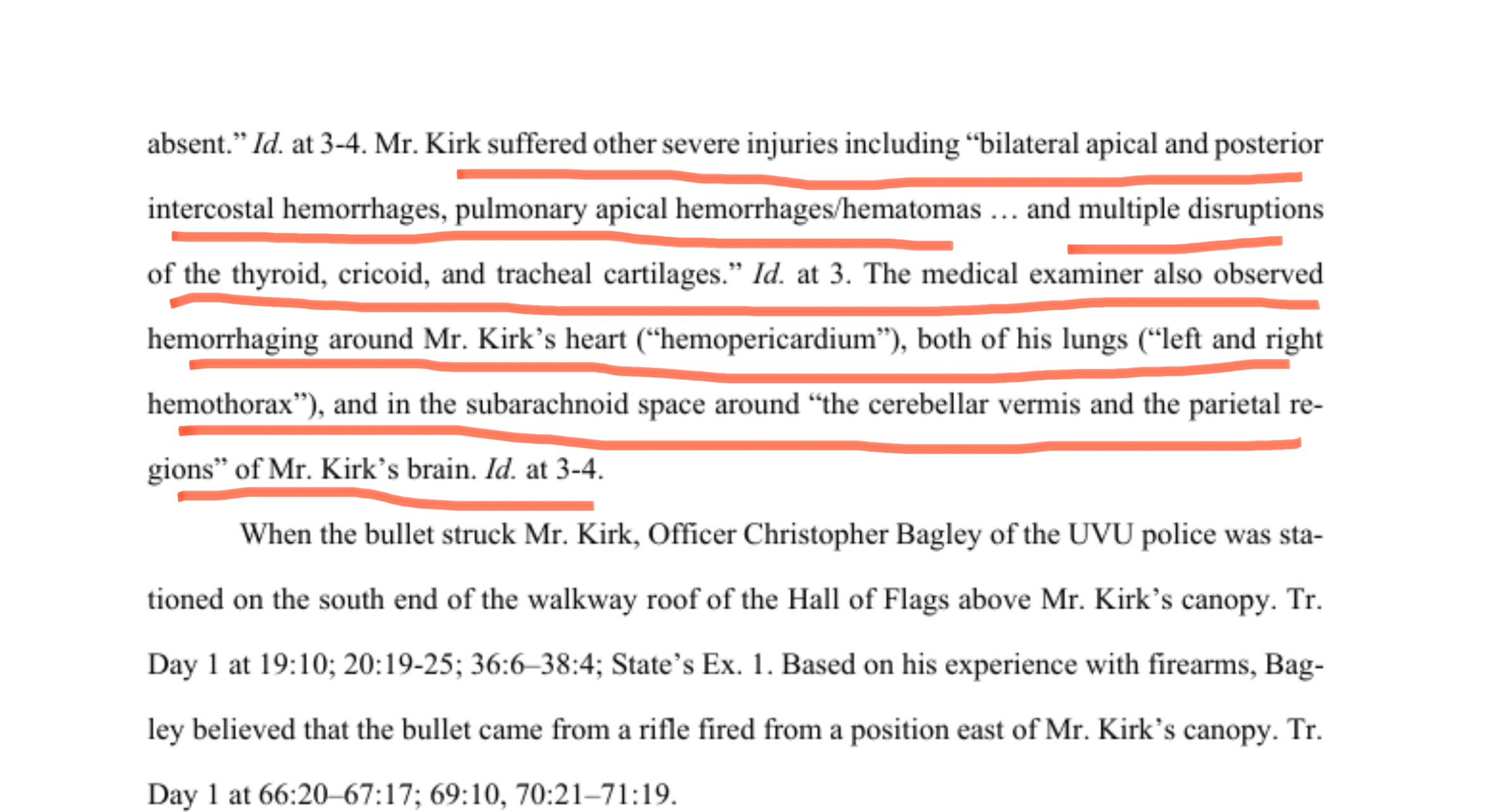
Page 3, transcribed
absent." Id. at 3-4. Mr. Kirk suffered other severe injuries including "bilateral apical and posterior intercostal hemorrhages, pulmonary apical hemorrhages/hematomas … and multiple disruptions of the thyroid, cricoid, and tracheal cartilages." Id. at 3. The medical examiner also observed hemorrhaging around Mr. Kirk's heart ("hemopericardium"), both of his lungs ("left and right hemothorax"), and in the subarachnoid space around "the cerebellar vermis and the parietal regions" of Mr. Kirk's brain. Id. at 3-4.
When the bullet struck Mr. Kirk, Officer Christopher Bagley of the UVU police was stationed on the south end of the walkway roof of the Hall of Flags above Mr. Kirk's canopy. Tr. Day 1 at 19:10; 20:19-25; 36:6–38:4; State's Ex. 1. Based on his experience with firearms, Bagley believed that the bullet came from a rifle fired from a position east of Mr. Kirk's canopy. Tr. Day 1 at 66:20-67:17; 69:10, 70:21–71:19.
(Transcribed by OCR and verified by reading the images directly. "State's Ex. 11 st 3" and "C2-7" appear as-is in the filing.)
What the point is
The poster's argument rests on putting two sentences from the same brief side by side.
| The brief says | Where |
|---|---|
| The trajectory was "front to back, slightly left to right, and downward" | Page 2, first paragraph |
| The bullet "obliterate[ed] the left side of the C2-7 vertebrae" | Page 2, last paragraph |
C7 is the lowest cervical vertebra, at roughly shoulder level. C2 is the second from the top, just below the skull. The entrance is described as the anterior left side of the neck — the front. So a projectile entering the front of the low neck on a downward path should be damaging vertebrae that get progressively lower. Instead the damage is described as running the full column up to C2.
That is the same objection a self-identified surgeon raised in comments under Candace Owens' show two days earlier — see Doctors Question the ME Report. Images 3 and 4 of this post are re-posts of those same two doctor comments, which is why they are not duplicated here.
The second half of the argument is the distance of the other injuries from the neck: blood around the heart, blood in both chest cavities, hemorrhaging in two regions of the brain. Those are catalogued in full on Charlie's Injuries and scored against competing mechanisms on Shape Charge vs Bullet.
The leaked hospital claim
Alongside the document images, the poster published a quote he attributes to Timpanogos Hospital staff:
"The doctors that worked on him had never seen anything like what killed Charlie. They all believe it was some kind of specialized tech. There was no exit wound, his spine was obliterated. They think it could've been some kind of small bomb that penetrated his body, and the blood that burst from his neck was from the explosion that happened within his body.
"They've seen the X-rays. They intimately know what they're talking about. The 'exploding mic' theory (or some type of small explosive) seems to be what the majority of the staff — doctors, nurses, and administrators — believe is what killed him."
— quoted by @matt82704417 on X, July 30, 2026
This quote is anonymous and at least third-hand. Under direct questioning in the replies, the poster said it reached him via a friend from a person whose job title he is deliberately withholding, and that he has held it since November 2025. It names no one, and this website has not verified it. Read it as an unverified claim about what hospital staff reportedly believe — not as a medical finding.
One detail in it does line up with the filing: the brief says the round "fragmented in Mr. Kirk's neck," which is consistent with the leak's "no exit wound." That is also completely ordinary behaviour for a fragmenting rifle round, so it does not by itself distinguish between the theories.
The "exploding mic" reference points to the theory tracked in the Mic section.
Corrections from the reply thread
Two things surfaced in the 26-post reply thread that change how the post should be read. Both are included here because they cut against the poster's framing.
1. These are not the ME report. @a_slick_dog, about two hours after the post:
"To clarify, the first 2 images are from State's brief filed 2 days ago making its case for the judge to find probable cause which quote the ME Report. They are not extracts from the report itself. I'm cautious about drawing inferences from what might be State's cherry picked [selection]."
The poster accepted the correction immediately: "Thanks Slick Dog 🙏 Yes me too." This matters because a probable-cause brief is an advocacy document — the State selects which parts of the ME report to quote. Passages that would contextualize the injuries may exist in the full report and simply not appear here.
2. The leak is third-hand. @BasedSamParker pressed the poster on his sourcing. After the poster explained the chain, Sam replied:
"So your source is allegedly a leak via a 3rd party. You should say that in the first place."
A sub-debate on CPR. Several commenters raised resuscitation as an alternative explanation for the chest findings. @isaac_semple: "There's no way any of these injuries are from CPR. That would affect your sternum, not your ribs." @signalfire41415 argued proper CPR was unlikely to have been performed at all given transport by private vehicle with no flat surface — see Charlie Trip to Hospital.
Other replies suggested an acoustic weapon, asked whether the leak is confirmed as Timpanogos (the poster: "Yes 100%"), and called for the hospital staff to be subpoenaed as witnesses. One commenter reported the post was gated behind an X age-verification prompt.
Counterpoints
Beyond the two corrections above, the standard rebuttals to the trajectory argument:
- The round fragmented. The same page says the bullet created a "complex entrance gunshot wound" and fragmented in the neck. A fragmenting round throws a diverging cone of fragments, so a single downward primary path can still drive individual fragments upward and outward. This is the direct answer to the C2 objection, and it also offers a route to the chest findings via fragment tracks.
- Temporary cavitation. High-velocity rifle rounds transfer energy into surrounding tissue, producing hemorrhage well away from the wound track. This is the conventional explanation for remote findings like subarachnoid hemorrhaging.
- "C2-7" describes a range, not a path. The phrase records which vertebrae show damage. It does not state the order in which they were struck, and does not require the projectile itself to have travelled from C7 to C2.
- The same document says rifle. Page 3 records Officer Christopher Bagley, positioned on the Hall of Flags walkway roof, believing from experience that the shot came from a rifle east of the canopy. The rooftop account and the injury list are in the same filing — see Trial & Autopsy Report.
- The ATF found a .30 caliber class round. That is a physical forensic determination, not a narrative choice.
- Resuscitation trauma remains a partial competing explanation for thoracic findings, though it was contested in the thread as noted above.
The fact underneath all of it stays the same: the full Medical Examiner report is still not public, so the public is reading a prosecutor's selection of it. See Autopsy Report Not Public and Ballistics & Wound Analysis.
X.com posts:
This website's author is @HolonCitizen on X and YouTube/@HolonCitizen. Follow me there.
Interesting
- A camera SD card was reportedly pulled within five minutes of the shot.
- A man openly carrying an air rifle through downtown Provo was reportedly never identified.
- Nobody has established what the south-door photographer captured, or whether it was handed over.