Who Was the Medical Examiner for Charlie Kirk?
The short answer
The autopsy was performed by Dr. Andrew R. Guajardo, M.D. — at the time Deputy Medical Examiner at the Utah Office of the Medical Examiner. His name was read into the record under oath at the July 2026 preliminary hearing.
The office he worked in was run by Dr. Deirdre E. Amaro, Utah's Chief Medical Examiner. She headed the office that produced the report. Court records do not show her performing the examination herself.
Both are real, ordinary, appointed public-health officials doing the job Utah law assigns them. Neither is accused of anything on this page. What follows is the story of why that answer took ten months and a courtroom to surface — and why the document they produced still is not public.
Most people arrive at this question from a search box, because the answer is genuinely hard to find. Utah has no county coroners; every violent or suspicious death in the state goes to one office in Taylorsville. Charlie Kirk was shot in the neck at 12:23 PM on September 10, 2025 at Utah Valley University, pronounced dead a short time later at Timpanogos Regional Hospital in Orem, and his body was moved to that state facility the same day. The examination began the evening of September 10 and ran into the early hours of September 11.
And then — nothing. No press conference from the examiner. No published report. No pathologist on a witness stand. For ten months the person who actually looked at the wound was, to the public, a blank.
The two names, and why people mix them up
Almost every confusion about this question comes from collapsing two different jobs into one word. "Medical examiner" is both a title for the person who runs a state office and a description of the pathologist who holds the scalpel. In this case they are two different people.
| The question people actually mean | The name | What is behind it |
|---|---|---|
| Who performed Charlie Kirk's autopsy? | Dr. Andrew R. Guajardo | Named under oath by DPS/SBI Agent David Hull at the preliminary hearing, spelled out on the record as G-U-A-J-A-R-D-O |
| Who ran the office that produced the report? | Dr. Deirdre E. Amaro | Utah's Chief Medical Examiner, in post since July 1, 2024 |
| Who explained the wound on television? | Dr. Kendall Crowns | Chief medical examiner of Tarrant County, Texas — a media commentator on this case who had no role in it |
| Who was the ME death investigator at the hospital? | Officer Bullock | Scene-side role, not the pathologist |
| Who signed the final report? | Not publicly known | The signature block has never been released |
That last row is the one that keeps this page alive. We know who did the work. We still do not have the signed page.
Dr. Andrew R. Guajardo — the man who did the examination
Dr. Guajardo is not an obscure figure once you know where to look. His career is documented in public professional records, and it is a serious one.
Training
- B.S. in chemistry, forensic science and toxicology concentration — John Jay College of Criminal Justice, New York
- M.D. — New York Medical College, Valhalla, NY, 2013
- Post-graduate pathology training — Johns Hopkins Hospital, Baltimore, 2013–2018
- Forensic pathology fellowship — New Mexico Office of the Medical Investigator, 2018–2019
Credentials and volume
- Triple board certified — anatomic pathology, neuropathology, and forensic pathology
- Approximately 2,000 patient examinations performed
- Approximately 1,000 neuropathology examinations performed
- Adjunct instructor of pathology, University of Utah School of Medicine
- Director of the University of Utah forensic pathology fellowship
The neuropathology certification is worth pausing on, and it is one of the few genuinely useful facts in this whole story. A neck wound that reportedly obliterated the cervical spine from C2 to C7 is, anatomically, a spinal-cord question as much as a ballistics question. The office did not hand this case to a generalist. It handed it to one of the few forensic pathologists in the state who is separately board-certified to read nervous-system tissue. That cuts directly across the missing spinal cord question and the trajectory versus C2–C7 damage dispute — whatever the report says about the cord, it was written by someone qualified to say it.
Dates: when he started at the Utah office, and when he left
| Date | Event |
|---|---|
| 2019 | Joins the Utah Office of the Medical Examiner as Assistant Medical Examiner |
| 2024 | Promoted to Deputy Medical Examiner — the number-two forensic post in the office |
| Sept 10–11, 2025 | Performs the Charlie Kirk autopsy at the state facility in Taylorsville |
| March 11, 2026 | Dutchess County, New York announces his appointment as its Medical Examiner |
| March 23, 2026 | Starts in New York. Roughly six months and thirteen days after the autopsy |
| July 2026 | His name is read into the Utah record at the preliminary hearing. He is not there |
He had been at the Utah office for about six and a half years when he left. Dutchess County Executive Sue Serino announced the appointment on March 11, 2026, and Dr. Guajardo's own statement on the appointment was gracious and unremarkable: "I am honored to serve as Dutchess County's Medical Examiner, and I thank County Executive Serino for this appointment."
Changing jobs is completely ordinary. Forensic pathologists move between offices constantly — the field is roughly half the size it needs to be nationally, and a triple-boarded neuropathologist can write his own ticket. A promotion to a county chief medical examiner post is a step up, not a flight. Nothing about this move is evidence of anything.
The narrow, legitimate observation is this: the only pathologist ever named on the record as having examined Charlie Kirk's body was, by the time of the hearing that decided whether Tyler Robinson would stand trial for capital murder, 2,000 miles away and no longer employed by the office holding the sealed report — and he was never put on a stand and asked a single question. That is a transparency problem, not an accusation. It sits alongside the other departures catalogued at Medical Staff Changes and Institutional Resignations.
Dr. Deirdre E. Amaro — the chief who ran the office
77-second clip in which Candace Owens reports on her show that Dr. Deirdre Amaro has resigned as Utah's chief medical examiner. Presented as attributed commentary, not as a confirmed fact. Source: @ProjectConstitu on X, July 27, 2026.
When someone says "Utah's medical examiner," they usually mean Dr. Deirdre E. Amaro — sometimes written Deirdre Weiss Amaro in online discussion. She is the state's Chief Medical Examiner and the head of the statewide Office of the Medical Examiner (OME), an operation of roughly fifty staff covering investigations, recruiting, and operations for the entire state.
Her documented career record:
- M.D., 2009 — Sidney Kimmel Medical College at Thomas Jefferson University
- 2009–2013 — Residency in anatomic and clinical pathology, UC San Diego
- 2013–2014 — Fellowship in forensic pathology, University of New Mexico Office of the Medical Investigator
- 2014–2016 — Fellowship in neuropathology, UC San Diego
- Board certified in anatomic/clinical pathology, forensic pathology, and neuropathology — commonly described as quadruple board-certified
- ~2016 — Forensic pathologist, Shasta County, California
- Then Missouri — Chief Medical Examiner for Boone and Callaway Counties, and faculty at the University of Missouri in Columbia
- May 9, 2024 — Utah DHHS announces her hire
- July 1, 2024 — Begins full-time in-person work as Utah's Chief Medical Examiner
She succeeded Dr. Erik Christensen, who retired after nearly sixteen years at the office — first as a deputy, then as chief from 2016. The office earned National Association of Medical Examiners accreditation around the time of the transition.
Note the pattern: both the chief and the pathologist who did this autopsy are fellowship-trained neuropathologists. That is unusual and it matters more than any rumor on this page.
Publicly, Dr. Amaro has talked about the physically demanding reality of autopsy work, about death investigation as a public-health instrument — tracking overdose and suicide trends — and about the work ultimately serving the living. Interviews and a 2025 podcast describe someone splitting her time between hands-on forensic work and running an office.
The start-date confusion, resolved
Investigation notes across this site have carried two start dates for Dr. Amaro — July 1, 2024 and July 1, 2025 — and the discrepancy mattered, because a chief who had been in post for two months when a president's-level assassination landed on her desk reads very differently from one who had been there fourteen months.
It is 2024. Utah DHHS announced the hire on May 9, 2024 and stated she began full-time in-person work on July 1. By September 10, 2025 she had been running the office for fourteen months. The "brand new chief" framing that circulates online is wrong.
The reported resignation, and the fact that cuts against it
On July 27, 2026, @ProjectConstitu circulated a Candace Owens clip — the video above — reporting that Dr. Amaro had resigned, with no reason given beyond "moving on." Spellings vary across posts ("Deedra," "Deidre"). The claim traveled fast because it fit an existing pattern of departures.
Here is the counterweight, and it belongs on the page just as prominently: Utah DHHS organizational charts as of May 2026 still listed her in the role, and no state announcement of a departure has appeared in news coverage. The resignation claim is attributed commentary that this site has not been able to confirm. It may be true. It is not established.
Resigning a state post is lawful and ordinary and is not evidence of anything. Full treatment: Dr. Deirdre Amaro.
What the examiner actually found
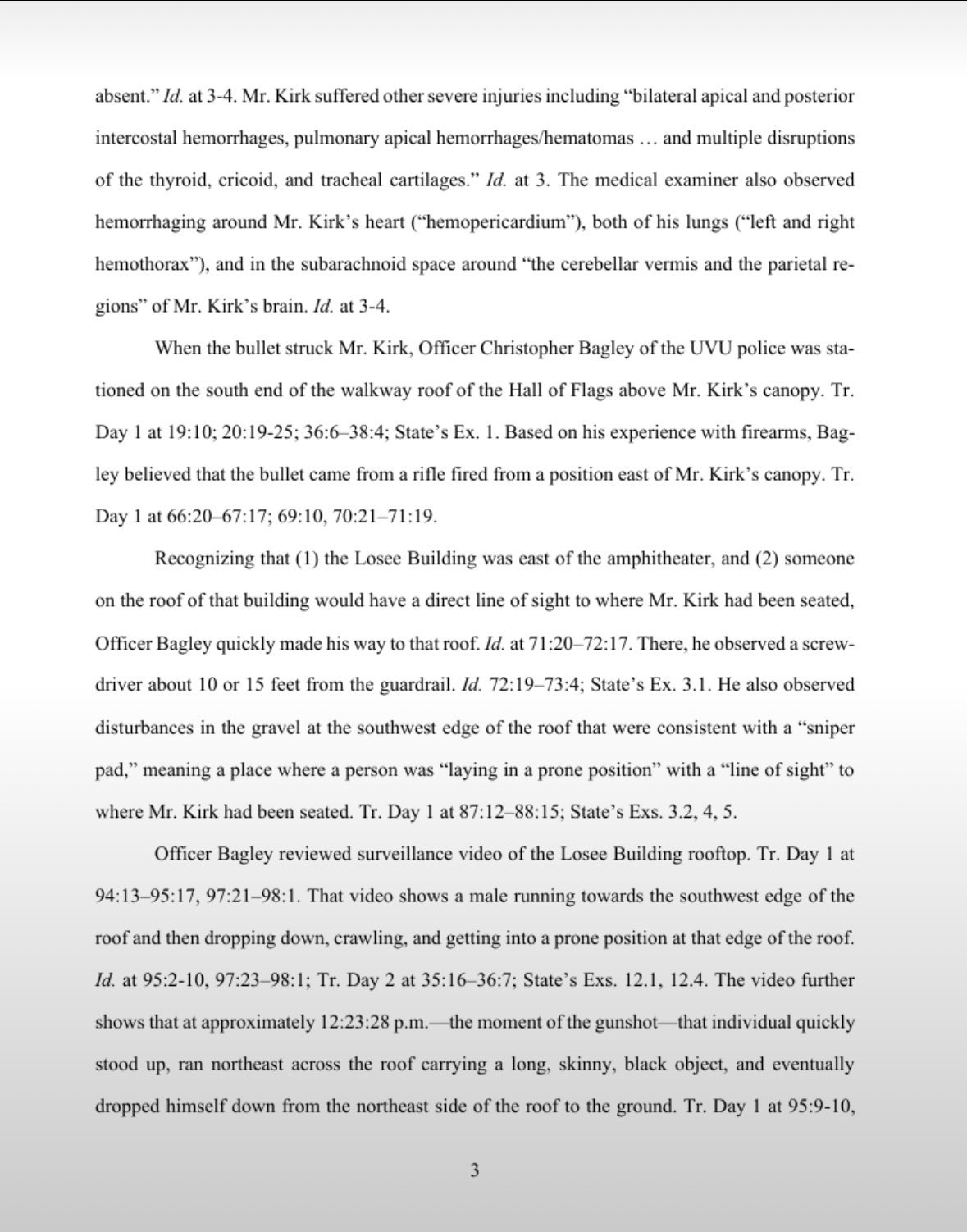
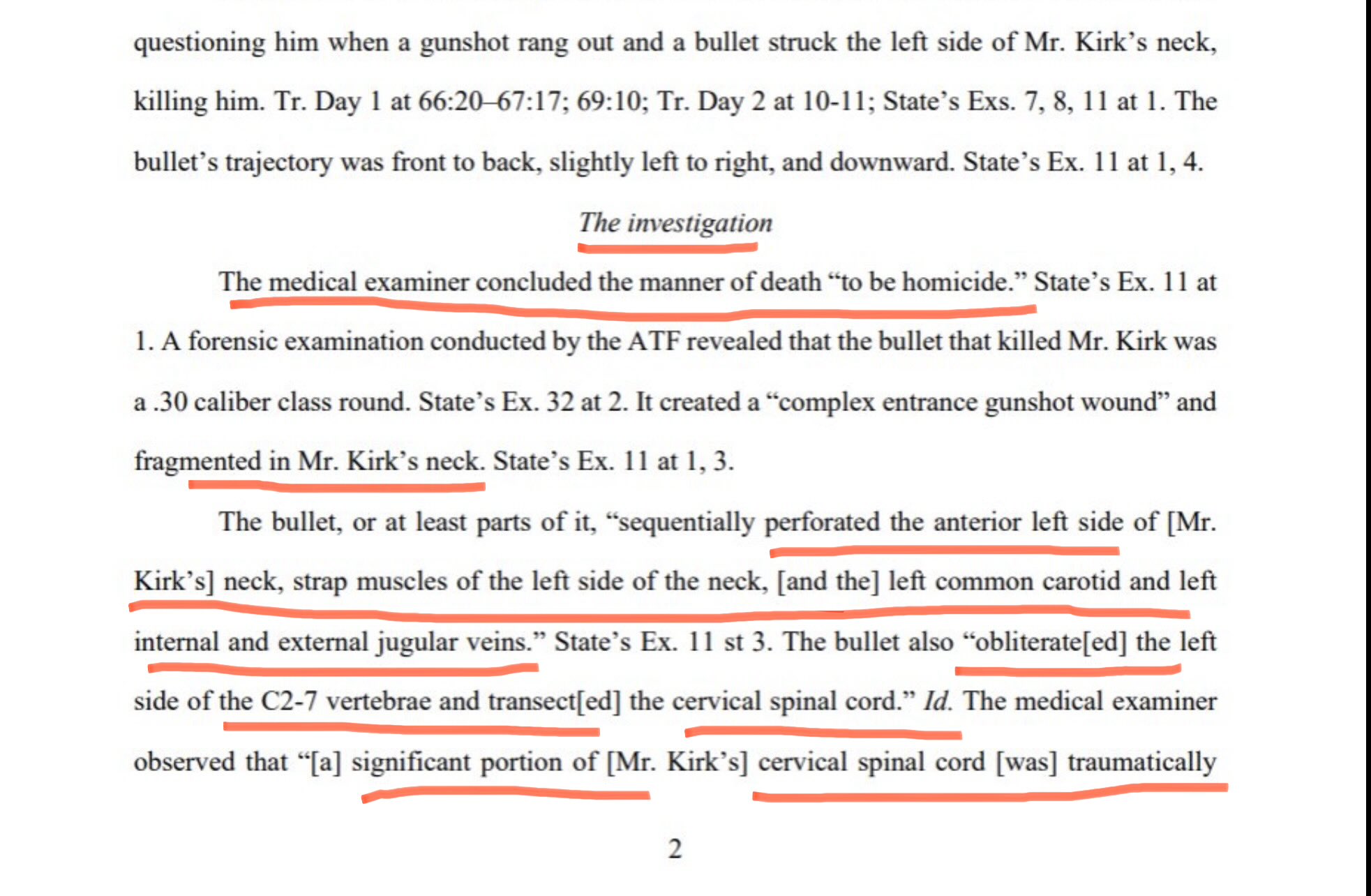
A court filing quoting the medical examiner's findings, followed by Officer Bagley's rooftop account. Source: @thisauthentic on X.
The report runs to nine pages. It was admitted at the preliminary hearing as State's Exhibit 11. Two lines from it are all the public firmly has:
- Manner of death: homicide.
- Cause of death: gunshot wound of the neck.
Bullet fragments recovered during the examination were sent to the ATF for analysis — the analysis that came back with a .30-caliber class finding and, on the jacket comparison, an inconclusive match to the recovered Mauser. Downstream filings quote the report describing a complex entrance wound, fragmentation, a downward trajectory, and destruction of the cervical spine from C2 to C7.
Everything else is sealed. Utah statute keeps autopsy reports out of the public record; they go to next of kin, law enforcement, a legal representative, and an attending physician — nobody else. The judge additionally barred publication of the exhibit out of respect for the family's privacy.
That is why every medical page on this site is a map of questions rather than a diagnosis. See Charlie Kirk Autopsy Report for the whole event, Charlie Kirk Medical Examiner Report for the document itself, Autopsy Report Not Public for the sealing, Charlie's Injuries for the injury list quoted in filings, and Trial & Autopsy Report for how it played in court.
The hearing where the name finally surfaced — and the examiner who wasn't there
On July 6–7, 2026, at Tyler Robinson's preliminary hearing in Utah's Fourth Judicial District before Judge Tony F. Graf Jr., the autopsy came into evidence — through Agent David Hull of the Utah State Bureau of Investigation, major crimes division.
Not through a pathologist. Through an investigator reading someone else's report.
Utah Rule of Evidence 1102 permits "reliable hearsay" at preliminary hearings, which is why this was legal. It is also why it happened. Prosecutor David Surgill walked Hull through the document. The exchange that produced the name went like this:
- An autopsy was conducted by the Utah Medical Examiner's Office.
- Timing: late evening September 10, 2025, possibly into September 11.
- Hull and Agent Davis met the doctor who conducted it, at the Medical Examiner's Office, within a few days.
- Asked who performed it, Hull checked his notes for the pronunciation and answered: "Dr. Guajardo, I believe is how it's pronounced."
- Spelled on the record: G-U-A-J-A-R-D-O.
Defense counsel Kathryn Nester fought it, and her objection is the cleanest statement of the problem anyone has made:
"This is an expert report without an expert present."
Without the pathologist on the stand, she argued, the defense could not test the credibility of the evidence or cross-examine anyone about it. Judge Graf overruled the hearsay objection and admitted Exhibit 11.
Nester won a smaller point that is worth keeping. Hull initially testified that the report gave the cause of death as "murder." Nester objected: "It's not stated as a murder. I believe it's stated as a homicide, which is an important distinction." The judge sustained it. Hull re-read the document and corrected himself: "Yes, I misspoke. It does say homicide."
The distinction is real and not pedantic. Homicide means one person killed another. Murder implies malice and is a legal conclusion a jury reaches, not a finding a pathologist makes. A medical examiner never writes "murder." That a state investigator read it that way from the stand, in a capital case, is exactly the sort of thing cross-examining the actual author would have caught in seconds.
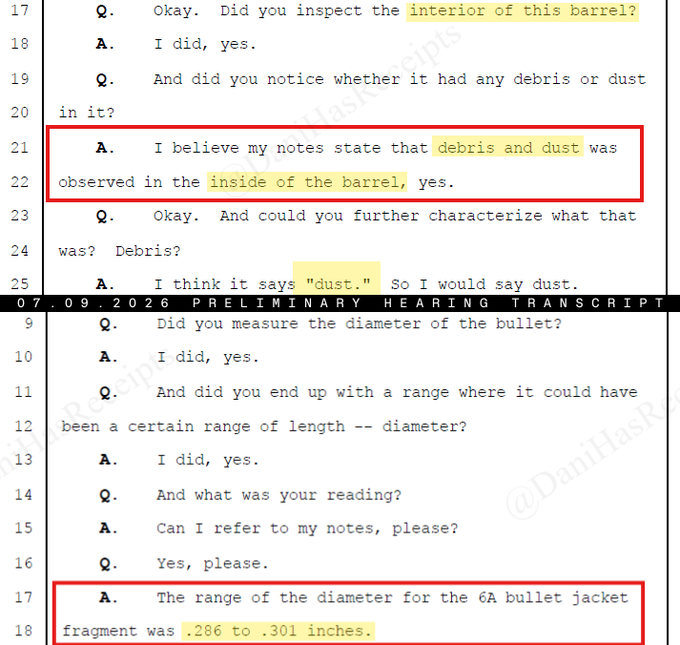
Day-by-day record: Preliminary Hearing and Day 1.
The examiner who went on television was from Texas
Here is where a lot of the public's confusion about "who was the medical examiner" was manufactured rather than found.
Dr. Kendall Crowns, chief medical examiner of Tarrant County, Texas, appeared in national media explaining that a neck gunshot of this kind would be catastrophic. He is a legitimate expert with a legitimate office. He also did not perform this autopsy, did not see this body, and has no connection to the Utah case.
For months, the face and voice attached to "what happened to Charlie Kirk's neck" belonged to a man in another state working from public reporting — while the Utah pathologist who actually did the examination stayed silent, and then moved to New York.
Dr. Crowns has done nothing wrong. The criticism, raised by accounts including @fratercrc, is about message control: a nationally consequential wound was narrated by a convenient booking rather than by the person holding the file. Catalogued at Autopsy Sealed and Performing Examiner Kept Out of View and Doctors Question the ME Report.
Names that are not the medical examiner
The vacuum pulled in other names. They should be kept out of the answer to this question.
Officer Bullock — death investigator
Hull testified that a medical-examiner death investigator, Officer Bullock, was at Timpanogos when Kirk was pronounced and relayed that fact. A scene-and-hospital interface role — not the pathologist.
Angela Hammond — unverified
Some citizen notes assert an examiner by this name was newly appointed in September 2025. No official record supports it. Open and unconfirmed: profile.
The "mystery woman who signed off"
A secondhand private-message claim, relayed July 2026, that an unfamiliar person signed the report while it was still a draft. Uncorroborated, and no name was ever produced. Handled carefully at Mystery Woman Who Signed Off and Death Certificate.
The hospital doctors
No treating physician or nurse has been publicly named. That is a separate transparency gap and it belongs on Doctors, Hospital Leader, and Military Backgrounds — Staff, not on the examiner's signature line.
There is one more category worth naming plainly. Threads circulate that build identity-based narratives out of Dr. Amaro's medical school, or that speculate about her private life. This site does not carry either. Where someone went to medical school is a credential, not a motive, and a living official's private life is not investigative material. The questions worth asking here are about documents and testimony, and they are all still unanswered without any of that.
The hospital side of the same day
The medical examiner received a body. Everything that happened to Charlie Kirk before that happened somewhere else, and the transport decisions are their own unresolved story: an SUV rather than an ambulance, 5.8 miles to a Level IV facility past a closer Level II trauma center.
3 minutes 2 seconds. An unidentified woman who says she formerly worked at the hospital asks why Charlie was taken to a Level IV centre past a Level II, and raises the surgeon's specialty. Anonymous and uncorroborated. Source: @VLuvMully on X.
Follow that thread through Charlie's Trip to Hospital, Hospital Choice and Transport, Emergency Response, Hospital Scene and EMS, and Events at Hospital.
A second cluster of claims — all anonymous, all unverified — says the Timpanogos ER was cleared hours before the shot: patients moved to another wing, transferred to another hospital, buses or shuttles, files moved with them, and a Kirk chart appearing before 12:24 PM. Alongside those sit the 911 call claims, the surgeon reportedly warned before surgery, the security cameras and the FBI, and the bullet claims attributed to hospital staff.
None of it is established. All of it would be settled instantly by records nobody has produced.
Why this question is so hard to answer, in five steps
- Utah seals autopsy reports by statute. The public was never going to get the document by default.
- The judge additionally barred publication of Exhibit 11 for family privacy — reasonable, and also a second lock.
- Rule 1102 let the State skip the author. An investigator read the report; the pathologist never appeared. No cross-examination, no signature block, no name on camera.
- The performing pathologist left the state six months after the examination, before the hearing that used his work.
- The information vacuum filled itself — with a Texas examiner on television, with a "no autopsy happened" viral claim that was flatly false, and with invented names.
The result: a nationally consequential death whose medical file exists, was examined by a well-qualified specialist, was accepted by a court — and which the public can only read through a prosecutor's paraphrase.
What would actually settle it
- The full nine-page report, including the signature block.
- Any draft versions and the chain of who reviewed and signed.
- Sworn testimony from Dr. Guajardo himself, subject to cross-examination.
- The complete injury list, so Charlie's Injuries, Ballistics & Wound Analysis, the shape charge versus bullet comparison, the missing spinal cord question, and the wound analysis theories can be tested against the record instead of against each other.
- The death certificate and its signer: Death Certificate.
Laws (Charlie Kirk)
The identity and CV of every pathologist and signer on the Charlie Kirk medical examiner report, the full signed report, and any draft versions are among the things the Charlie Kirk Investigation Laws may result in powerful truths coming out that aren't out yet. See also Medical Examiner Transparency and the Utah statutory backdrop at Utah Autopsy Law (SB0082) and Autopsy Law SB0082.
The rest of the medical record on this site
- Investigation Index
- Death Timeline
- Medical Examiner
- Charlie Kirk Medical Examiner Name
- Charlie Kirk Medical Examiner Report
- Charlie Kirk Autopsy Report
- Autopsy Report Not Public
- Autopsy — subsection
- No-Autopsy Claims
- Medical Examiner & Surgeons
- Trial & Autopsy Report
- Doctors Question the ME Report
- Witness Account Conflicts
- Lapel Mic & Audio Theories
- Timpanogos Facility
- Hospital — subsection
- Medical Staff Changes
- Doctor DC Phone Call
- Israel Searches for Medical People
- Site Changes / Paving
- Charlie's Injuries
- Ballistics & Wound Analysis
- Shape Charge vs Bullet
- Trajectory vs C2–C7
- Missing Spinal Cord Question
- Utah Autopsy Law (SB0082)
- Cause of Death
- Cover Up (Possible)
Sources
- Dutchess County — Sue Serino Appoints New Medical Examiner — March 11, 2026 appointment announcement, Utah service dates, credentials
- New York Medical College — alumni profile of Andrew R. Guajardo, M.D. '13 — career timeline, case volume, fellowship directorship
- Utah DHHS — welcomes new medical examiner — Amaro hire, July 1, 2024 start, Christensen succession
- KSL — Videos, medical examiner's report submitted at Robinson prelim despite flurry of hearsay objections — Nester objection, Judge Graf ruling
- ABC4 — Investigators testify, video played during preliminary hearing
- Focal Points — Medical Examiner's Conduct in the Tyler Robinson Trial — August 3, 2026, on the examiner's absence from court
- Utah Office of the Medical Examiner — office, fellowship program
Citizen commentary referenced above: @stratagemmer (Guajardo spelling from the transcript), @fratercrc (Crowns critique), @lindseey_loo (signed-off allegation), @ProjectConstitu and Candace Owens (reported resignation).
Related Areas
This website's author is @HolonCitizen on X and YouTube/@HolonCitizen. Follow me there.
:::caution Legal Disclaimer Nothing on this page is a finding of wrongdoing, criminal conduct, ethical violation, or participation in any crime by Dr. Andrew Guajardo, Dr. Deirdre Amaro, Dr. Kendall Crowns, or any other living person named here. Every person named holds or held an ordinary professional or public office, and appears here only because of that role, sworn testimony, or public commentary. Claims labelled unverified are unverified. All persons are presumed innocent; Tyler Robinson is charged, not convicted. :::