Explosive Residue — Transfer, Trapping and Recovery from Fabric
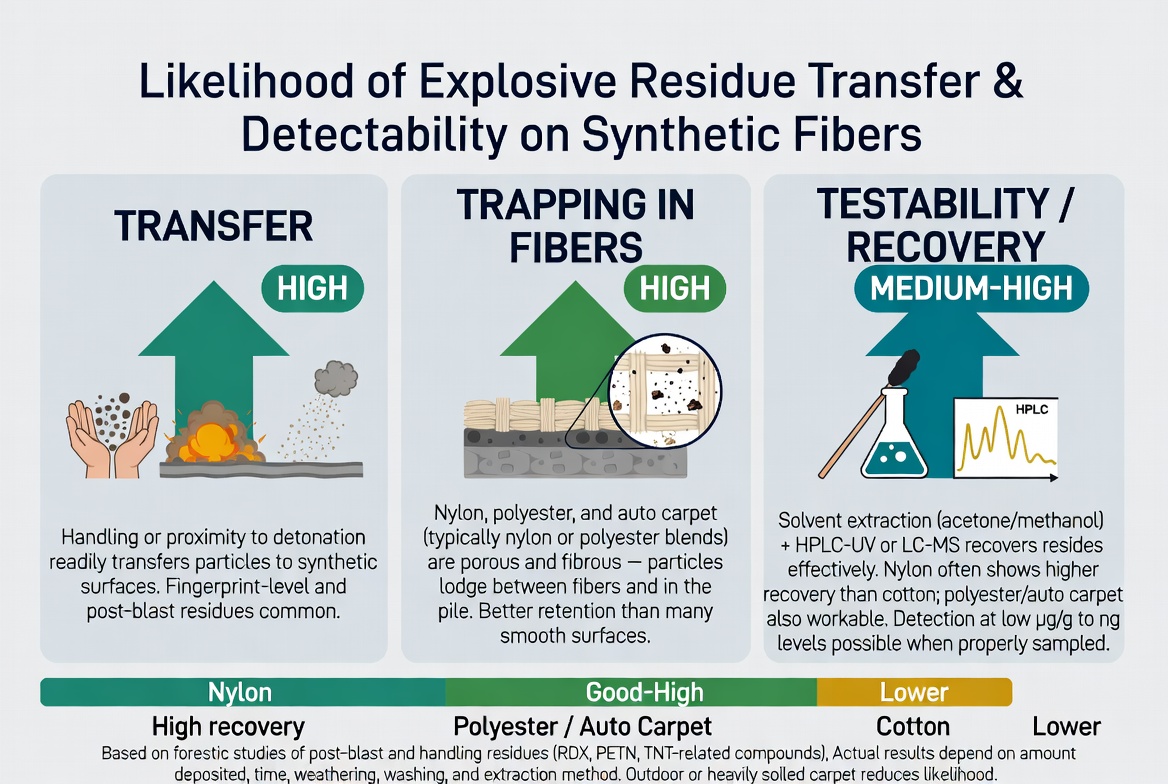
Transfer, trapping and recovery of post-blast residue on synthetic fibers, summarizing published forensic studies. Posted by @jonaaronbray on X, July 31, 2026. IPFS CID QmfGsfEeW5c6M5y1ivwrgd3psaqjGyAD2iUc44ZWGVnNSq.
If a high explosive functioned on Charlie Kirk's chest, the single most decisive question is not what anyone saw — it is what stayed on the cloth. Post-blast residue is not fragile trace evidence that vanishes in an afternoon. It transfers readily, it lodges in synthetic fiber, and it comes back out under solvent extraction at concentrations laboratories routinely quantify.
The claim, as posted
According to @jonaaronbray on X, July 31, 2026, summarizing the published literature:
"Residues of military/high explosives (e.g., RDX, PETN, TNT-related compounds) have been detected on fabric after detonations or simulated post-blast conditions. One HPLC study recovered RDX at low concentrations (around 3–4 μg/g) from nylon and cotton cloth exposed in post-blast scenarios; recovery varied strongly by fabric type (better from nylon than cotton; none from denim in that work)."
That last clause matters as much as the headline. Recovery is fabric-dependent, and the study he cites recovered nothing at all from denim. Any argument built on residue testing has to say which garment, made of what.
What the graphic says
The infographic posted with that text breaks the question into the three stages a forensic chemist would separate. Its own text, as posted:
- Transfer — rated HIGH. "Handling or proximity to detonation readily transfers particles to synthetic surfaces. Fingerprint-level and post-blast residues common."
- Trapping in fibers — rated HIGH. "Nylon, polyester, and auto carpet (typically nylon or polyester blends) are porous and fibrous — particles lodge between fibers and in the pile. Better retention than many smooth surfaces."
- Testability / recovery — rated MEDIUM-HIGH. "Solvent extraction (acetone/methanol) + HPLC-UV or LC-MS recovers residues effectively. Nylon often shows higher recovery than cotton; polyester/auto carpet also workable. Detection at low μg/g to ng levels possible when properly sampled."
The ranking strip along the bottom runs nylon (high recovery) → polyester / auto carpet (good–high) → cotton (lower). The graphic's own footer carries the caveat: it is "based on forensic studies of post-blast and handling residues (RDX, PETN, TNT-related compounds)," and "actual results depend on amount deposited, time, weathering, washing, and extraction method. Outdoor or heavily soiled carpet reduces likelihood."
Why auto carpet is on that list
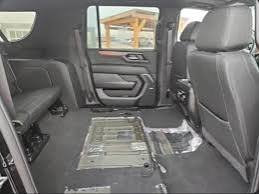
SUV interior. Vehicle floor covering is typically a nylon or polyester pile — the second-best substrate on the chart. Posted by @jonaaronbray on X, July 31, 2026. IPFS CID QmPLRmfGspN3sPz9SBdBrty8v6nF9pVCY6BtjsfXBpUdNN.
The inclusion of auto carpet is not incidental to this investigation. Kirk was carried into a transport SUV and driven from the venue. Vehicle floor covering is a deep synthetic pile — by the chart's own ranking, one of the better substrates for trapping and later recovering particulate. The interior of that vehicle is the subject of the SUV photos page, the burnt object page, and the custody question page. According to those accounts the vehicle was towed, cleaned, and placed on a path to resale rather than held as a long-term forensic shell. No residue result from that vehicle has been made public.
The same logic runs through the rest of the Removing Explosive Residue Cover-Up section: the security detail's clothing, reportedly seized by federal agents; the soil under the tent, stripped and then sealed under pavers; the necklace. Each is an ordinary step taken alone. The question raised is about the set, and about the absence of a single released test result.
What a test would actually settle
The method is not experimental. Swabs or fabric cuttings go into an acetone or methanol extraction; the extract runs on HPLC-UV or LC-MS against a reference library of known explosive compounds. The result is close to binary. A positive across the seized clothing, the shirt, the vehicle carpet or the soil would confirm what investigators have concluded and reframe the entire case. The test is cheap, standard at any federal laboratory, and — on the public record as it stands — has not been reported either way.
What is not established
- No explosive residue test result has been publicly released for any item connected to September 10, 2025.
- The recovery figures above come from published post-blast studies, not from any item in this case. The 3–4 μg/g RDX figure describes laboratory and simulated post-blast cloth, not Kirk's shirt.
- Collecting clothing and towing a vehicle are normal homicide procedure. Nothing here establishes wrongdoing by any FBI employee, by any member of the security detail, by TPUSA, or by any other named person or organization. Nothing indicates anyone on the security or AV team knew of any device.
- The government's narrative is a rifle gunshot wound. Most citizen investigators have concluded the cause was an explosive at the microphone; this page documents why the residue test matters. See the Mic hub.
The Shards Themselves, On Video
The physical debris this page's residue question orbits around has also been claimed on film: an August 2026 slow-motion clip by @ProjectConstitu shows what the poster identifies as exploded black plastic pieces falling from underneath Charlie's shirt as he collapses — argued to be shrapnel from the mic transmitter on his belt. If those fragments were recovered, they would be the most direct residue-test candidates of all. Video and write-up: Black Shards Falling From Charlie Kirk's Shirt.
X.com posts:
- Explosive residue recovery from fabric — RDX, PETN, TNT
- Black shards fall from under Charlie's shirt, slow-motion
Interesting In This Area
- One HPLC study pulled RDX at three to four micrograms per gram from nylon.
- That work recovered nothing from denim, so garment type decides the test.
- The clothing and the soil were both testable objects.
- Auto carpet retains particles well, which matters for the SUV cabin.
Other Pages In This Section
"Get That Off Of Him" — Alleged 911 Call Audio Tip
A line reportedly caught on a 911 call from the vehicle: "get that off of him." The clip is unverified and the poster does not say what "that" was — which is exactly why it keeps circulating.
Read this
RØDE Wireless PRO — The Microphone on Kirk's Shirt
The RØDE Wireless PRO on Kirk's shirt: what the hardware actually is, how it mounts, and how large the transmitter body is. Every device theory on this site has to fit inside those dimensions.
Read this
Several witnesses told reporters within minutes that Charlie Kirk was shot in the chest. Candace Owens argues those descriptions never matched the visible neck wound.
Read thisLandscaping Crew Replaced Dirt With Cement / Pavers
Soil was hauled out of the tent courtyard and pavers went down over the exact spot where Charlie Kirk fell. If that ground would have shown residue, it is gone.
Read thisThis website's author is @HolonCitizen on X and YouTube/@HolonCitizen. Follow me there.
More angles in this section
Transfer math only matters if someone still has a testable surface; the residue cover-up hub walks item by item through clothing, soil, the necklace, and the transport vehicle. Chemistry context for what a lab would swab for sits on the high explosive (RDX / PETN / TNT) page, while the burnt object in the SUV and broader SUV Candace photos ask whether transmitter debris and carpet still exist. Device-origin hypotheses that would create that residue start with the RØDE Wireless PRO and video frame analysis, with Canon XA55 audio as the acoustic counterpart. If the fatal energy was on the chain rather than the lapel, see exploding pendant and mic vs pendant. Alleged post-shot language about removing something from the body is on the "get that off of him" 911 tip page, and procurement timeline context remains on the DoD contract and AES factory explosion pages.
Interesting
- The mic pack's whereabouts are unaccounted for after people went over the table.
- A foreign-interference probe was reportedly snuffed out within six days.
- A FARA filing for Israeli messaging work landed eight days after the shooting.
Related Areas
- The SUV That Was Destroyed
- Ten Inches of Dirt Removed
- Mic as Explosive — Cover-Up Side
- Charlie Kirk's Security Team
- Candace Owens — Investigation Coverage
- Medical and Wound Analysis