Mic Explosion — Video Frame Analysis
Independent video analysts, including Jon Bray (@jonaaronbray), argue that Charlie Kirk was not killed by the alleged .30-06 rifle shot attributed to Tyler Robinson but by an explosive event originating from the RØDE Wireless PRO transmitter clipped to Kirk's shirt. Their analysis uses frame-by-frame review of multiple camera angles; Canon XA55 audio independently reports a stage detonation separate from a distant muzzle blast. Compare Mic vs Pendant for the competing crucifix theory.
Satirical LEGO-animated music video referencing Charlie Kirk's RØDE mic, via @RickyTheGuido, July 24, 2026. IPFS CID Qmd6zPTaBkhDSqCA9nEVrx1e7JsgAEUV7qSDu1pGELiPZJ.
The Key Camera Angles
The most significant evidence comes from two high-quality video sources:
- "Cub's" 60fps camera — a high-frame-rate side-angle recording that captures the event in slow motion. The high frame rate provides sub-frame resolution of the sequence of physical events.
- "Mark's" 30fps camera — a separate camera from a different angle, providing independent confirmation of the physical sequence visible in Cub's footage.
The convergence of observations across two independent high-quality angles makes this analysis significantly more robust than single-source assessments.
The Physical Sequence Captured on Video
According to Jon Bray's analysis, the frame-by-frame review reveals the following sequence:
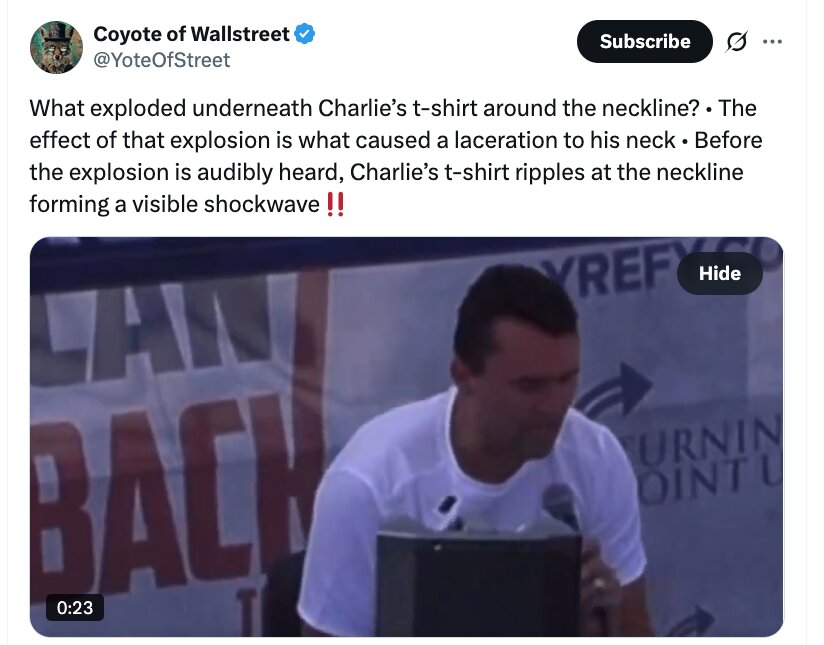
1. Shirt deformation precedes wound appearance. An outward, omnidirectional expansion of fabric and air originating from the chest/mic position is visible before any expected rifle-shot wound signature appears. A high-velocity rifle round (.30-06 at 2,700+ fps) would produce directional kinetic energy transfer — the entry wound appears, then the body reacts. The footage instead shows a spherical outward pressure wave consistent with an explosive overpressure event.
2. The magnetic clasp becomes a projectile. A black rectangular object — matching the size and shape of the RØDE Wireless PRO's magnetic clasp — is visible being ejected from/through Kirk's neck area. In at least two different camera angles, this object is seen falling out of the neck wound area, followed by the heaviest blood flow observed in the footage. The shape and trajectory of the object are inconsistent with a rifle round or secondary fragmentation from a rifle strike.
3. No ballistic signatures from a rifle round. Using optical flow and vector mapping analysis on high-resolution footage, Bray claims zero evidence of supersonic shockwave, cavitation, yaw, or directional tissue displacement consistent with a ~2,700+ fps rifle round. All motion radiates spherically from the mic location — consistent with blast overpressure from a confined explosive device.
4. Timing mismatch. The chest/mic event — the outward fabric deformation — clearly precedes the appearance of the neck wound in the footage. A single high-velocity rifle shot cannot explain an injury sequence where the chest reacts before the alleged neck impact point shows any disruption.
The "Pulls Shirt" Sequence
Multiple observers described a phenomenon visible in the footage: as Kirk falls, the shirt appears to be pulled or "pinched" upward in a diagonal path from the mic pack location toward his neck. According to Bray's analysis, this trajectory is consistent with a shaped-charge blast propagating from the left-side mic pack upward under the fabric — not consistent with an external impact from a rooftop 200+ feet away.
The sequence as analyzed:
- Blast originates at the left-side mic receiver pack on Kirk's belt
- Detonation occurs under the shirt fabric
- An object (the magnetic clasp or device fragment) is propelled upward, creating the characteristic "pinched" effect on the shirt as it moves toward his neck
- The object exits through the neck area and falls back down under the shirt
- The object tracks diagonally across his chest before coming to rest at the lower right
This is the "explosive path" that Bray describes in his public analysis posts.
No one on stage needed to know
We assume that every TPUSA employee and every audio-visual contractor working at UVU that day had no knowledge of any explosive that may have been in the mic, even if they handled the mic. Nothing indicates anyone on the security or AV team knew of any device. A remotely triggered device would not require anyone on the stage to know about it.
Why the 30-06 Narrative Doesn't Explain the Video
The official narrative requires a .30-06 round — carrying approximately 3,950 Joules of muzzle energy — to produce the injury seen in the Kirk footage. As Rob O'Neill and Brig. Gen. Holt confirmed, that energy level does not produce the observed shirt behavior. A .30-06 round travels at 2,700+ fps and transfers kinetic energy directionally. At range, it would produce a clean entry followed by a catastrophic exit wound — visible on the footage as a linear event, not a spherical expansion.
The observed fabric behavior — omnidirectional expansion from the mic position, no linear vector, everything radiating from one point — is not physically consistent with an external rifle projectile. It is consistent with a small internal explosion.
Jon Bray's Lab Replications
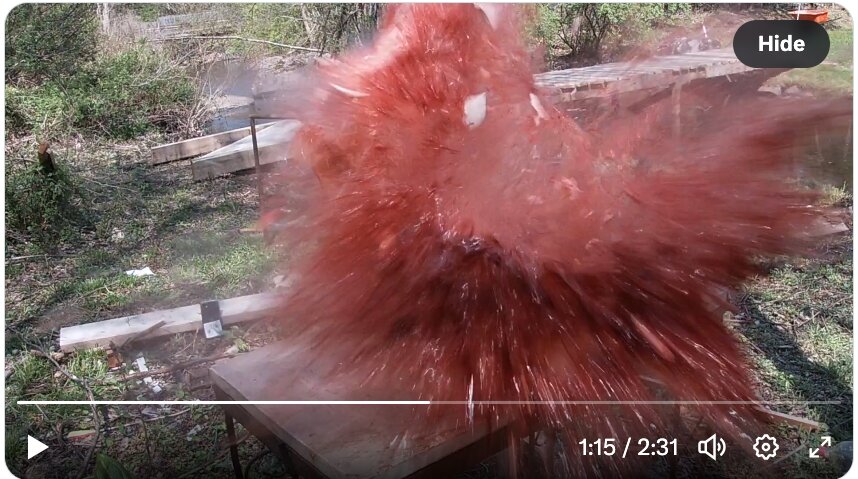
Jon Bray (@jonaaronbray) has conducted and documented attempts at physical replication of the observed shirt behavior using controlled explosive charges of comparable scale. These replications are intended to demonstrate that a small shaped charge of the type that could be concealed in audio equipment produces visual signatures consistent with what the video shows — and that a rifle round at distance does not.
The replications require proper explosives licensing and were conducted with appropriate safety protocols. Bray has stated that further demonstrations are planned.
Candace Owens' PETN Shaped-Charge Breakdown
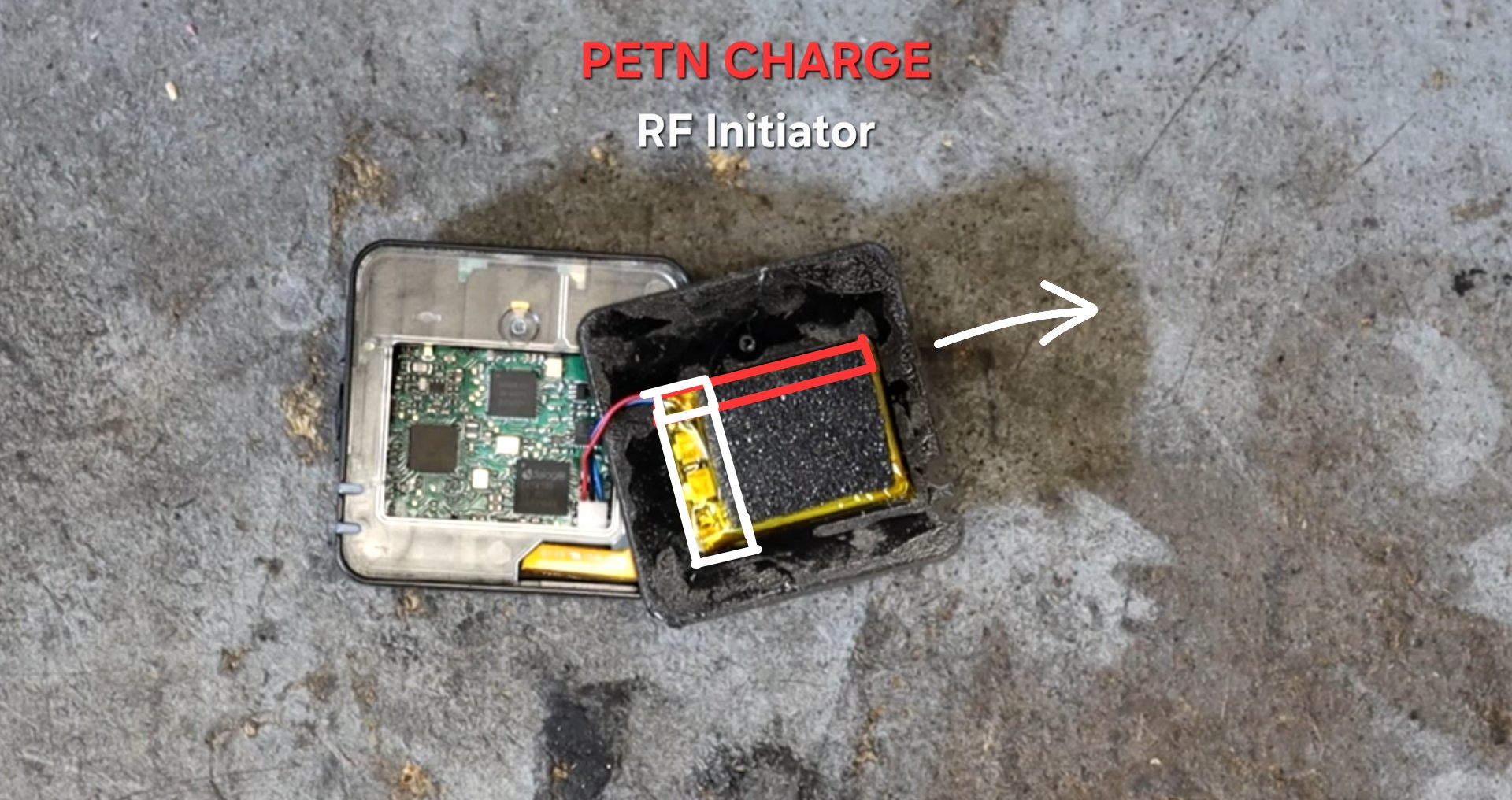
Commentator Candace Owens has publicly laid out a version of the theory that a PETN shaped charge — likely rigged into Kirk's RØDE lavalier ("Road mic pro") — was the actual mechanism of death. Her breakdown, shared widely on X, ties the physical anomalies together:
- Black glass shards throughout the SUV — argued to be fragments from the mic housing shattering, not from a rifle round. See SUV Transporting Charlie.
- The necklace breaking first, ahead of the neck wound appearing.
- The shirt movement at the mic position.
- Extra soil removed from the scene — she argues PETN residue "sticks" to soil, offering a reason the crime-scene ground was dug out and paved over.
In her account she says, "I think there was explosives… a shape charge was used to kill him and what killed him was on him." These are her stated interpretations of the available footage and photos, not authenticated forensic findings.
Crime-Scene Handling Anomalies
Owens and other commentators point to several handling decisions they say are inconsistent with a straightforward long-range rifle shooting:
- No bomb dogs were reportedly used at the location where Kirk fell.
- The transport vehicle was towed and cleaned quickly, before independent examination.
- Roughly 10 inches of soil was reportedly removed from the scene, which proponents link to eliminating PETN residue rather than routine cleanup.
Investigators argue that if the death were simply a rifle shot from a rooftop, none of this urgency around the ground and the vehicle would be necessary. Officials may describe scene cleanup and vehicle recovery as routine; investigators answer that routine handling would still have included a residue test, and none has been made public.
Fort Huachuca and the Hezbollah Pager Precedent
Two further threads run through the online analysis. First, some posts allege the device was tested or coordinated at Fort Huachuca — the U.S. Army intelligence base in Arizona — and cite tracked aircraft movements there around the assassination date, some said to be linked to TPUSA. Second, proponents repeatedly invoke the 2024 Hezbollah pager operation, in which small concealed PETN charges were remotely detonated inside everyday devices, as a real-world precedent showing a miniaturized, remotely triggered charge in ordinary equipment is feasible. Both threads are unverified allegations offered as context for the exploding-mic theory and the AES factory explosion, not established facts.
Significance for the Investigation
The video analysis matters because it establishes a physical basis for the exploding mic theory independent of circumstantial financial and flight evidence — including Stew Peters' allegation that he broke the AES connection. If the footage genuinely shows an explosion originating from the mic position — and two elite military veterans with direct combat experience agree that it does — then the cause of death is not what the official narrative claims, and the alleged murder weapon (Robinson's rifle) is at most a secondary element of the assassination.
This reframing has direct implications for the Tyler Robinson trial: if an explosion from a concealed device in the microphone was the actual cause of death, then Robinson's rifle — regardless of whether it was fired — did not kill Charlie Kirk.
Laws (Charlie Kirk)
- Explosive‑residue testing of Kirk's shirt and the RØDE mic and the autopsy wound trajectory ruling explosion versus rifle and the AES factory and DoD anti‑personnel‑charge contract records are not public yet; the Charlie Kirk Investigation Laws could bring these powerful truths out.
Black Shards Visible in Slow Motion (August 2026)
In August 2026, @ProjectConstitu published a slow-motion frame-by-frame clip in which you can see small black plastic shards falling from underneath Charlie's shirt as he collapses — fragments the poster identifies as debris from the exploding mic transmitter on his belt, in line with the neck wound. If genuine, the falling debris is a direct visual complement to the fabric-motion analysis on this page. Watch the clip with its full write-up on its own video page: Black Shards Falling From Charlie Kirk's Shirt.
Citizen Investigator Claims on X (Frame Analysis)
- @ProjectConstitu (Aug 2026): slow-motion clip showing black shards falling from under the shirt, argued as transmitter shrapnel from an upward-radiating explosive force.
- @jonaaronbray (Mar 2026): multi-camera bulge / MagClip / PCB / battery trajectory package remains a central pro-device-rupture exhibit on X.
- @matt82704417 (June 2026): claims USB logo on shards in RODE/receiver explosion video analysis.
- @alexboge (July 2026): same video corpus used to argue absence of explosive signatures (no flash, smoke, fabric tear, soot). Investigators answer that a gram-scale charge pressed under a shirt vents little visible flash or smoke into open air, and that the same footage shows the fabric expanding outward from the mic before the wound and black shards falling — see the shaped-charge demo.
- Hearing-era posts add: any video theory must address entered autopsy COD GSW + fragments.
This website does not assert as fact that any living person named on this page committed a crime, did anything wrong or illegal, or had any knowledge of or involvement in the assassination. Names appear here only in the context of public discussion and reporting. Nothing on this page is a finding by this website.
Another clip for frame-by-frame review: eight seconds at the tent in which a hand presses something under a security man's shirt. What it was is unknown — see Video: What Was Pressed Under the Shirt?
Interesting In This Area
- Canon XA55 audio separates a distant blast from a louder event at the stage.
- Six visual signatures are argued as things a rifle round cannot produce.
- Two veterans on NEWSMAX said something exploded on him, independently of each other.
- The mic version and the pendant version both put the charge at the collar.
Images
Other Pages In This Section
Microphone — The Exploding Mic Theory
Citizen investigators have concluded the lavalier clipped to his shirt concealed a small explosive — the leading conclusion of the investigation, and the thread that runs through video, audio, procurement, and post-event debris.
Read this
Who placed the microphone, who owned the equipment, and how early the word "dead" entered the timeline. Attributed reporting about named living people; no wrongdoing is alleged.
Read thisCharlie Kirk's Necklace — Residue Search and Custody
Reported federal urgency to recover the cross necklace, read by Candace Owens and others as a residue hunt. Frank Turek and Erika Kirk give different recovery accounts, and no test has ever been made public.
Read thisThis website's author is @HolonCitizen on X and YouTube/@HolonCitizen. Follow me there.
More angles in this section
Video motion is only one pillar: the Canon XA55 uncompressed audio is the main acoustic argument for a stage-origin event separate from a distant rifle report. The hardware that would have to fail or detonate is inventoried on the RØDE Wireless PRO page, including under-shirt placement discussed with the AV team setup. Immediate aftermath claims—people rushing the table for a device, chest-shot language on camera, and an alleged removal command—appear under table jumpers, chest-shot witnesses, and the "get that off of him" tip. Debris and residue questions continue in the SUV photos, the burnt-object transmitter claim, and explosive residue on fabric. For compound class and the geometry questions, use high explosive, the shaped-charge demo, and the mic vs pendant fork; procurement threads live on DoD contract, AES, and the factory explosion.
Interesting
- A 1,300-acre shaped-charge maker holds the DoD contract that anchors this whole thread.
- Researchers mark a close-range shell casing near the canopy with "shot came from here."
- A map of every camera aimed at the tent raises how little footage was released.
Related Areas
- Gun & Bullet Analysis
- Real Killer
- Witnesses
- Videos
- Medical
- Proof Not Tyler