Crack-Bang Interval Argument for a Close Shot
 Next Image
What This Image Shows
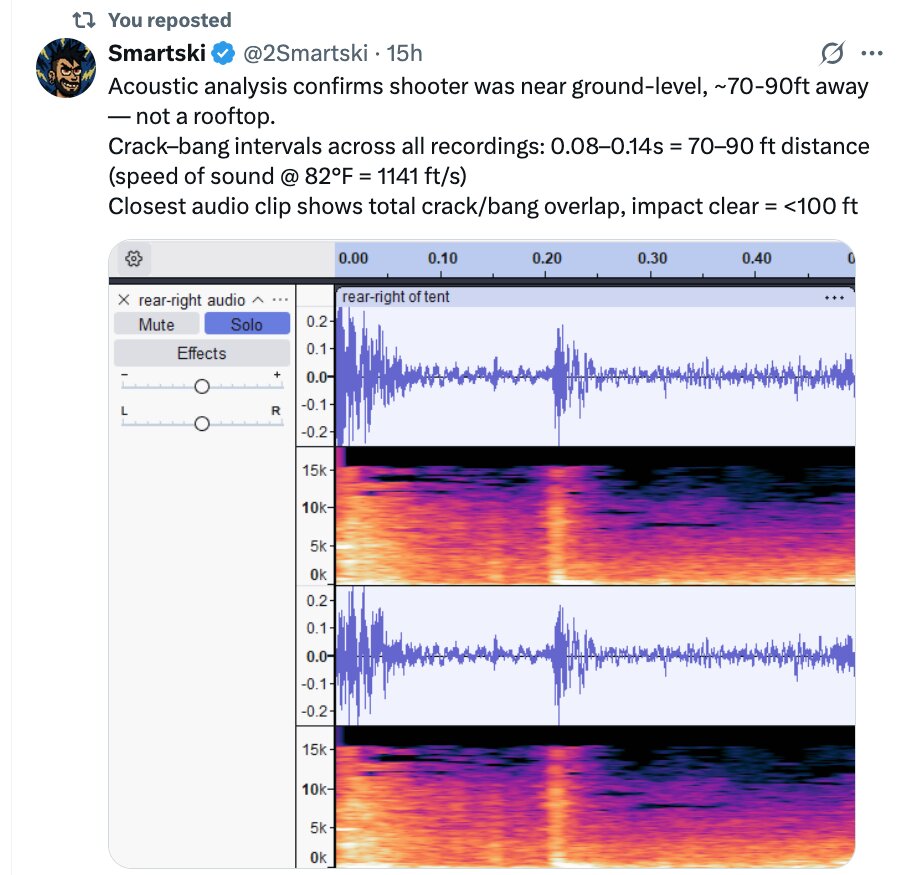
A screenshot of a post on X from an account posting as Smartski, @2Smartski, attaching audio-editing software showing waveform and spectrogram panels on a track labelled rear-right of tent.
The post reads: acoustic analysis confirms shooter was near ground-level, about 70 to 90 feet away, not a rooftop. It gives its working — crack-bang intervals across all recordings of 0.08 to 0.14 seconds equal 70 to 90 feet of distance, with the speed of sound at 82 degrees Fahrenheit taken as 1141 feet per second — and adds that the closest audio clip shows total crack and bang overlap with the impact clear, putting it under 100 feet.
The crack-bang method is legitimate physics: a supersonic round produces a sonic crack at the listener before the muzzle blast arrives, and the gap between them scales with distance from the firing point. Whether it was applied correctly here depends on whether the two transients identified are genuinely crack and bang rather than direct sound and echo, and on whether the recordings were time-aligned properly — both of which other analysts dispute. The word confirms is the poster's, not a finding. See Acoustic Two-Event Split, Alternative Calibers and Weapons, and the Acoustics Expert sub-cluster.
This website's author is @HolonCitizen on X and YouTube/@HolonCitizen. Follow me there.
Where This Image Appears
This image is used on the following investigation pages:
Related Areas
- Cluster: Ballistics and the Gun
- Section: Gun & Bullet Analysis
- All photos: Photos