ATF Appendix: What Inconclusive Means
 Next Image
What This Image Shows
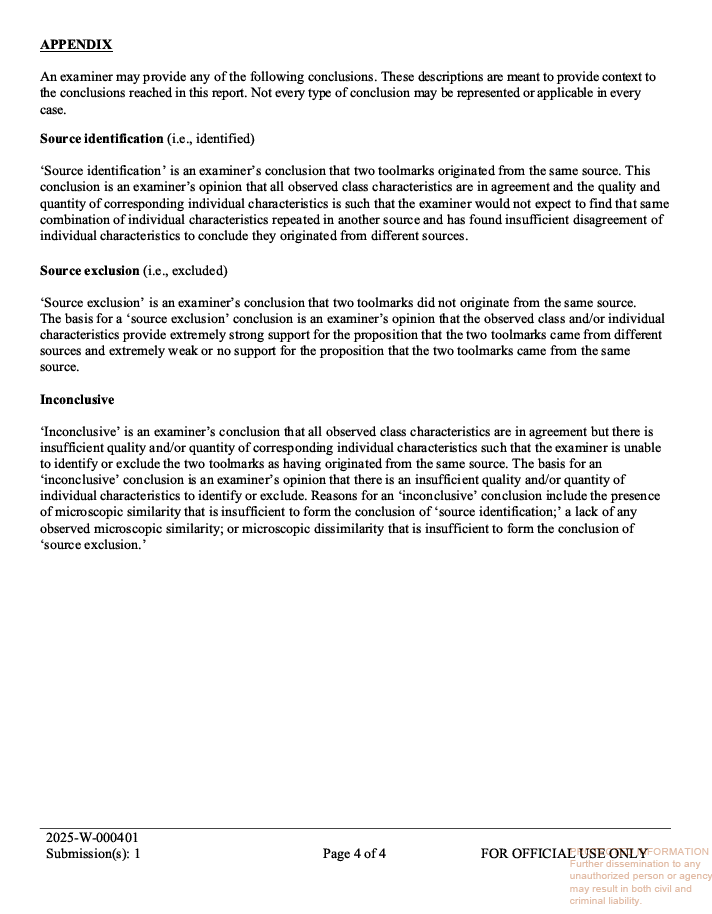
Page four of four of the ATF report — the appendix. It carries a case and submission number, a page marker, and a FOR OFFICIAL USE ONLY classification in the footer. This page contains no findings; it defines the vocabulary the findings are written in, which is why it is worth reading before the report itself.
The introduction states that an examiner may provide any of the following conclusions, and that the descriptions are meant to provide context to the conclusions reached in the report, noting that not every type of conclusion may be applicable in every case. It then defines source identification as an examiner's conclusion that two toolmarks originated from the same source, describing it explicitly as an examiner's opinion that all observed class characteristics are in agreement and that the quality and quantity of corresponding detail supports it. Source exclusion and inconclusive are defined in the same terms.
The significance is straightforward. The word inconclusive in this report is a defined technical outcome, not a hedge or a placeholder — and the appendix makes plain that even a positive identification is framed by the laboratory as an examiner's opinion rather than a certainty. That framing is what the argument over the Exhibit 6A fragment has been fought on ever since. See ATF Fragment Inconclusive, ATF Inconclusive Ballistics, and the report page in this cluster.
This website's author is @HolonCitizen on X and YouTube/@HolonCitizen. Follow me there.
Where This Image Appears
This image is used on the following investigation pages:
Related Areas
- Cluster: Ballistics and the Gun
- Section: Gun & Bullet Analysis
- All photos: Photos
More In This Cluster
- Previous: Reference: Rifle Wound Size on Game Animals
- Next: Tragectory yMn