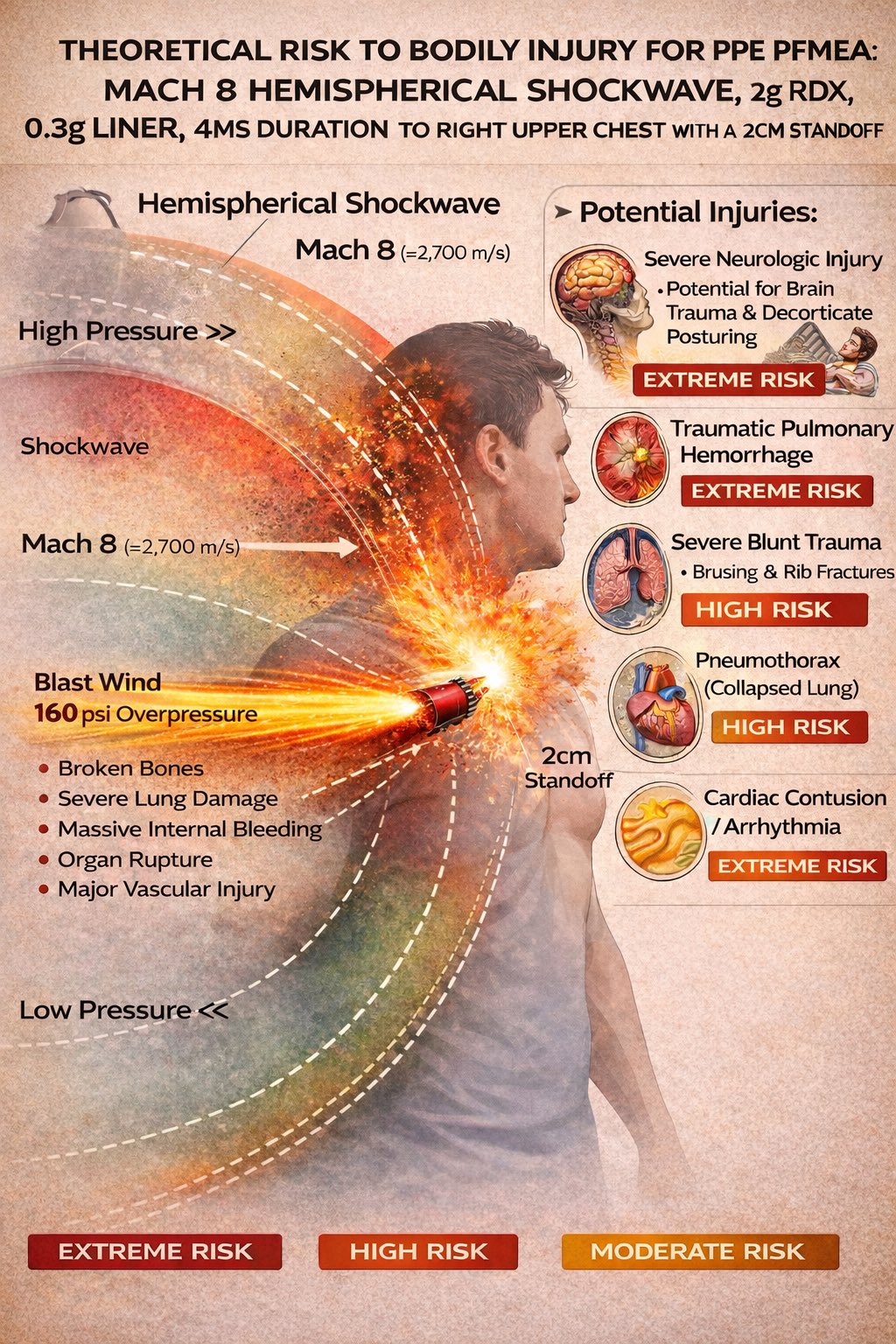
Modeled Blast Injury Chart for a 2g RDX Charge
 Next Image
What This Image Shows
An engineering-style graphic on a parchment background, headed THEORETICAL RISK TO BODILY INJURY FOR PPE PFMEA: MACH 8 HEMISPHERICAL SHOCKWAVE, 2g RDX, 0.3g LINER, 4MS DURATION TO RIGHT UPPER CHEST WITH A 2CM STANDOFF. A semi-transparent side profile of a man is overlaid with concentric colored shockwave bands, and a small red and silver cylinder is shown impacting the upper chest at the marked 2cm standoff with a blast flare erupting from the contact point. Callout boxes state a shockwave velocity of Mach 8, about 2,700 metres per second, and 160 psi overpressure, with graded risk labels: severe neurologic injury and potential brain trauma with decorticate posturing at extreme risk, traumatic pulmonary hemorrhage at extreme risk, cardiac contusion and arrhythmia at extreme risk, and severe blunt trauma with bruising and rib fractures and pneumothorax at high risk.
The chart is written in the format of a failure modes and effects analysis, which is a manufacturing risk-assessment method rather than a forensic one. Its function in the argument is to establish that a very small charge held close to the body could plausibly produce the injuries and the posture visible in the video, without a projectile.
Every figure on it is an assumption fed into a model. No charge of any kind has been recovered or identified in this case, the official finding is a rifle shot, and the decorticate-posture reading is contested. The companion timeline graphic in this cluster models the same event in time rather than in energy. See Microphone — The Exploding Mic Theory, Demo of Shape Charge, and The Exploding Pendant for the competing charge-placement variant.
This website's author is @HolonCitizen on X and YouTube/@HolonCitizen. Follow me there.
Where This Image Appears
This image is used on the following investigation pages:
Related Areas
- Cluster: The Microphone
- Section: Microphone — The Exploding Mic Theory
- All photos: Photos
More In This Cluster
- Previous: Hands Holding a Transmitter Clip Plate
- Next: The Microphone — Photo 21