Extreme Close-Up of the Device on the White Shirt
 Next Image
What This Image Shows
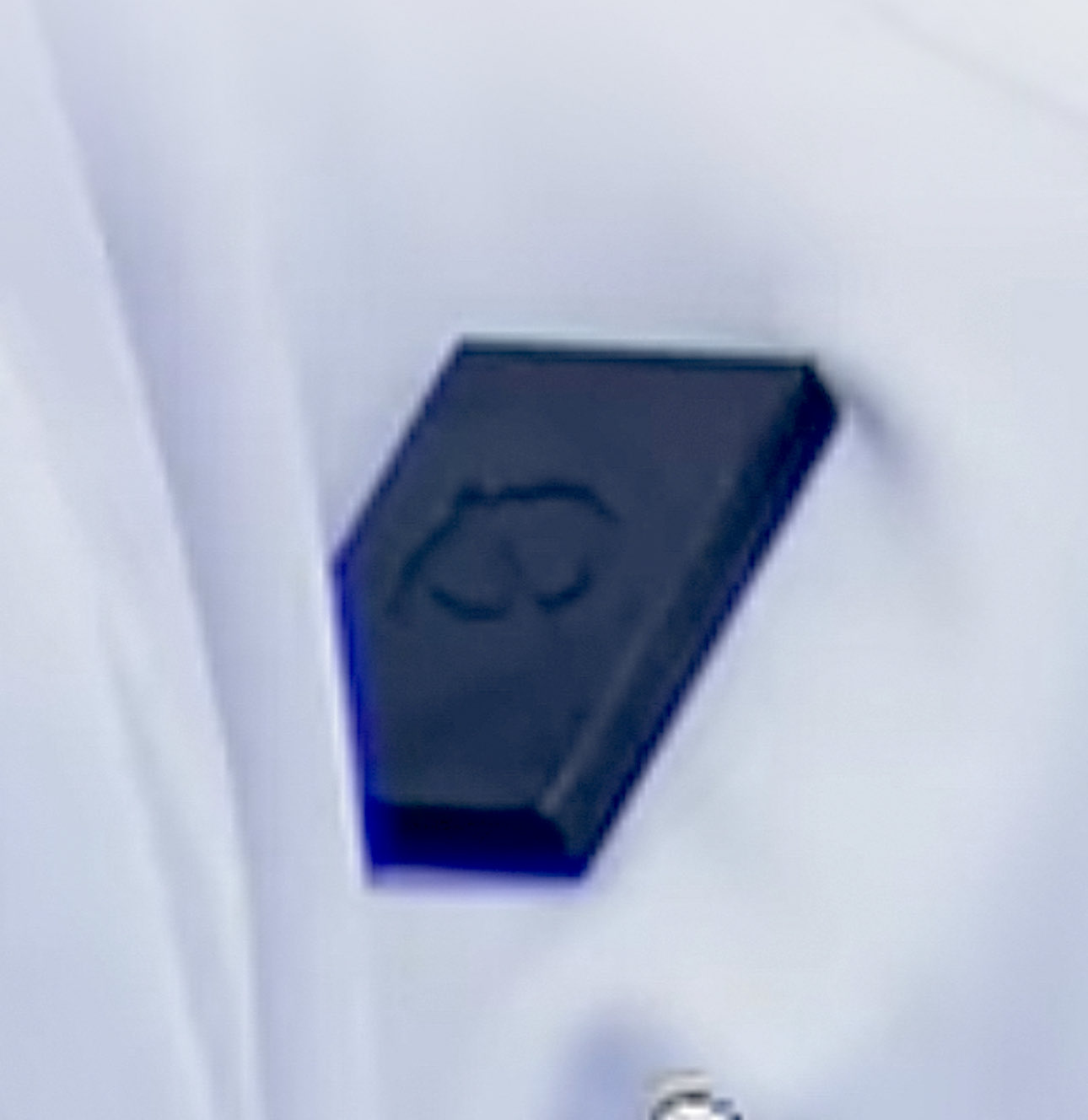
An extreme close-up of a small, matte, five-sided dark component pinned to bright white fabric. The face of the object carries a faint embossed or debossed circular mark, too soft in this frame to read. A thin blue accent runs along its lower-left edge, and a small silver circular element — consistent with a pin backing or clip hardware — is partly visible and heavily blurred at the bottom of the frame. The fabric behind it is smooth and weave-free with soft vertical folds, consistent with a lightweight synthetic garment.
The white fabric matters as much as the object. Charlie Kirk was wearing a white synthetic shirt at Utah Valley University on September 10, 2025, and the device clipped near his collar is the physical starting point of the entire exploding-mic question. Frames like this one are used by researchers to argue about what exactly was on the shirt and where it sat, because the identification changes what the surrounding material means.
The image alone does not identify a make or model — the logo is not resolvable at this focus, and at this magnification a lapel microphone, a transmitter, and a pin badge are hard to tell apart. That is precisely the point of contention. Compare it with the measured product photography and the enhancement work on RODE Wireless PRO Mic and the defense-styled CLAHE panel elsewhere in this cluster, and read the full argument on Microphone — The Exploding Mic Theory.
This website's author is @HolonCitizen on X and YouTube/@HolonCitizen. Follow me there.
Where This Image Appears
This image is used on the following investigation pages:
Related Areas
- Cluster: The Microphone
- Section: Microphone — The Exploding Mic Theory
- All photos: Photos
More In This Cluster
- Previous: CAD Render of a Transmitter Housing Interior
- Next: The Microphone — Photo 3