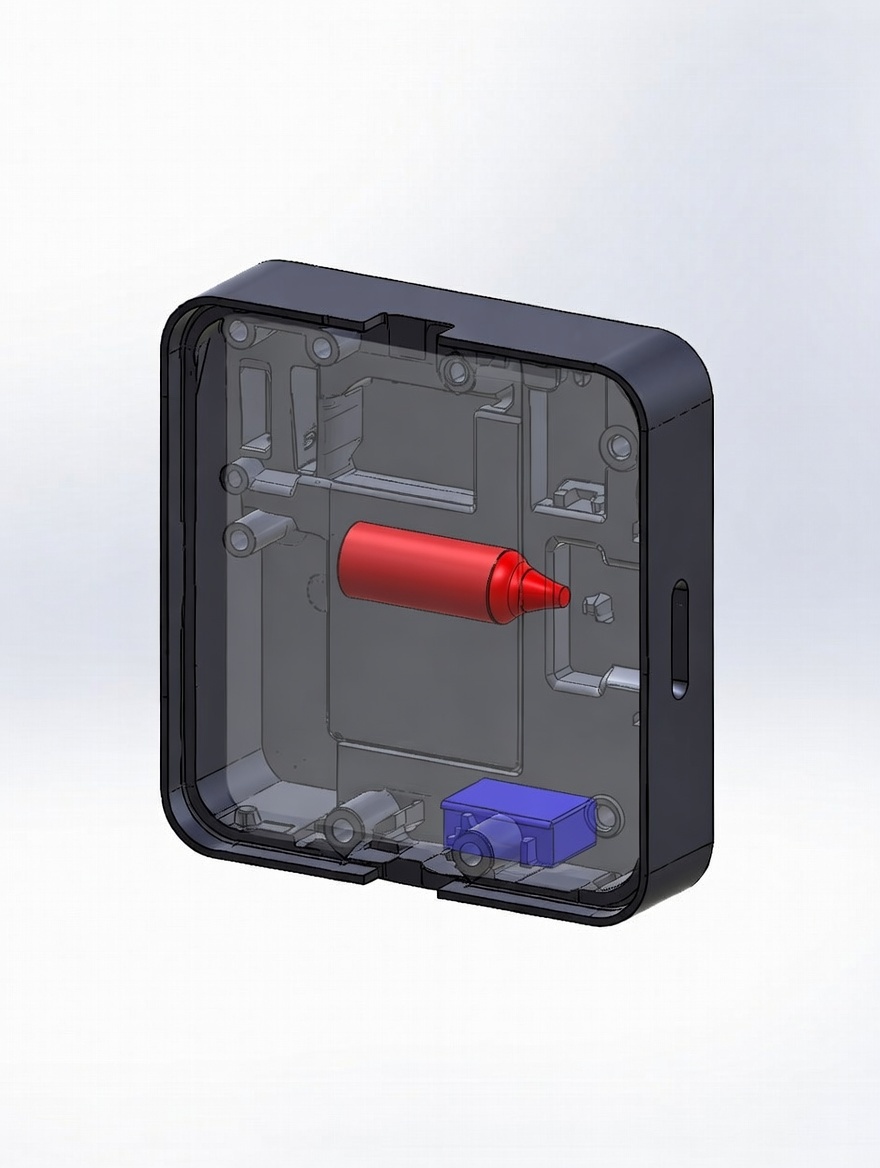
CAD Render of a Transmitter Housing Interior
 Next Image
What This Image Shows
This is a computer-aided design rendering, not a photograph. It shows a square enclosure with heavily rounded corners and a smoked semi-transparent front cover, through which the molded interior is visible: screw bosses, structural ribbing, recessed compartments, and an oval port cutout on the right edge. Two components are rendered in solid saturated color against the grey chassis — a horizontal red cylinder that tapers through a stepped neck to a narrow nozzle, and a small blue rectangular module in the lower right with a circular collar facing a matching opening in the base.
The form factor is the square, clip-on body of a wireless lavalier transmitter. The red and blue elements are drawn in a way that separates them visually from the housing, which is how proponents of the exploding-mic argument present the internal-modification claim: that the standard interior of the device Charlie Kirk was wearing on his shirt could have been altered to carry something other than a battery and a circuit board. The rendering contains no text or measurements, so nothing in it establishes scale, materials, or that any real device was ever built this way.
Treat this as an illustration of a hypothesis rather than proof of one. The written case for and against that hypothesis is laid out on Microphone — The Exploding Mic Theory and the hardware page RODE Wireless PRO Mic, where the actual dimensions and internal layout of the shipping product are documented. The official finding in the case remains a single rifle shot, and skeptics of the mic theory are given equal space on Mic vs Pendant and Demo of Shape Charge.
This website's author is @HolonCitizen on X and YouTube/@HolonCitizen. Follow me there.
Where This Image Appears
This image is used on the following investigation pages:
Related Areas
- Cluster: The Microphone
- Section: Microphone — The Exploding Mic Theory
- All photos: Photos