The Shot-Through-the-Heart Narrative (Claims)
The full 3:43 live TV-news segment outside the UVU entrance — the longest cut of this interview archived here, and the only one in which both witnesses give their names on air. Source: @ProjectConstitu on X, July 26, 2026. Pinned to IPFS as QmPLMHuGuMPLP69zSznq4xZ9KzN6S7Vm74wXgjxJFCxuH8.
:::caution Attributed claims only This page records a thesis and the witness statements it is built on. Nothing here is a finding of this site. The ordinary explanation — that acute stress, obstructed sightlines, and "heart" as everyday shorthand for a fatal upper-body hit produce exactly this pattern with nobody coordinating anything — is stated in full below and has to be weighed first. No witness on this page is accused of lying, being coached, or being a "crisis actor." Tyler Robinson is charged, not convicted. :::
Claim snapshot
| Field | Value |
|---|---|
| The claim | The earliest on-camera witnesses described a chest-and-heart wound because that is the wound the mechanism was meant to produce — a shaped charge aimed to blast through the center of the chest. The charge is said to have tilted, striking the neck instead, leaving the heart description stranded with nothing visual behind it |
| Raised by | @HolonCitizen, building on the heart-claim catalog at Shot in the Heart and the shaped-charge material at Chest-Shot Witnesses |
| Featured source | @ProjectConstitu, July 26, 2026 — the full 3:43 cut of the TV segment |
| Rests on | Witness language across many interviews, plus the absence of any chest wound on the shirt. No autopsy, no device recovered, no test |
| Evidence rating | SPECULATIVE — the pattern it points at is real; the mechanism it proposes is unproven |
What is alleged
The thesis has two halves, and they have to be kept apart because they are not equally strong.
The mechanism half. The claim is that a shaped charge was positioned to fire through the center of the chest — that the intended effect was to blow open the chest at the heart, so that the injury would read to every observer as a rifle shot straight through the heart. On this account the charge did not fire true: it tilted, and the jet went into the neck instead of the sternum. Everything downstream follows from that error. The wound is in the wrong place for the story that had already been prepared, and so the story and the body stop matching. This is the weakest part of the thesis and it should be labelled clearly: no device has been recovered, no autopsy has been released, and no test has been run. It sits alongside the other device readings in Chest-Shot Witnesses and the shaped-charge demonstration as an interpretation, not a finding.
The narrative half. This is the part that rests on something anyone can check. Across a large number of direct-to-camera interviews, people appear to say they personally saw it — that they watched him get shot straight through the heart, with the blood coming from the center of his chest. Not "somewhere in the upper body." The heart, specifically, and the chest, specifically, described in the first person. The observation offered here is that these accounts arrived as an initial wave: they surfaced fast, they reached TV news in a number of different places, and then — quickly — that framing was turned off. It appears to stop after a while. Later coverage runs on a neck wound and largely stops repeating the heart language at all.
What the shirt does to it
The reason the heart description is worth a page is that it is checkable, and it fails the check. Charlie Kirk was wearing a white shirt. A round or a jet through the center of the chest leaves that shirt torn at the entry and soaked from the middle outward, and both would be plainly visible against white fabric on ordinary viewing. Neither is there. There is no chest entry, no shredded shirt front, and no blood blooming from the sternum. The blood is at the neck.
So the heart accounts are not a close call that the footage merely fails to confirm. They describe something the footage shows did not happen. That is the whole engine of this page: the claim was confident, it was specific, it was first-person, it was on television — and it was wrong in a way a white shirt makes obvious to anyone who looks. The thesis asks why a wrong description arrived that early and that uniformly.
The featured clip, and what is new in it
The segment above is the same live TV-news interview already archived on this site in two shorter cuts — via @charlie_ward77 and @Maxwell1995Vjjo, both about 52 seconds. This cut runs 3 minutes 43 seconds, and two things appear in it that are in neither short version.
First, both witnesses are named on air. The anchor asks "Your name?" and gets two answers: Angie Martin and Darren Brunson. Angie Martin is the retired-law-enforcement witness — she says that "because of my past experience in law enforcement, I knew it was a gun." Darren Brunson is the man who delivers the heart line. Every earlier page on this site had to describe him as "the witness is not named in the clip." This cut supplies the name.
Second, the segment keeps going past the point where the short cuts end, into Angie Martin's account of the crowd and her closing remark to the anchor.
Transcript — key statements
Auto-transcribed, lightly cleaned for readability, reproduced as spoken and attributed to the speaker rather than adjudicated here.
Darren Brunson, on the wound:
Yeah, I was there, and I watched the shooting. It looked like that, uh, he got hit, a direct shot, right to the heart. As soon as he was hit, he fell backwards, went to the side. The audience went to their knees. I stayed up a little bit because I wanted to see if anyone saw the shooting, if they would jump all over the guy. I saw nothing like that.
And later in the same answer:
I think whoever did it was a good shooter, a sharpshooter. It was one shot right directly to the heart, and we need to find out who did this. I think there should be a research completely done that took place hours, maybe a day before anything went on. Who could be there and pull that trigger and do it?
Angie Martin, on what she heard and did:
So I went towards the doors and heard a crack — because of my past experience in law enforcement, I knew it was a gun, and then I tucked behind the corner, and all the crowds started racing out… I was worried about people trampling each other. And I saw two college-age girls, one was having a panic attack. So I grabbed both of them because she was collapsing and rushed her down underneath the tunnel and got her to calm down, then put her in my car and got hold of her parents.
Three details in Brunson's answer matter beyond the heart phrase. He says he deliberately stayed standing to see whether the crowd would tackle a shooter, and saw nothing of the kind. He is asked twice whether the man taken into custody had anything in his hands — a device, anything — and answers plainly: "No, I did not." That is a witness on live television declining to supply the hand-device claim, which is relevant to the Rick Cutler hand-device item and to the device readings generally. And he describes the detained man as calm and compliant.
On the man taken into custody
Both witnesses discuss the man detained at the scene, whom Brunson names and says he believes was "the wrong guy." That man — George Zinn — is a living person. Authorities reported that he was not the shooter, and he was charged with counts unrelated to the shooting. This site does not assert that he committed any crime in connection with the assassination. The witnesses' characterisations of him are their own on-air opinions, recorded here only because the "wrong guy" framing is inseparable from the rest of their statements, and their further personal allegations about him are not reproduced on this page.
Angie Martin also closes the segment with an on-air impression about the person who asked the final gun question — "it almost felt like that the person that was asking the questions about gun knew it was gonna happen." That is a witness impression and nothing more. No evidence supports it, it has never been substantiated, and the questioner — a living private citizen — is not accused of anything by this site. It is recorded because the segment is being archived in full, not because the site gives it weight.
The ordinary explanation
This has to be given properly, because it explains the whole pattern without any device at all.
Wound location is the single least reliable thing a witness reports. Under acute stress, from 30 metres away, in a crowd that is already moving, with a sightline partly blocked by other people, observers routinely place wounds wrong. "Shot in the heart" is not a forensic statement when a bystander says it — it is ordinary English for "shot fatally in the upper body." People reach for it precisely because it conveys he is not going to survive this, which was the one thing every witness there did correctly perceive.
Television selects for it. Live news bookers and producers take the most vivid, most confident, most quotable account available in the first hour. A witness who says "one shot right directly to the heart" gets airtime; a witness who says "I'm not sure where he was hit" does not. That is a selection effect, and it manufactures uniformity out of a mixed pool of accounts without anybody being told what to say. It also explains the concentration on TV specifically, which is the part of the pattern the thesis leans on hardest.
And the fade has a boring cause. The heart language receded exactly when better video and official statements arrived. Coverage moved to the neck wound because the evidence moved there. A narrative dying when it is contradicted is what is supposed to happen; it is not by itself evidence that the narrative was installed. Note too that the heart accounts were never actually unanimous — on the same day, other witnesses described blood "gushing out of his neck," which is catalogued alongside the heart claims at Shot in the Heart.
What survives all of that is narrower than the thesis, and it is a fair question: the heart accounts were unusually specific and unusually first-person — "I watched it," "right where his heart is" — for a detail that a white shirt shows did not occur. Whether that exceeds ordinary chaos and airtime selection is not settled by anything currently public.
What would settle it
- Release the autopsy. It describes the wound track. It would establish whether anything entered the chest at all, and would end the heart-versus-neck question outright.
- Pull the raw TV feeds and pre-interview notes. If the heart phrasing was fed to witnesses, that shows up in the unaired tape and the booking notes, not in the broadcast.
- Interview the named witnesses directly. Both Angie Martin and Darren Brunson gave their names on air. Nobody has published a follow-up asking Brunson what he actually saw, from where, and whether he meant "heart" literally.
- Run the shaped-charge test. A charge fired at a torso surrogate in a white shirt — on-axis and deliberately tilted — would show whether a tilted charge can produce this wound and this shirt. Until that is filmed, the mechanism half of the thesis stays SPECULATIVE.
- Count the accounts properly. A systematic tally of every first-hour interview, coded for wound location and for whether the outlet was broadcast or citizen video, would test the "TV concentration" claim instead of asserting it.
Interesting In This Area
- Chest wound accounts sit against a neck wound in the record.
- The pendant reading and the mic placement supply the charge this thesis needs.
- The shirt moves before the blood, which proponents read as an outward event.
- No autopsy report is public, so the chest description cannot be checked against tissue.
Interesting In Other Areas
- Second-row witnesses describe the impact landing on his chest and blood from its middle.
- The heart claims are catalogued against the absence of any visible chest wound.
- Candace Owens argues the chest descriptions never matched the visible neck injury.
- Conflicting witness accounts are laid side by side rather than resolved.
Other Pages In This Section
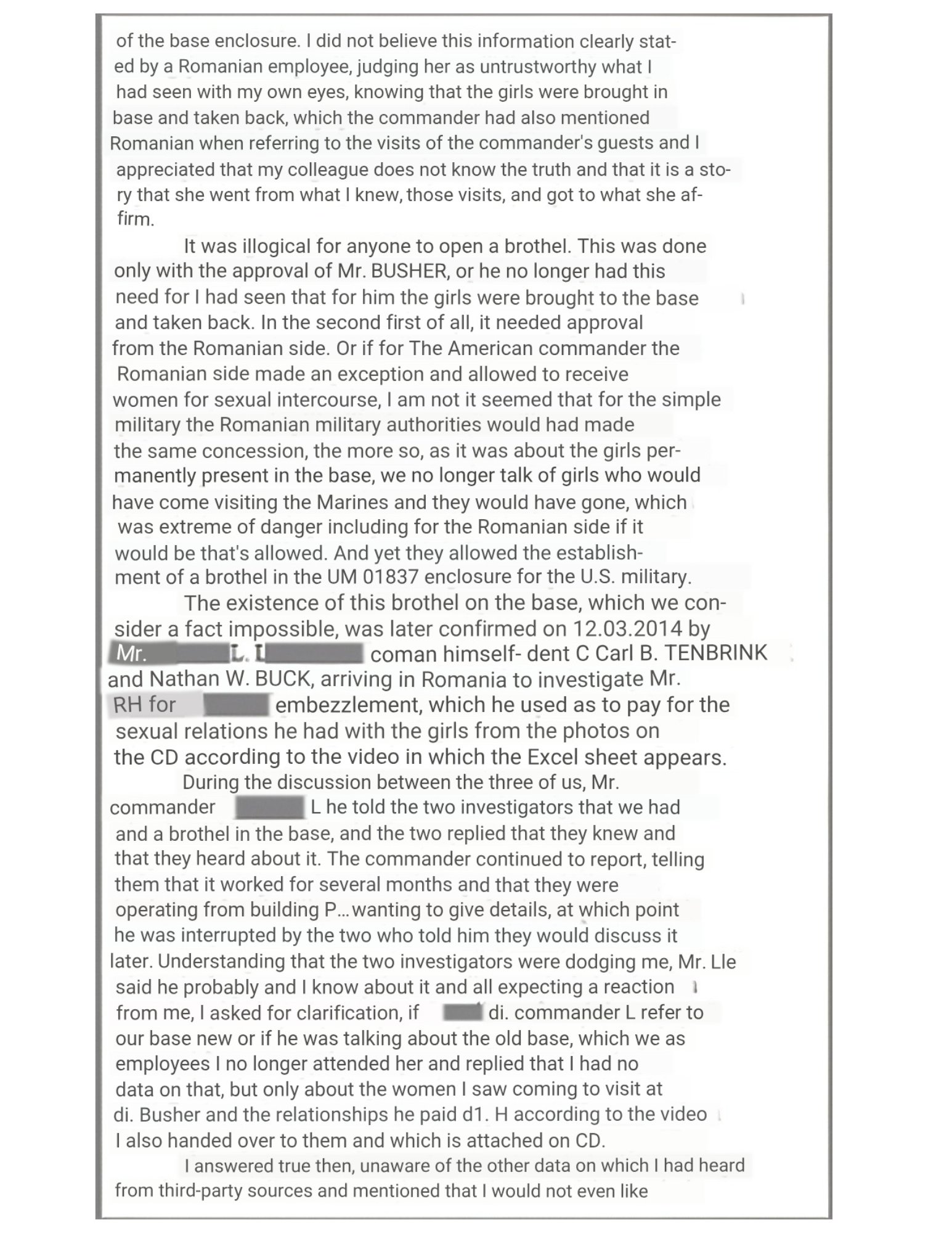
Baron Coleman Says Robinson Is in Grave Danger (Claims)
Baron Coleman says he is 100 percent convinced Tyler Robinson was framed and is in grave danger of being killed. He offers no evidence of any threat, and Robinson has been held in a high-security unit since September 2025.
Read this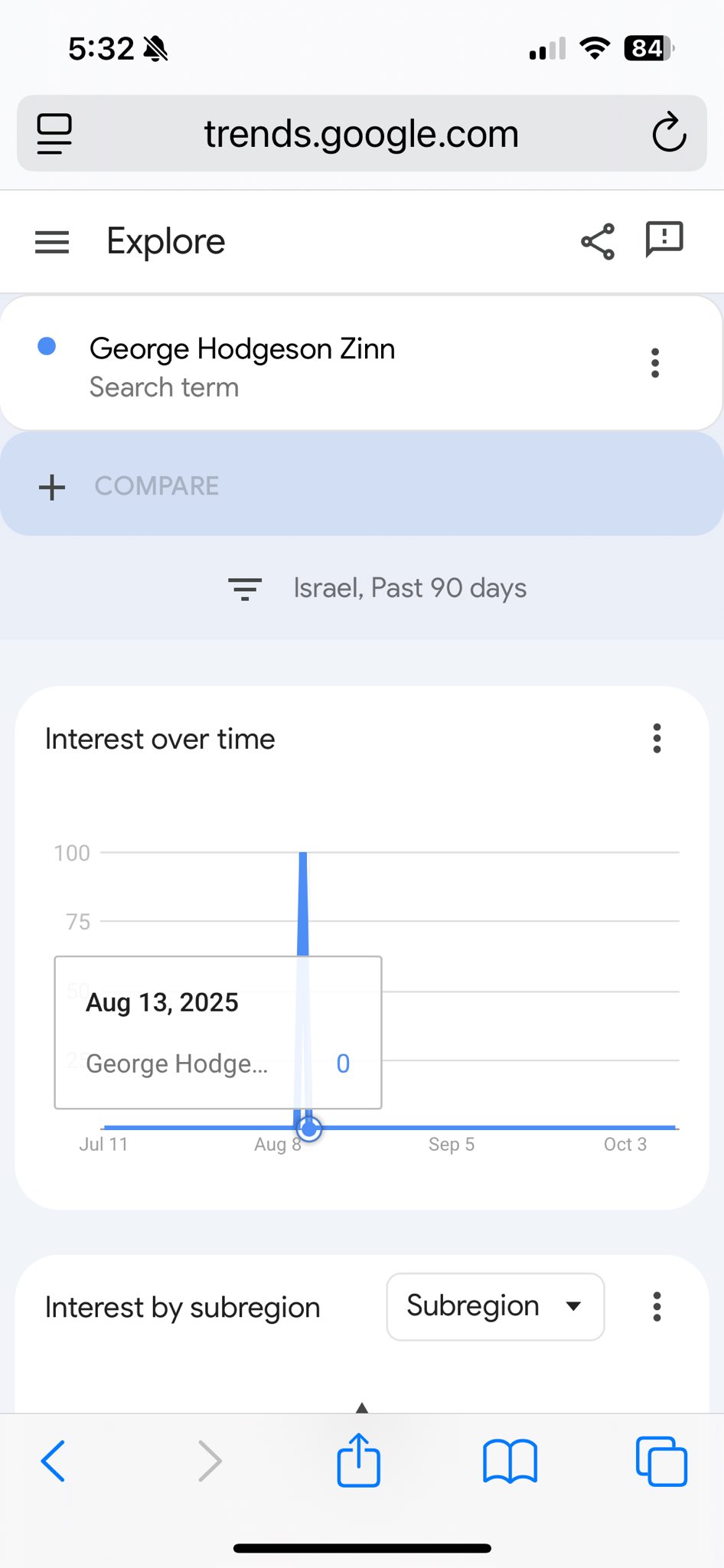
Kathryn Nester and the Google Trends Spike (Claims)
An anonymous post reads a December 2024 Google Trends graph as proof lead counsel was pre-selected from abroad. Trends cannot report IP addresses, and Utah law makes the claim's premise impossible — published here to be examined, not credited.
Read thisFBI and ATF Reportedly Withholding Discovery (Claims)
The claim that Robinson's defense sought a continuance because the ATF and FBI would not release files held since September — DNA data, video chain of custody. Attributed and unverified, though it tracks the docket.
Read this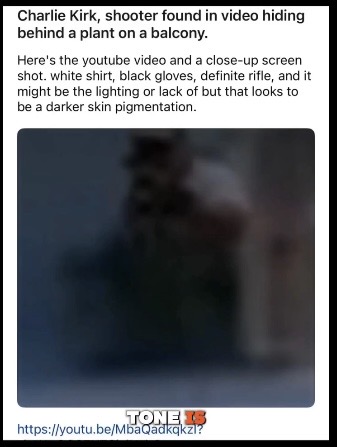
Feds Directed the Re-Search That Found the Rifle (Claims)
Hands found no gun, dogs found no gun, and the rifle reportedly turned up only after federal agents sent junior local officers back to search again. Unsourced in the file, and squarely relevant to where the rifle was recovered.
Read thisElsewhere In The Investigation
"You Just See It Hit His Chest" — Second-Row Witnesses Describe a Heart Shot
Second-row witnesses describe the impact landing on Kirk's chest and blood coming from the middle of it — one says outright he was shot in the heart. The white shirt shows no chest wound, which is what makes the pattern worth explaining.
Read thisShot in the Heart — Early Claims vs. What Video Shows
A catalogue of the posts, TV clips and threads claiming Charlie was shot in the heart or chest, set against the absence of any visible chest wound. The pattern is real even when every individual claim is soft.
Read this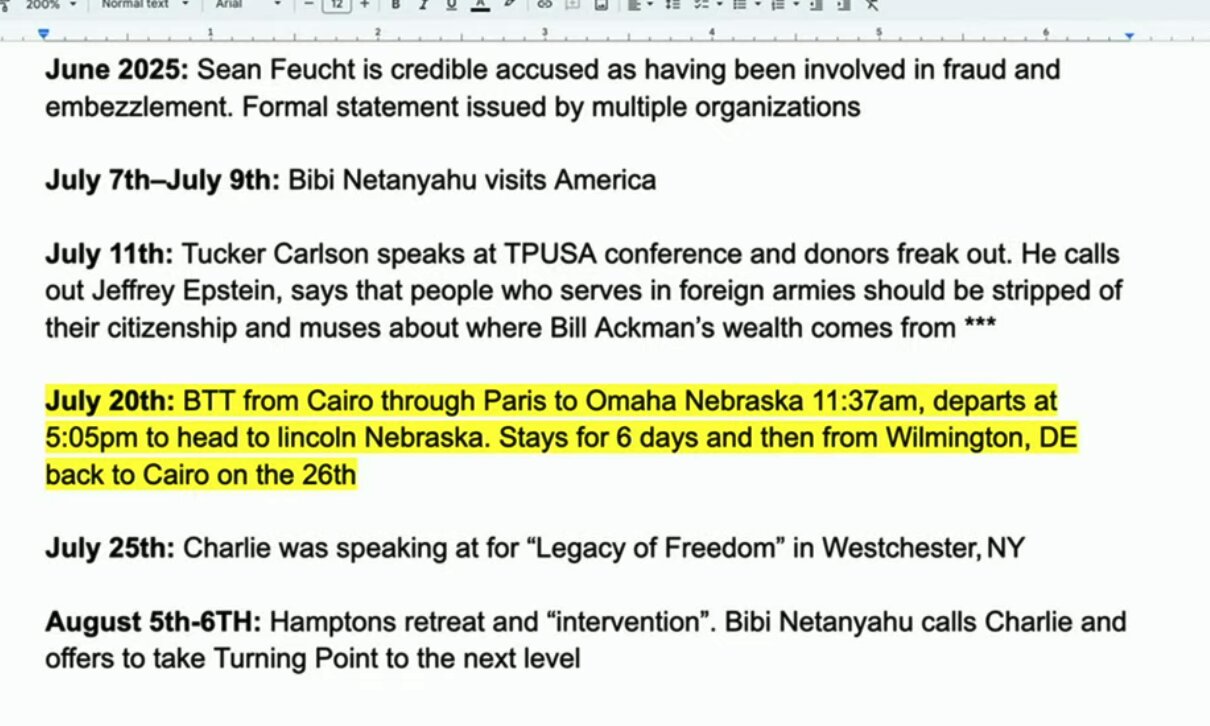
Chest-Shot Witnesses — Planned Narrative?
Witnesses who told cameras within minutes that Charlie was shot in the chest — a description Candace Owens argues never matched the visible neck wound. Why so many people gave the same detail is the open question.
Read this
Witness Account Conflicts — Chest vs Neck
Chest and heart on camera in the first hour, neck in the record afterwards. This page lays the conflicting witness descriptions next to each other rather than choosing between them.
Read thisSources
- @ProjectConstitu, 2026-07-26 — the full 3:43 cut of the TV segment, naming both witnesses — https://x.com/ProjectConstitu/status/2081179762265919683
- @charlie_ward77, 2026-07-13 — ~52-second cut of the same segment
- @Maxwell1995Vjjo, 2025-09-11 — earliest archived cut, posted with the question "why did every eye witness say he got shot in the heart/chest when he clearly got shot in the neck?"
- The full catalog of heart and chest claims, and the contrasting neck-wound accounts — Shot in the Heart
- The tilt/shaped-charge framing is @HolonCitizen's thesis as recorded in the investigation file; no third-party source or test is cited for it.
X.com posts:
This website's author is @HolonCitizen on X and YouTube/@HolonCitizen. Follow me there.
Interesting
- Booking paperwork and the affidavit differ by six hours in the arrest-time discrepancy.
- Users reported a poll on this case would not post, only drafts on X.
- Long ballistics breakdowns reportedly draw strikes on YouTube and Meta, pushing evidence to IPFS.