Baron Coleman Says Robinson Is in Grave Danger (Claims)
:::caution Attributed opinion, offered without supporting evidence This page records a prediction stated as conviction by a named commentator. Baron Coleman is a living attorney and radio host; the "framed" and "grave danger" characterizations are his stated opinions, not findings, and no person or agency is alleged here to have threatened anyone. Tyler Robinson is charged, not convicted. :::
Claim snapshot
| Field | Value |
|---|---|
| The claim | Robinson was framed, "was not supposed to survive to turn himself in," and is in grave danger of "being taken out physically from this earth" |
| Raised by | Baron Coleman, clipped by @IGraceAshford; related framing by Ian Carroll |
| First surfaced | 2026-07-13 (the "grave danger" clip); a related Coleman cover-up clip is dated 2026-06-30 |
| Rests on | On-record statement of personal conviction — no document, witness, or threat evidence is offered |
| Evidence rating | SPECULATIVE |
What is alleged
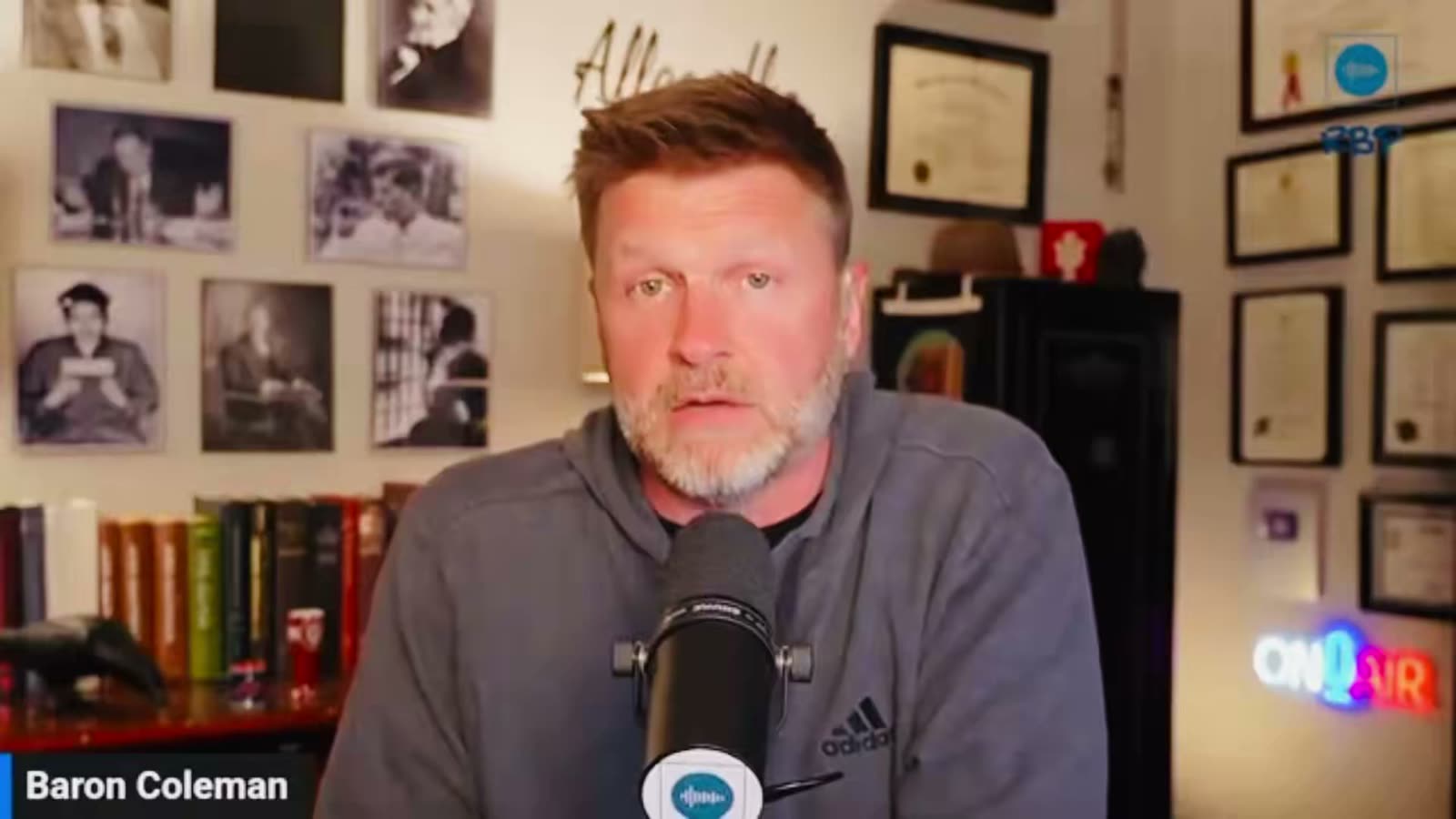
Baron Coleman, an attorney and radio host, states on the clip that he is now "100 convinced" Robinson was framed, and that Robinson is in danger: "I think that there are two people who are in grave danger right now, unbelievably grave danger, and by grave I mean a danger of of being taken out physically from this earth. The first may be obvious. It's Tyler Robinson… Tyler Robinson was not supposed to survive to turn himself in."
His stated logic is that the case cannot survive adversarial testing. "Tyler Robinson cannot go to trial. He cannot because they cannot prove he did it. Not only that, if he goes to trial, it's going to just blow the whole thing apart." In Coleman's framing, Robinson's continued survival is therefore itself a threat to the official narrative, and the danger follows from that. Ian Carroll echoes the theme in a shorter register: "Hopefully Tyler Robinson is still alive by then."
The implication critics draw for this section is that Robinson's legal defense operates inside a threat environment that could shape counsel's strategic choices.
The ordinary explanation
The theory runs into the custody record. Robinson has been held since September 2025 in a high-security special housing unit in isolation at the Utah County Jail in Spanish Fork — initially on suicide watch and under the most restrictive custody level — and appears at hearings virtually from that facility. Those are the standard institutional conditions for a high-notoriety capital defendant, and they happen to be the conditions that minimize precisely the access Coleman's theory would require. Isolation cuts both ways: it is what you would impose if you wanted him unreachable, and it is also just what jails do with defendants like him.
Coleman's "cannot prove he did it" assertion is an opinion formed without access to the evidence. The sealed discovery in this case is held by the defense team, not by commentators; the investigation file itself records that the Utah State Bureau of Investigation has had 28 different law enforcement agencies produce evidence. A person outside that record is not positioned to say what it does or does not establish, and Coleman does not claim to have seen it.
The prediction also has a structural problem worth naming: it is unfalsifiable in the direction that matters. Nothing has happened to Robinson. A defendant surviving pretrial custody is the ordinary outcome in every capital case in the country — it is the baseline, not a narrative anomaly requiring explanation. If Robinson is tried, the theory can be recast as "they were stopped in time"; if he is not, it is confirmed. A claim that cannot fail is not evidence.
Coleman offers no evidence of any threat — no report, no incident, no source. He offers his conviction, which he states honestly as conviction.
What would settle it
- Obtain Utah County Jail incident and housing records for Robinson to establish whether any threat, assault, or security event has actually been logged.
- Ask Coleman, on the record, what specific evidence of a threat he possesses beyond his inference from the strength of the State's case.
- Watch the ordinary marker: whether the case proceeds to trial on schedule, which is what the theory predicts cannot happen.
Interesting In This Area
- Coleman's 6:25 PM Miranda reading came out of a defense motion.
- He also says the surrender video was refused, then reported deleted after thirty days.
- A jailhouse informant transport order is read by critics as positioning.
- The booking sheet arrest time reportedly conflicts with the affidavit.
Interesting In Other Areas
- Every Coleman claim in date order shows which arguments he built on which.
- He says the family denies the confession and were absent from the witness list.
- Volunteer attorneys were reportedly turned away while an unrelated inmate was moved.
- The early turn-in argument turns on video the county says it no longer holds.
Images
Videos
Footage related to this page. Each card opens that clip's own page, with the video, the full write-up, and its source.
Other Pages In This Section
Defense Acquiescence to the Sua Sponte Gag Order (Claims)
Judge Tony Graf entered a publicity order on his own motion, and critics ask why the defense never fought it. Such orders are routine in capital cases and exist mainly to protect the defendant — so the complaint runs against Robinson's own interest.
Read thisSuspicious by Defense Attorneys
Nine things citizen investigators flag about Tyler Robinson's legal defense — counsel selection, the unchallenged gag order, the Miranda exhibit, the jailhouse informant. Questions about strategy, not accusations of misconduct against any attorney.
Read this
Enhanced Stairwell Photos Released After Custody (Claims)
Baron Coleman alleges the enhanced stairwell suspect photos went out after Robinson was already in custody and being Mirandized. It is his inference from a Bates-stamped filing, not a finding.
Read thisSelective 4K Release Versus the FBI Gag Claim (Claims)
TPUSA's October 14 tribute video reportedly used crisp 4K and drone footage from September 10 — footage said elsewhere to be unreleasable on FBI advice. An attributed inference about which version of the day gets shown.
Read thisElsewhere In The Investigation
Baron Coleman Allegations & Timeline
Every Coleman claim in date order — the custody-versus-Discord argument, the Bates 003996-R2 Miranda reading, the grave-danger clip. Laid out chronologically you can see which claims he built on which.
Read thisBaron Coleman — Family Denies the Confession
Coleman says on the Julian Dorey podcast that Robinson's family does not believe he did it and denies he confessed to them, and notes the parents were absent from the preliminary-hearing witness list.
Read this
Volunteer Defenders Reportedly Blocked, Jailhouse Informant Positioned (Claims)
Reported claims that volunteer attorneys were turned away while an unrelated inmate was positioned as a possible jailhouse informant. Two separate claims critics read together; each is weak on its own.
Read thisBaron Coleman: Early Turn-In & the Refused Surrender Video
Coleman's case that Robinson turned himself in during the early afternoon of September 11, not after 9 PM — and that Washington County refused or deleted the video that would show it.
Read thisSources
- Baron Coleman, "grave danger" clip via @IGraceAshford: x.com/IGraceAshford/status/2076585079015391653
- Baron Coleman, multi-agency cover-up clip via @IGraceAshford: x.com/IGraceAshford/status/2072021982296551765
- Ian Carroll (@IanCarrollShow): x.com/IanCarrollShow/status/2076529988237767086
- Custody conditions and the 28-agency discovery addendum: investigation file.
This website's author is @HolonCitizen on X and YouTube/@HolonCitizen. Follow me there.
Interesting
- Filings reportedly show a Miranda warning given before the tip call that named him.
- The same alleged UVU devices were later tracked to a hotel hosting US-Iran negotiations.
- Israeli Cellebrite and BriefCam reportedly handled the core evidence in this case.