Three Minutes to the First Police Report (Claims)
:::caution Attributed claims only Two and a half minutes from a shooting to the first archived radio traffic is fast, not slow — and this page argues that the claimed anomaly is not one. The 12:26 figure is stated in the investigation file with no link to any audio or dispatch log, so even the number is secondhand. Nobody named or implied below is accused of a crime. :::
Claim snapshot
| Field | Value |
|---|---|
| The claim | "According to police audio, the first report of the shooting came in at 12:26 p.m." — roughly two and a half to three minutes after the shot, and by the file's own reconstruction more than a minute after the SUV had already departed for the hospital |
| Exact time in window | 12:26 PM MT; the SUV departs between 00:43 and 01:05, i.e. 12:24:13–12:24:35 |
| Raised by | The investigation file's "Day of Shooting" section, attributed to police audio |
| First surfaced | Undated in source |
| Rests on | Secondhand hearsay — an assertion attributed to "police audio," with no link, no recording, no dispatch log, no agency named |
| Evidence rating | MODERATE |
What is alleged
The investigation file states it in a single sentence: "According to police audio, the first report of the shooting came in at 12:26 p.m." Set against the file's own fixed time for the shot — 12:23:30 — that is a gap of about two and a half minutes.
The ordering is the claimed anomaly, not the duration. The file's second-by-second reconstruction records the SUV departing for the hospital between 00:43 and 01:05, which is 12:24:13 to 12:24:35. On those numbers, Kirk had been carried into a vehicle, the vehicle had left campus, and roughly ninety seconds had passed — all before the first report of the shooting reportedly reached the radio. The suggestion drawn from it is that the response ran ahead of the notification: that people acted before anyone told anyone.
The same minute carries a second, disputed point. One reconstruction in the file places Mikey McCoy three-waying Erika Kirk at 12:26 — which sits badly against her reported statement that the call came at 12:23. That conflict is treated at McCoy alone in frame, Neff nowhere and is not resolved here.
The figure itself has no support in the file. There is no link to the audio, no dispatch log, no agency identified, no channel named, and no indication of who timed it or how. The claim that police audio says 12:26 is, in the file, an assertion that police audio says 12:26.
The ordinary explanation
Two and a half minutes is fast. It is worth being blunt about this, because the item's rhetorical force depends entirely on the reader assuming it is slow. National benchmarks for answering a 911 call are measured in seconds; getting from answer to triage to dispatch to a broadcast on an archived channel routinely takes minutes even when everything works. A shooting at a public event producing radio traffic in under three minutes is a system working, not a system failing.
The ordering objection rests on a misunderstanding of what "first report" means. It means the first time it hits the radio channel that somebody archived — not the first time anyone knew. Officers physically standing at an event react before they narrate; the entire training model is to address the threat and the casualty first and get on the radio when your hands are free. A security detail on site is typically running on its own comms channel entirely, often a private one that no scanner archives and no public records request reaches. So the sequence the item finds suspicious — people moving a victim into a vehicle before the incident appears on a police channel — is the sequence you would predict if you knew how event security works. The SUV leaving at 12:24 and dispatch traffic at 12:26 are not a contradiction. They are two different systems, one of which was already there.
And because the file provides no link to the audio, even the 12:26 figure is secondhand. It may be the first transmission on one archived channel; it may be a summary someone wrote; it may be off by a minute. Nobody can check it from what the file contains, which is why the ordering argument cannot bear the weight placed on it.
What would settle it
- Obtain the actual dispatch audio and the CAD (computer-aided dispatch) log for 12:20–12:30 p.m. MT, with timestamps.
- Identify which agency and which channel the 12:26 figure refers to, and whether other channels carry earlier traffic.
- Obtain the event security detail's own radio traffic, which is likely on a separate system and may predate the police channel considerably.
- Establish the 911 call log — when the first call was received, not when the first broadcast was made.
Interesting In This Area
- The SUV departs before 12:24:35, well ahead of the radio traffic.
- Farnsworth is reportedly filming twenty-seven seconds after the shot.
- The 12:26 three-way call conflicts with Erika Kirk's reported 12:23.
- The file itself cannot decide between 12:23 and 12:27.
Interesting In Other Areas
- The ten minutes after the shot is where every timing dispute lives.
- The manhunt began from descriptions that reached the radio later still.
- No counter-snipers or Secret Service means no federal comms channel was running.
- Charlie's trip to the hospital started before dispatch reportedly knew.
Images
Other Pages In This Section
McCoy Reportedly Phones His Wife as the Shot Lands (Claims)
A reconstruction places Mikey McCoy phoning his wife at 12:23:30, the same second as the shot. No phone record supports that timestamp; it is an inference drawn from footage.
Read this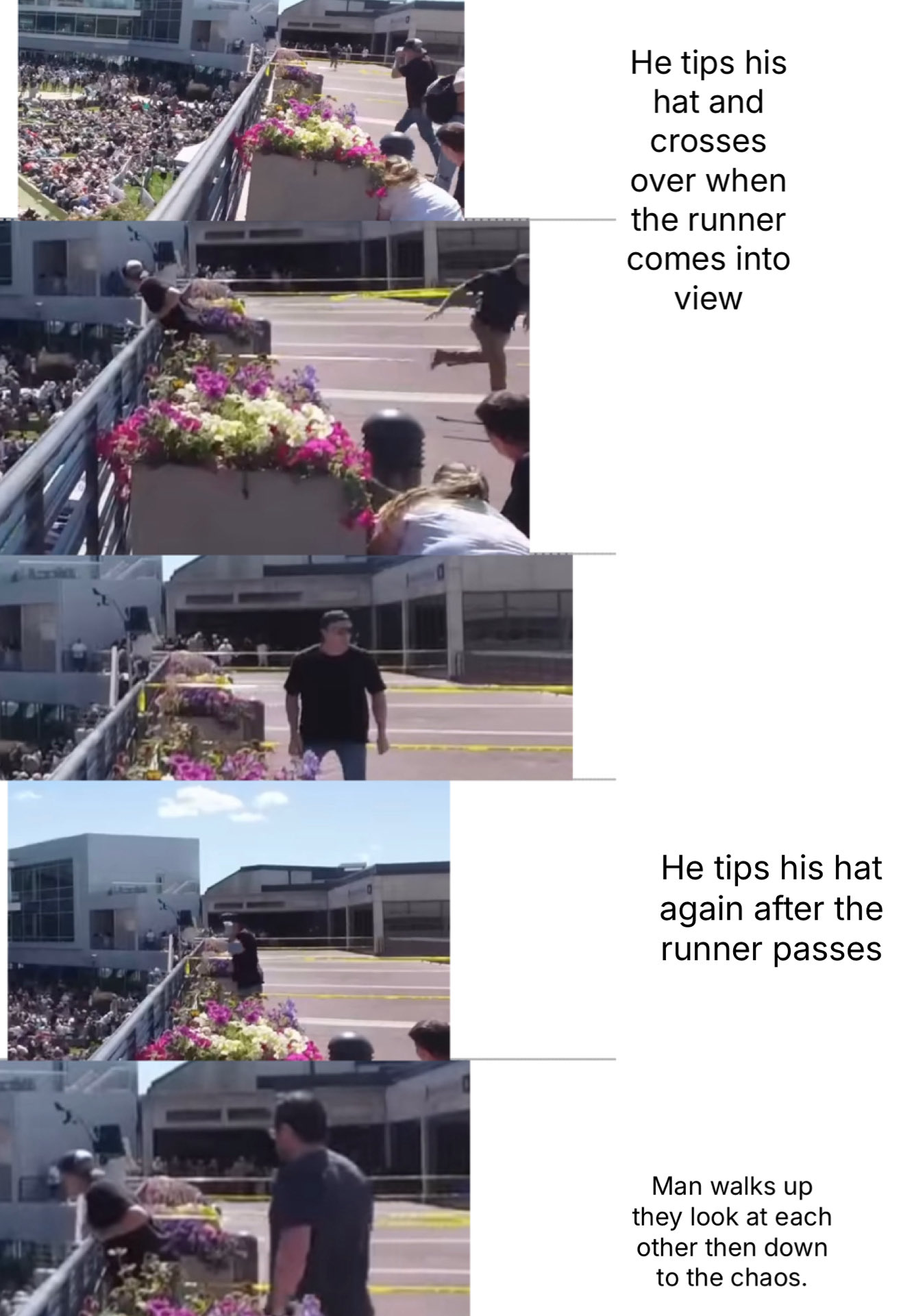
The Claim the Runner Started Before the Shot (Claims)
An unattributed passage back-extrapolates the rooftop runner's start to 12:23:28, two seconds before the shot. The arithmetic assumes constant velocity from a standing start, which is exactly where the two seconds come from.
Read this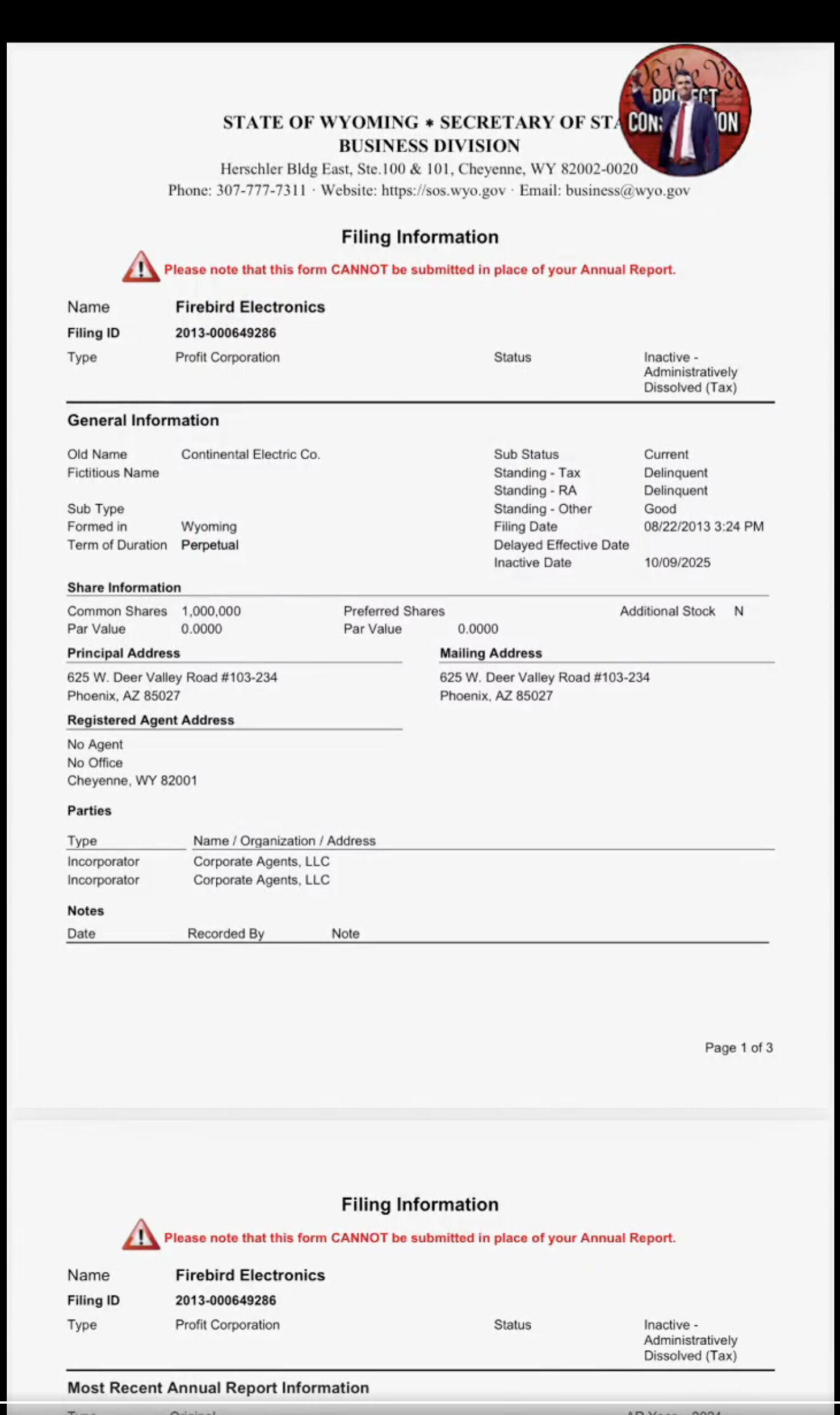
The GGLF 2023 LLC Life-Insurance Policy (Claims)
Researchers claim a policy on Charlie Kirk was taken out right after he questioned October 7. The Wyoming filing offered as proof shows the LLC was formed five months before October 7 — the exhibit defeats the claim it was produced for.
Read thisA Whistleblower's TPUSA Recruitment Claim (Claims)
A former TPUSA representative alleges he was questioned about Israel at a bar during training, and told by two colleagues they were with Israeli intelligence. Single-source, no names, no documents — and recorded here as exactly that.
Read thisElsewhere In The Investigation
Immediate Aftermath: 10 Minutes After the Shot (12:23–12:33 PM MDT)
The ten minutes from the shot to the hospital doors, second by second, where nearly every enduring dispute in this case is seeded. Every source in the window disagrees with the others.
Read thisSuspect Manhunt & Misidentification
The first-hours description — dark hat, flag shirt, dark jeans, a stiff right-leg gait — set against the man eventually charged. A witness says the photo he was shown was someone else.
Read this
No Counter-Snipers or Secret Service
No counter-snipers, no Secret Service, an overlooked rooftop, and a speaker with a documented threat history. This page is about what was not there.
Read this
No ambulance, no sirens — carried into a private vehicle by his own detail. Using the car already on hand in a chaotic scene is not evidence of wrongdoing, which is why the page is about who controlled the evidence, not about rescue.
Read thisSources
- Investigation file, "Day of Shooting" section: "According to police audio, the first report of the shooting came in at 12:26 p.m." — no link to the audio, no dispatch log, and no agency is cited.
- Investigation file, second-by-second reconstruction: "00:43-01:05 SUV departs for hospital."
- Investigation file, separate reconstruction: "12:26PM MDT Mikey three-wayed in Erika Kirk" — unattributed.
This website's author is @HolonCitizen on X and YouTube/@HolonCitizen. Follow me there.
Interesting
- The RODE pack was reportedly worn under the shirt against his torso that day.
- Kash Patel reportedly rebuffed an offer to probe foreign involvement, and Kent stepped down.
- Kirk reportedly told a counter-terrorism official "stop us from getting into a war with Iran".