Sheriff Brooksby's Resignation (Claims)
:::caution Attributed claims only Sheriff Nate Brooksby and President Astrid S. Tuminez are living people. Neither has been charged with or found to have committed any wrongdoing, and resigning a post is not evidence of anything. This page records an observation about timing that circulates among investigators, and explains why that observation carries very little weight on its own. :::
Claim snapshot
| Field | Value |
|---|---|
| The claim | The sheriff who facilitated the surrender resigned, and so did UVU's president — a pattern worth noting |
| Raised by | The investigation file's compiler; unnamed X posters; Baron Coleman (on the press-conference timeline) |
| First surfaced | Undated in source |
| Rests on | Anonymous posts — no primary source is cited |
| Evidence rating | THIN |
What is alleged
The investigation file records the observation in close to its entirety in two short passages. The first: "Does anyone else find it strange that Sheriff Nate Brooksby — who reportedly received the tip that led to Tyler Robinson turning himself in — AND UVU President Astrid S. Tuminez both resigned this year?" The second restates it: Washington County Sheriff Nate Brooksby, who reportedly received the relayed tip and facilitated Robinson's surrender at his office on September 11, has resigned. Robinson turned himself in accompanied by his parents and a family friend the day after Kirk's shooting; Brooksby facilitated that surrender; "Now he's gone."
The framing ties the departure to the disputed material covered elsewhere in this section: the 8:02/8:04pm call account Brooksby gave publicly, which Baron Coleman argues cannot be reconciled with a reported 6:25pm Miranda warning; and the missing lobby CCTV and bodycam footage from Brooksby's own agency. Read that way, the resignation is offered as the third leg of a pattern — the official at the center of a contested timeline leaving the post from which he described it.
The pairing with Tuminez, president of the university where the shooting occurred, is offered as corroboration: two institutions touched by the same event, two senior departures, one year.
The ordinary explanation
Elected sheriffs and university presidents resign for entirely ordinary reasons — term fatigue, health, family, a private-sector offer, or simple burnout after the defining crisis of a career. A resignation months after a mass-casualty event on your watch is at least as consistent with exhaustion as with anything else, and arguably more so: running the agency at the center of the most scrutinized homicide in the state's recent history, under national media pressure and a public-records fight, is the kind of experience that ends careers by attrition rather than by scandal. Nothing in the file suggests either official was removed, disciplined, or left under a cloud.
The two-departures pairing is weaker still. An enormous number of senior officials touched this case across UVU, Orem PD, two sheriff's offices, Utah DPS, the Governor's office, and the medical examiner's office. Finding two resignations among them in a year is a small and unsurprising sample — you would expect some turnover in that population in any twelve-month window, with or without a shooting. Without a stated causal reason from either person, treating adjacency in time as evidence of connection is the textbook post hoc fallacy. It is the kind of item that feels significant precisely because the underlying case is unresolved, and it should be held to the same standard as anything else: what document, statement, or record actually links the departure to the conduct being questioned? At present, none is offered.
What would settle it
- Obtain Sheriff Brooksby's resignation letter and the county commission's records of his departure, which would state the reason on the record.
- Ask Brooksby directly, or obtain any public statement or interview in which he explains the timing.
- Establish the actual dates of both resignations relative to the shooting and to the GRAMA appeal, since the file gives neither.
- Compare against baseline turnover — how many comparable Utah officials left posts in the same period — which would show whether there is any pattern at all.
Interesting In This Area
- The 6:25pm Miranda claim is the timeline his account is measured against.
- No bodycam, purged CCTV came from his own agency's systems.
- The booking sheet gap runs six hours across two records.
- UVU GRAMA warnings are the strongest documentary item in this section.
Interesting In Other Areas
- Institutional resignations collects every departure investigators have flagged since September.
- Washington County Sheriff is the building where the surrender reportedly happened.
- Baron Coleman's early turn-in argument is where the timeline objection originates.
- Sheriff video withheld is the cover-up version of the footage question.
Other Pages In This Section
The Courtyard Paved Over Days After the Shooting (Claims)
A contractor says on camera he was told "the governor and the FBI... want this done by Monday." Pavers went in four days after the shooting, over the ground that would carry any residue. The instruction is secondhand from an unnamed on-site coordinator.
Read this
The Claim That Robinson Did Not Surrender Voluntarily (Claims)
Candace Owens argues there is no sworn written confession, and that a former deputy warned a frightened 22-year-old to come in before a raid. Prosecutors rarely obtain written confessions in capital cases, so the missing document proves less than it is asked to.
Read this
The Empty ER and Hospital Personnel Changes (Claims)
A rare page that turns on its own source: the investigation file contradicts itself three lines apart and retracts one of its own claims inside the same paragraph. Those failures are stated plainly instead of repeated.
Read this
Was a Nearer Level II Trauma Center Bypassed? (Claims)
Kirk was taken to a Level IV hospital when a Level II trauma centre was reportedly closer. The investigation file gives two flatly incompatible sets of distances, neither sourced to any mapping record — and the conspiracy-friendly version is the unsourced one.
Read thisElsewhere In The Investigation
Institutional Resignations After the Shooting
A sheriff, a university president, a state chief medical examiner and an FBI field boss all left their posts inside a year. Each departure has an ordinary explanation; the page tracks the timing anyway, because the surrender dispute runs through some of the same people.
Read this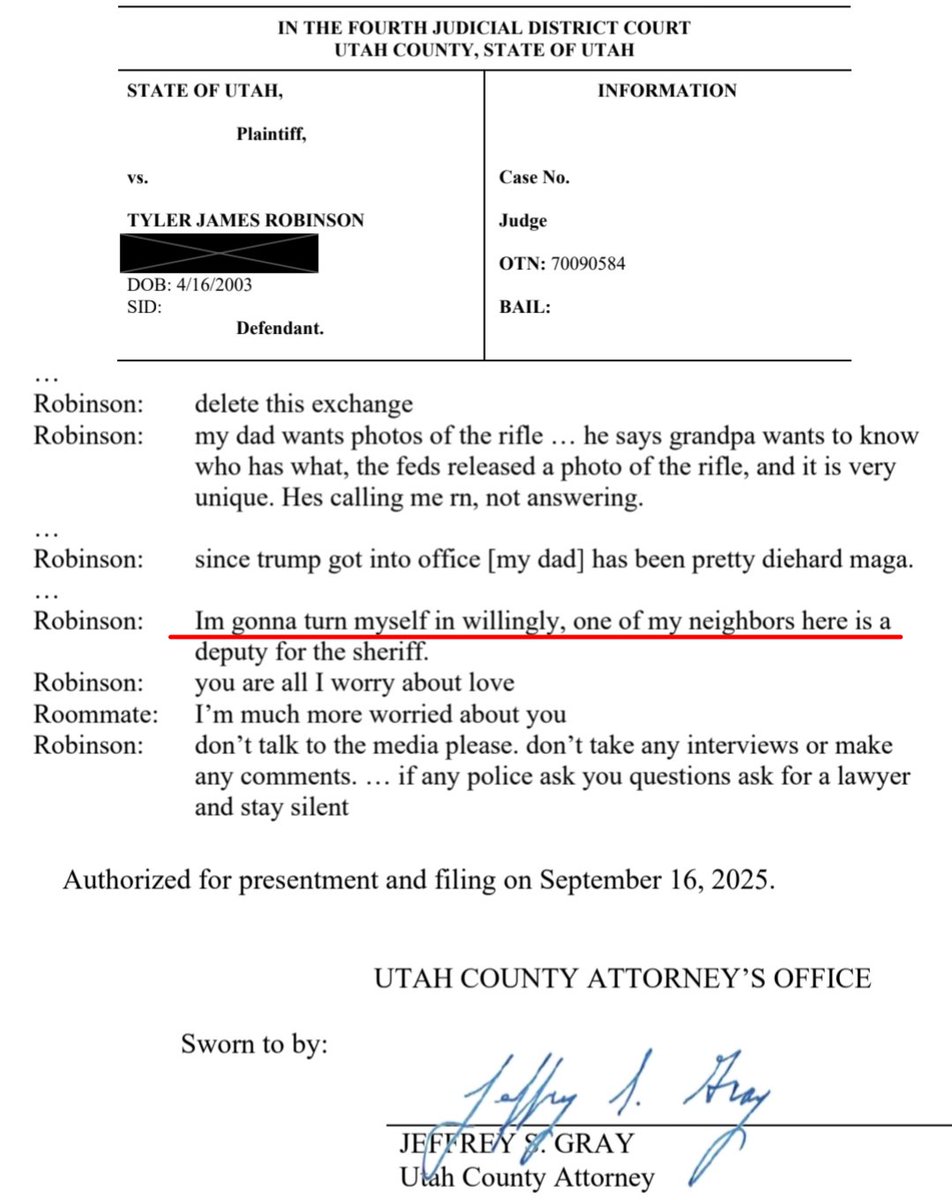
Washington County Sheriff's Office (Surrender Site)
The Hurricane office where the accused arrived with his parents, sat unrestrained with water, and was never questioned by the county. Federal and state investigators took custody around 2 AM and drove north.
Read this
Baron Coleman: Early Turn-In & the Refused Surrender Video
Coleman's case that Robinson turned himself in during the early afternoon of September 11, not after 9 PM — and that Washington County refused or deleted the video that would show it.
Read thisTyler Robinson Surrender Video Not Publicly Released (Claims)
The Washington County Sheriff's Office reportedly returned "no records" for video of the surrender and booking. A 33-hour manhunt ended, and the ending was apparently not recorded.
Read thisSources
- No primary source is cited in the investigation file for this claim. The file records it as an observation drawn from unnamed X posts.
- Baron Coleman interview clip (WDYFW podcast), referenced for the Brooksby press-conference timeline rather than for the resignation
This website's author is @HolonCitizen on X and YouTube/@HolonCitizen. Follow me there.
Interesting
- Reporting alleges the FBI director shut down a foreign-nexus counterterrorism review.
- A since-deleted post said the UVU firm wanted to remain in the shadows while another took blame.
- Greg Shaffer said publicly he was stabbed in the back over the last-minute security switch.