Palantir Reportedly Linked to the Gun-Recovery Land (Claims)
:::caution Attributed claims only This is the weakest-sourced item in this section, and it is published as a claim to be retired rather than a lead to be followed. It is hearsay, it is contradicted by a competing claim in the same list, it misspells the company's name, and it concerns a fact anyone could check in public records that nobody has produced. Palantir is accused of nothing. :::
Claim snapshot
| Field | Value |
|---|---|
| The claim | The land where the rifle was reportedly recovered was owned by Palantir — or, per the same list, by the university |
| Raised by | Anonymous citizen investigators; items 9 and 18 of the "Strange events" list |
| First surfaced | Undated in source |
| Rests on | Secondhand hearsay — the file's own wording is "Someone said" |
| Evidence rating | THIN |
What is alleged
Two lines in the investigation file's "Strange events" working list record competing claims about who owns the property where the rifle was reportedly recovered. Item 9 reads: "Who owns the house the gun was left at? Someone said the university owned it. Someone said Palentire owned it." Item 18 asks the same thing again: "Palentire owns the land the gun was left at?" The spelling "Palentire" appears to be a rendering of Palantir, the defense and intelligence data-analytics firm.
The reason it landed in an intelligence-adjacent section at all is guilt by adjacency: Palantir is a prominent contractor to US intelligence and defense agencies, so the possibility of its name attaching to the parcel where the case's central piece of physical evidence surfaced was treated as a thread worth resolving. That is the whole of the argument.
The same list records the recovery itself as suspicious, and that is the more substantive claim of the pair. An initial arm-to-arm sweep by local law enforcement reportedly found nothing. K-9 dogs reportedly found nothing. The weapon was reportedly located only after three federal agents directed three junior officers to search the area again. That sequence is covered separately at the rifle found after federal redirect.
The ordinary explanation
Every structural feature of this item marks it as an unverified rumor rather than a lead. The file records it only as hearsay — "someone said," twice, with no source attached to either. It presents a directly competing claim in the same breath, namely that the university owns the land, which means the list's own author had two mutually exclusive answers and no way to choose. And it misspells the company's name, which is the signature of a claim transmitted verbally through several hands rather than read off a document.
Then there is the fact that decides it. Land ownership is a public record, trivially checkable through Utah County parcel data by anyone with a browser and five minutes. No investigator appears to have produced it — and that absence is itself the finding. A claim this easy to verify, left unverified for this long, is far better explained by nobody having bothered than by anyone hiding anything.
On the substance: Palantir is a software company. It does not conventionally hold rural or campus-adjacent real estate, and there is no reason it would. Even granting the improbable — that some entity with a similar-sounding name held the parcel — ownership of land near a search area implies nothing whatsoever about the search or about what was found there. Property does not participate in crimes.
The recovery sequence has an ordinary explanation too, and it is a strong one. A second, more careful sweep of a re-scoped search area after federal investigators arrive and narrow the parameters is standard practice, and it frequently finds what a broad first pass missed. That is not a suspicious sequence; that is how searches work.
What would settle it
- Pull the Utah County parcel record for the recovery location. This costs nothing and ends the question permanently.
- Establish the exact recovery location, which the claim never specifies — "the house the gun was left at" is not a legal description.
- Determine whether the university's ownership claim, the competing entry in the same list, is the correct one.
- Obtain the search log showing how the second sweep's area differed from the first.
- If no record supports it, retire the claim publicly — which is the likely outcome and the useful one.
Interesting In This Area
- The same working list elsewhere says the university owned the parcel instead.
- Feds reportedly directed the re-search that produced the rifle in those trees.
- The gun drop location and search sequence remain the load-bearing part of the state case.
- The ATF fragment report could neither identify nor exclude the recovered Mauser.
Interesting In Other Areas
- The rifle was reportedly wrapped in a dark towel in trees north of campus.
- A citizen journalist circles a white Kia Soul turnaround at that exact lot.
- An arm-to-arm search and a K-9 pass reportedly found nothing first.
- Who sealed the bundle, and when, stays unanswered on the public record.
Images
Other Pages In This Section
Provo Airport Badge Access List Modified 9/11/25 (Claims)
One sentence in a working list: the badge access list at the airfield ten minutes from campus was reportedly modified the day after. No document, no custodian, no before-and-after — an observation someone wrote down to check, and nobody checked.
Read this
The Canon XA55 Audio and a Third Boom (Claims)
Uncompressed four-channel broadcast audio is argued to separate three events: a Mach cone, a muzzle blast around 120 metres, and a louder low-frequency peak roughly 46 metres away — right at the tent where Charlie was seated.
Read this
Tyler Robinson's Clothing Changes That Day (Claims)
Maroon shirt and shorts at 8:29 am, black long-sleeve and jeans by 11:49, a pronounced limp at 11:50 that is gone by the 12:22 roof run. He is charged, not convicted, and the file itself lists these as questions.
Read thisThe ATF Fragment Shows Only Class Characteristics (Claims)
The ATF's September 17 lab report reportedly could neither identify nor exclude the Mauser 98 as the source of the recovered jacket fragment. It is the only item in this section resting on a document rather than a thread — and both camps overclaim it.
Read thisElsewhere In The Investigation
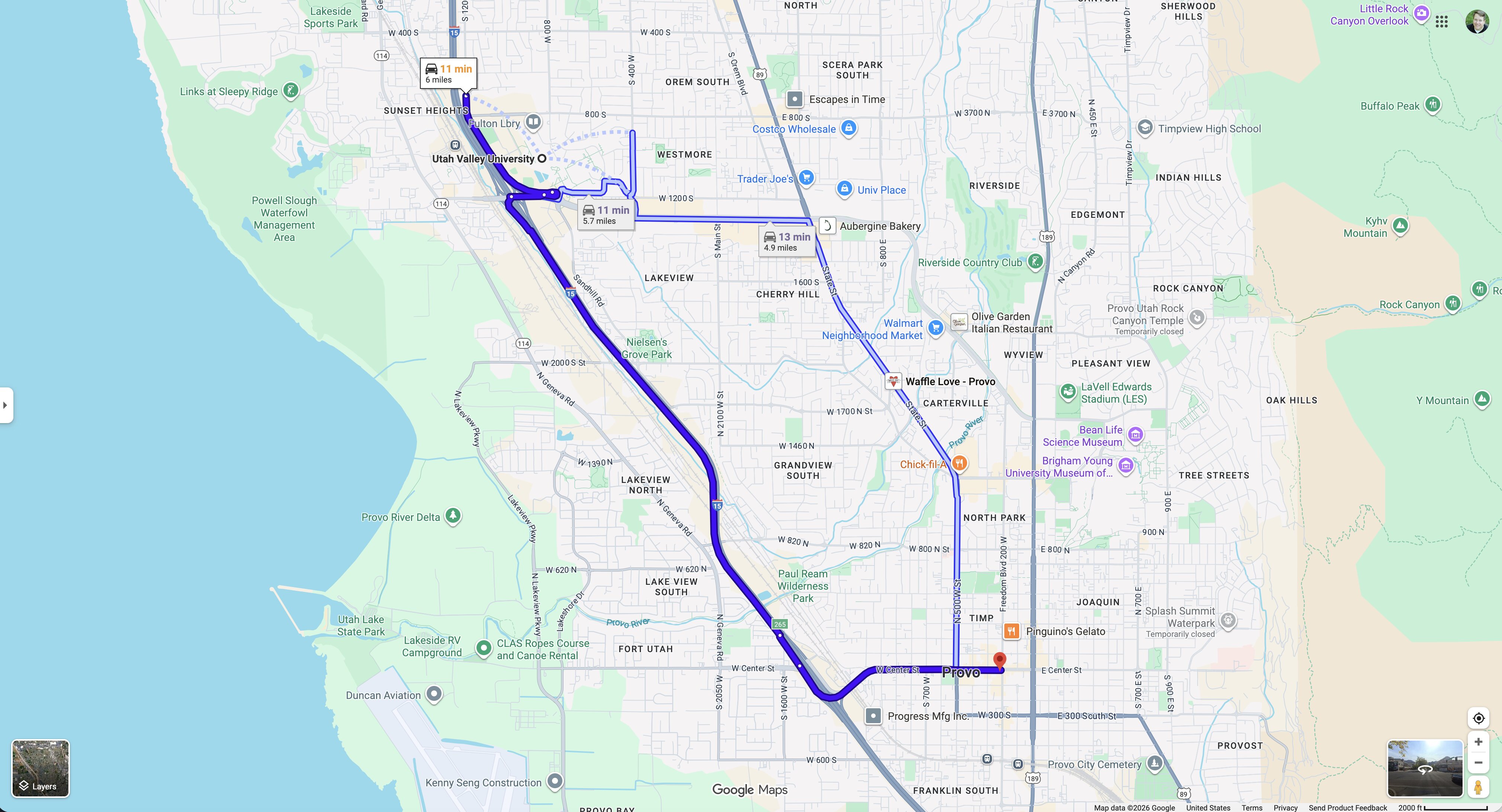
Wooded Area — Gun Recovery (North of UVU)
A scoped Mauser .30-06, reportedly wrapped in a dark towel, found in trees north of campus after earlier sweeps and a K-9 pass reportedly found nothing. The state's whole theory rests on that recovery.
Read this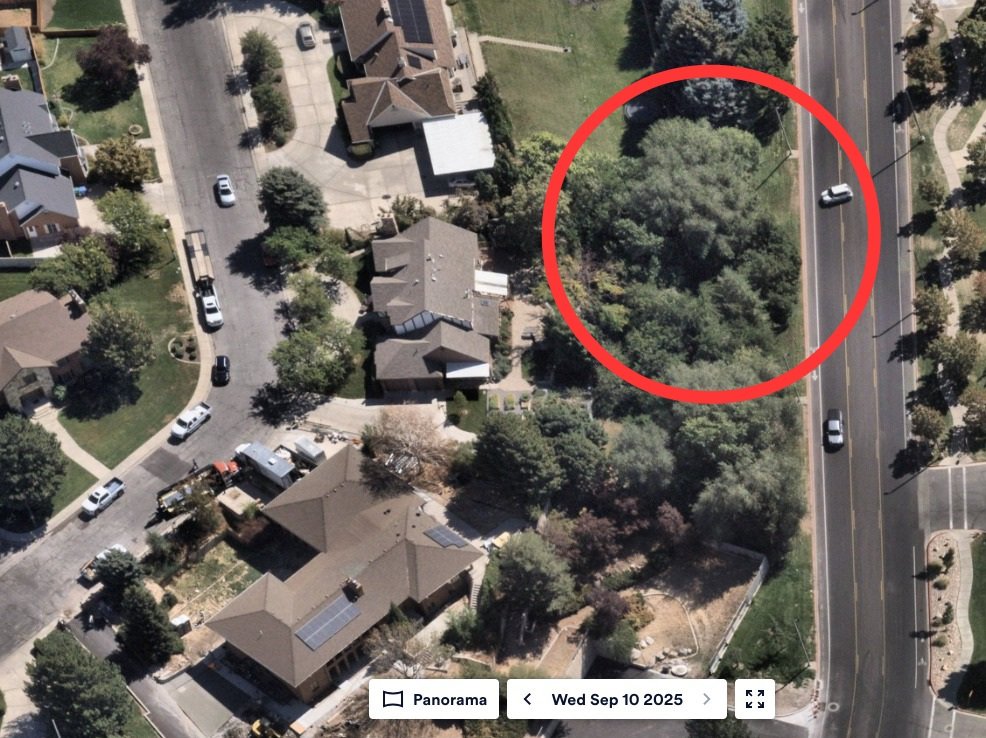
Rifle Site — White Kia Soul Turnaround (Claims)
A citizen journalist circles a wooded lot on September 10 aerial imagery and says a white Kia Soul turned around at exactly that spot that morning. No plate, no VIN, no registration — the page carries the claim and the missing links together.
Read this
Rifle Found Only After a Federal Redirect (Claims)
An arm-to-arm search found nothing. A K-9 pass found nothing. Then federal agents arrived, sent local officers back over the same ground, and a towel-wrapped rifle appeared — the reported sequence skeptics keep returning to.
Read this
Who found the rifle, when, after which K-9 passes, and how the towel-wrapped bundle was photographed and sealed. These are ordinary evidence-handling questions, and on the public record they are unanswered.
Read thisSources
- No primary source is cited in the investigation file for this claim. It appears as items 9 and 18 of an anonymous "Strange events" working list, recorded as hearsay ("Someone said"), with a competing contradictory claim alongside it and the company's name misspelled.
This website's author is @HolonCitizen on X and YouTube/@HolonCitizen. Follow me there.
Interesting
- A VIP jet reportedly carrying the Pentagon's top intelligence official sat at Fort Huachuca.
- A court filing argues rights were invoked one minute after the warning.
- The Salt Lake City FBI chief was reportedly forced out months before the killing.