An Anonymous Caller Demanded the Event Be Cancelled (Claims)
Nobody knows who the caller was, and this page does not suggest anyone. Demanding that a speaker be cancelled is protected speech and, by itself, is not a threat. The open question here is procedural: the university recorded the call, so was it ever traced, logged in full, or passed to police? Tyler Robinson is charged, not convicted.
Claim snapshot
| Field | Value |
|---|---|
| The claim | Twelve days before the event, an anonymous caller demanded that Charlie Kirk's September 10, 2025 appearance at UVU be cancelled |
| Where it comes from | UVU's own After-Action Report, released September 25, 2026, planning timeline, p. 18 |
| Raised by | @BasedSamParker on X, September 28, 2026 |
| Status | Documented — the sentence is in the report. Everything else is open: who called, what else was said, and whether anyone followed it up |
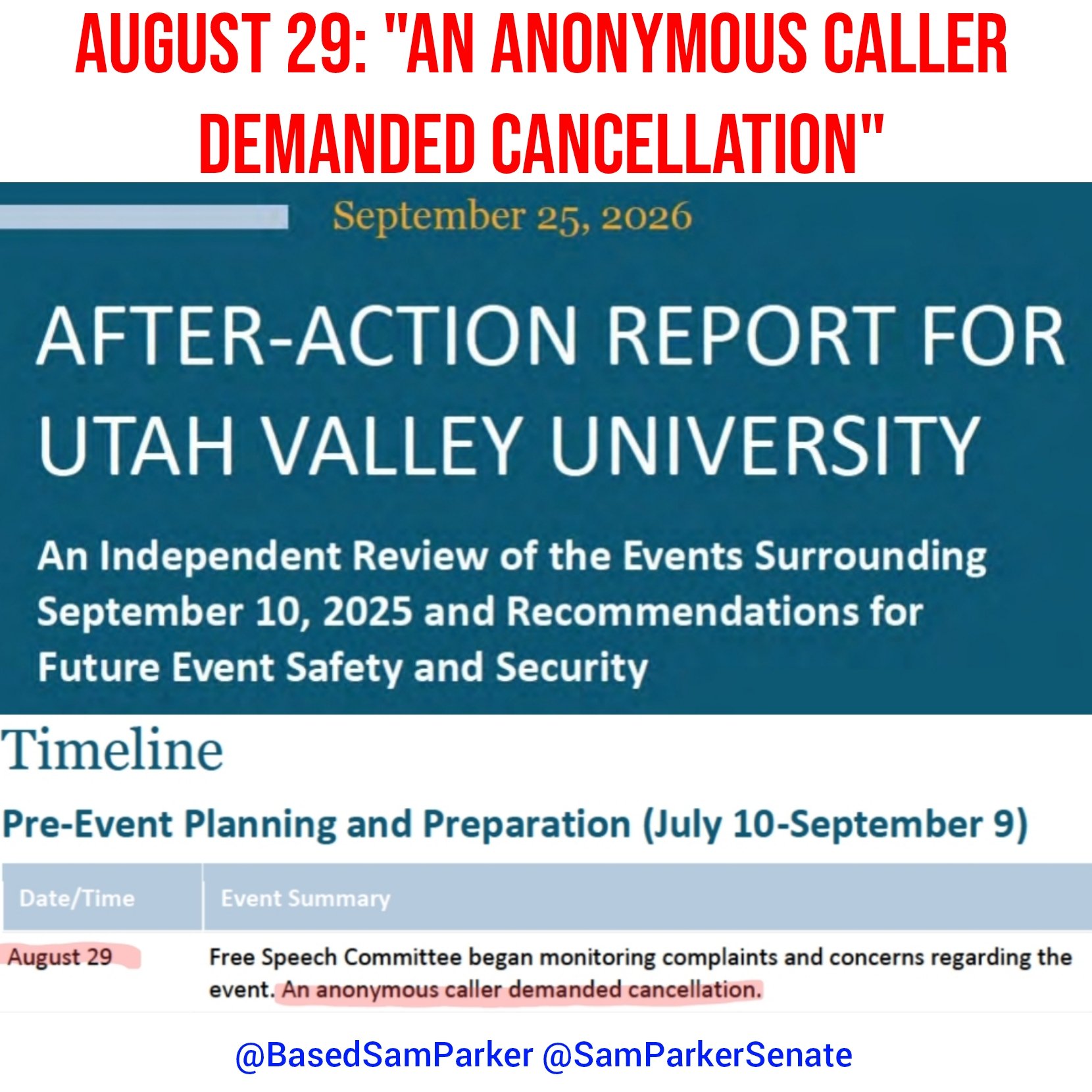
The report's cover and its August 29 timeline row, with "An anonymous caller demanded cancellation" highlighted. Source: @BasedSamParker on X, September 28, 2026.
What the report says
UVU commissioned an independent review of the event, published on September 25, 2026 as the After-Action Report for Utah Valley University. Its timeline section, "Pre-Event Planning and Preparation (July 10–September 9)", has this row on page 18:
August 29 — Free Speech Committee began monitoring complaints and concerns regarding the event. An anonymous caller demanded cancellation.
That is the whole entry. We searched the rest of the report's text and found no other mention of the caller. It gives no name, no phone number, no transcript or summary of the call, and no sign that the call was passed to UVU Police, the Utah SIAC, or the FBI.
Read page 18 of the report →What is being asked
According to @BasedSamParker, posting on September 28, 2026:
So the anonymous caller who on August 29 demanded Charlie's event be cancelled was notable enough to include in the timeline but not notable enough to run down the details on? Weird. What's this all about?
That is the question on this page. The reviewers thought the call was worth putting in the timeline. The report then says nothing more about it.
Where it sits in the timeline
The same page of the report shows what happened around the call:
- August 27 — the event was approved "before a documented Security Assessment or written Event Action Plan was developed" (a Key Decision Point in the report).
- August 29 — the Free Speech Committee starts monitoring complaints; the anonymous caller demands cancellation.
- September 2 — UVU's police chief says no security request has come from TPUSA yet.
- September 3 — the committee notes "increasing anti-Kirk online activity and petitions to cancel the event."
The report records one more anonymous contact. On the morning of September 10, an anonymous tip about an EMP-type device came in, and the Utah SIAC reportedly dismissed it as not credible because the tipster had given unreliable information before. That tip is covered on The EMP-Device Tip. The report does not say whether the August caller and the September tipster were the same person. The GRAMA records add a third pre-event warning: two men who reportedly came to UVU the night before, asking to talk to police about "a plan."
The ordinary explanation
This is almost certainly the most likely reading. A well-known, polarizing speaker coming to a public campus draws angry calls and cancellation petitions, and the report itself says the committee was tracking "complaints and concerns" and petitions. One anonymous caller demanding cancellation fits that pattern and does not have to mean anything more. The report's own criticism elsewhere also fits: it found that pre-event monitoring "focused primarily on protest activity and reputational concerns" rather than on threats. If so, the call was noted as a complaint and dropped. That would be a gap in process, not proof of a plot.
What would settle it
- The call record: which UVU office took the call, what time, and from which number (even if it was blocked).
- Any notes or a fuller account of what the caller said, especially whether it included a threat or a reason.
- Whether the call was passed to UVU Police, the Utah SIAC, or the FBI, and whether anyone tried to trace it.
- Whether the review team interviewed the staff member who took the call, and why the report records it without comment.
- Whether the call can be linked to, or ruled out as, the September 10 EMP tipster or the two men from September 9.
Interesting In This Area
- Six campus officers and no ambulance covered a crowd the chief later put at 3,000.
- The claim a group blocked university security is another access question from the same day.
- The UVU 9/10 list is the venue-and-people half of this section.
Interesting In Other Areas
- Two men contacted UVU the night before, according to the university's own records.
- The UVU After-Action Report — Contested Points page covers what the report gets wrong and leaves out.
- Posts before the event asks the same question about warning signs that may never have been followed up.