Fourteen Ways TPUSA Went the Opposite Direction After Kirk
:::caution Legal Disclaimer — No Claim Of Wrongdoing Nothing on this page is a finding by this website that any living person named here committed a crime, acted unethically or illegally, or had any knowledge of the assassination of Charlie Kirk before it happened. No one named here has been charged with, accused by any authority of, or found to have committed any offense connected to September 10, 2025.
What appears here about who was where, who travelled on what, or who attended what comes from comments made by other people on social media and in public commentary, attributed to whoever made them. This site does not adopt those claims. They are recorded so that readers, journalists and investigators can check them against primary records — a flight manifest, a visitor log, a FOIA release — and establish whether there is any truth in them. Until that is done, nothing here should be read as an accusation. :::
After Charlie Kirk's assassination on September 10, 2025, multiple observers, former supporters, and disaffiliated TPUSA chapters began documenting a troubling pattern: the organization and its continued media operations were allegedly taking stances that directly contradicted Kirk's own publicly stated positions. The fourteen areas below represent the most concrete and most-discussed reversals identified across social media analysis, press reporting, and former affiliate accounts.
This page presents these as reported claims and observations. Where individuals are named, the content reflects what has been publicly stated and alleged—not findings of fault or wrongdoing.
Table of Contents
- Support for Rep. Thomas Massie
- Opposition to War and Regime Change in Iran
- Evolving Stance on Israel and Pro-Israel Donors
- Traditional Family Roles and Working Mothers
- Use of Kirk's Personal Social Media Accounts
- Jeffrey Epstein and Intelligence Agency Scrutiny
- America First Non-Interventionism vs. Hawkish Pivot
- Internal Critics and Movement Purity
- Legacy Preservation vs. Rebranding for New Leadership
- Organizational Direction and Donor Influence
- DOGE-Style Internal Audit Launched Then Dropped
- Opposition to Anti-BDS Legislation on Free-Speech Grounds
- Questioning October 7 as a Pretext for Gaza Operations
- Hosting Open Debates with Israel Skeptics
1. Support for Rep. Thomas Massie
During his lifetime, Charlie Kirk repeatedly and publicly praised Rep. Thomas Massie (R-KY) as one of his favorite members of Congress. Kirk described Massie as principled, Constitution-loving, liberty-focused, and tough on intelligence agencies—sentiments on record from at least as far back as a 2016 TPUSA event and repeated across subsequent public appearances. The praise was consistent enough that Massie's name was closely associated with the kind of lawmaker Kirk held up as a model.
After Kirk's assassination, the continued Charlie Kirk Show—hosted by Andrew Kolvet and Blake Neff according to published reports—reportedly reversed course and attacked Massie as a RINO. Show hosts allegedly cited "private" frustrations Kirk had expressed over Massie's votes on the 2025 omnibus bill and his public comments about the Epstein files. Critics pointed out the obvious problem: these were unverifiable private claims being used to contradict a long and well-documented public record of praise.
Reports further indicate that TPUSA amplified Trump-backed primary challenger Ed Gallrein rather than endorsing the incumbent Massie. Massie reportedly lost his primary by approximately 55–45 percent in May 2026—a result many of his supporters attributed in part to pressure generated by TPUSA and its affiliated media. Whether Kirk would have backed that effort or whether the campaign represents any genuine continuation of his views remains sharply disputed.
2. Opposition to War and Regime Change in Iran
Charlie Kirk staked out a clear and consistent public position on U.S. military involvement in the Middle East: he opposed it. In numerous appearances Kirk warned against repeating what he called the quagmires of Iraq, Libya, Syria, and Afghanistan. He emphasized America First budget priorities over foreign intervention, noted that younger conservative voters had no appetite for endless wars, and—when pressed specifically about Iran—reportedly described regime change talk as "very complicated" and said he avoided pushing it.
After the organizational transition following Kirk's death, the continued Charlie Kirk Show and TPUSA's public messaging reportedly shifted toward a markedly more hawkish stance. According to observers and published commentary, TPUSA began promoting or endorsing military action against Iran, with references to Operation Epic Fury appearing in contexts that framed intervention favorably. Former TPUSA chapter leaders and online commentators characterize this shift as a direct contradiction of Kirk's own stated foreign policy philosophy.
Critics note that no credible evidence was offered to show Kirk had privately changed his view on Iran in his final months. The hawkish turn has been attributed by former allies to donor influence and to ideological realignment among the people who now direct the organization's media output.
3. Evolving Stance on Israel and Pro-Israel Donors
In the months before his assassination, Kirk's public comments on Israel became notably more critical and cautious. According to reports and video or audio clips that circulated after his death, Kirk had grown skeptical of unconditional U.S. support for Israel and—approximately three days before the September 10 shooting—made a public statement that he was considering "leaving the pro-Israel cause" after sustained donor pressure. He also declined to bar critics of Israel, including Tucker Carlson, from TPUSA events, and stated publicly that Jeffrey Epstein may have had ties to Israeli intelligence (Mossad). Reports indicate that Robert Shillman, a significant donor, cut ties with Kirk or threatened to do so in response.
Following his death, TPUSA leadership under Erika Kirk and the continued show hosts reportedly reversed this trajectory. The organization's public messaging moved back toward strong pro-Israel talking points and toward alignment with neoconservative positions on Middle East policy. Many former Kirk supporters on X accused the new leadership of rewriting his legacy and prioritizing donor relationships over the genuine evolution Kirk's thinking had undergone in his final months.
These remain contested claims. TPUSA and its current leadership have not publicly acknowledged this as a reversal, and some Kirk associates argue that his private views were more complex than critics describe. Readers should weigh these accounts against TPUSA's own public statements and available primary documentation.
4. Traditional Family Roles and Working Mothers
Charlie Kirk was a vocal and consistent public advocate for traditional family values, including the position that mothers with young children should prioritize home and family over full-time professional careers. These views were central to his public persona and stated frequently on his show, at TPUSA events, and in his writing. Kirk presented this not as personal preference but as a principled stance tied to the health of families and society.
On September 18, 2025—eight days after Kirk's assassination—Erika Kirk, his widow and mother to their young children, was reportedly elected full-time CEO and board chair of TPUSA. Critics and former supporters cite this directly as a contradiction of the values Kirk publicly championed. They argue that the organization he built on traditional family messaging now has a working mother in its most demanding executive role, installed in the immediate aftermath of his death.
Supporters of Erika Kirk's leadership counter that she was the most qualified person available to stabilize the organization during an acute crisis, that Kirk's public views were nuanced in ways his critics ignore, and that her role reflects practical necessity rather than ideological reversal. The debate over whether this arrangement contradicts Kirk's stated legacy continues within the TPUSA community.
5. Use of Kirk's Personal Social Media Accounts
In the immediate aftermath of the assassination, Erika Kirk was publicly reported to have stated that TPUSA would not post on Kirk's personal social media accounts as though he were still alive, describing such an approach as "tone deaf and really disturbing." This commitment was widely noted and appreciated by many of Kirk's followers as a respectful acknowledgment of his individual voice and the impossibility of replicating it posthumously.
According to multiple reports and community notes filed on X, TPUSA subsequently used Kirk's accounts to publish content promoting regime change in Iran and other hawkish foreign policy positions—stances that, as documented elsewhere on this page, reportedly contradict Kirk's own publicly stated views. Community notes labeled at least some of this content as misleading or inconsistent with Kirk's known positions.
Critics have characterized this as a direct breach of the public commitment Erika Kirk made. If accurate, it raises serious questions about organizational integrity and about the use of a deceased person's established audience to amplify positions he may not have endorsed or would have opposed.
6. Jeffrey Epstein and Intelligence Agency Scrutiny
Charlie Kirk spoke openly and at some personal and professional risk about Jeffrey Epstein, including public statements suggesting Epstein operated as or with Israeli intelligence (Mossad) and calling for transparency around related intelligence agency files. These statements put Kirk in tension with certain donors and allied organizations who reportedly viewed Epstein transparency as politically hazardous to their interests.
After Kirk's death, reports indicate that TPUSA's continued show hosts invoked alleged "private" frustrations Kirk had expressed—specifically about Rep. Massie's public Epstein stance—as justification for attacking Massie's character. Critics observed the contradiction: Kirk's public record showed consistent support for Epstein transparency and skepticism of the intelligence community's narrative, yet claimed private sentiments were weaponized against a lawmaker who shared that skepticism.
The suggestion that Kirk privately resented Massie's Epstein positions directly contradicts the arc of Kirk's public statements on the subject. These alleged private opinions cannot be independently verified and may represent a selective or invented characterization of his views—one that happens to serve the post-death TPUSA's preferred political direction.
7. America First Non-Interventionism vs. Hawkish Pivot
In his final active period, Kirk had been articulating an increasingly distinct version of America First politics—one that was skeptical of Middle East entanglements, critical of the donor influence that drove foreign policy decisions, and aligned with the populist non-interventionist wing of the Republican Party. This evolution was evident in his rhetoric, his booking decisions, and his public commentary in the months preceding his death.
Reports from former TPUSA chapter leaders, prominent X accounts in the America First space, and journalists covering the post-Kirk transition describe a significant shift in the organization's orientation. The continued Charlie Kirk Show and TPUSA's broader messaging are characterized by critics as drifting toward neoconservative positions on Iran, Israel, and broader Middle East policy—precisely the positions Kirk had been moving away from. Multiple TPUSA chapters reportedly disaffiliated from the national organization citing betrayal of Kirk's principles.
Whether the shift reflects the genuine views of the new leadership, donor requirements, or a period of organizational instability remains an open question. The internal unease among TPUSA affiliates is real and documented, even if the specific ideological interpretation is disputed.
8. Internal Critics and Movement Purity
Kirk's approach to ideological diversity within the America First movement was notably pluralistic by the standards of some in that space. He reportedly refused to cut off figures whose views conflicted with donor preferences, maintained his relationship with Tucker Carlson despite pressure from pro-Israel donors to sever it, and issued public warnings against extremists such as Nick Fuentes infiltrating the movement—a sign he took the risks of radicalization seriously without embracing donor-pleasing purges.
After his death, post-September 2025 TPUSA is characterized by critics as more aggressive in marginalizing internal dissenters and aligning more rigidly with specific donor and MAGA factions. The attacks on Rep. Massie—a figure Kirk praised repeatedly—are cited as one concrete example. Some observers argue the new leadership has become more doctrinaire in ways Kirk actively worked to prevent, while others contend TPUSA is simply consolidating its base in a turbulent transitional moment.
Whether this represents a fundamental reversal of Kirk's approach or an understandable organizational shift after the loss of a dominant founding figure is debated. Those who believed Kirk was steering America First toward genuine independence view the post-death TPUSA as a co-optation of his name for purposes he would not have endorsed.
9. Legacy Preservation vs. Rebranding for New Leadership
A broad and persistent concern raised across X, by former TPUSA affiliates, and by commentators throughout the months following Kirk's assassination is the allegation that new leadership has engaged in rewriting Kirk's public record. This takes the form, critics argue, of citing claimed "private" stance changes known only to the inner circle—changes that conveniently align with the new leadership's hawkish and donor-friendly positions—while systematically downplaying or ignoring Kirk's documented public evolution.
The concern is amplified by reports that Kirk's name and show branding are being actively used for fundraising while the organization shifts its substantive values. Former supporters describe this as "grifting on his name" while abandoning the principles that gave the original Charlie Kirk Show its distinctive character. Claims that Kirk's "real" private views justified the new direction on Iran, Israel, Massie, or donor relationships cannot be verified and are disputed by people who worked closely with him.
These are serious reputational allegations. They are reported here as what is being publicly alleged, not as established findings. Kirk's full private views may never be fully known, and the interpretation of his public record remains genuinely contested among those who followed him closely.
10. Organizational Direction and Donor Influence
In the period immediately before his assassination, Kirk was reportedly managing significant and escalating tension with key donors—particularly those with strong pro-Israel alignments—over his shifting rhetoric and programming decisions. Reports describe near-daily pressure from certain donor figures, and multiple accounts indicate that Kirk had severed or was in the process of severing ties with at least one prominent donor, Robert Shillman, over these disagreements. The friction was described as serious enough to affect the organization's financial relationships in the short term.
Following Kirk's death and the transition to new leadership under Erika Kirk, reports allege that TPUSA reversed course on these donor relationships—restoring or prioritizing alliances that Kirk had been pulling back from. Critics point to this as evidence that donor requirements, not ideological continuity with Kirk's evolution, now drive the organization's direction. They cite internal unease, chapter disbandments including reportedly the University of Arkansas chapter, and vocal public backlash on X as symptoms of the underlying tension between the original Kirk brand and the post-death institutional direction.
The extent to which these organizational shifts represent deliberate betrayal versus difficult transition management is contested. What is not contested is that TPUSA is operating differently than Kirk's longtime supporters expected it would, and that the donor dynamics Kirk was actively navigating remain among the most unresolved and consequential questions in understanding both his death and what happens to TPUSA next.
11. DOGE-Style Internal Audit Launched Then Dropped
Approximately one week before the assassination, on or around September 2, 2025, Charlie Kirk reportedly issued an internal memo launching an organization-wide efficiency and financial review of TPUSA—described by observers as a "DOGE"-style audit of spending, metrics, organizational culture, and donor influence. Kirk had apparently grown concerned enough about TPUSA's internal operations to initiate a systematic review that went beyond routine annual accounting.
After his death, new leadership under Erika Kirk reportedly declined to complete or meaningfully pursue the audit, characterizing the process as no more than a standard annual review. Critics, including Candace Owens, seized on this as evidence of financial impropriety, donor-influence cover-ups, and mismanagement—and argued that Kirk's decision to launch the review in the final week of his life raises serious questions about what he had discovered or feared. The timing of both the audit's initiation and its subsequent abandonment has become a frequently cited detail in discussions of motive surrounding the assassination.
These allegations of financial cover-up are disputed. TPUSA has not confirmed the scope or substance of any pre-death internal review, and the claims about what the audit would have revealed remain speculative. The episode is nonetheless considered significant by many investigators because it places Kirk in a posture of internal institutional challenge just days before his death.
12. Opposition to Anti-BDS Legislation on Free-Speech Grounds
In May 2025, Charlie Kirk publicly opposed HR 867, federal anti-BDS legislation (Boycott, Divestment, and Sanctions against Israel), on the grounds that it would effectively criminalize private boycott decisions and thus violate First Amendment principles. Kirk argued that such legislation would backfire politically by giving credibility to claims that the U.S. government was being directed by pro-Israel interests—a narrative he considered particularly damaging among younger conservative voters he was working to reach.
Post-death TPUSA has reportedly aligned more closely with pro-Israel legal priorities and donor preferences, reducing or abandoning the free-speech caveats Kirk applied to Israel-related policy questions. The organization's shift away from Kirk's HR 867 position reflects a broader pattern critics describe as prioritizing donor alignment over the principled free-speech framework Kirk used to evaluate government action—including government action favorable to Israel.
Kirk's opposition to anti-BDS legislation was notable precisely because it came from someone considered broadly supportive of Israel rather than from a hostile critic. His willingness to hold that position under donor pressure was cited by supporters as evidence of genuine principle. Post-death TPUSA's departure from that position is presented by critics as another example of the organization's values shifting to match its donor base rather than Kirk's actual record.
13. Questioning October 7 as a Pretext for Gaza Operations
In his final months, Kirk reportedly made public statements suggesting that the October 7, 2023 Hamas attacks had provided a convenient pretext for the Netanyahu government to pursue what Kirk described as a campaign of displacement or ethnic cleansing in Gaza. This represented a significant departure from the uncritical pro-Israel framing common in conservative media, and it generated substantial controversy and donor pressure. Kirk framed these observations as concerns about the scale and character of the military response, not as denials of Israeli suffering or justifications for the October 7 attacks themselves.
After his death, new TPUSA leadership reportedly dropped all such skepticism entirely. The continued Charlie Kirk Show and TPUSA's public messaging are characterized by critics as promoting strong, uncritical support for Israel's military operations and reframing Kirk's legacy as fully aligned with unconditional backing of Israeli government policy. Former supporters argue that this misrepresents the actual position Kirk had arrived at in the months before his death.
These claims about Kirk's views are based on circulated clips and accounts from people who knew him; they are contested by those who argue his statements were more qualified than critics describe. What is not contested is that post-death TPUSA's public line on Gaza is significantly more uniformly supportive of Israeli operations than the position Kirk himself was articulating in mid-2025.
14. Hosting Open Debates with Israel Skeptics
During his final active period, Kirk hosted and moderated TPUSA events featuring genuine debate on Israel and U.S. foreign policy, including panels where prominent Israel-skeptical voices were given a full hearing. A notable example involved Dave Smith debating Josh Hammer on the U.S.-Israel alliance and broader foreign policy—an open-format exchange of the kind that placed serious America First skepticism alongside pro-Israel arguments on a TPUSA stage. Kirk's willingness to platform these debates reflected his belief that the movement needed to grapple honestly with the questions his audience was raising rather than suppress them.
Post-death TPUSA has reportedly reduced or eliminated this format, shifting to uniformly pro-Israel programming and distancing the show from voices that challenge U.S.-Israel policy. Former chapter leaders and America First commentators have accused new leadership of suppressing the same skeptical voices Kirk was platforming, and of treating open debate on Israel as too politically costly to continue given the organization's donor relationships.
The contrast between Kirk's open-debate posture and the post-death show's programming choices is cited by critics as one of the clearest measurable differences between the pre- and post-assassination versions of TPUSA's media operation—a difference observable by any listener who followed the show before and after September 10, 2025.
Laws (Charlie Kirk)
- The dropped DOGE-style audit findings and the donor wire transfers and pressure records and Kirk's private texts on leaving the pro-Israel cause are things that the Charlie Kirk Investigation Laws may result in powerful truths coming out that aren't out yet.
Citizen Investigator Claims on X (2026 refresh)
The “fourteen ways TPUSA went opposite Charlie” list remains a high-traffic citizen frame.
- 2026 posts (@phantompain1984, @Aric333) re-allege programming pivots on Iran/Israel, donor posture, and personnel — often with extreme moral language. Re-state as attributed media/political claims.
- Cross-check each bullet against primary video, board statements, or news reporting before treating it as documented.
- Even if some policy reversals are real, policy reversal ≠ homicide. This page tracks legacy tension, not a murder charge against leadership.
Counter-Claims and Debunk Attempts
Defenders of post-death leadership argue continuity of campus tours, memorial growth, and Trump-aligned activism prove loyalty to Kirk’s project. Skeptics answer that outward activism can coexist with donor-line shifts. Readers should demand primary quotes on each disputed issue (Massie, Iran, Israel, family roles, etc.) rather than list-count rhetoric.
Interesting In This Area
- The audit Kirk reportedly ordered was never completed after September 10.
- His 752 living-catalog episodes are reportedly no longer listed on Apple.
- Continuity leadership reportedly reached television within hours of the shooting.
- On Iran the organization moved toward supporting strikes he had resisted.
Interesting In Other Areas
- Kirk's own Iran warnings are on the record in his words.
- His on-air remarks about donor pressure predate the reversal debate by months.
- The Charlie Kirk Show continued under substitute hosts after his death.
- Candace Owens became the loudest former-employee critic of that direction.
Images

Videos
Footage related to this page. Each card opens that clip's own page, with the video, the full write-up, and its source.

Other Pages In This Section
TPUSA Leadership Succession After Kirk's Death
How fast continuity leadership was announced — a replacement figure reportedly on Fox News within one to four hours, during an active manhunt. Defenders cite the need to reassure staff, donors and chapters.
Read thisTPUSA DOGE Audit (What Charlie Ordered)
What the September 2, 2025 memo reportedly ordered: a broad efficiency and financial review going well past routine accounting, eight days before the assassination. Ordering an audit is prudent and normal; the timing is why it is here.
Read thisWere Charlie's Podcasts Deleted?
One question, checked rather than repeated: are the episodes Charlie hosted before September 10 reachable on Spotify and Apple today? The answer is given platform by platform, with dated proof links instead of restated claims.
Read this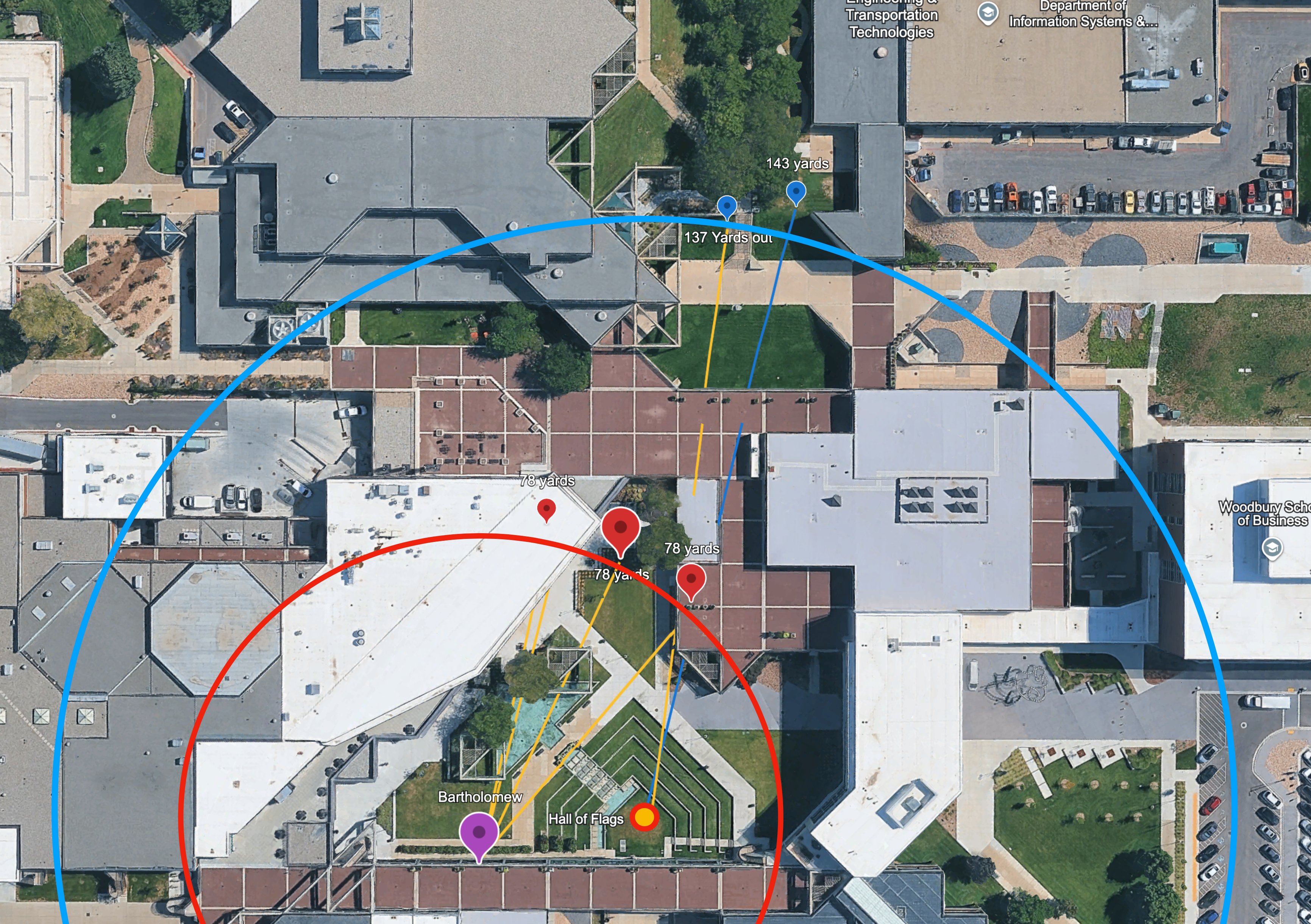
Superfeed Technologies (Claims)
A private technology company whose board reportedly seats Erika Kirk's mother beside a Turning Point Action executive. The claim that TP Action money moved into it is unverified, and board service is lawful.
Read thisElsewhere In The Investigation
TPUSA's Post-Death Pivot on Iran
The claim that after Kirk died, the organization and the show carrying his name shifted toward the pro-war posture he had reportedly been breaking from — the mirror image of his final positions.
Read thisWar-drums warnings in Washington, restraint language on air, and reported lobbying of Trump against regime change during the 2025 strike window. Investigators treat the anti-war stance as motive surface — a hypothesis, not a verdict.
Read this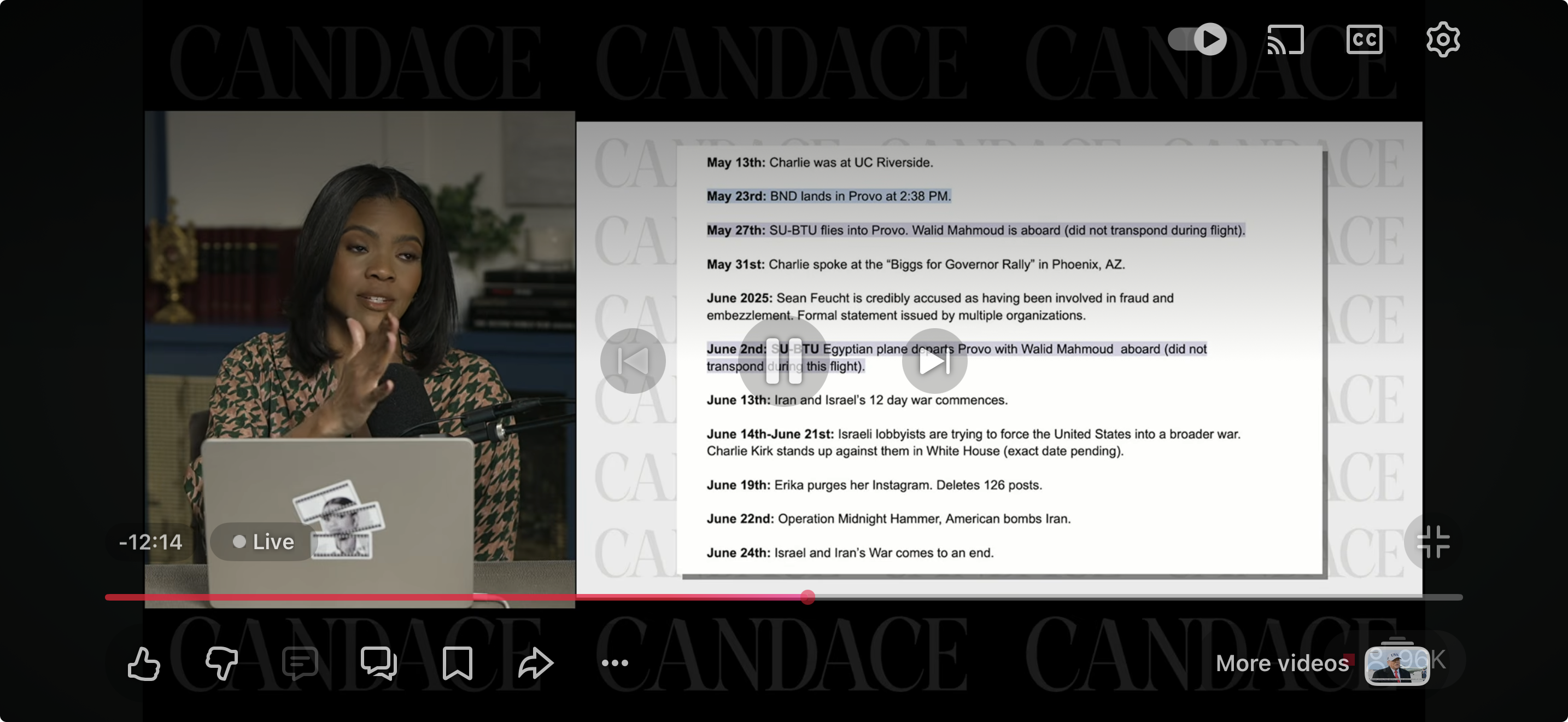
The single largest independent engine driving this investigation into public view. Several of the document trails cited across this site surfaced first on her episodes.
Read this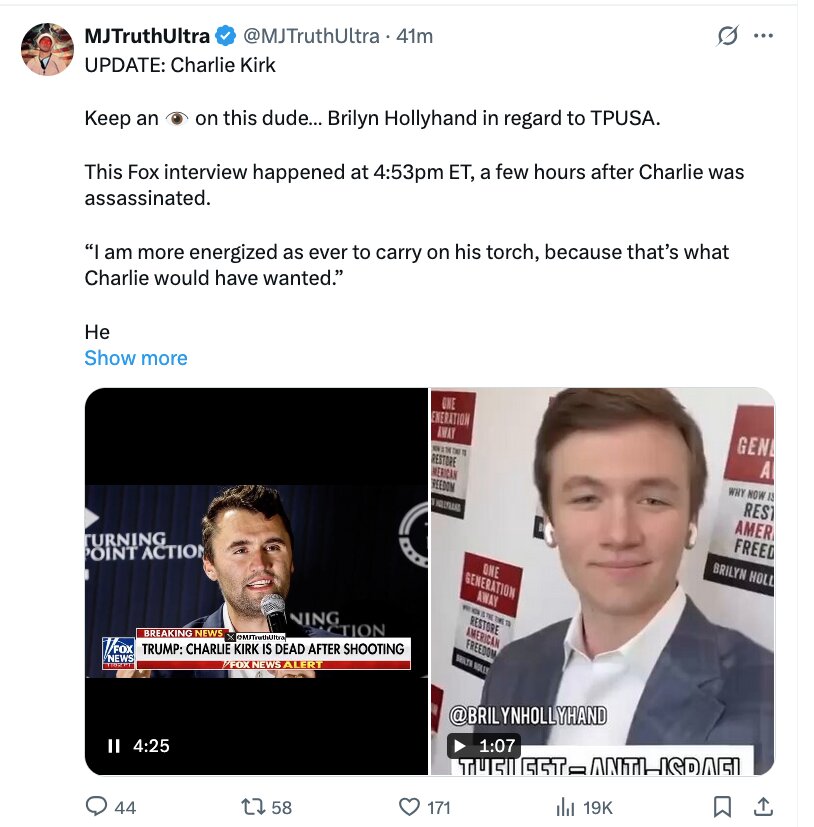
TPUSA Replacement — Fox Interview Timing
A replacement figure appeared on Fox within hours of the killing. Logged here as succession optics worth noting, explicitly not as proof of foreknowledge.
Read thisThis website's author is @HolonCitizen on X and YouTube/@HolonCitizen. Follow me there.
Interesting
- Kirk reportedly ordered a DOGE-style audit of his own organization days before his death.
- Frank Turek says Kirk wrote "I know they want me dead" and asked for prayer.
- Kirk reportedly wrote about being "wiped out at any time" well before the 2025 donor fight.