2024 Pre‑Event Timeline (Searches and Early Signals – Claims)
This page covers the calendar year 2024 — a full year before the September 10, 2025 shooting — and collects everything citizen researchers point to as the earliest visible signal in the case. Almost all of it is one evidence class: Google Trends screenshots. Trends is aggregate, normalized and carries no user identifiers, so nothing on this page shows who searched for anything. Read it as a map of what researchers claim to see in 2024 data, not as a catalog of proven pre-planning.
Scope of this page. 2024 only. Where a 2024 entry has a 2025 or 2026 continuation, it gets one line and a link — the depth lives on 2025 Context Timeline, Timeline 2025 and Timeline 2026. The year-level router is Timeline by Year.
What 2024 evidence actually is, and is not
Every search-pattern entry below rests on graphs of relative topic interest, sometimes filtered by region. Trends can make a handful of absolute queries look like a spike of 100. It cannot tell you whether one person searched a hundred times or a hundred people searched once, and it cannot attribute a query to a person, an organization, or a country beyond a coarse regional label. Both facts are why researchers who advance these claims describe them as suggestive rather than probative, and why the trends deletion and suppression dispute matters — if the underlying graphs later changed, the screenshots become the only record. The full search corpus is indexed at Google Searches.
The Timeline
First half of 2024 — context, not signals
-
April 2024 — Tyler Bowyer, TPUSA Action's COO, is indicted in an unrelated Arizona fake-electors matter. He has not been convicted and contests the charges. It appears here only because his name returns in the 2025 DOGE audit timing thread — the audit Kirk ordered inside TPUSA is at TPUSA DOGE audit and its results; it has no established connection to the Kirk case.
-
May 2024 — Flight-history compilations note that the jet later tracked as N888KG was flying an ordinary schedule at this point, including trips to Cancun. Researchers cite the clean prior history precisely to argue the September 2025 ADS-B behaviour — its Provo vanish and the N888KG LLC ownership question — was anomalous.
-
May 2024 (alternate reading, claimed) — Some secondary analyses argue aggregate Israel-region interest in Kirk-adjacent topics around this window tracks public Netanyahu/Kirk monitoring and letters, not operational planning. Trends still cannot identify searchers; this is a non-foreknowledge explanation node, not a finding of fact.
-
June 30, 2024 — TPUSA's fiscal year closes. Filings covering this year are where researchers locate the $350,000 loan attached to the GGLF 2023 LLC life insurance arrangement, examined at GGLF life insurance. The policy's existence and its interpretation are two different things.
-
June–November 2024 (claim vs counter-claim) — Proponent compilations assert search interest across the term cluster "Tyler Robinson Discord / Reddit / FBI / LDS / TPUSA / Israel" during this window. If real, it would mean the man later charged was a search subject roughly a year before the event. Tracked at Tyler Robinson and Lance Twiggs searches. Counter-claim (skeptic analyses): “Tyler James Robinson” shows near-zero Trends interest through 2024, with the mass spike only after September 2025 identification. Both cannot be fully true without screenshot-level reconciliation — flag as an open data conflict. Tyler Robinson is charged, not convicted.
August 2024 — the UVU building searches
-
August 2024 (claim) — Researchers report Google Trends activity for "Utah Valley University buildings" and, across the broader compilation, terms including UVU rooftop, gun, parking, CCTV, layout and the Losee Center — the building whose roof the State says the shot came from. This is the earliest entry treated as possible site reconnaissance. See UVU campus location searches and pre-event searches and recon.
-
August 2024 (claim) — The same compilation reports a search from Israeli IP addresses for Greg Gunn, the drafting attorney behind what became Utah's autopsy-law change — months before the bill was introduced, with a second reported spike in May 2025 the same week the new law took effect. The law itself and why it matters to this case are on autopsy law SB0082, Utah autopsy law changes and Utah autopsy law; the SB0082 dates sit on Timeline 2025.
-
Caveat that applies to both — Neither entry identifies a searcher. A rise in interest in "Utah Valley University buildings" is also what a construction bid cycle, a student intake, or a local news story produces.
September 2024 — capability and threat context
-
September 10, 2024 — Per federal filings later cited in this investigation (New Jersey District Court, Case No. 2:25-cr-00299), the Department of Justice documented a threat to kill Candace Owens and her family. The defendant in that matter is charged; charges are not convictions. It sits in this timeline exactly one year before the shooting and is cited by researchers as evidence the threat environment around Kirk's circle predated 2025.
-
September 17–18, 2024 — Operation Grim Beeper: thousands of pagers and hundreds of walkie-talkies intended for Hezbollah detonate across Lebanon and Syria after a supply-chain infiltration, targeting Hezbollah. This is well-documented mainstream history, entirely separate from the Kirk case, and appears here only because it is the reference point researchers use when arguing about device-based capability — see Operation Grim Beeper, Beepers and Grim Beeper capability. Citing a capability is not evidence it was used.
November 2024 — the political backdrop
-
November 2024 — The U.S. general election concludes and the political temperature that frames every 2025 event is set. TPUSA's turnout operation is at peak visibility; the resulting White House access is what makes Charlie Kirk's mid-2025 dissent over Israel and Iran consequential — the arc itself is on 2025 Context Timeline. Background at heightened political tensions.
-
2024 (parallel, unrelated) — Nick Fuentes runs a second, online-only "Groyper War," this time aimed at the Trump campaign rather than at campus events. It is not a continuation of the 2019–2020 in-person disruptions that targeted Kirk directly; the earlier episode is on the Charlie Kirk timeline.
December 2024 — the entries the whole page turns on
-
December 2024 (claim) — The master investigation file records, as a single line in its own timeline, "Google Searches for the location." Researchers describe early search activity in this month from certain regions — including Washington, D.C. and foreign IPs — for locations and people later central to the case. It is a compressed note, not a dataset. See Israel IP search patterns and pre-event searches and recon.
-
December 8–14, 2024 (claim) — A one-week Google Trends spike peaking at an interest value of 100 for Kathryn Nester, attributed by commentators including Baron Coleman and later amplified in the @ProjectConstitu / Jimmy Dore orbit to Israeli IP addresses. Nester later joins the defense team for the man charged. Proponents call this advance interest in a future defense attorney; skeptics note Trends normalizes to 100 regardless of absolute volume, so a rare name with almost no baseline traffic will show a dramatic spike from a handful of queries. Spelling variants (Katherine / Kathy) appear in secondary posts. No mainstream outlet has independently reproduced absolute volumes for this spike as of mid-2026 research captures. Both readings are laid out at Nester Google Trends and Kathryn Nester searches.
-
Disambiguation — not December 2024 — Separate citizen datasets claim Nester-related interest on ~April 21, 2025, August 3, 2025 (Cayman Islands IP list in the Sam Parker ecosystem), and post-appointment 2025 traffic. Do not collapse these into the December 2024 cell. Likewise, the large July–August 2025 Timpanogos Regional Hospital / medical-examiner / surgeon Trends wave popularized by @5149jamesli and others belongs on 2025 Context Timeline, not here.
-
December 2024 onward (claim) — Compilations assert that a residential address in St. George, Utah associated with Lance Twiggs — the charged man's roommate, and later a witness whose phone and device evidence becomes central at the 2026 preliminary hearing — was searched continuously from December 2024 through September 2025. This site does not publish the address. Twiggs is a living private individual and no wrongdoing is alleged; the Twiggs family is likewise uncharged. See Tyler Robinson and Lance Twiggs searches.
-
Late 2024 (claim) — The same threads assert search interest beginning to cluster around Utah hospitals, medical examiners and certain legal actors — including, per Judges Graf and Lunnen searches, judicial names — later presented as a pre-planning layer for post-incident handling. Collected at Timpanogos and medical searches and Israeli search patterns. Keep this late-2024 cluster distinct from the July–August 2025 medical Trends wave on the 2025 page.
Where 2024 claims continue (not 2024 events)
These two entries are not 2024 events. They are here because they determine whether the 2024 evidence above can be checked at all.
-
2025–2026 (meta, scrubbing claims) — Influencer investigations — including material associated with Anna Escobar amplified on Stew Peters' show and still cited mid-2026 — continue to allege Trends scrubbing of pre-event graphs. If true, 2024 screenshots become the only residual record; they remain unverifiable without Google logs. See trends deletion and suppression and Google search and Trends scrubbing.
-
December 2025 (contrast, not pre-event) — Google's public Year in Search 2025 lists Charlie Kirk as a top U.S. search after the assassination (CBS / The Hill reporting). That is post-event mass interest and must not be read as corroboration of 2024 foreknowledge claims — see Timeline 2025.
Conflicts and Disputed Points
| Point | Proponents say | Skeptics say |
|---|---|---|
| The Dec 8–14 Nester spike | A one-week, single-region surge for an obscure attorney a year before she was appointed is not coincidence | Trends normalizes to 100. For a name with near-zero baseline, a few queries produce an identical-looking graph; no mainstream absolute-volume corroboration |
| Competing Nester dates | Dec 2024 is the primary pre-event cell | Apr 2025 / Aug 2025 Cayman / post-appointment interest are separate datasets often mis-merged in discourse |
| “Tyler Robinson” in 2024 Trends | Jun–Nov 2024 cluster claim includes his name | Skeptics: near-zero 2024 interest, spike only after Sept 2025 ID — screenshot reconciliation still open |
| The August 2024 UVU searches | Early site reconnaissance — rooftop, CCTV, layout, parking | Aggregate topic interest with no searcher attribution; ordinary campus activity produces the same curve |
| Regional attribution ("Israeli IPs", "D.C.") | Trends' region filter shows where interest originated | The region filter reflects coarse geolocation and is trivially confounded by VPNs and by low absolute volume |
| Are the screenshots reliable? | They were captured before any alleged scrubbing (Anna Escobar / Stew Peters orbit claims) | If the underlying graphs cannot now be reproduced, the screenshots are unverifiable — see Google Trends scrubbing |
| What 2024 proves | The event was not spontaneous — attention to these people and places ran for a year | Even taken at face value, none of it identifies a searcher, an intent, or a plan; post-event #1 Year-in-Search is not pre-event evidence |
Open Questions
- Can the December 8–14, 2024 Nester spike be independently reproduced in Google Trends today, and what were the absolute query volumes behind the normalized value of 100?
- Do Google's underlying query logs for the 2024 spikes resolve to identifiable subscribers or IP ranges?
- What exactly does the master file's one-line "December 2024: Google Searches for the location" refer to — which locations, which regions, and from which screenshots?
- Why would a specific Utah attorney's name draw regionally concentrated interest in December 2024, months before any of the events that made her relevant?
- Are there any non-Trends 2024 records — flights, filings, communications — that independently support a 2024 preparation phase?
- Which 2024 search screenshots still match live Trends output, and which no longer do?
Laws (Charlie Kirk)
Google's underlying search logs behind the 2024 regional spikes together with subscriber and IP attribution, the full 2024 Trends corpus in a form that can be independently reproduced rather than screenshotted, the TPUSA filings covering the fiscal year ended June 30, 2024 including the GGLF 2023 LLC insurance arrangement and its $350,000 loan, and any NSA signals record touching the 2024 activity described here are not public yet; the Charlie Kirk Investigation Laws could bring these powerful truths out.
Interesting In This Area
- The December 8–14 Nester spike peaked at 100, a year before her appointment.
- 2025 opens with an autopsy-photo bill introduced in January, effective in May.
- The year router carries 2024 signals, the 2025 assassination year, and the 2026 court calendar.
- Hamptons and the September 9 meeting are where these names acquire motive.
Interesting In Other Areas
- Google Trends cannot name a searcher, which is why the screenshots became the record.
Other Pages In This Section
The pressure arc of a single year in order — donor and Israel-policy friction, TPUSA internal politics, foreign aircraft movements, and the private meetings researchers cite. It runs from a December 2024 carry-over to the December 2025 gag order.
Read thisCandace Owens Public Statements & Releases Timeline
What she said and released, in the order she released it: the September 9 three-sources claim, the donor texts, the flight-log episodes, the SUV photographs. Ordering the releases shows which claim was built on which.
Read this
Dispatch, Police Radio & Scanner Timeline — September 10
What the police radio actually carried on September 10 — the 12:26 first report, an all-black suspect description, the 911 calls, the detention. Dispatch audio is the least edited record of that afternoon.
Read this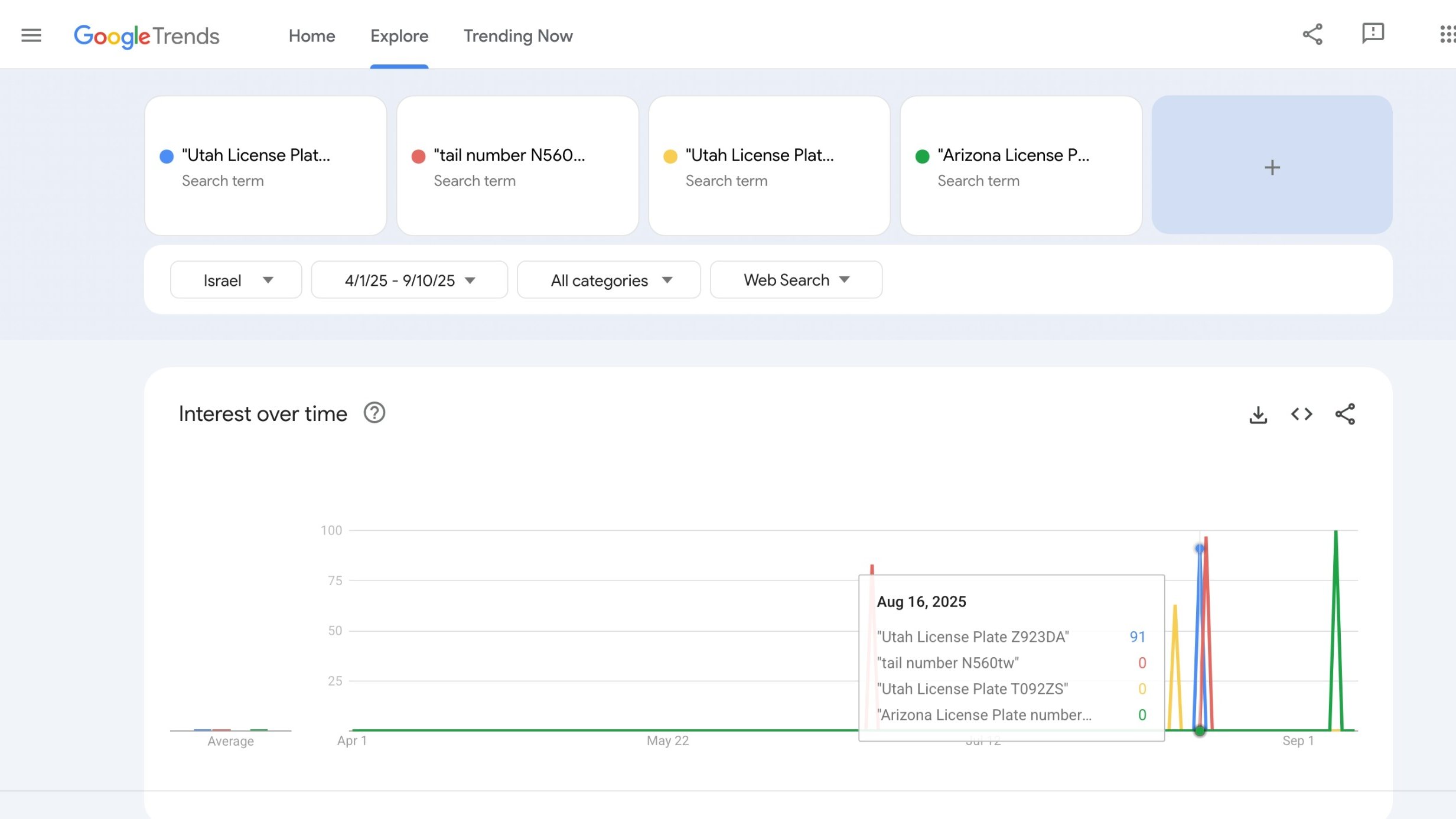
Hamptons Intervention Meeting (Early August 2025)
Five weeks of chronology built around one reported early-August weekend Kirk is said to have afterwards called an "intervention." Both accounts run side by side, denials included in full. It is where the AmFest invitation dispute actually happened.
Read thisThis website's author is @HolonCitizen on X and YouTube/@HolonCitizen. Follow me there.
Interesting
- A 600,000-file production with withheld raw DNA and a destroyed SUV stalled the defense.
- Sharing autopsy images became a brand-new Utah crime on May 7, 2025, months before the killing.
- A 20-year police veteran said the wound "would have been shot from below".
Related Areas
- Kathryn Nester search-pattern claims
- Google Trends deletion and suppression
- Utah's autopsy law change
- Pre-event searches and reconnaissance
- The GGLF 2023 life insurance policy
- Operation Grim Beeper capability context
- Judges Graf and Lunnen search patterns