Discovery, Brady & Evidence Timeline (2025–2026)
This timeline follows one thread only: what happened to the evidence. Not who did it — what was collected, sealed, produced, protected, destroyed, or never handed over, in the order it happened. The docket in State of Utah v. Tyler Alexander Robinson (Case No. 251403576) is the spine; citizen-investigator claims and press reporting fill the gaps. Tyler Robinson is charged, not convicted, and nothing below is a finding that any official acted unlawfully.
The Timeline
September 2025 — collection, and the first losses
-
Sept 10, 2025 — A black SUV transports Charlie Kirk from the UVU courtyard; the vehicle later becomes the subject of the SUV destruction claim, which alleges it was cut up and melted down rather than preserved as a scene vehicle — see also the SUV and ADL floor-sharing claim and the blurred-window interior photos.
-
Sept 10, 2025 — Officer Chris Bagley's body-worn camera is described as ending while he is still on the roof, roughly 27 minutes and 35 seconds into the recording — the gap examined on the Bagley bodycam page, the officer Bagley bodycam page, and in the GRAMA no-footage response.
-
Sept 10–11, 2025 — Witness phone videos from the scene are alleged to have been remotely wiped, and separate claims describe federal agents asking a witness to delete footage — see videos deleted remotely and the FBI-asked-delete-video page.
-
Sept 11, 2025 — A Mauser .30-06 rifle is recovered from the wooded area north of campus, per the gun recovery location page; the sequence in which it was found is itself disputed on the gun discovery sequence page.
-
Sept 11, 2025 — A news organization is later reported to have requested the video of Robinson turning himself in. The American Prospect / KOMO–Scripps reporting describes a multi-step GRAMA path (wrong entrance or camera answers first), after which Washington County stated the lobby file had been deleted under a 30-day retention policy and that no bodycam captured the intake — the account also tracked by Baron Coleman on the missing surrender discovery page and the Baron Coleman timeline.
-
Sept 14, 2025 — The courtyard where the shooting occurred is paved and altered, documented on the paving timeline, the pavers account, and the crime-scene paving page. Officials describe restoration of a campus space; critics call it the destruction of a scene.
-
Sept 16, 2025 — The Information and the probable-cause affidavit are filed, along with a bail order, an acknowledgment of firearm restriction, a proposed pretrial protective order, the State's notice of intent to seek the death penalty — filed six days after the shooting, a speed examined on the death-notice page — and the signed protective order. The affidavit's contents are summarized on the probable-cause page.
-
Sept 17, 2025 — The ATF laboratory report on Exhibit 6A — the deformed bullet jacket fragment recovered at autopsy — is dated. Its conclusion is inconclusive: the fragment could neither be identified as nor excluded from the recovered rifle. See ATF inconclusive ballistics, court ballistics, and — for the later allegation that the FBI reached for the abandoned lead-composition method — the banned CBLA bullet-lead test. It stays under seal for months.
-
Sept 22, 2025 — Initial appearance, plus a Protection Order Re: Pre-Trial and Trial Publicity — the first speech restriction in the case, and the ancestor of the later gag-order fight tracked on court gag orders.
-
Sept 24, 2025 — A standing decorum order and an order to transport are entered.
-
Sept 25–27, 2025 — Rule 8 declarations and pro hac vice admissions bring Michael N. Burt and Richard G. Novak onto the defense team alongside Kathryn Nester.
-
Sept 30, 2025 — The defense files its formal Request for Discovery — the starting gun for everything that follows.
October 2025 — preservation, protection, and the first sealed hearing
-
Oct 6–8, 2025 — A request for the audio recording is filed, the video/audio record is produced, and the defense files a Motion to Preserve Evidence — an explicit request that physical items not be consumed, altered, or destroyed.
-
Oct 13, 2025 — The parties file a stipulated Motion for a Discovery Protective Order, agreeing that material produced would be restricted from public release.
-
Oct 15, 2025 — The court enters the Discovery Protective Order. From this point most of what changes hands is invisible to the public — the structural fact behind the evidence sealing 2026 page.
-
Oct 20, 2025 — The court grants the Motion to Preserve Evidence.
-
Oct 22, 2025 — The State moves to set aside the October 20 preservation order and files a response opposing the preservation motion — the first open clash over whether items would be preserved intact or subjected to consumptive testing. The defense's parallel complaint that it was refused observer access to testing is tracked on denied access to testing.
-
Oct 24, 2025 — A sealed hearing is held. Its transcript becomes its own two-month dispute, catalogued on closed hearings and missing transcripts.
-
Oct 27, 2025 — The State files a Notice of Open File Policy and Invitation to Inspect Physical Evidence — the prosecution's answer to the withholding narrative, and a document the defense's later filings say did not solve the raw-data problem.
-
Oct 28, 2025 — The New York Times publishes reporting on FBI files in the case, the first major press attention to what the federal side is holding — see FBI discovery delays.
-
Oct 30, 2025 — Media organizations file a Request for Notice of Motions to Close Judicial Proceedings and Records, the opening move of the press intervention.
November–December 2025 — sealing versus the press
-
Nov 3, 2025 — A stipulated motion regarding the order to preserve evidence is filed, together with a stipulation to classify the October 24 transcript and audio as private.
-
Nov 4, 2025 — The court enters a stipulated order setting aside the October 20 preservation order and granting in part the motion to preserve — a partial preservation regime whose exact scope has never been made public.
-
Nov 5, 2025 — Media intervenors file a Motion for Limited Intervention seeking notice of any motion to close, seal or reclassify.
-
Nov 6, 2025 — The State moves to amend or clarify the pre-trial publicity order, later opposed on Nov 20 and briefed through Nov 28.
-
Nov 13, 2025 — The court orders the parties to serve all closure and reclassification motions on the media, and separately orders the transcript of the October 24 hearing.
-
Nov 17, 2025 — The October 24 transcript is filed as Protected — not publicly available, and a second transcript is listed as not posted for purchase.
-
Dec 4, 2025 — The parties file a Joint Status Report Concerning the Redaction of the October 24 sealed-hearing transcript — a negotiation over which lines the public may read.
-
Dec 8–9, 2025 — Media intervenors file a memorandum opposing classification of the October 24 transcript as private; the defense replies.
-
Late 2025 (docket, contested reading) — A transport order moves an unrelated inmate held in the same Utah County Jail. Citizen commentators read it as a jailhouse-informant placement ahead of a closed hearing; no court has made such a finding. See informant transport timing.
-
Dec 16, 2025 — Judge Tony Graf issues a gag order on his own motion, without a request from either party. The court's stated purpose is protecting the jury pool. See gag orders and sealing.
January–June 2026 — the production fight
-
Jan 21, 2026 — A FedEx discovery list compiled outside the court process arrives at defense counsel, and is emailed the same day — the citizen-submission channel described on the discovery and Brady disputes page and drafted in the Discovery workspace.
-
March 2026 — Digital-forensics warrant material — device search history, communications, location data — is described in research notes as sealed until this month, per evidence sealing 2026.
-
March 2026 — The defense cites the inconclusive ATF report and moves to delay the preliminary hearing for further forensic review; the report's unsealing is widely amplified online, as tracked on the trial and autopsy report page.
-
March 14, 2026 — A Utah judge rejects an effort to keep certain records sealed and allows cameras at a Robinson hearing — a rare opening in a case otherwise moving toward closure.
-
~Mar 30, 2026 — Defense files a lengthy (~258-page) fair-trial / camera-exclusion motion (Andrea Burkhart materials discussed publicly) compiling alleged pretrial publicity violations and, per The American Prospect (April 15, 2026), surfacing the Miranda transcript clocks later used in custody analysis. Treat as a docket-spine event for publicity and discovery-adjacent fair-trial litigation, not a merits ruling.
-
March 27, 2026 — An addendum to a defense filing states that the Utah State Bureau of Investigation has had 28 different law enforcement agencies produce evidence in the case — a custody chain wide enough that no single agency can account for the whole record.
-
April 2026 — The defense seeks a six-month continuance, stating the ATF and FBI have not produced files they have held since September 2025, and asks for time to retain independent forensic biologists, genetic-systems engineers and statisticians. Victim-side counsel opposes the continuance and objects to some discovery requests — the clash documented on victim lawyers oppose continuance.
-
April 2026 — in open court (quoted online) — Defense counsel, as reported by @ImBreckWorsham and others: neither ATF nor FBI will hand over DNA analysis data files despite multiple requests — "We know these data files exist because we have summary ATF and FBI reports summarizing the analysis which go back to September… so why hasn't the FBI turned over this data yet?" Parallel posts frame the question as whether any physical/digital DNA on rifle trigger, casings, or towels was actually produced beyond summaries. That is the case's clearest Brady framing: the files are known to exist because the summaries reference them. The State points to its open-file policy and inspection invitations on the docket. See FBI discovery withholding.
-
April 2026 — Citizen investigators allege the State "drowned" the defense in roughly 600,000 files while the specific contested items remained hard to isolate — the volume-versus-access argument on discovery document dump and discovery dump and continuance. Exact file counts remain citizen-asserted unless a docket index is published.
-
2026 — The State is reported to have moved the bullet fragment to Virtual Comparison Microscopy while the defense was denied observer presence or videotaping — a consumptive-testing objection tracked on FBI ballistics and forensics.
-
June 2026 — Judge Graf finds Deputy Utah County Attorney Christopher Ballard in civil contempt for public statements describing "ample evidence" of guilt notwithstanding the inconclusive ballistics; prosecutors are ordered to reimburse fees tied to the motion. Ballard is a living person; the finding was civil contempt over publicity, not a finding of evidence tampering.
-
July 2026 (remedy fight after contempt) — Coverage of later argument states a defense bid to remove the death penalty as a sanction for publicity-order violations was rejected as disproportionate to the prosecutor's misconduct. Procedural consequence fight only — not a merits ruling on guilt.
-
June 30, 2026 — Attorney and radio host Baron Coleman publicly asserts a multi-agency cover-up and says Robinson was in custody well before 6:30 PM on September 11 — an attributed claim, examined on the Baron Coleman timeline.
July 2026 — the preliminary hearing, and what still is not in the file
-
July 2026 — The preliminary hearing opens; surveillance video, DNA and officer testimony are presented across Day 1 through Day 4.
-
July 2026 — Agent David Hull walks the court through UVU surveillance video, chain of custody and the rooftop search, per Day 2. Researchers note the rooftop clothing-change portion drew no public follow-up.
-
July 2026 — An officer testifies that his body camera battery died at the moment he was on the roof, and that a red and black screwdriver he found there was photographed into evidence — but the screwdriver and DNA statements are said to be absent from the charging documents and the affidavit. See Bagley bodycam gap.
-
July 2026 — Fulton abandoned items (DNA stop) — Hearing accounts state a backpack, jacket, and gloves recovered along the escape route near Fulton Library were sent for FBI DNA; testing was stopped and, per some prelim-era summaries, items were later identified as belonging to the Kirk security detail. Who ordered the stop remains disputed (Sgt. Faumuina memory-lapse testimony is already on the site). See forensic tests skipped and the dispatch / radio timeline.
-
July 2026 — multi-donor / ballistics discovery pressure — Citizen hearing syntheses claim ATF-related testimony included inconclusive body fragments relative to the recovered rifle and DNA from multiple donors on the weapon (numbers vary online). Treat multi-donor counts as attributed commentary pending raw instrument files; the production fight is that those raw files remain the contested Brady object (ATF inconclusive ballistics).
-
July 2026 — enhanced masters in court — Courtroom observers (e.g. @bennyjohnson) report HD/4K enhanced campus footage played with media cameras restricted or off, while the public still lacks UVU high-definition masters listed below as unproduced — discovery-exists-but-public-access-does-not tension.
-
July 14, 2026 (claimed) — A recirculated hearing clip is described online (e.g. @SSTTP777) as showing an ATF examiner confirming that no one had asked her whether the laboratory lost bullet evidence in the case. Low-engagement, single-source, and unverified against a transcript — logged as a chain-of-custody question, not a finding that evidence was lost.
-
July 2026 — who the gag order actually binds (disputed) — Posts contrasted the silence of Robinson's family with Erika Kirk's continued public speaking and argued the gag order was enforced unevenly. The counter-reading is that the December order reaches parties, counsel, officials and witnesses, not every public figure who comments. No court has found selective enforcement.
-
July 2026 — Extraction disputes surface: the State is reported to disclaim certain device extractions, against the Cellebrite extraction contradiction and the state-disclaims-extractions page. The Israeli forensics vendor behind the extractions is profiled at Cellebrite, and the device inventory at Robinson's phones and devices.
-
Still unproduced / still contested, as of the latest entries on this site — UVU's high-definition camera masters (UVU HD footage withheld), the untrimmed rooftop video (rooftop video trimmed), the surrender video (sheriff video withheld), hospital footage and associated NDAs (hospital footage and NDAs), the full autopsy (sealed autopsy), the UVU GRAMA records (UVU GRAMA records), and — per citizen posts into mid-July — the raw ATF/FBI DNA instrument files behind the September summaries (status claim pending docket confirmation).
Conflicts and Disputed Points
| Point | Version A | Version B | Who asserts what |
|---|---|---|---|
| Is discovery being withheld? | Federal agencies have held DNA and ballistics files since September 2025 without producing raw data | The State filed an open file policy and invited inspection of physical evidence on Oct 27, 2025 | Version A: defense statements in open court, April 2026. Version B: the docket entry itself |
| The 600,000 files | A deliberate burial of contested items in volume | The ordinary size of a multi-agency capital production spanning 28 agencies | Citizen investigators assert the first; the 28-agency addendum supports the second reading |
| The surrender video | Refused, then deleted, though pleadings suggest footage still exists in law-enforcement hands | Ordinary 30-day retention expiry with no request timely enough to preserve it | Baron Coleman asserts the first; Washington County's stated position is the second |
| The SUV | Chopped up and melted to destroy a scene vehicle | Ordinary disposal of a private vehicle never designated as evidence | Citizen compilations assert the first; no court finding exists either way |
| Preservation scope | The Oct 20 order protected the physical evidence | It was set aside on Nov 4 and replaced with a partial grant whose scope is not public | Both are docket facts; what the partial order actually covers has never been published |
| Ballard contempt | Evidence of a State that talks publicly while raw lab files lag; death-penalty removal sought as sanction | A narrow publicity violation unrelated to production; death-penalty removal rejected as disproportionate | Citizen investigators assert the first; the order itself is civil contempt over statements; remedy fight reported July 2026 |
| Fulton backpack / gloves DNA | Testing stopped after security-detail identification; raw results still contested | Ordinary triage once ownership clarified | Prelims / citizen summaries vs incomplete public production record |
| Multi-donor DNA on rifle | Multiple contributors make sole-shooter DNA narrative incomplete without raw files | Summaries plus charging narrative already satisfy production | Citizen hearing synthesis vs State's open-file posture |
Open Questions
- What exactly does the November 4, 2025 partial preservation order cover, and what did it leave unprotected?
- Do the raw DNA instrument files referenced in the September 2025 summary reports still exist in FBI and ATF custody, and when were they first requested?
- What is in the redacted portions of the October 24, 2025 sealed-hearing transcript?
- Did the surrender video ever exist in a second copy, and do the pleadings that reference it identify who holds it?
- Was the SUV ever designated as evidence before it was disposed of, and by whom was that decision made?
- Which of the 28 agencies produced which items, and is there a single master index tying custody to each exhibit?
- Why do the screwdriver and DNA statements appear in hearing testimony but not in the charging documents or the affidavit?
Laws (Charlie Kirk)
- The unredacted October 24, 2025 sealed-hearing transcript, the full scope of the November 4 partial preservation order, the raw FBI and ATF DNA instrument files and examiner notes behind the September 2025 summaries, the complete 600,000-file production index tied to each of the 28 producing agencies, the sealed digital-forensics warrants and their authorizing affidavits, the Washington County surrender video and its retention and deletion logs, the disposal record for the transport SUV, and the withheld UVU high-definition camera masters are not public yet; the Charlie Kirk Investigation Laws could bring these powerful truths out.
Interesting In This Area
- A preservation order was granted on October 20 and set aside two days later.
- Twenty-eight agencies produced evidence, and no public index maps custody to exhibit.
- Testing on items recovered near the library was stopped, per hearing testimony.
- The surrender video was refused, then reported deleted, while pleadings suggest otherwise.
Interesting In Other Areas
- A prosecutor was held in civil contempt in June 2026 over public statements.
Other Pages In This Section
Dispatch, Police Radio & Scanner Timeline — September 10
What the police radio actually carried on September 10 — the 12:26 first report, an all-black suspect description, the 911 calls, the detention. Dispatch audio is the least edited record of that afternoon.
Read this
Hamptons Intervention Meeting (Early August 2025)
Five weeks of chronology built around one reported early-August weekend Kirk is said to have afterwards called an "intervention." Both accounts run side by side, denials included in full. It is where the AmFest invitation dispute actually happened.
Read thisMedical & Death Timeline — Shot to Pronouncement
Forty minutes from the shot to the reported 1:03:30 pronouncement, and almost every minute inside it is contested — a private SUV instead of an ambulance, a Level IV hospital instead of the nearer Level II.
Read this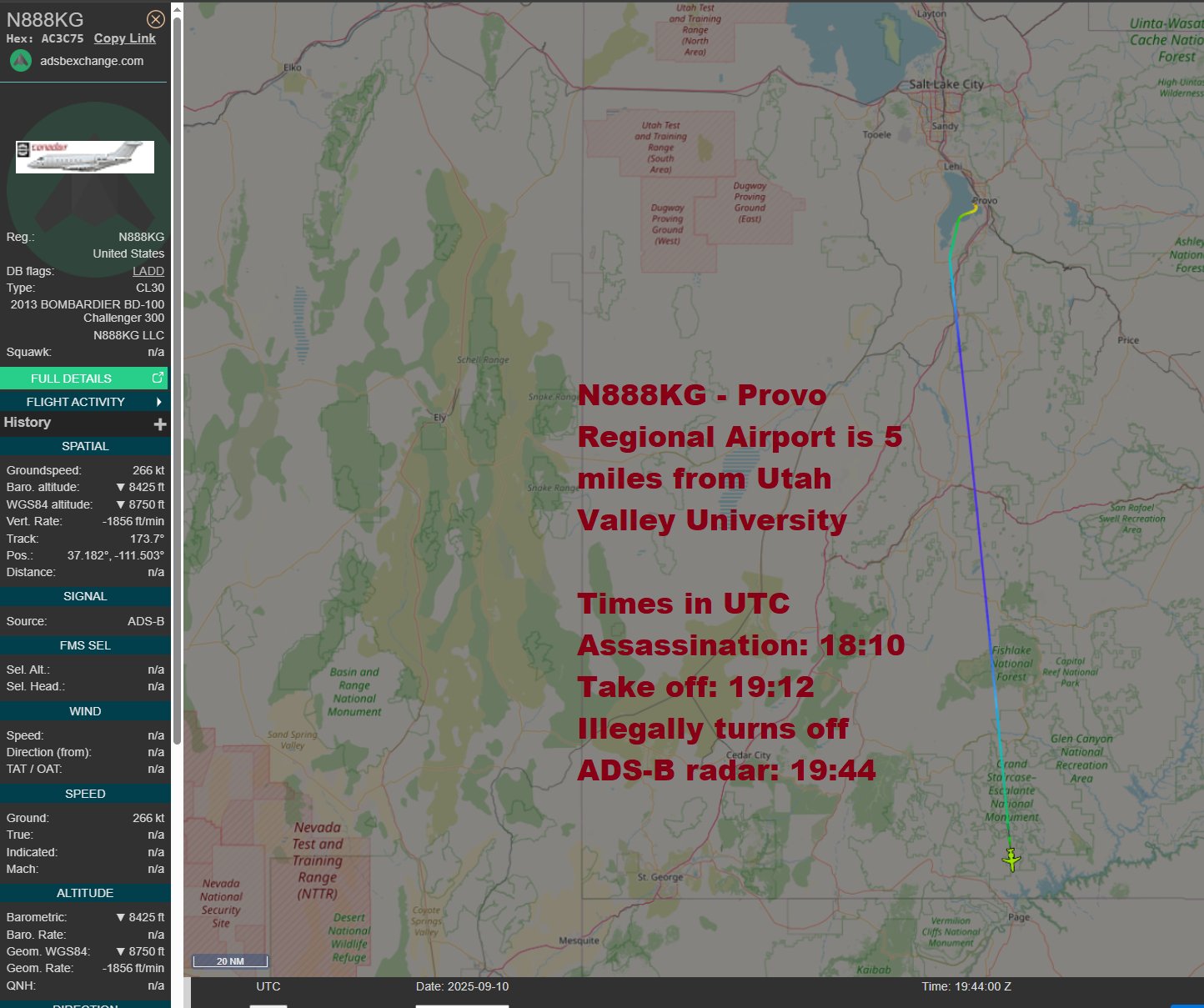
Other Planes Activity Timeline (N888KG, SAM Flights, Cluster)
Everything in the air except the two famous tails: a Provo departure with a dark ADS-B leg, Fort Huachuca VIP flights, an Egyptian cluster, and the arrival stack that landed after the shot.
Read thisElsewhere In The Investigation
A reported 600,000-file production arrived while the DNA chain-of-custody material the defense asked for reportedly did not. The fight over what the defense received is now the fight over what the public will ever see.
Read thisThis website's author is @HolonCitizen on X and YouTube/@HolonCitizen. Follow me there.
Interesting
- Three official records paint three different arrest pictures.
- An investigator says a military-grade 5G mast stood onsite that day: the comms antenna mast.
- Some capabilities can reportedly make a shooter look like a lone crazy person.
Related Areas
- Forensic tests that were never run
- UVU records withheld under GRAMA
- Hospital footage and the NDAs around it
- Right-to-discovery reform proposal
- Cellebrite extraction contradiction