Post-Shooting Scene Changes, Paving & Evidence Handling Timeline
This timeline follows one physical object — the ground of the UVU courtyard — from the moment of the shot on September 10, 2025 until it was covered in pavers. In under five days a grass courtyard that was a homicide scene became a hardscape. The chronology below assembles the reported dates, the contractor's own on-camera account, and UVU's stated explanation, and keeps the documented parts separate from the unverified ones. Times are Mountain Daylight Time (MDT). The ground matters because Charlie Kirk was killed standing on it, and the soil itself is one of the few surfaces that could still carry residue evidence about how he died.
Nothing on this page asserts that any living person or organisation destroyed evidence or acted illegally. Rapid site restoration after a violent death on a campus has ordinary explanations, including biohazard remediation and grief-management. Those explanations are stated alongside the questions.
The Timeline
September 10 — the scene while it was still a scene
-
12:23:30 PM, Sept 10 — Charlie Kirk is shot in the courtyard beneath the event tent; the physical setting is described on the tent structure page and the UVU courtyard page.
-
12:23:57 PM, Sept 10 — Terryl Farnsworth is already filming from the rock pile, per the minute-by-minute reconstruction and the rock-pile page.
-
Minutes after the shot, Sept 10 — Citizen research alleges that camera media and SD cards were removed from the scene before it was secured, an allegation set out on cameras and SD cards removed, crime-scene camera actions, and the SD-card removal claim. These are allegations, not adjudicated findings.
-
Afternoon, Sept 10 — Researchers allege that bomb dogs were kept away from parts of the scene, the claim on bomb dogs kept away and the FBI bomb-dogs page. It matters here only because the same theory — an explosive device rather than, or in addition to, a rifle round — is the reason soil composition later became contested. See the exploding-pendant theory and PETN and soil absorption.
-
12:35 PM, Sept 10 (official account) — A Mauser Model 98 .30-06 rifle is reported found wrapped in a dark towel in the wooded area north of campus, per the affidavit summary and the Mauser page. A competing account places the find the following day, after K-9 and officer searches had failed — the conflict developed on the gun-discovery sequence.
-
12:39 PM, Sept 10 — First FBI agents arrive on scene, beginning the federal role described on the FBI investigation page and crime-scene handling.
September 11 — the scene loses its perimeter
- Sept 11 (claim) — A widely circulated allegation states that the crime scene was demolished and repaved the next day. The "next day" framing conflicts with the contractor's own September 14 paver date. Both are recorded on the paving timeline; the likeliest reconciliation is two distinct work phases, excavation first and pavers later.
September 12–13 — the first team and the excavation
-
~Sept 12 (two days post-shooting) — A work order is issued, per notes compiled on Hardscape Specialties LLC. No public bidding process has been identified.
-
Sept 12–13 (reported, unverified) — An unidentified first team removes topsoil and grass around the shooting spot and power-washes the area. Figures cited for the depth range from six to ten inches. The identity and authority of this team have never been confirmed by any official source — see six inches of dirt removed and state workers and groundskeepers.
-
Sept 13 (approx.) — Per the account on the Hardscape Specialties page, the company said to have performed the tent-area paving had been dormant for about twenty years and was revived in February 2025, with an owner described as a Utah Attorney General special agent and a co-owner described as former UVU operations staff. These are compiled research claims; the corporate record questions are also carried on the TPUSA-adjacent LLC page and the UVU Hardscape page.
September 14 — the paver install
-
Sunday, Sept 14 — Daniel Merrell, owner of Hardscape Utah, says he received an unexpected "paver emergency" call and assembled a crew within roughly ninety minutes. His account is the single most detailed first-hand source and is transcribed on the Daniel Merrell page.
-
Sunday, Sept 14 — on arrival — Merrell states the excavation was already complete when he got there: "Everything's dug up… They had taken out about 10 inches of the dirt around the whole place." He says he photographed it and that it did not strike him as odd at the time.
-
Sunday, Sept 14 — the quoted instruction — Merrell quotes an on-site coordinator: "This is above our pay grade. The governor and the FBI said they want this done by Monday. And we need to get it done." He also says the crew were told "we're not talking to anybody… not saying anything to the media." These are Merrell's characterisations of what he was told by a third party — not statements by Governor Spencer Cox or by the FBI, neither of whom has confirmed any such instruction. See the Utah officials timeline and FBI crime-scene paving.
-
Sunday, Sept 14 — who was coordinating — Merrell describes two men in charge: one said to manage a state-owned facility in American Fork, the other a maintenance groundskeeper at a Provo facility, with what he called a "ragtag crew." Sunday hardscape work on a university courtyard is described in citizen research as unusual for Utah County.
-
Monday, Sept 15 — the deadline — The stated completion target. By this point the courtyard grass had been replaced with brick pavers over the area where Kirk had stood. Photographic before-and-after material is on the UVU pavers page and site alteration evidence.
After — the explanations and the disputes
-
Days following, Sept 2025 — UVU characterised the work as pre-scheduled. The university's president reportedly declined to give specifics, citing a pending external review, per AP-sourced reporting summarised on the UVU institutional response page. Local outlets noted the courtyard changes without naming a contractor or an authoriser. Hearing-era summaries also cite campus reopen / class-resume ~Sept 17 as an operational pressure and an administrative line that UVU controlled its own property after scene release.
-
Nov 2025 (public-records claims) — Posts circulating UVU text messages said to come from records requests (e.g. @WallStreetApes) quote campus-side urgency to pave the courtyard and language that workers were "well trained in keeping quiet." Authenticity and full context should be checked against the raw GRAMA production; if genuine, the texts cut against a purely routine pre-Sept-10 schedule narrative.
-
Autumn 2025 — A rumour attributing the work to the charged suspect's father's company circulated widely; reporting found no credible link, and it is corrected on other contractors and the dad rumour.
-
Jan 2026 — @DiligentDenizen, citing Sheriff Mack on Stew Peters, claims the Utah prosecutor's office was unaware the scene had been paved within about a week — a chain-of-command surprise claim, not a court finding.
-
Summer 2025 (retrospective claim) — Citizen researchers claim Google Trends shows Daniel Merrell's name searched from Israeli IP addresses in the summer of 2025, in the same window as searches for the hospital and the state medical examiner. This is a search-pattern inference, not evidence of contact, and is logged on misc figures searches and Israeli search patterns.
-
May 13, 2026 — @ProjectConstitu recirculates drone footage of the deserted courtyard post-evacuation (canopy / kill-zone view and pan toward the Losee Center) as a before-state visual, taken before tent removal and paving.
-
May 21–22, 2026 — Merrell's interview clips re-enter mass circulation (multi-million-view posts from e.g. @JodyChaseTN, @MJTruthUltra, @ShadowofEzra, @RealAlexJones). Amplifiers sometimes phrase the instruction as coming from "Kash Patel's FBI"; that is amplifier language layered on Merrell's third-hand coordinator quote, not a confirmed FBI statement. The recirculation is tracked on the courtyard-paved-over page and site changes and crime-scene handling.
-
July 2026 (preliminary hearing) — Lead investigator David Hull testified, in widely shared cross-examination clips (e.g. @ZachJones1994, @HotSpotHotSpot), that he did not approve tent removal, was not involved in the decision to pave the dirt under the tent, and learned of the paving from the news. That is the investigator's own account of non-consultation — not a finding that any named official committed a crime.
-
July 2026 — @realstewpeters published photos said to show excavation of the courtyard soil (~10 inches) before pavers. Purpose interpretations (biohazard cleanup vs residue/DNA destruction) remain disputed; the photos are evidence of soil work, not of motive.
Conflicts and Disputed Points
| Point in dispute | Version A | Version B | Who asserts each |
|---|---|---|---|
| When the scene was altered | "The next day" — Sept 11 | Four days later — Sept 14 pavers | Viral claim versus Merrell's own date; likely two separate phases, excavation then pavers |
| Depth of soil removed | Six inches | About ten inches | Circulated figures versus Merrell's on-camera statement, "about 10 inches" |
| Why the soil was removed | Paver over-excavation — Merrell explains that doing pavers correctly means over-excavating to get a good base | Biohazard remediation after a fatal injury — routine and required | Explosive-residue removal, because compounds like PETN bind strongly to soil |
| Who did the excavating | Merrell's crew | An earlier, unidentified team already finished when he arrived | Merrell is explicit that he did not do it; no official has identified who did |
| Who ordered the deadline | The governor and the FBI, per the on-site coordinator quoted by Merrell | Neither has confirmed any such instruction | A third-hand quotation — Merrell quoting a coordinator quoting an unnamed authority |
| Was the work pre-scheduled? | UVU's stated position; biohazard / reopen defenses (e.g. Liz Wheeler–style arguments summarized on X) | Compiled research + alleged UVU "keep quiet" texts + Merrell emergency framing contradict a routine schedule | UVU versus citizen researchers; the work order and any prior schedule remain unreleased |
| Who had authority to alter the ground? | UVU property control after scene "release"; class reopen ~Sept 17 | Merrell quote: governor/FBI emergency deadline; Hull: lead investigator not consulted | Three or four competing authority stories for one patch of ground |
| Did prosecutors know? | Assumed chain-of-command awareness | Mack / Diligent claim: prosecutor's office surprised by rapid paving | Allegation about awareness, not a court finding |
| Was forensic collection finished first? | Presumed yes | Unestablished — no public clearance record exists; Hull learned paving from news | Neither side has the document; this is the question the whole page turns on |
Open Questions
- What is the dated work order, who signed it, and does it predate or postdate September 10?
- Who was the first team that excavated the soil, under whose authority, and where did the soil go?
- Is there a forensic clearance record showing ballistics, blood-pattern, and residue collection were complete before the ground was disturbed?
- Did anyone test the removed soil for explosive residue before disposal, and if so, what did the test show?
- If the courtyard work was pre-scheduled, where is the pre-September-10 schedule, purchase order, or campus maintenance calendar entry showing it?
- Who was the on-site coordinator Merrell quotes, and will that person confirm or deny the "governor and FBI" instruction on the record?
- How does lead investigator Hull's non-consultation / learned-from-news testimony square with either a pre-scheduled UVU plan or a governor/FBI emergency order?
- Are the UVU texts about paving urgency and workers "keeping quiet" in the GRAMA production, and what is their full context?
Laws (Charlie Kirk)
The dated work orders and emergency authorisations for the courtyard excavation and paving, the pre-September-10 campus maintenance schedule that would substantiate the pre-scheduled explanation, the forensic clearance record showing what was collected before the ground was disturbed, the disposal record for the removed soil and any testing performed on it, the identity of the first excavation team and the authority it acted under, and the chain-of-custody log for every camera and SD card taken from the scene are not public yet; the Charlie Kirk Investigation Laws could bring these powerful truths out.
Interesting In This Area
- A lead investigator testified he was never consulted before the courtyard changed.
- The university chronology records which camera feeds exist and which never appeared.
- Forensic dates run in parallel with the soil being hauled away.
- The discovery docket is where preservation orders finally arrive.
Interesting In Other Areas
- A landscaping crew reportedly replaced the dirt with cement on a Sunday.
Images
Other Pages In This Section
The Shooting: 12:23 PM MDT Minute-by-Minute Timeline
Sixty-six seconds, reconstructed second by second. Security moves at 00:18, a bystander is already filming at 00:27, and "He's dead" is spoken at 01:06 — thirty-nine minutes before the pronouncement.
Read this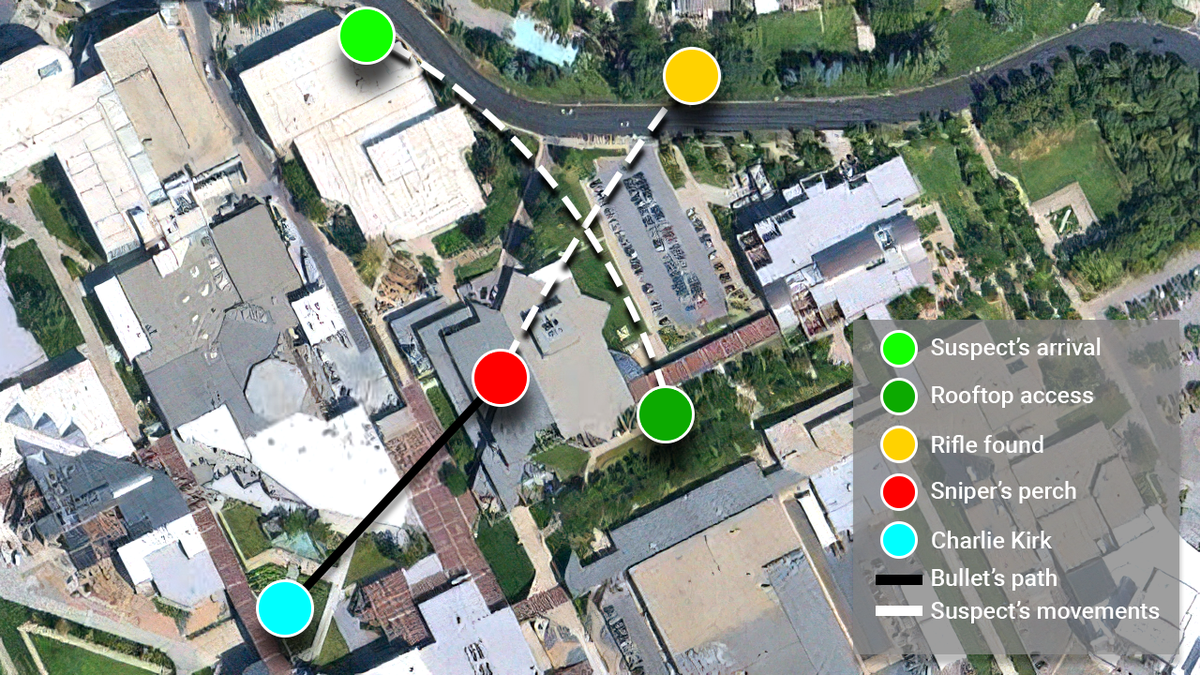
Tyler Robinson: Pre-Shot UVU Campus Movements Timeline
8:07 AM to 12:22 PM, frame by frame — the doorbell captures, a clothing change inside an unfilmed 105-minute window, the backpack dispute, and the stairwell stills the FBI later called enhanced.
Read thisThe court year. Judge Graf's rulings, the March fight to seal the inconclusive ATF report, the April discovery stall, a June contempt finding, and five days of preliminary hearing in July.
Read thisThe master chronology for the charged man, from September 9 through booking and into the capital case. The custody, Miranda and confession-order conflicts are shown rather than reconciled, because the public record does not reconcile them.
Read thisElsewhere In The Investigation
Landscaping Crew Replaced Dirt With Cement / Pavers
Soil was hauled out of the tent courtyard and pavers went down over the exact spot where Charlie Kirk fell. If that ground would have shown residue, it is gone.
Read thisThis website's author is @HolonCitizen on X and YouTube/@HolonCitizen. Follow me there.
Interesting
- A speech 55 hours after the death reportedly said "evil do-ERs" — plural.
- The mic pack's whereabouts are unaccounted for, and attention centers on the table jumpers.
- Frame analysis reportedly shows outward shirt expansion before any wound and no supersonic shockwave.
Related Areas
- What the site alteration could have destroyed
- Before-and-after photos of the courtyard
- PETN and why soil holds explosive residue
- The contractor's own account, in full
- Bomb dogs reportedly kept from the scene
- UVU's institutional response to the questions