Tyler Robinson Weapon and Rifle
The prosecution's physical case ties Tyler Robinson to a scoped Mauser Model 98 in .30-06, reportedly belonging to a family member, recovered near UVU after the shooting. Citizen investigators and defense filings emphasize the ATF's inconclusive link between the autopsy bullet jacket fragment and that rifle — and the wound trajectory argument that a rooftop shot from the Losee Center does not match Charlie Kirk's neck entry path. This page organizes those threads without asserting that evidence was planted.
Official weapon narrative (as reported)
Charging documents and mainstream outlets describe:
- Mauser Model 98, bolt-action, .30-06, with scope
- Recovered in or near bushes close to campus, wrapped in a dark towel
- DNA on the weapon reported to match Robinson (BBC and others)
- Inscriptions on casings cited in investigative summaries
- Grandfather ownership cited for the rifle's provenance
Recovery followed K-9 and officer searches; project notes flag that a separate figure (Kennington) was reportedly found at the scene with a rifle the same day the "missing" gun appeared — see Charlie_Kirk.txt and Law Enforcement threads.
ATF inconclusive — Exhibit 6A vs Exhibit 1
A defense motion and ATF laboratory report (September 17, 2025) summarized in Charlie_Kirk.txt states:
- Bullet jacket fragment Exhibit 6A from autopsy could not be identified or excluded as fired from Exhibit 1 (the Mauser)
- Rifling on the fragment matches characteristics of "numerous makes and models"
- Neither sufficient agreement nor sufficient disagreement of individual characteristics to link source rifle
Calling the fragment ".30-caliber class" is generic — it does not uniquely implicate the attributed Mauser.
July 2026 hearing — dust in the barrel, and a fragment measuring under .308
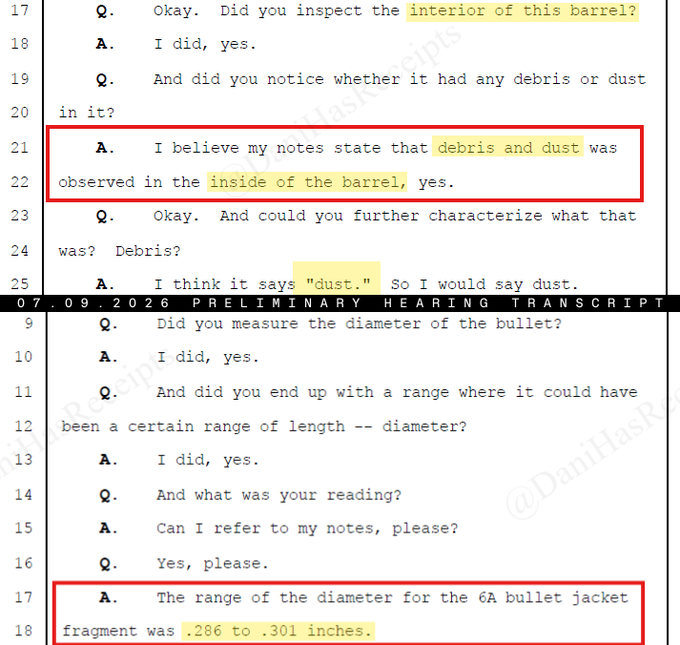
Preliminary hearing transcript excerpts as circulated on X. Source: @TheDibsterX on X, July 31, 2026.
Two exchanges from the July 2026 preliminary hearing bear directly on whether the rifle attributed to Robinson is the weapon that killed Charlie Kirk. The witness is Samantha Karner, the same ATF firearms and toolmark examiner whose report produced the inconclusive finding above, examined by defense attorney Mr. Burt.
On the inside of the barrel:
Q. Did you inspect the interior of this barrel? And did you notice whether it had any debris or dust in it?
A. I did, yes. I believe my notes state that debris and dust was observed in the inside of the barrel, yes. ... A plethora of things. I'm not sure why something is ever in a barrel.
On the diameter of the fragment:
A. The range of the diameter for the 6A bullet jacket fragment was 0.286 to 0.301 inches.
@TheDibsterX posted the transcript screenshot on July 31, 2026, writing, in his words:
"According to the ATF Ballistic expert, Tyler Robinson's rifle could not have been fired, nor the bullet matches the size that rifle uses. I don't understand why is there such a large amount of people online that STILL say Tyler Robinson used this rifle to kill Charlie. Are they bots? Are they stupid? Is it a combination of both?"
The reading behind that post has two parts. A rifle fired shortly before seizure would be expected to show combustion residue — fouling, soot, unburned powder — rather than settled dust, so the dust observation is treated as an argument the weapon had been sitting unfired. And a .30-06 fires a bullet of nominal .308-inch diameter, so a measured range topping out at .301 inches sits below that figure.
Both readings are contested. Karner did not testify that the rifle could not have been fired — she was asked what she observed and answered that her notes record dust and debris, with no last-fired analysis offered either way. A fired barrel can also collect dust across outdoor recovery, towel wrapping, and evidence handling before it reaches a laboratory bench. And a jacket that has struck a body and come apart is no longer round, so prosecution-side framing is that .286 to .301 inches brackets a .30-caliber class consistent with a deformed .308 jacket — which is also why caliber is a class characteristic, as Karner said in the same answer. The full argument, counterargument, and disclosure list are on Barrel Dust & Bullet Diameter. Robinson is charged, not convicted, and is presumed innocent.
FBI Virtual Comparison Microscopy fight
Because the ATF result is exculpatory, the state reportedly moved the fragment to the FBI for Virtual Comparison Microscopy (VCM). Contested points include:
- FBI described fragment as fragile; examination may require pliers, risking new marks
- ATF may have already detached a portion before FBI receipt
- Defense requested to observe or require videotape — FBI policies reportedly denied both
- Critics allege resurrection of banned Comparative Bullet Lead Analysis (CBLA) tactics
Full detail: FBI Ballistics & Forensics and Medical — Trial and Autopsy.
Trajectory and caliber mismatch arguments
Independent analysts (including posts citing @AndrewKolvet and @_DaniFesto) argue:
- Losee Center rooftop shot implies ~5–9° downward angle
- That angle would likely strike face or jaw first, not the reported entry between larynx and trachea, left of cervical spine
- A true .30-06 from the east at distance would expect a more catastrophic neck exit and blood on the white tarp behind Kirk — disputed against scene descriptions
These are hypothesis-level ballistics arguments pending full autopsy and scene reconstruction release.
Mauser vs Remington image discrepancy
Social-media analysts including @DiligentDenizen noted FBI materials describing a Mauser while some released images resemble a Remington profile. We document the inconsistency as a transparency issue, not proof of substitution.
Carry feasibility (Tyler-specific)
Even if the rifle is legally attributed to Robinson, Stairs Guy analysis argues he could not have transported a broken-down scoped .30-06 in morning shorts and a half-full light backpack. That is a logistics challenge to the lone-rooftop-shooter story, separate from the ATF mismatch.
Gray Converse and clothing forensics
April 2026 reporting (NY Post) describes gray Converse shoes as a matching element between surrender clothing and evidence. Analysts counter that shoe match does not prove shooting — only presence or wardrobe overlap.
Engraved casings — the four inscriptions
According to the Officer Brian Davis probable-cause affidavit quoted in Charlie_Kirk.txt, investigators found casings engraved with meme text alongside the recovered rifle. The inscriptions are reported as:
- Fired casing: "Notices Buldge OWO what's this?"
- Unfired casing 1: "hey fascist! CATCH!" (with an up arrow, a right arrow, and three down arrows)
- Unfired casing 2: "O Bella ciao, Bella ciao, Bella ciao, Ciao, ciao!"
- Unfired casing 3: "If you read This, you are GAY Lmao"
The same four engravings were reported by NBC News, The New York Times, LiveNOW from FOX, and Deseret News, which quotes Governor Spencer Cox reading the engravings publicly. Per the defense motion summarized in Charlie_Kirk.txt, the engravings are described as consistent with a rotary tool like a Dremel — a detail critics say could be produced by anyone, not uniquely Robinson.
Mauser 98 provenance — commercial, not a K98
Charlie_Kirk.txt records a provenance dispute over the rifle's origin story. The reported narrative is that the gun came from Robinson's grandfather and dated to World War I. Analysts counter that the recovered weapon is "just a commercial made Mauser 98," and "not even a K98" (the WWII-era German service rifle). One widely circulated image of a black scoped rifle laid on cardboard over grass is described in the file as possibly a stock photo rather than the actual evidence rifle. A separate X analyst cited in the file notes that M98 Mausers were not chambered in .30-06 during WWI and that some serial numbers trace to 1898 — used to argue the grandfather-WWI provenance and the .30-06 chambering do not cleanly fit together. These are open provenance questions, not proof of fabrication.
Jacket fragment: "class" match, not individual match
Charlie_Kirk.txt clarifies the precise wording of the forensic finding. The jacket fragment (Exhibit 6A) is identified as coming from a .30-caliber class bullet and shared class characteristics with the attributed Mauser 98 — so the rifle could not be excluded. But the fragment lacks the individual characteristics needed to identify one rifle to the exclusion of all others. The ATF wrote that rifling similar to the fragment is produced by "numerous makes and models." An FBI analyst who received the fragment from the ATF noted part of the jacket had become detached in the packaging. The defense filed its motion on January 9 after requests to photograph the fragment in its current state and to attend or photograph future testing were denied.
CBLA precedent — the Jimmy Yates case
Critics writing in Charlie_Kirk.txt frame the FBI's involvement as reviving Comparative (Compositional) Bullet Lead Analysis (CBLA), a technique used from the 1980s until 2005, when the FBI abandoned it for "flawed scientific, statistical, and interpretive validity." They cite the Jimmy Yates case (1991), in which a conviction reportedly rested on FBI lead analysis matching a bullet in his car to a crime scene before the science was discredited. This is presented as commentary on why citizen investigators distrust a new FBI examination of Exhibit 6A — not as an assertion that the current fragment was faked.
Disclosure still needed
- Complete ATF and FBI lab notes on Exhibit 6A
- VCM scan files and any destructive-exam video
- Purchase/transfer records for Exhibit 1
- Full autopsy photographs and trajectory rods
- GSR testing records (commentary notes Robinson was never given standard GSR test per some X posts)
Rifle Recovery Photos and Counter-Claims on X
- @JohnMcCloy (Jul 9, 2026) recirculated photos described as the Mauser recovered wrapped in a towel in a cardboard box in woods across from UVU — assembled, with spent .30-06 and etched bullets — tagging @JackPosobiec (post).
- Skeptics still challenge whether a Mauser 98 / "K98" labeling, takedown practicality, and blood / wound physics match a .30-06 from Losee (see ballistics pages).
- Acoustic researchers arguing a stage detonation component say a single recovered rifle does not exhaust the event list (@jonaaronbray XA55 thread).
Weapon identity in charging documents is not the same as a complete public forensic audit.
X.com posts:
This website's author is @HolonCitizen on X and YouTube/@HolonCitizen. Follow me there.
Interesting
- An alibi receipt from that same evening is examined in the Cowboy's Smokehouse check.
- A 12:10 versus 12:23 shooting-time conflict is unresolved in the investigation methodology.
- Sealed forensics and a jet departing 7:08 a.m. appear in miscellaneous evidence leads.
Related Areas
Images