The Device Record Nobody Is Offering
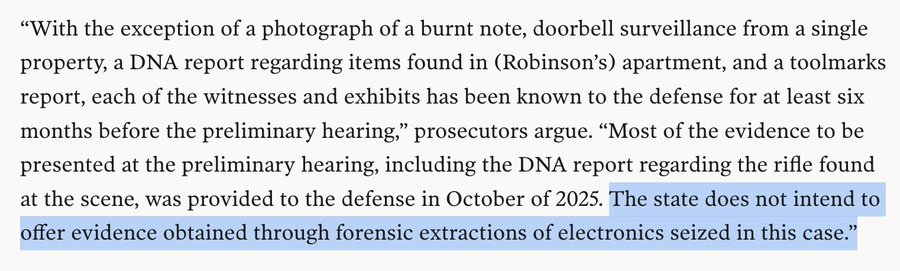
Reporting quoting the state's filing on what it will and will not offer. Full write-up →
What the Screenshot Shows
A capture of published text quoting a prosecution filing. Read off the image:
"With the exception of a photograph of a burnt note, doorbell surveillance from a single property, a DNA report regarding items found in (Robinson's) apartment, and a toolmarks report, each of the witnesses and exhibits has been known to the defense for at least six months before the preliminary hearing," prosecutors argue. "Most of the evidence to be presented at the preliminary hearing, including the DNA report regarding the rifle found at the scene, was provided to the defense in October of 2025. The state does not intend to offer evidence obtained through forensic extractions of electronics seized in this case."
We record what the capture shows and who published it. We do not assert the capture is authenticated. The same statement is examined from the Discord angle on The State Will Not Offer Forensic Extractions.
Why It Matters — for the Steam side
Take the last sentence literally and ask what lives inside a "forensic extraction of electronics."
On a gaming PC or a phone, that is exactly where the Steam side of a person's life is stored:
- the friend list, resolved to accounts rather than display names
- private Steam messages, as opposed to the public comment wall strangers screenshotted
- voice-session history — who, how often, for how long
- login and session records on that device
- the timeline of when accounts were added, renamed, or removed
None of that is being offered. Which means, on the current path, none of it is tested in open court, none of it is characterised on the record, and none of it becomes public.
Put it beside the other closed door: every username in the Discord group except Robinson's was redacted out of the warrant — Every Other Username Was Redacted.
Together those two facts explain the shape of this whole section. The associates are redacted out of the documents, and the device that holds the account lists is not being put in front of anyone. What the public has instead is a handful of screenshots of a public comment wall, taken by strangers — The Steam Names Roster.
Being fair about what this statement is
A statement that the state does not intend to offer something at a preliminary hearing is a statement about that hearing's evidentiary strategy. It is not a declaration that the material does not exist, and it is not proof that anything is being concealed. Prosecutors routinely present the minimum needed to bind a case over.
But the practical effect is the same either way, and it is the effect this section is about: a record that is not offered is not disclosed, and a record that is not disclosed is not published. Meanwhile the reporting record already contains extracted material that has surfaced publicly, which is a tension worth naming rather than smoothing over.
Tyler Robinson is charged, not convicted, and presumed innocent, and none of this is saying that any of the people in the surrounding online circle did anything illegal or immoral.
What Would Settle It
- Disclosure of what the forensic extractions actually contain with respect to Steam: friend list, private messages, session and login history.
- Valve's own subpoena return, which is the independent copy and does not depend on the device at all — The Friend List and What Valve Holds.
- Whether any account on that friend list was operated from outside the United States.
- A plain statement of whether the extractions were reviewed for foreign contacts at all.
The Fix
The gap here is not that the evidence is missing. It is that nothing compels it into the open. The Charlie Kirk disclosure laws are the mechanism.
- Law 1 — DoJ / FBI Forced Disclosure forces out what has already been pulled from the devices and from the platforms.
- Law 3 — Require to Investigate makes the friend-list and login-IP inquiry mandatory rather than a matter of prosecutorial preference.
- Law 4 — Trusted Investigations reaches past the devices entirely: it lets trusted investigators compel the records straight from Valve and take testimony under threat of perjury.
Read the four laws → · The explainer video →
This website's author is @HolonCitizen on X and YouTube/@HolonCitizen. Follow me there.