Panguitch — The Town That Breaks the Timeline
The state's night-of timeline needs Tyler Robinson in the Orem area all evening, but restaurant staff 209 miles south in Panguitch say he was sitting at their counter — and nobody drives that road in the time the timeline leaves.
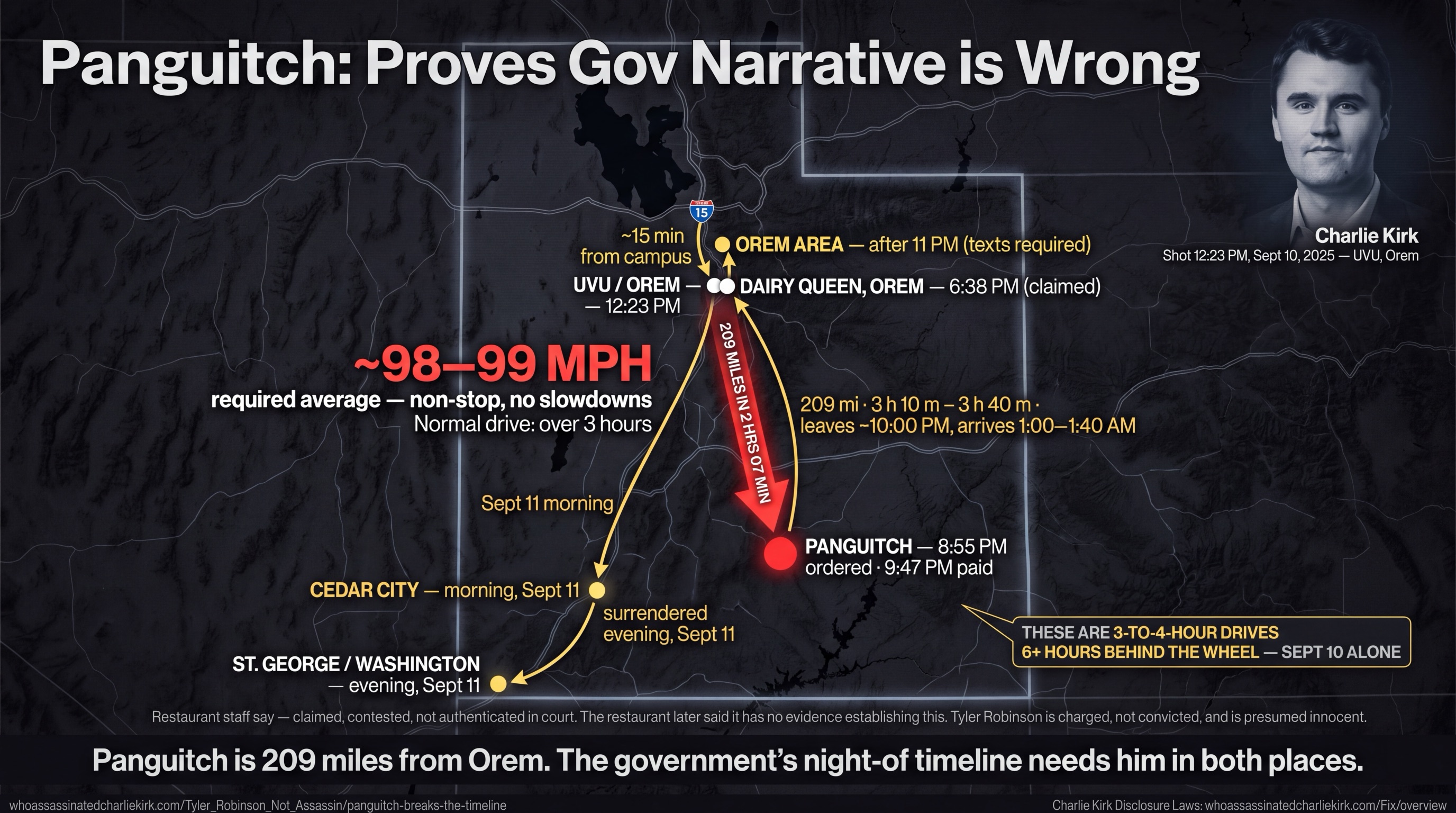
The 209 miles between Orem and Panguitch, drawn to the clock. The Panguitch identification is claimed by restaurant staff and contested — it has not been authenticated in court, and the restaurant later said it has no evidence establishing it. Tyler Robinson is charged, not convicted, and is presumed innocent.
Panguitch is a small town in Garfield County, southern Utah. It is also the name that citizen investigators say the government's night-of timeline cannot survive. Staff at Cowboy's Smokehouse — also listed as Cowboy Smokehouse Cafe-Steakhouse — in Panguitch have said, on camera and to the FBI, that the quiet man who ate alone at their counter on the evening of September 10, 2025 was Tyler Robinson. A photographed receipt puts that meal at roughly 8:55 PM to 9:47 PM, with the customer leaving around closing, near 10:00 PM. Charlie Kirk had been shot that same day at approximately 12:23 PM on the Utah Valley University campus in Orem — 209 road miles / roughly 3 hours 10 minutes to 3 hours 40 minutes north of that counter.
The claim runs through figures amplified by Candace Owens, the citizen journalist @DiligentDenizen ("Diligent Denizen"), and related X accounts. Robinson is charged, not convicted, and is presumed innocent. Every claim on this page is attributed to the person or outlet that made it. The receipt has not been authenticated by any court, the customer's identity has not been officially confirmed, and the restaurant has since issued a statement of its own — covered in full below.
Where Panguitch actually is
The distance is the whole argument, so it has to be stated precisely.
| From | To | Road distance | Typical drive time |
|---|---|---|---|
| UVU / Orem | Panguitch | ~200–209 miles | 3 h 09 min – 3 h 40 min |
| Orem | St. George / Washington (Robinson's home area) | — | ~3.5 – 4 hours |
Three things about that table matter:
- Straight-line distance is irrelevant. The only number that counts is road miles on I-15 south and the connecting routes east and southeast. That is where the 200–209 mile figure and the 3-plus-hour drive time come from.
- Panguitch is not on the way. It does not sit on the direct, continuous I-15 run from Orem down to Cedar City and St. George. Reaching it requires a deliberate exit and detour that costs significant additional time. A man simply fleeing south to his home area does not pass through Panguitch by accident.
- It is an intermediate town, not a destination. Robinson's own home area of St. George/Washington is farther south still. So the Panguitch stop, if real, is a chosen waypoint — someone sat down and ordered a steak.
What the Panguitch witnesses say
The claim surfaced first in early-2026 reporting — Fox News Digital covered a tip about it — and was then pursued hard in July 2026 through on-location interviews and video published by @DiligentDenizen and discussed by Candace Owens. The full 34-minute visit recording and the receipt itself are preserved on their own pages: Cowboy's Smokehouse Full Visit Video and the Cowboy's Smokehouse Receipt.
What the staff describe, in their own words as recorded:
- A quiet, shy, solo male customer matching the photos of Robinson released by the FBI ate at the counter on the evening of September 10, 2025.
- He ordered a medium-rare sirloin steak with vegetables and a baked potato (mashed potatoes in some retellings). Accounts differ on drinks — the receipt shows soft drinks; the on-camera witness recalled a couple of beers. No alcohol is specified in some versions of the account.
- He sat alone, texted on his phone the entire time, paid by card, and left near closing.
- Staff recognized him from the FBI photos the next day, tipped the FBI themselves, provided the last four digits of the card, and were interviewed.
- Cameras were inoperable or nonexistent in the relevant area — one account describes a hole in the ceiling where a camera had been removed. This connects to the broader camera questions that recur across this case.
- A receipt has been referenced and shown in citizen reporting, with the last four digits visible and no customer name printed — the card was run as a debit transaction, which prints no name.
@DiligentDenizen published raw interview video with a server who "100%" identified the customer as Robinson for the 8:55–9:47 PM window, and said the restaurant's owner facilitated access to both the receipt and the witness.
The restaurant: Cowboy's Smokehouse in Panguitch
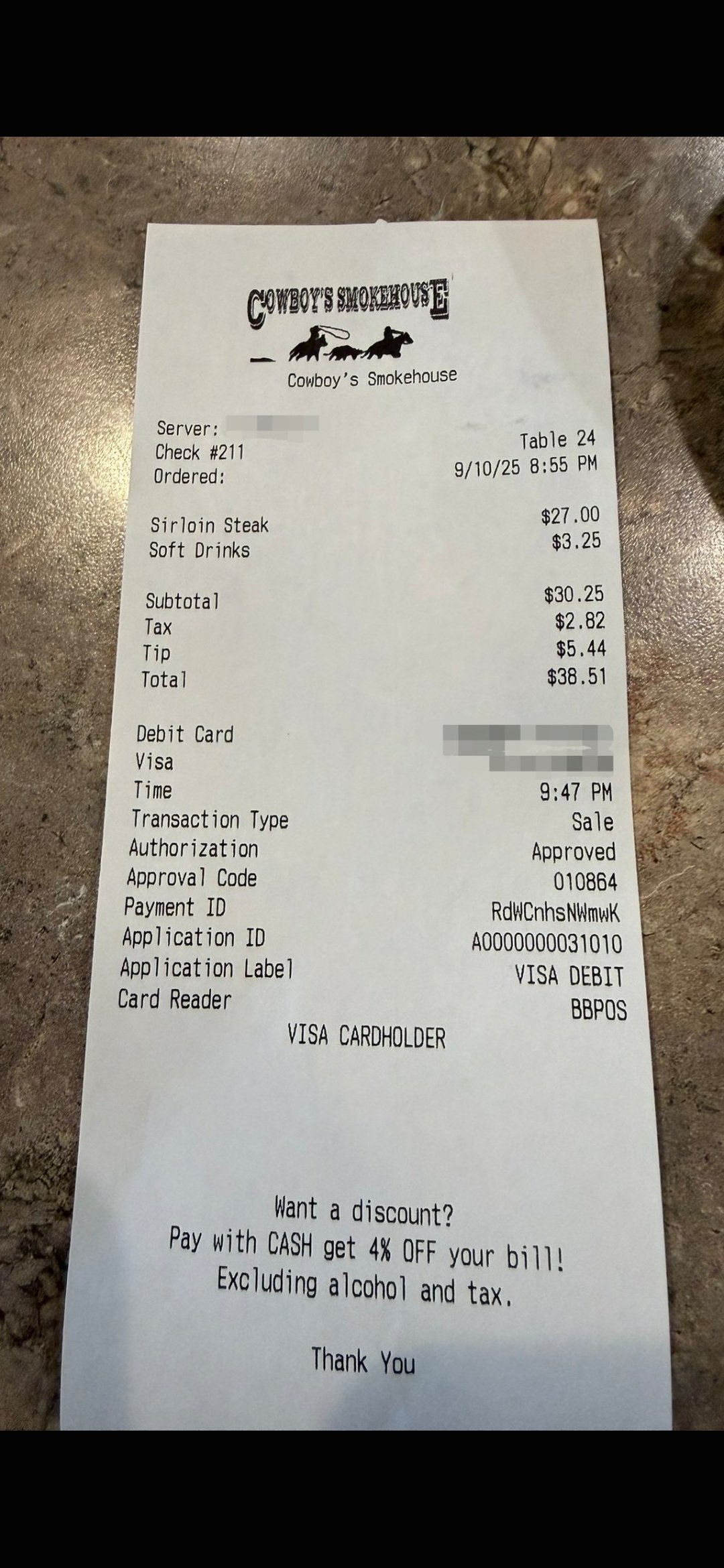
"Here's the Tyler Robinson Panguitch receipt — per Cowboy's Smokehouse servers." Source: @DiligentDenizen on X, August 14, 2026. The receipt is unauthenticated; the cardholder has not been officially confirmed.
Posting the receipt photo on August 14, 2026, @DiligentDenizen wrote, in full:
Here's the Tyler Robinson Panguitch receipt—per Cowboy's Smokehouse servers. 🫡
That one sentence is the whole claim, and it is worth reading precisely. It does not say the receipt has been authenticated, and it does not say the state agrees. It attributes the identification to the restaurant's own servers — the people who were behind the counter that night — and nothing more. Within a day the post had passed 10,000 views with roughly 694 likes and 116 reposts.
Panguitch is the seat of Garfield County — a small high-desert town on the southern Utah tourist corridor, better known as a stop near Bryce Canyon than as anything connected to a national murder case. Cowboy's Smokehouse is a family-run main-street barbecue and steak house there. Nothing about either the town or the restaurant would be part of this investigation at all except for one claim: that on the night of the assassination, the man the state says was the shooter sat at that counter and ate dinner.
What the recorded visit establishes about the restaurant itself matters for how much weight the identification can carry, in both directions:
- It closes at 10:00 PM. The employee gives that closing time on camera, and it is what makes a 9:47 PM checkout a near-closing checkout rather than a mid-evening one.
- The seating is a counter/bar. The customer is described as sitting at the bar, "close to the end, second seat in" — a spot where staff pass repeatedly, which is the basis for the claim of multiple interactions rather than one glance across a dining room.
- The card was run as a debit transaction, so the receipt prints no name. That single technical detail is why this has never been settled: the paper carries a time but not an identity, and only the merchant processor can join the two.
- There was no working camera. On the recorded visit the owner says the old system "has never worked," that he removed the dining-room camera when repainting in the winter of 2023, and that the only camera on the property then was a consumer unit watching firewood on the patio — later moved inside "after the whole Tyler Robinson thing." A new security system was being installed at the time of the recording. See the broader camera questions that recur throughout this case.
- It is a small-town business that did not ask for this. The owner describes harassing phone calls since the story spread, including one in which a caller screamed obscenities at a 14-year-old girl who answered the phone. He says he reported a number to police.
The server's own account, on camera
The full raw 3:46 interview with the Cowboy's Smokehouse employee, face cropped and name withheld at his request. Source: @DiligentDenizen on X, August 14, 2026 (originally posted as 2079273906506965009). IPFS CID QmT3wxEWv5LQsxih65s6XhvTwchUfU3sU6xW27FNt9y5Q7.
On August 14, 2026, @DiligentDenizen re-posted the raw interview with the caption "Herself the server saying it was 100% Tyler Robinson." The clip runs 3 minutes 46 seconds and is the unedited version of the exchange excerpted in the 34-minute full visit. Everything below is the employee's own account, quoted from the recording. It is one witness's recollection, not a court finding, and Tyler Robinson is charged, not convicted.
He had worked there about a year and a half and was on shift that night. "Yes, I was working here. I remembered him coming in, sitting at the bar. He ordered a steak, a couple beers." Asked whether it was at the end of the bar: "Close to the end, second seat in."
He was not the customer's waiter. "I wasn't the waiter who was taking his order and everything, but I did have a couple interactions with him just trying to help out." This is a detail worth holding onto in both directions — it limits how long he was face-to-face, and it is also why his specific claim is about the checkout, not the order.
He says the voice, not the face, is what settled it. "I heard his voice and it's unforgettable." By his account he was not following the news during the shift: "I'd seen that Charlie had been shot, and I didn't really want to give any of my energy to it until I was done with work." The next morning at his other job a coworker pulled up a picture — "I recognized the face" — and then, he says, the video of Robinson receiving his college acceptance letter was released: "when I heard his voice, it was no doubt… that was him."
He puts the departure at closing and confirms the 9:47 PM checkout. Asked what time the customer left: "it was close to closing" — and closing is 10 o'clock. Asked whether a 9:47 checkout time on the receipt sounds right: "Sounds about right, and I was the one who helped him check out." Asked to confirm he personally took the card: "Yep… I took the card. I figured that would be good information for the feds to look into."
Asked how certain he is, he says: "100%." He repeats it, unprompted, three times in the exchange.
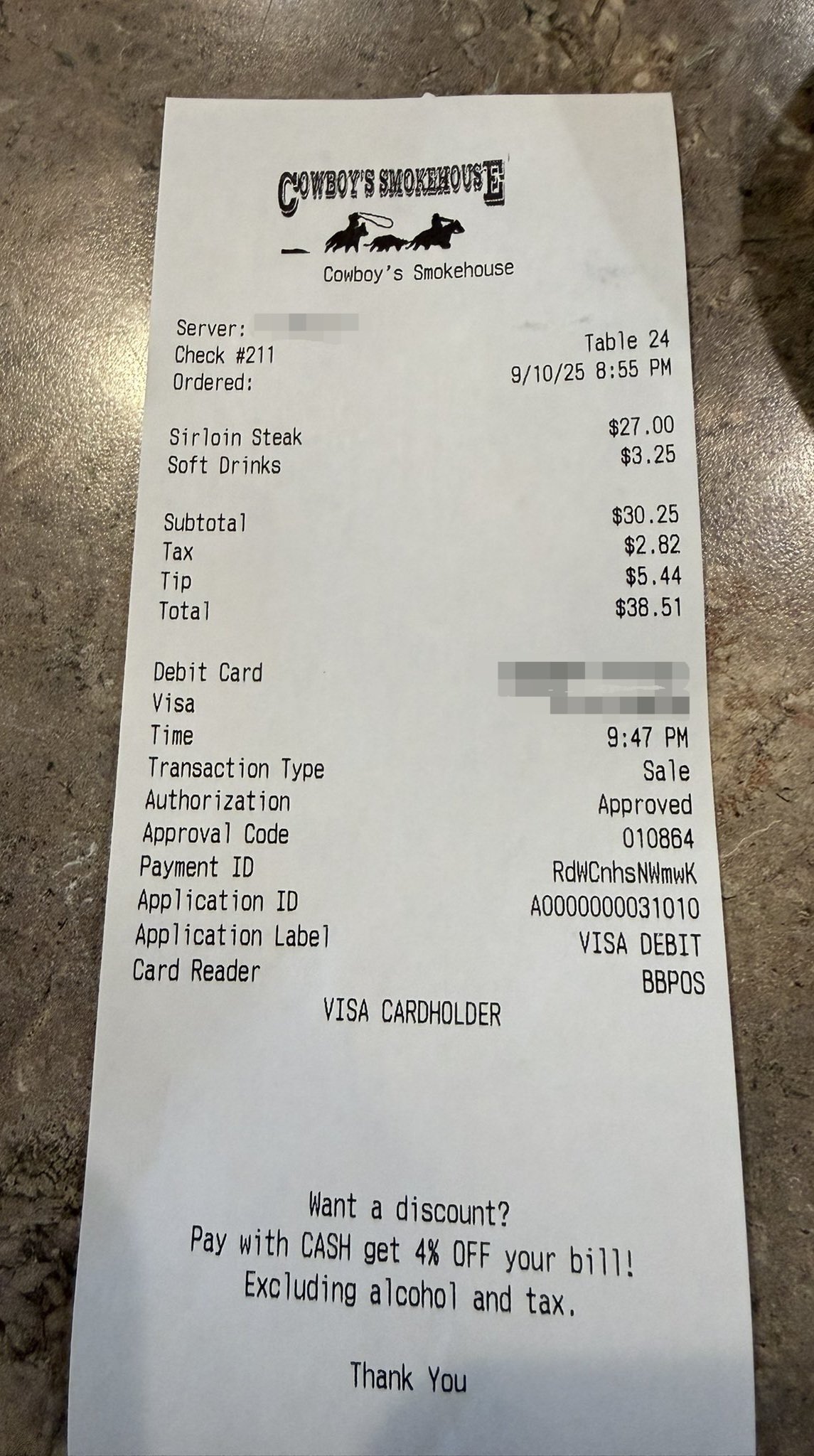
Still posted with the raw interview. Source: @DiligentDenizen on X.
Nobody came back to him
The part of the interview investigators treat as most significant is not the identification at all — it is what happened after it. In his account:
- He told his boss; the boss contacted the FBI.
- "They got our contact information, but we never heard anything from him." Asked directly whether the FBI ever came back after the report: "Never heard anything."
- Asked whether the card details were ever checked: "Not once. I don't know if they checked into that. I know they got that information from my boss."
- Asked whether the prosecution ever reached out to have him testify — and then whether the defense did — his answer covers both: "No one's reached out regarding anything to do with Tyler Robinson."
He says that silence is what pushed him to send the tip to Candace Owens' team himself: "that's kind of what prompted me to send it in. It just didn't sit right with me." These are his claims. Neither the FBI nor either party in the case has publicly responded to them.
The owner hands over the receipt on camera
The full 34:46 visit to Cowboy's Smokehouse, recorded July 11, 2026 — the owner hands over the receipt at 12:22 and points out the witness at 13:07. Source: @DiligentDenizen on X, August 14, 2026. Full breakdown: Cowboy's Smokehouse Full Visit Video.
Posting the receipt photo on August 14, 2026, @DiligentDenizen followed it with the longer recording and the caption: "Here's the owner confirmation that it's the receipt in question and giving it to me." That confirmation is the reason the receipt image above is treated as the actual Check #211 rather than an unsourced photo circulating online.
On the recording the owner retrieves the printed ticket, tells the journalist "you can have it," says "that's the ticket" — and, at the point cited in the post, that it "IS the ticket in question." He says he gave "everything" to the FBI. He also states plainly that he was not there that night, that his staff believe it was Robinson, that "as far as I know, that wasn't him — my staff thinks it is… it would make sense that it could be," and that authorities "never told us it was or wasn't."
That is the honest shape of the evidence: an owner who does not claim to have seen anything, staff who say they did, a receipt whose time is printed and whose cardholder is not, and — by every account given on camera — no official body that has moved to resolve it either way. The receipt's visible fields (Check #211, Table 24, ordered 8:55 PM, paid 9:47 PM, $38.51, Visa Debit) are itemized on the Cowboy's Smokehouse Receipt page.
The government's timeline needs him in Orem that night
The prosecution's case keeps Robinson in the Orem/UVU vicinity for hours after the 12:23 PM shooting, because that is what makes the text messages work as evidence. Those texts, with roommate and partner Lance Twiggs, reportedly carry:
- The instruction to look under the keyboard for a handwritten note — the note reading "I had the opportunity to take out Charlie Kirk and I'm going to take it."
- An explicit admission — "I am, I'm sorry."
- Motive — "I had enough of his hatred. Some hate can't be negotiated out."
- Planning duration — that he had planned it for a bit over a week.
- Rifle logistics — the weapon wrapped in a towel, fingerprint worry, and the need to go back and retrieve it.
- Real-time surveillance of the manhunt — police activity in the area, dogs ("I hope that pooch has a bad sniffer" or similar), waiting for an officer to move so he could act.
- An instruction to Twiggs to delete the messages.
Alongside those texts, the official record and hearing testimony reference activity consistent with him still being near campus or in the Orem area late — a midnight-or-later officer encounter, and vehicle and doorbell-camera sightings after midnight. The next morning, September 11, there is a claimed gas-station stop farther south in the Cedar City area. He surrendered the evening of September 11 in Washington County after family involvement.
The rest of the state's evidence — campus surveillance of a figure with a distinctive stiff gait that speeds up after the shot, DNA said to be consistent with him on the recovered rifle, trigger, towel and screwdriver, and the handwritten note — is argued elsewhere on this site. This page is only about where his body was that evening, because that is what the texts require.
Problem one: the return leg is impossible
If Robinson was physically at the Panguitch counter until 9:47–10:00 PM, the later Orem-area texts and sightings cannot be his.
- Leaving Panguitch at ~10:00 PM puts the earliest realistic arrival back in Orem at 1:00–1:40 AM — and that is with no traffic, no stops, and no slowdowns.
- He therefore cannot be sending real-time "I'm watching the cops / the dogs / waiting for them to leave so I can grab the rifle" updates from the Orem area after 11 PM while he is still hours to the south.
- The round trip is absurd on its face: shoot at 12:23 PM, leave the scene, drive three-plus hours south for a calm sit-down steak dinner ending at 10:00 PM, drive three-plus hours back north for post-midnight activity near the crime scene, and then eventually turn around and head south again toward home. That is six-plus hours of hard driving in both directions, on the day of a high-profile assassination, in the middle of an active manhunt.
Problem two: the southbound leg is impossible too
A second, independent claimed sighting closes the trap from the other end.
Candace Owens and others circulated a photo said to show Robinson at a Dairy Queen in Orem at 6:38 PM on September 10 — maroon shirt, roughly 15 minutes from campus. That location and time are also part of the affidavit timeline discussed on the Dairy Queen Orem page.
Now do the arithmetic:
| Depart Orem | 6:38 PM |
| Arrive Panguitch | ~8:45 PM (seated before the 8:55 PM order) |
| Elapsed | ~2 hours 7 minutes |
| Distance | 209 miles |
| Required average speed | ~98–99 mph, the entire way |
That average requires zero stops, no slowdowns, perfect conditions, and sustained illegal speeding for the whole run. Normal driving time is over three hours. Even the most optimistic nonstop estimates do not get under roughly 2 hours 50 minutes to 3 hours.
Citizen investigators draw the conclusion bluntly: either the Dairy Queen photo or the Panguitch sighting is wrong — or both are — or the person in the two places was not the same individual, because no one covers that ground at that speed.
What this breaks in the government's narrative
The texts are not a supporting detail in the state's account. They are the spine. They supply the confession language, the motive, the planning duration, the instructions to hide and delete evidence, and the post-crime actions including the attempted rifle recovery.
If Robinson was verifiably in Panguitch at the claimed dinner time, then those messages cannot be genuine real-time communications from a man still near UVU. They would have to be fabricated, pre-written, sent by someone else, or the product of an entirely different timeline. That collapses the coherent post-shooting sequence — the lone suspect who lingers near the scene, generates an electronic trail, and only then flees south. The custody-timeline argument about who typed the later messages runs on a parallel track and reaches the same place.
It also raises a procedural question that investigators consider the most damning part: why did neither the prosecution nor, apparently, the defense formally subpoena the restaurant records, the full card data, or the staff in a way that resolved the conflict on the record during the preliminary hearing process? The on-camera witness says the FBI took the staff's contact information and never followed up, and that as of the recording neither party in the case had contacted him to testify — despite his claimed direct, hand-to-hand contact with the customer.
Taken together — Panguitch eyewitness identifications + the receipt claim + drive-time impossibility + the Dairy Queen timing conflict — citizen investigators treat this as proof that the official "Robinson did it, lingered, then fled" sequence cannot hold. Either he was not the shooter in the manner described, or critical pieces of the government's evidence, the texts above all, are unreliable.
The contested side of the record
This claim is not established in court and it is contested. The following belongs on the record alongside everything above:
- In July 2026, the restaurant issued a statement that, based on the information available to them, they have no evidence establishing whether Robinson was there around September 10.
- The owner — named as Ralph Perkins in some accounts — has been reported by some callers as later saying it was not him following law-enforcement verification, and that the receipts circulating publicly were not the relevant one. On the recorded visit, the owner had already said he was not present that night, that his staff believed it was Robinson, that "as far as I know, that wasn't him… it would make sense that it could be," and that authorities "never told us it was or wasn't."
- The restaurant has reported harassing phone calls since the story spread.
- A single staff identification from a brief interaction, plus an unauthenticated debit receipt carrying no printed name, prove nothing on their own.
Citizen investigators' answer to all of that is the same in each case: the initial staff identifications, the tip the restaurant itself made to the FBI, and the timing arithmetic are what matter, and the fastest way to settle any of it — pulling the merchant processor records for Check #211 and matching the last four digits — is the step no official body appears to have taken publicly.
Why this one is a problem for narrative control
Citizen investigators argue that the reason Panguitch draws such heavy pushback is not that it is the wildest theory in the case — it is that it is the most checkable one. A receipt is a document. A card has a cardholder. Drive time is arithmetic. Unlike most of the disputed material in this investigation, this thread could be closed in an afternoon by anyone with subpoena power, and it has not been.
In the reading circulated by these accounts, there is a recognisable set of six subjects that attract immediate and disproportionate effort to shut them down. Each is an unproven theory in public circulation, and each is listed here as a topic that gets contested, not as a finding of this site:
- That Israel might be involved. A foreign-nexus thread that former NCTC director Joe Kent says his center's parallel review was ordered to stop pursuing once Robinson was in custody.
- That Lance Twiggs might be involved. Robinson's roommate, whose phone supplied the text messages the state's night-of timeline depends on. Twiggs has not been charged with any crime, and no evidence establishing involvement has been presented in court.
- That Erika Kirk might be involved. No accusation against her has been made in any legal proceeding, and the speculation circulating online is exactly that — speculation.
- That Tyler Robinson might be a patsy. The framing that follows if the physical case does not hold. He is charged, not convicted, and presumed innocent.
- That Tyler went to Panguitch — this page.
- That there might have been an exploding microphone. The alternative kill mechanism argued across the .30-06 mismatch and exploding-mic pages.
The observation those accounts keep returning to is about the shape of the response rather than its content. Enormous energy goes into closing each of those six doors. Comparatively little goes into the one thing that would make all six unnecessary:
Affirmatively and independently proving that Tyler Robinson did it.
That asymmetry is the argument. If the physical case were airtight, the off-ramps would not need policing — the evidence would close them on its own. Citizen investigators read the reverse priority as a sign that narrative maintenance is doing work the evidence cannot, and they treat the fear the Panguitch story provokes as a measure of how little it would take to break the official timeline. This is their inference about editorial behaviour, not an established fact about anyone's motives, and none of the six theories above is established either.
What would settle it
- Subpoena the merchant processor. Check #211, paid 9:47 PM on 9/10/25. The cardholder behind those last four digits is a matter of record somewhere.
- Release the FBI's disposition of the tip. The restaurant says it called the Bureau and handed over "everything." What happened to that lead?
- Reconcile the two sightings on the record. The 6:38 PM Dairy Queen entry sits in the affidavit timeline. If the state stands by it, the state also has to explain the 209 miles.
- Depose the staff. A witness who says he personally took the customer's card and is "100%" certain has never, by his own account, been asked to testify by either side.
Until those things happen, Panguitch remains what investigators call it: a 209-mile hole in the middle of the government's night-of timeline that no one with subpoena power has publicly tried to close.
The document the whole argument rests on
This website's author is @HolonCitizen on X and YouTube/@HolonCitizen. Follow me there.
X.com posts:
- The Tyler Robinson Panguitch receipt, per Cowboy's servers
- Server on camera saying it was 100% Tyler Robinson
- Owner confirms this is the receipt in question
- Full raw interview with the witness who ID'd Robinson
Interesting
- The receipt's printed fields — Check #211, Table 24, ordered 8:55 PM, paid 9:47 PM, $38.51 — are itemized on the Check #211 receipt page.
- The same evening's messages are argued on authorship grounds in the custody-timeline fake-confession analysis.
- The morning-after southern stop is documented at the Cedar City Maverik.