UVU After-Action Report — Contested Points
Utah Valley University released a 158-page After-Action Report on the September 10, 2025 event where Charlie Kirk was killed. UVU commissioned it through Request for Proposal 2026-1172. It was written by The Lake Forest Group (the security review) and Brownstein Hyatt Farber Schreck, LLP (the legal review). The report is dated September 25, 2026. It says it drew on more than 70 interviews, "thousands of pages" of records, dispatch and radio logs, text messages, and campus video.
The report does not investigate who killed Charlie Kirk or how. It states that its objective "is not to examine political viewpoints or speculate regarding motivations." It reviews planning, staffing, command, alerts, and law. That limit matters, because the report still restates the government's account of the shot as settled background.
Read the whole report the way it was published. Every page is rendered from the original PDF, and you can search and select the text. An outline jumps to each section.
📄 Open the Full After-Action Report → or download the original PDF (10.8 MB)
What people are contesting
These are the points in the report that readers, citizen investigators, and commentators are arguing about. Each one cites the report's own page, which you can open in the full report.
The cause of death is assumed, not examined
- The report's timeline says "a single gunshot was fired, striking Charlie Kirk." It also says "post-incident surveillance footage review" shows the "assailant" crossing the Losee Center roof and taking "a prone position" (report pp. 20–21). It performs no acoustic, ballistic, or forensic analysis of its own.
- That is the government's narrative. Citizen investigations on X, by a large majority, have concluded that Charlie Kirk died from an explosive, not a .30-06 bullet: see the exploding microphone evidence and the Canon XA55 multi-boom audio. The report never mentions that evidence.
- At about 7:23–7:30 a.m. on September 10, Chief Jeff Long emailed the Utah SIAC an anonymous tip. According to the report, the tip warned of "a potential threat involving an electronic-magnetic-pulse device that a suspect might use at the event." The report says SIAC answered that the threat was not credible because the tipster "had provided similar information in the past that was determined to be unreliable" (report p. 42). Readers are asking what exactly the tip said, who sent it, and whether anyone looked for a device at the stage.
"No bad faith," from a review UVU paid for
- The report's headline conclusion: "at no time… did any employee or agent of UVU act in bad faith or in willful and wanton disregard for the safety of others" (report p. 10). Critics note that UVU commissioned the review, and that a finding of bad faith or willful and wanton conduct is exactly the legal threshold that matters for liability.
- The same report lists a long run of failures: no documented Security Assessment, no written Event Action Plan, no face-to-face walkthrough, no mutual-aid request, and nobody watching cameras live (Key Findings 1–5, report pp. 11–15). Readers are asking how those findings fit with the "no bad faith" conclusion.
Who picked the courtyard
- The report says TPUSA asked for the outdoor Fountain Courtyard from the first email on July 10, 2025. It says UVU staff raised concerns at the August 25 MEAC meeting, but the committee let TPUSA keep the venue and run its own ticketing (report pp. 17–18, 39–40).
- On the November 17, 2025 Shawn Ryan Show, TPUSA security lead Brian Harpole said UVU told TPUSA, "Nope, this is where you have to have it." The report says that claim "conflicted with what the Project Team learned" (report p. 47).
- Harpole, TPUSA Security Supervisor Dan Flood, TPUSA field representative Maycee Crofts, and the UVU TPUSA club president did not respond to the review team's calls or certified letters (report pp. 6–7). So their side of these disputes is not in the report. Readers should weigh the venue finding with that in mind.
Rooftops: one walkway covered, the Losee roof not
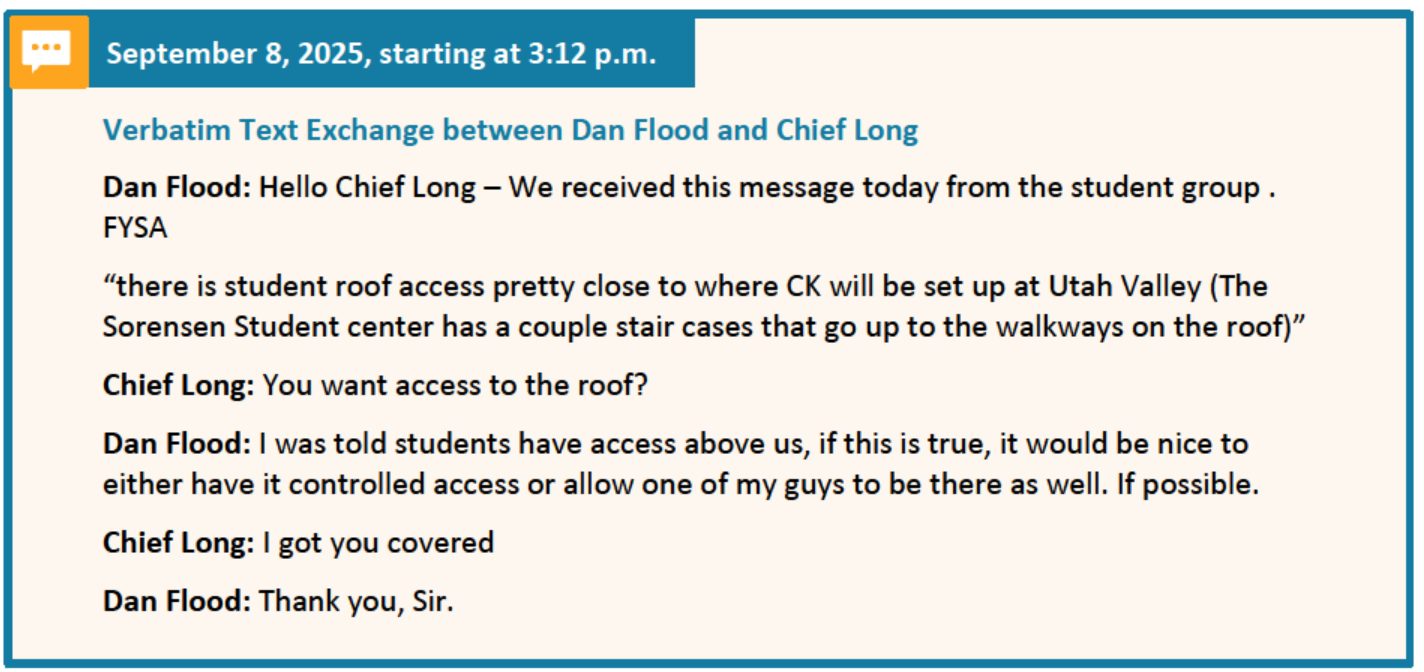
- On September 8, Flood texted Chief Long about "student roof access pretty close to where CK will be set up." Long replied, "I got you covered" (report p. 42, reproduced at right). The report's own timeline gives the time as 4:11 p.m. and the words as "We got you covered." The verbatim box says 3:12 p.m. and "I got you covered."
- The report treats that exchange as being about the Hall of Flags walkway above the canopy. On event day, two officers were posted there behind police tape (report pp. 43–45). The report records no officer, camera watcher, or security team member covering the Losee Center roof. By its account, someone climbed onto that roof at 12:17 p.m.
- Harpole said "federal law" would not let his team post a counter-sniper on a roof. The report says it is "unclear why he did not post any members of his team in elevated locations for general security observation" (report p. 47). Compare No Counter-Snipers and Perimeter and Rooftop Failures.
Six officers, no mutual aid, no drone
- UVU started with three officers and grew to six after Long saw the crowd. That was "all of the UVUPD sworn staffing on duty on that day" (report p. 44). Two Utah State University officers were there only to observe.
- Orem Police Chief B.J. Robinson told the reviewers that his department had a live-video drone and "would have provided that resource… had it been requested" (report p. 52). No request was made before the event, or after the crowd size became clear (report p. 53).
- Harpole said his team's drones were grounded by Provo Airport airspace. The report says its "basic research" puts UVU at least six miles from the airport, outside the five-mile Class D ring (report p. 47). Investigators have pointed to counter-drone activity at Provo Airport as another reason drones may not have flown. See also UVU Security and No Drones.
Cameras were watched only after the fact
- The report says "no individual had been specifically assigned to monitor relevant camera feeds in real time" (Key Finding 5, report p. 14). Campus video became "a post-incident investigative resource" instead of a warning system.
- Readers note that the report relies on that same footage for its roof timeline, yet the full-resolution campus video has never been released to the public. See UVU HD Surveillance Withheld.
"Suspect in custody" and "[insert location]"
- At 12:26 p.m. UVUPD reported an attendee in custody "after allegedly admitting involvement." The report says it "was later determined he was not a suspect" (report p. 20).
- The first Rave Alert, at 12:42 p.m. (19 minutes after the shot), told campus "suspect in custody." The UVU website repeated it at 12:48. A vice president corrected it by speakerphone at 1:04 p.m. (report p. 21).
- At 1:51 p.m. an "erroneous fifth Rave Alert" went out: "Shooter in [insert location] … Run-Hide-Fight." It was retracted two minutes later (report p. 22). The report says no immediate campus alert came from the Incident Commander at all (Key Finding 4, report p. 13).
Who was in charge
- UVU's Emergency Management Director was out of state. When Orem's emergency manager called about 20 minutes after the shot to offer help, according to Orem, it was declined (report pp. 21, 51).
- President Tuminez was returning from Atlanta (report p. 22). The report found "confusion regarding who was responsible for managing the EOC" and who could send alerts (report p. 11). Chief Long ran the Command Post from Fugal Room 204, which had floor-to-ceiling windows. The report says he "heard the gunshot and saw Charlie Kirk get shot" (report p. 45).
Utah law: screening could not keep guns out
- The legal section says that on September 10 an adult with a permit could lawfully carry openly or concealed on a Utah campus. It says UVU had no power to ban lawful firearms at the event, so screening "may not result in prohibiting possession of the weapon inside the venue" (report pp. 114–115). Readers are divided on whether this explains the thin security posture or excuses it. See Screening and Credentials and Event Security Standards.
The report's own map of the key locations
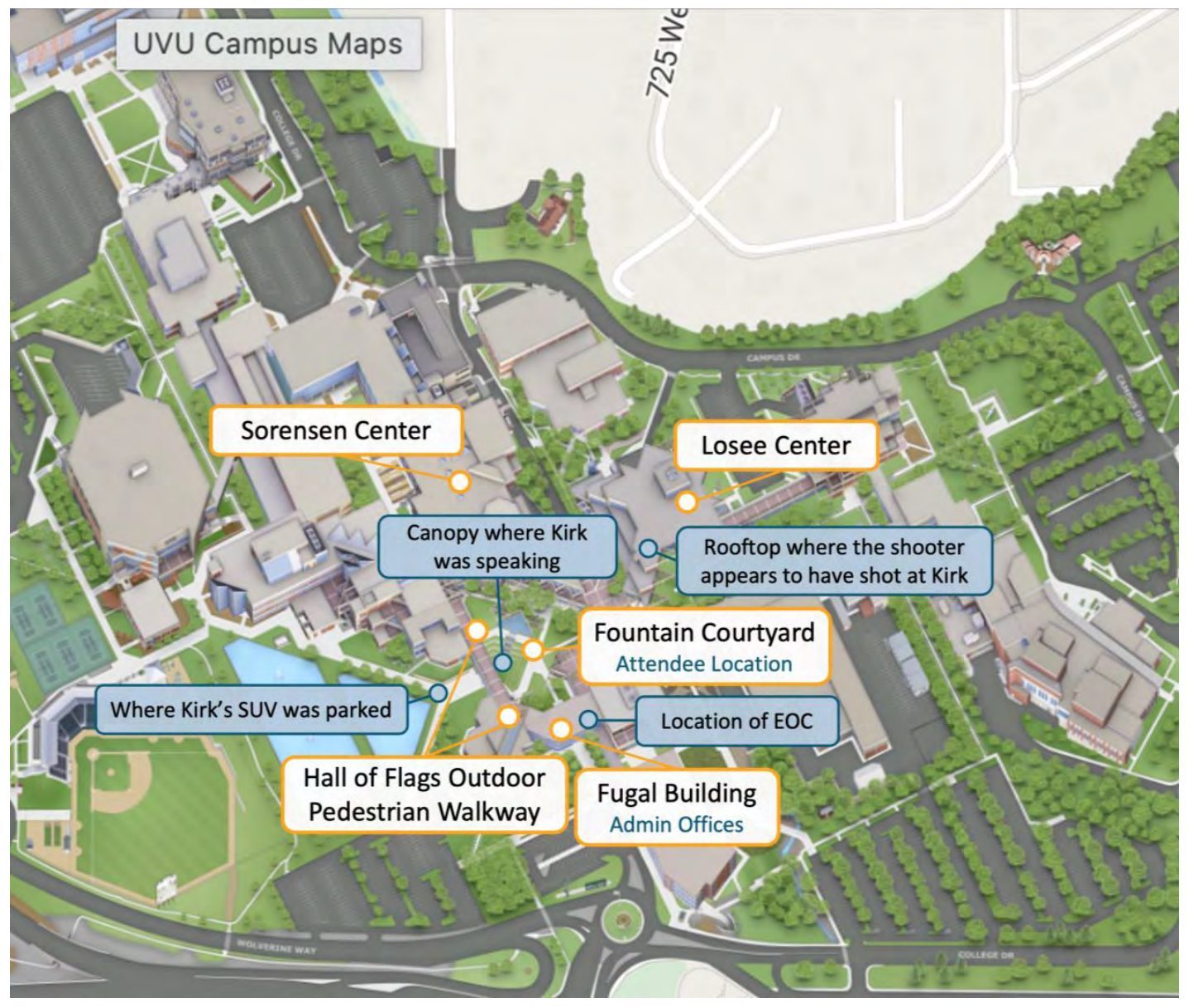
The report labels the Losee Center roof "Rooftop where the shooter appears to have shot at Kirk" (report p. 24). Note the word appears. The same map shows how close the Hall of Flags walkway, the Fugal Building command post, and the Sorensen Center are to the canopy. Walk these distances on our UVU campus maps and the courtyard page.
The report's nine key findings and its recommendations (Section 9, report pp. 117–128) are mostly about the future: a campus safety vice president, written Event Action Plans, a mutual-aid agreement with Orem, live camera monitoring with rooftop video analytics, and plain-language alerts. It names no individual as responsible for any failure. It also leaves out the questions this site tracks: the stage, the microphone, the aircraft overhead, and what happened to the evidence.
📄 Read the Full After-Action Report →