UVU Courtyard
UVU After-Action Report: The report says TPUSA asked for the Fountain Courtyard from its first email on July 10, and kept it over UVU objections at the August 25 MEAC meeting. It disputes Harpole's public claim that UVU forced the venue on TPUSA.
📄 Open the UVU After-Action Report → What people are contesting
UVU's 158-page After-Action Report never once mentions the house UVU owns on the hill above the construction site, 691 W 925 S, even though the rooftop man's exit path ran right beside it and the rifle was found at the base of that hill. Who was in that house on September 10, and whose vehicles were parked in front, may be the single fastest way to crack open who really carried out Charlie Kirk's assassination. UVU holds the keys, the approvals, and the records, so we all need to ask UVU to release a "UVU House / Charlie Kirk Report".
The UVU courtyard west of the Losee Center is where roughly 3,000 attendees gathered on September 10, 2025 under a white canopy tent whose opening faced east toward the building. Every theory of the fatal event — the rooftop account and the microphone device alike — is evaluated against this bowl-shaped space. The courtyard is also where the highest-density witness and camera record exists: TPUSA production gear, press photographers, student phones, and the fixed Canon XA55 rig that captured multi-channel audio independent analysts treat as the best acoustic anchor on site.
Layout and sight lines
Key spatial features from event footage and campus maps:
- Tent and stage — Charlie Kirk spoke from the canopy center; audience seating and standing zones radiated outward across the lawn.
- Losee Center (east) — elevated rooftop alleged in charging documents; ~150 yards to stage.
- Pedestrian tunnel under Campus Drive — north of the courtyard; appears in affidavit movement timelines as the suspect's approach path toward Losee.
- Two locked metal doors in the pavers — steel access doors at the tent spot, reported as an entry to an area or tunnel below; see Locked Metal Doors.
- Walkways and building edges — balconies, stairwells, and production positions along the courtyard perimeter.
The courtyard was paved over days after the shooting — see Pavers and Hardscape Specialties. That post-event change complicates soil-residue and scene-geometry work discussed under Mic — exploding mic theory.
Canon XA55 audio — four-channel courtyard record
A professional Canon XA55 broadcast camera sat roughly 46 meters from the tent. Per CK_FILE analysis, unlike crowd phones, it recorded uncompressed audio on four separate microphone channels at 48,000 samples per second. Its distance from the stage created an acoustic buffer that separated events phone audio smears together.
The analysis reports sounds arrived high-frequency first, then low — the pattern expected from a supersonic projectile's Mach cone (roughly +114 ms), followed by a muzzle blast (roughly +202 ms, attributed to a source about 120 meters away), rather than a single blast with simultaneous frequencies. The same review claims three distinct low-frequency booms, not one. Investigators read the extra, louder low-frequency transient at the tent — distinct from the distant muzzle report — as a detonation at the stage, one of the main reasons they have concluded Charlie Kirk was killed by an explosive at his microphone rather than by the government's rifle account (Canon XA55 Audio). These are researcher interpretations of the footage, not court findings; see also Proof Not Tyler — acoustic split and Mic overview.
People on the courtyard edge
CK_FILE and witness rosters identify figures along the tent perimeter and production line. All are living persons unless noted; inclusion documents reported proximity only — not guilt or foreknowledge. Nothing indicates anyone on Charlie's security team or the AV crew — including those who handled the microphone — knew of any device.
| Person | Reported position / role | Notes |
|---|---|---|
| Rick Cutler | Behind stage | Retired officer who reportedly worked on a mechanical issue behind the stage; presence only |
| Terryl Farnsworth | AV / sound crew | On the production line; nothing indicates he knew of any device |
| Hunter Kozak | Audience Q&A line | Reportedly asked the final audience question before the shot |
| Mikey McCoy | Near stage | Described as feet from stage; post-shot phone calls documented in timelines |
| Charles McClintock Wilson | ZUMA press | Photojournalist who captured final moments and immediate aftermath |
| Andrew Feraci | TPUSA photographer | Reportedly feet from Kirk when the shot occurred |
| Caleb Chilcutt | UVU TPUSA chapter president | Event-planning witness who helped bring Kirk to campus; on-site during the shooting |
| Jayden Wilson | AV crew | Mic/tent production line per event roster |
| Anthony West | AV crew | Mic/tent production line per event roster |
| Robert Golo | AV crew | Mic/tent production line per event roster |
| Cooper Brown | Audience / Fox chaos account | Eyewitness thread separate from production crew |
| Brayden Glascock | UVU videographer | Campus-side video roster |
Tunnel and rear-of-tent acoustic threads
The pedestrian tunnel under Campus Drive appears in the affidavit suspect route toward Losee Center. Separately, courtyard-edge audio analyses attributed in posts to @jonaaronbray describe a ~4940 Hz left-channel acoustic signature as a possible near-field source distinct from a distant rooftop crack. These threads are hypothesis tools, not established facts.
Adjacent to campus at 785 College Dr, construction worker Dylan Hope reportedly described a man in all-black tactical clothing who did not match the FBI's later public suspect image — a perimeter witness thread tied to black-clothing suspect research, not an accusation against Hope.
Teacher's balcony and south stairwell — alternative-position threads
Beyond the rooftop and tunnel, CK_FILE catalogs two courtyard-adjacent positions that citizen researchers ask investigators to examine:
- Teacher's balcony and the roof above it — a CK_FILE note claims a mechanical device elevated during the shot (and for roughly 20 seconds around it) and lowered right after, asking "what was the device that raised and lowered? Is it gone? Did a bullet come from here?" A separate acoustics thread attributed to a sound engineer and posted by @ProjectConstitu walks through a 3D model the poster says shows the sound arriving from the south, above the teacher's balcony.
- South stairwell / door — CK_FILE lists "possible shots from South stairwell/door," arguing the bullet angle and a muzzle blast visible in video are consistent with a near-courtyard south position rather than the 150-yard Losee rooftop.
These are researcher hypotheses and interpretations of footage, not court findings or accusations against any person. They are documented here because they compete with — and are tested against — the official rooftop account and the acoustic two-event split analysis.
Courtyard in witness footage and analysis
Multiple videos and photos capture the courtyard from different angles, showing:
- Crowd movement and reactions at the moment of the shot and immediately afterward.
- Positioning of security personnel, cameras, and production equipment around the tent and along courtyard edges.
- Background activity in the tunnel and adjacent building areas, which some analysts highlight when discussing alternative shooter positions.
Analysts use these visual records to build 2D and 3D reconstructions, attempt to synchronize audio and video, and test whether proposed trajectories fit the courtyard geometry. Compare Witness Nick (trajectory from Kirk's right), Tyler Robinson — Sept 10, and Proof Not Tyler.
Laws (Charlie Kirk)
- The withheld UVU courtyard camera feeds, the drone flights and video-feed recipients over UVU, and geofence warrant data for the courtyard are not public yet; the Charlie Kirk Investigation Laws could bring these powerful truths out.
Courtyard as Contested Forensic Space on X
- Paving timelines from GRAMA texts (@BasedSamParker, @ProjectConstitu) argue the courtyard was altered days after the hit, not under a long-planned hardscape schedule.
- Acoustic researchers place a stage-area impulse at the tent inside the courtyard envelope (@jonaaronbray XA55), competing with Losee-only rifle models.
- Counter-posts emphasize biohazard removal and student trauma mitigation once forensics released the scene.
See Pavers, Tent, Losee Center.
Interesting In This Area
- The tent stood on ground that was stripped and paved within days.
- Sight lines from the Losee Center roof are the whole rooftop argument.
- The paving contractor reached this exact patch of ground on September 14.
Interesting In Other Areas
- The Canon XA55 stood roughly forty-six metres away recording four uncompressed channels.
- A photographer was already filming from the rock pile when the shot landed.
- Water bottles and platform framing sat directly beneath where Charlie stood.
- The government's rooftop account and the investigators' exploding-mic conclusion both have to work in this space.
Other Pages In This Section
A landscaping LLC reportedly dormant for twenty years was revived in February 2025, and it is the company named in the courtyard paving. The corporate paperwork is public record; what it means is contested.
Read this
Active-shooter training gaps, lockdown conditions and withheld internal communications — the faculty half of September 10, built only from records and public statements. Unverified faculty material is quarantined rather than repeated.
Read this
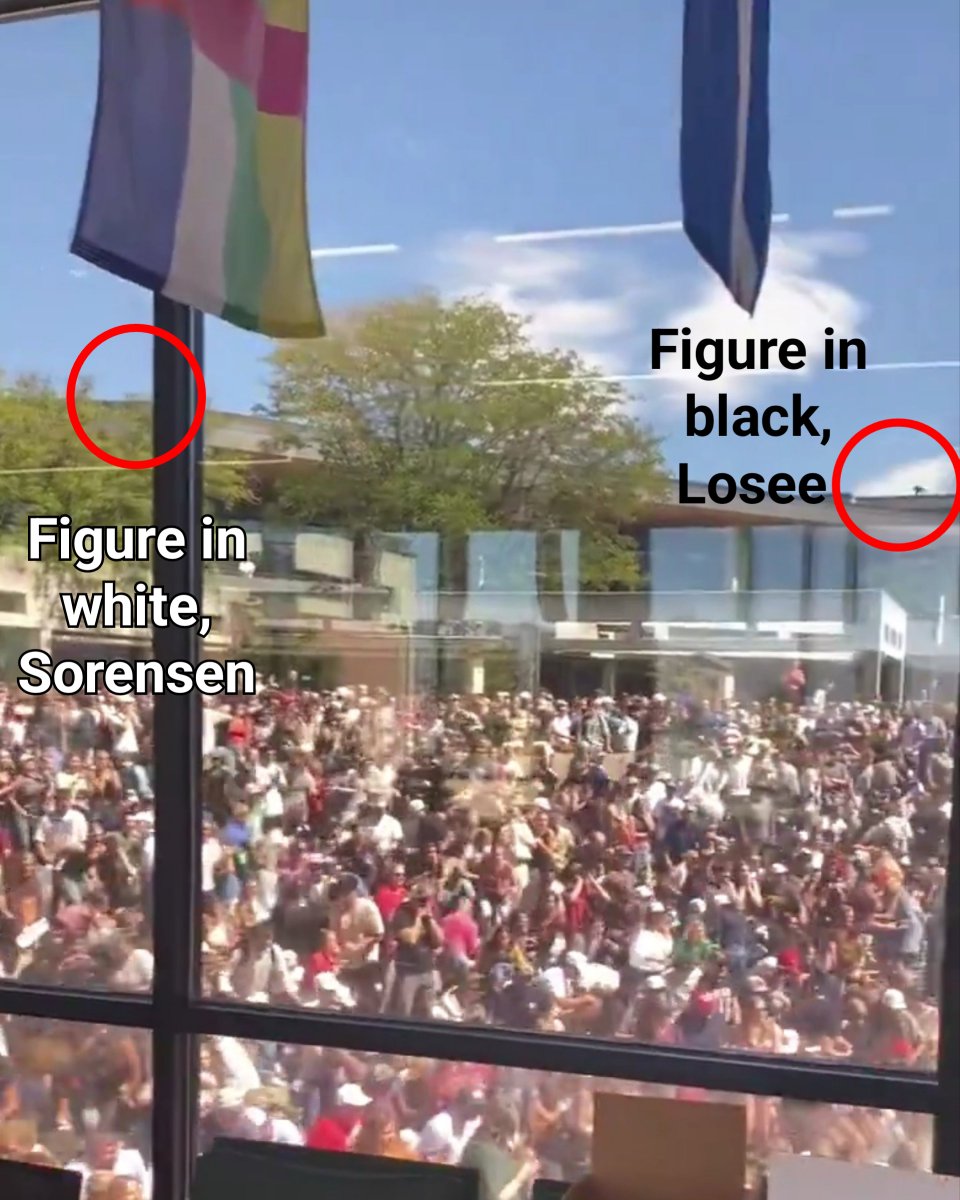
Losee Center (Alleged Sniper Rooftop)
The roof the government says the shot came from. Every part of it — line of sight, the lip, the drop, the screwdriver — has been measured by people who do not accept that account.
Read thisElsewhere In The Investigation
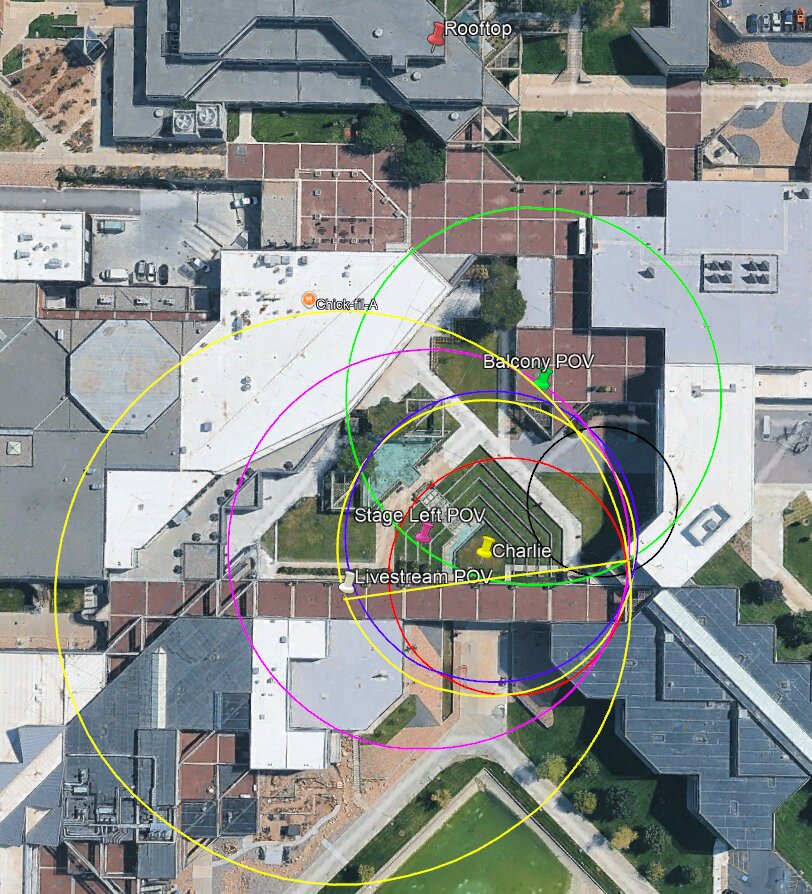
Canon XA55 Audio — Three Booms and Stage Detonation
Professional four-channel audio recorded about forty-six meters from the tent. Researchers say it separates a distant blast from a much louder event at the stage — two sounds, two places.
Read thisThis website's author is @HolonCitizen on X and YouTube/@HolonCitizen. Follow me there.
Interesting
- GRAMA compilations report faculty received no active-shooter training before the event.
- The Tyler Robinson hub records citizen investigators converging on an explosive in the mic.
- Stills of the September 10 movements show a pronounced limp that reportedly vanishes at 12:22.
Related Areas
- Canon XA55 broadcast audio
- Mic — exploding mic theory
- Proof Not Tyler — overview
- Gun & Bullet analysis
- Tyler Robinson — overview
- Suspects — shooting locations