Defense Bindover Brief — Hearsay and the "Intended Target" Aggravator
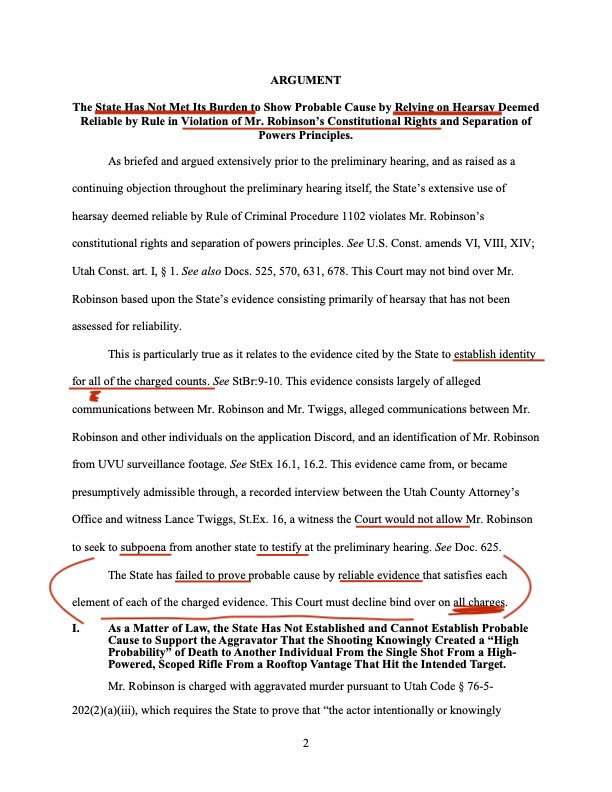
Page 2 of the defense brief, headed ARGUMENT. Circulated by @samtripoli on X, August 13, 2026. The underlying filing was reported by FOX 13 News Utah.
What this document is
A page of a defense filing in State of Utah v. Tyler Robinson (Case No. 251403576), circulated on X in August 2026 and reported the same week by FOX 13 News Utah under the headline "Robinson defense team says he hit the 'intended target,' did not endanger others."
The page is the opening of the brief's ARGUMENT section and contains two distinct arguments. Read together, they are a bindover challenge — an argument that the case should not be sent forward for trial on these charges after the preliminary hearing.
Argument one — probable cause built on unexamined hearsay
The first heading, transcribed from the image as far as it is legible, reads:
The State Has Not Met Its Burden to Show Probable Cause by [evidence] Deemed Reliable by Rule in Violation of Mr. Robinson's Constitutional Rights and Separation of Powers Principles.
The body argues, in the filing's own words:
As briefed and argued extensively prior to the preliminary hearing, and as raised as a continuing objection throughout the preliminary hearing itself, the State's extensive use of hearsay deemed reliable by Rule of Criminal Procedure 1102 violates Mr. Robinson's constitutional rights and separation of powers principles. See U.S. Const. amends VI, VIII, XIV; Utah Const. art. I, § 1. […] This Court may not bind over Mr. Robinson based upon the State's evidence consisting primarily of hearsay that has not been assessed for reliability.
Utah Rule of Criminal Procedure 1102 allows reliable hearsay at a preliminary hearing, which is why so much of the State's showing can come in without live witnesses. The defense's position is that Rule 1102 as applied here collides with the Sixth Amendment confrontation right and with separation-of-powers principles — a rule of court, they argue, cannot substitute for a reliability finding the Constitution requires.
The identity evidence and the Lance Twiggs subpoena
The filing then narrows to identity — the question of whether the State has shown it was Robinson at all:
This is particularly true as it relates to the evidence cited by the State to establish identity for all of the charged counts. […] This evidence consists largely of alleged communications between Mr. Robinson and Mr. Twiggs, alleged communications between Mr. Robinson and other individuals on the application Discord, and an identification of Mr. Robinson from UVU surveillance footage. […] This evidence came from, or became presumptively admissible through, a recorded interview between the Utah County Attorney's Office and witness Lance Twiggs, […] a witness the Court would not allow Mr. Robinson to seek to subpoena from another state to testify at the preliminary hearing.
This is the sharpest procedural point on the page. By the defense's account, the entire identity case rests on three things — the Twiggs communications, the Discord messages, and a UVU surveillance identification — and all three reached the court through a recorded interview with Lance Twiggs, whom the defense was not permitted to subpoena from out of state and therefore never cross-examined.
Two threads on this site bear directly on that: the Miranda / Discord timeline, which questions when the Discord messages could have been posted relative to custody, and the discovery and Brady disputes.
The filing concludes the section:
The State has failed to prove probable cause by reliable evidence that satisfies each element of each of the charged [counts]. This Court must decline to bind over on all […]
Argument two — the capital aggravator and the "intended target"
The second heading is the one FOX 13 led with:
As a Matter of Law, the State Has Not Established and Cannot Establish Probable Cause to Support the Aggravator That the Shooting Knowingly Created a "High Probability" of Death to Another Individual From the Single Shot From a High- Powered, Scoped Rifle From a Rooftop Vantage That Hit the Intended Target.
The page cites Utah Code § 76-5-202(2)(a)(ii), which requires the State to prove the actor "intentionally or knowingly" created a great risk of death to a person other than the victim. That aggravator is one of the findings that can make a murder charge capital — so this is, in substance, an argument against death-penalty eligibility rather than an argument about guilt.
The defense's logic is narrow and technical: one shot, from a scoped rifle, from a rooftop vantage, that hit the person it was aimed at, did not knowingly endanger the crowd. If that holds, the aggravator fails as a matter of law even if everything else the State says is accepted.
The reaction — and what the filing takes for granted
Comedian and podcaster Sam Tripoli posted the page on August 13, 2026 with a two-word caption:
Didn't happen!
He was quoting @EvanMahoney_, who had posted the FOX 13 story the previous day with the remark that "The Candace Owens vs Andrew Wilson debate is already over 😂😂" — treating the defense's own words as settling a public argument about what happened at UVU.
Tripoli's reply is a rejection of that framing, and it points at the thing worth noticing about this document. The defense brief does not contest the rooftop-single-shot account. It argues within it. Its whole second argument depends on accepting that there was a single shot from a high-powered scoped rifle from a rooftop that hit its intended target — because that premise is what defeats the aggravator.
Citizen researchers who dispute the government's account read that as significant in itself. This site's own coverage sets out the case that Kirk was killed by an explosive rather than a rifle round, and the evidence that Robinson did not kill him — including the inconclusive ATF ballistics comparison between the autopsy jacket fragment and the seized Mauser. On that reading, a defense that concedes the mechanism in order to win a sentencing argument is conceding the most contested fact in the case, and the concession is a tactical filing choice, not an independent finding of what occurred.
The narrower, non-committal reading is also worth stating: defense filings routinely argue in the alternative. Arguing that an aggravator fails even on the State's own version of events is standard practice and does not constitute an admission by the defendant. Nothing on this page establishes that any of the State's account is true.
Why it matters
- It is a bindover fight. If the Rule 1102 argument succeeds, counts fall before trial rather than at it.
- It is a death-penalty fight. The aggravator is what makes this a capital case.
- It puts Lance Twiggs' unexamined interview at the center of the identity case, by the defense's own account.
- It shows the defense's posture — contesting procedure and sentencing exposure, not the shooting mechanism.
Defamation and status note
Tyler Robinson has been charged, not convicted. Everything on this page is a description of arguments made in a court filing by his counsel, plus attributed commentary from social media. Nothing here states as fact that Robinson fired any shot, and nothing here should be read as a finding of guilt or innocence.
Lance Twiggs is a living person described in the filing as a witness. The filing raises a procedural objection about the defense's inability to cross-examine him; that is a criticism of a court ruling, not an allegation of wrongdoing by Twiggs. Sam Tripoli and @EvanMahoney_ are quoted as commentators expressing opinions.
Quotations from the brief are transcribed from a photographed page of uneven legibility; bracketed words mark where the scan is unclear. The authoritative text is the filed document on the court docket.
X.com posts:
Interesting In This Area
- The identity case reportedly reached the court entirely through one recorded interview.
- The defense was not permitted to subpoena that witness from out of state.
- The second argument targets death-penalty eligibility, not guilt.
- One shot at an intended target, the filing argues, creates no high probability for others.
Interesting In Other Areas
- Secrecy around the prosecution file is tracked under DOJ practice.
Other Pages In This Section
Kathryn Nester leading, with Michael Burt, Richard Novak and Staci Visser — appointments, motions and the estimated cost of the capital defense.
Read this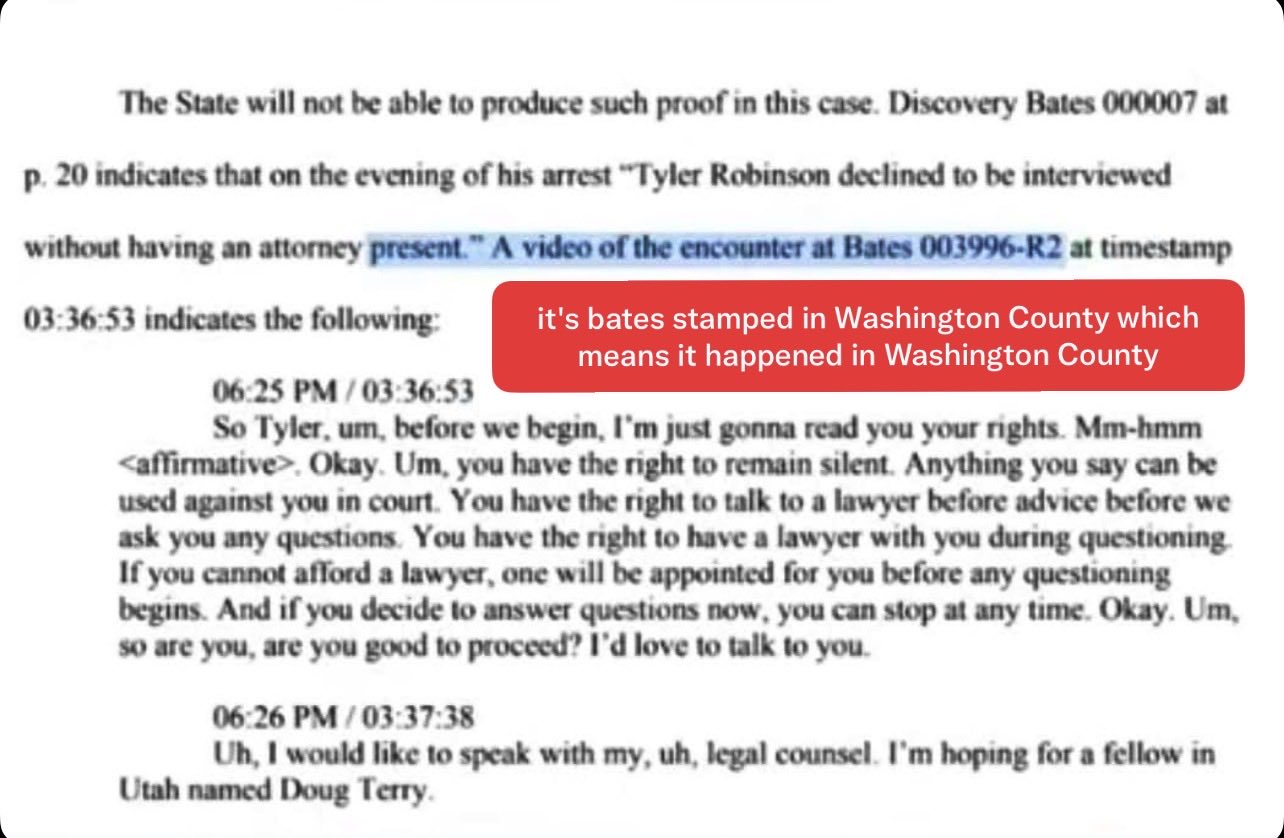
6:25 PM Custody & the Discord Confession
If the rights warning came at 6:25 PM and the phone went into evidence, who typed the Discord messages at 7:57? A single login-IP record that nobody has published would settle it.
Read this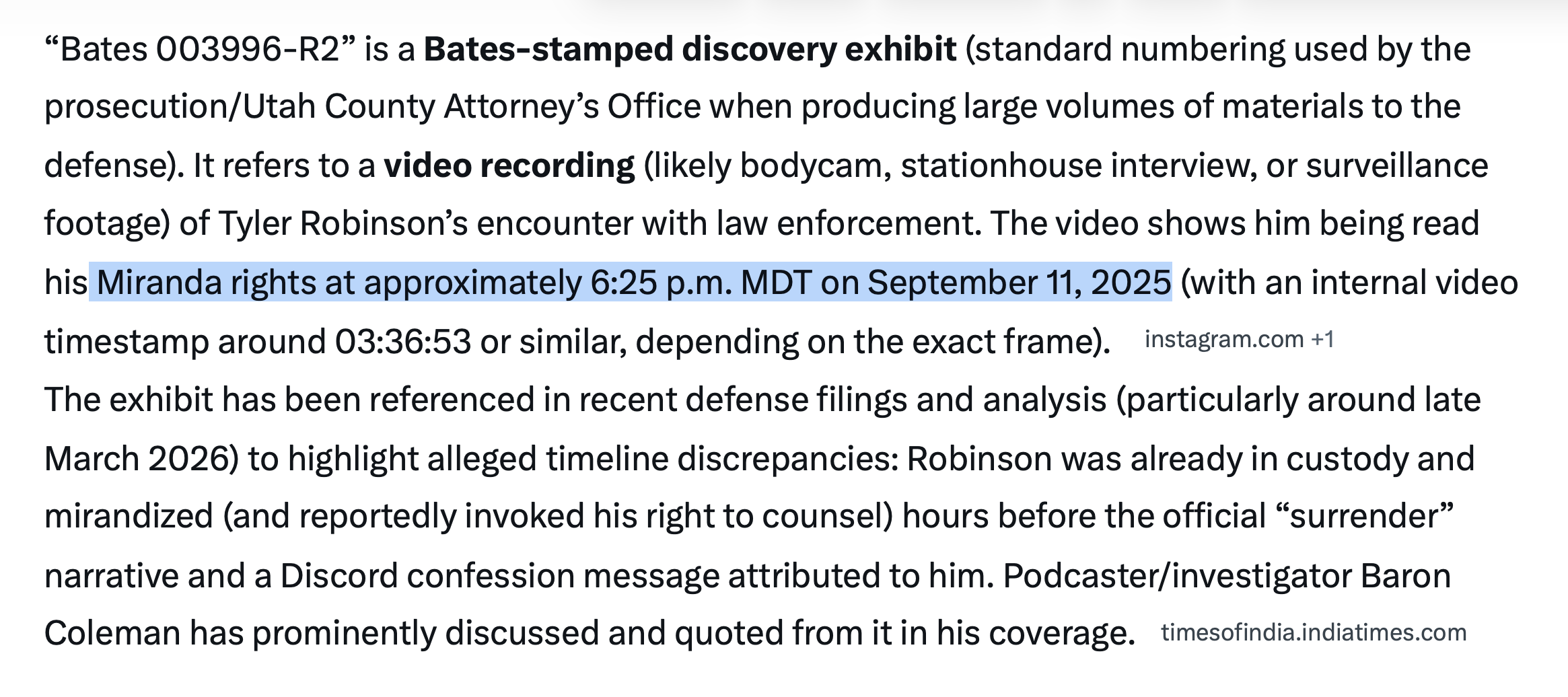
Image: Sept 11 Grok Screenshot — Bates 003996-R2 Analysis
A second screenshot, kept because it explains in plain language what a Bates number is and why 003996-R2 became the most argued exhibit in the case. Preserved with OCR so the text survives the image.
Read thisElsewhere In The Investigation
DOJ Prosecution and Evidence Secrecy
The public record on the charges and evidence handling, plus the sealing questions commentators raise. Digital-forensics warrants were reportedly sealed well into 2026, limiting outside review.
Read thisRelated Areas
This website's author is @HolonCitizen on X and YouTube/@HolonCitizen. Follow me there.