Missing Bodycam & the GRAMA "No Footage" Admission
The custody-timeline argument would be settled instantly by one thing: video of Tyler Robinson walking into the Washington County Sheriff's Office to surrender. That video is exactly what the public has been told does not exist.
According to social-media coverage of a GRAMA (Government Records Access and Management Act) public-records appeal hearing between Scripps News and Washington County, the media coalition asked for release of bodycam footage of Robinson's surrender on the evening of September 11, 2025. When the hearing director asked the county's representative, identified in the post as Mr. Snow, to address the request, his reported answer was: "There was a search made for body cam footage and there was none."
Tyler Robinson is charged, not convicted, and no court has found that any official destroyed or withheld evidence. The claims below are allegations and analysis drawn from social-media posts and cited public records; they are presented as questions the records should answer, not as proven findings.
The "double deletion" argument
The post frames the missing bodycam as the second half of a pattern:
- First, the public was told the CCTV / lobby surveillance video of Robinson walking in with his parents was no longer available.
- Now, on the legal record, the county's position is that no bodycam footage exists of the intake either.
The post's author argues that two independent categories of video going missing around the same high-profile surrender is what raises the flag — not either one alone.
The state-law argument
The post argues that "no bodycam footage" is not a neutral fact — that if it is literally true, it would mean officers violated both department policy and state law:
- Utah Code § 77-7a-104 (activation and use of body-worn cameras), subsection (4), reportedly requires that "an officer shall activate the body-worn camera prior to any law enforcement encounter, or as soon as reasonably possible." Taking a suspect into custody is, the post argues, the textbook definition of a law-enforcement encounter.
- Subsection (10) reportedly requires that if an officer fails to activate the camera, the officer must document the reason in a written report.
- The Washington County Sheriff's Office Field Operations Policy Manual (Section 225.2) is cited as requiring body-worn cameras to be active during encounters for "accountability and transparency."
From those provisions the post reaches its central demand: if there is genuinely no footage, then either the record is wrong, or there should be written reports documenting why every camera was off. "Demand the written reports."
Why the footage would be decisive
The post ties the missing video back to the timeline: if released, Robinson's turn-in footage or an unedited custody log would reveal exactly when he entered custody. If that time is early enough — before the ~7:57 PM Discord messages — it would corroborate the 6:25 PM custody argument. The post also notes that the holding-room video played at the hearing reportedly did not show a timestamp, which investigators treat as a significant gap precisely because a timestamp would settle the question.
This bodycam question overlaps a separate, documented dispute over Officer Bagley's body camera, which reportedly "died" while he was still on the roof — another instance where investigators say the camera record for a key moment is unavailable.
Counterpoint and open questions
There are lawful explanations that the records could still support: a 30-day retention policy that lapsed, cameras that were genuinely not activated in a controlled "soft interview" setting, or footage that exists but is being withheld from public release while litigation continues. Baron Coleman's own analysis notes that pleadings suggest footage may in fact exist and be in the hands of law enforcement, with a live dispute over access — see the Baron Coleman early-turn-in page. The open question the records should resolve: does the video exist, and if not, where are the § 77-7a-104 written reports explaining its absence?
X.com posts:
Interesting In This Area
- Two categories of video went missing around one surrender, which is what raises the flag.
- The holding-room video played at the hearing reportedly carried no timestamp.
- State law reportedly requires a written report whenever a camera is not activated.
- The same absence pattern appears in rooftop testimony from the July hearing.
Interesting In Other Areas
- Compelled production of unedited custody video is what the proposed laws target.
Court Video: He Turned Himself In on September 11, Before 6:25 PM
Preliminary-hearing audio. A state witness places the last text off Lance Twiggs' phone at about 7:42 PM on September 11, is offered September 12 as an alternative, declines it, and agrees September 11 "was when he turned himself in." Source: @JohPersso on X, 2 September 2026.
The September 11 turn-in is no longer only a citizen reading of a leaked exhibit. Three records now point at the same evening: the discovery index lists exhibit Bates 3996-R1 as "Video at WCSO on 9/11/2025"; page 70 of a defense filing quotes companion exhibit Bates 003996-R2 showing the Miranda warning at 06:25 PM and the invocation of counsel at 06:26 PM; and in the clip here the state's own witness, given an explicit chance to move the date to September 12, keeps it at September 11.
If Tyler Robinson was in custody and Mirandized at 6:25 PM, he could not have posted the Discord confession timestamped 7:57 PM that same evening. That is the argument, and it is now document-backed rather than inferred.
Two ordinary explanations stay open and are recorded in full on the linked page: the 6:25 PM reading could be a misread frame or an internal video clock not synced to wall time, or someone other than Robinson could have had the account — which would undo the confession as a confession by a different route. Nothing here states that any witness or official said anything untrue.
- Full write-up, transcripts and both filing pages: September 11 — The Day He Turned Himself In
Other Pages In This Section
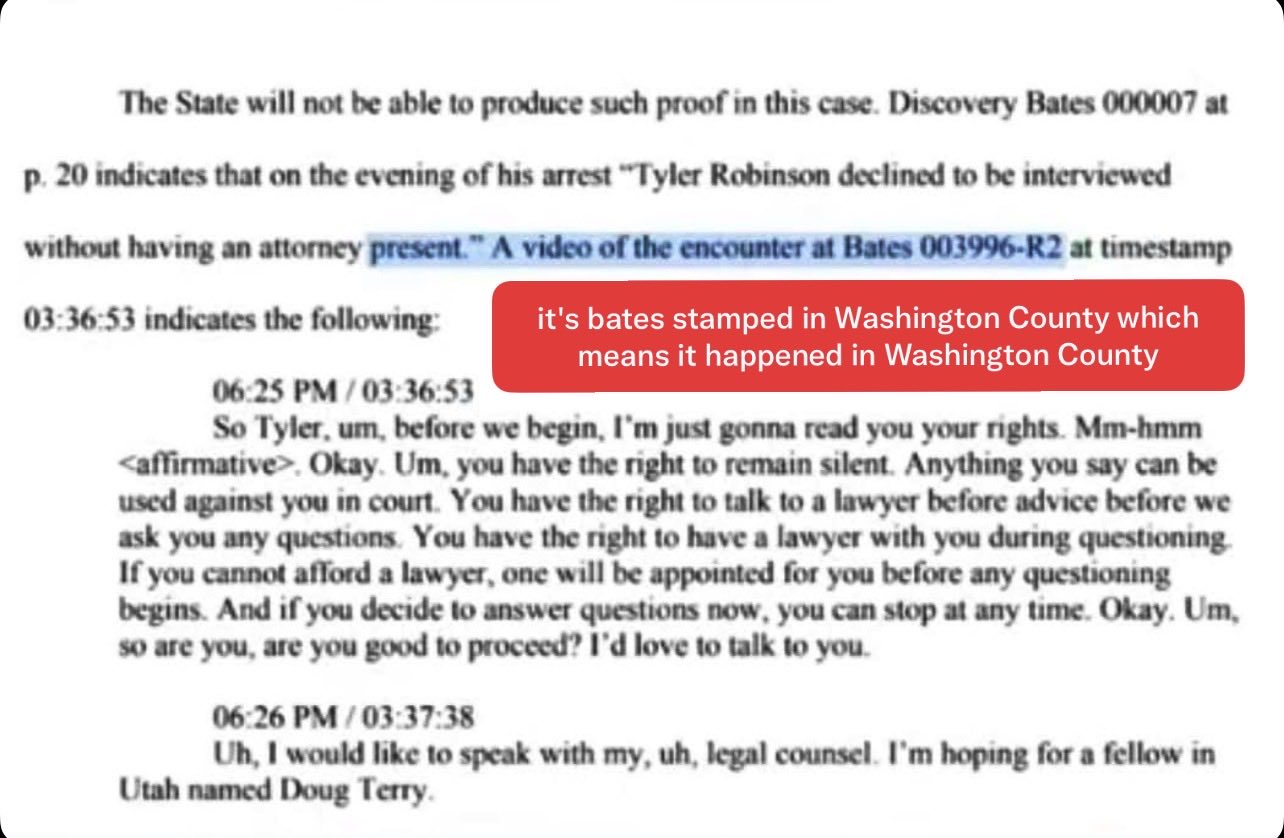
6:25 PM Custody & the Discord Confession
If the rights warning came at 6:25 PM and the phone went into evidence, who typed the Discord messages at 7:57? A single login-IP record that nobody has published would settle it.
Read this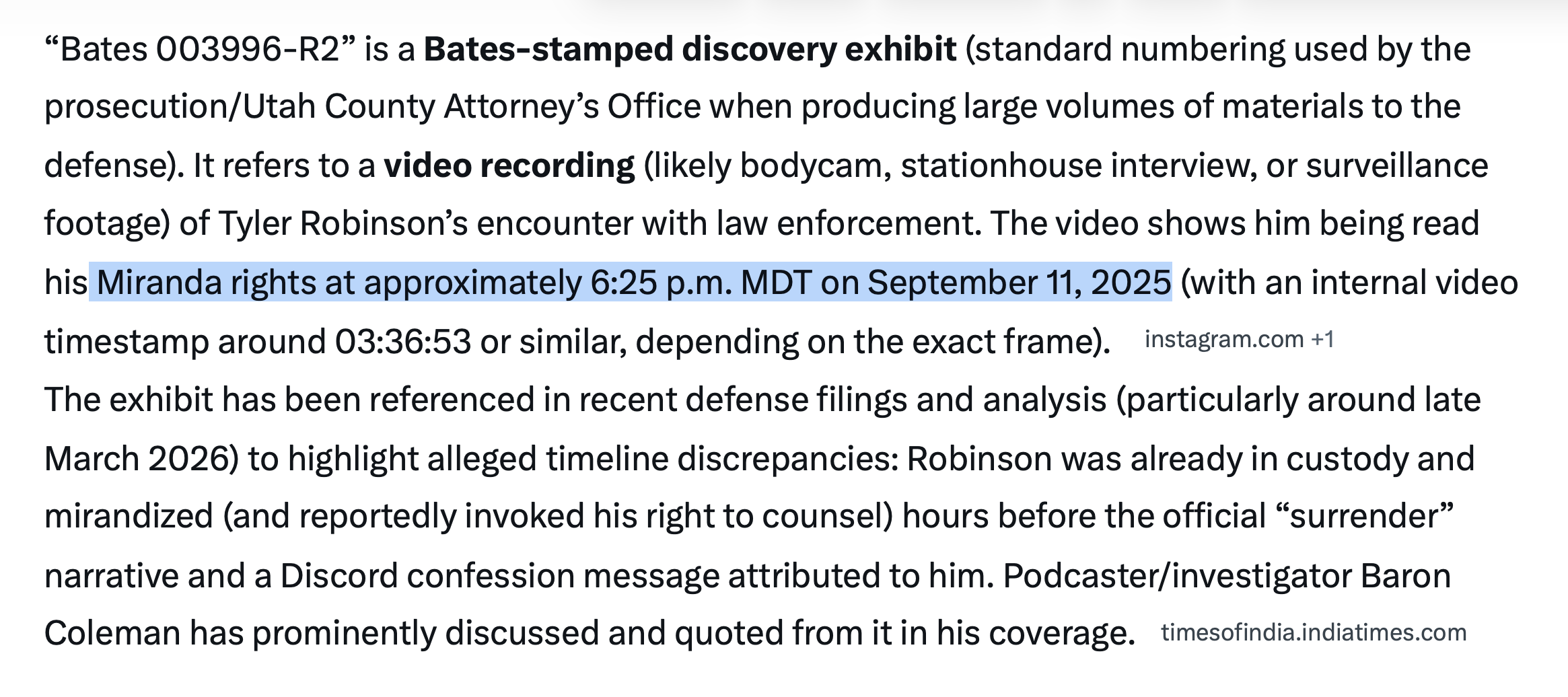
Image: Sept 11 Grok Screenshot — Bates 003996-R2 Analysis
A second screenshot, kept because it explains in plain language what a Bates number is and why 003996-R2 became the most argued exhibit in the case. Preserved with OCR so the text survives the image.
Read thisBooking 460956 in Spanish Fork, restricted housing, remote appearances, and the jailhouse-informant process questions that follow from all three.
Read thisCase Overview — State v. Robinson
The caption, the docket, the charges, and what the state actually alleges — separated from what has been proven. The defense disputes the forensic links, starting with the inconclusive ATF comparison.
Read thisElsewhere In The Investigation
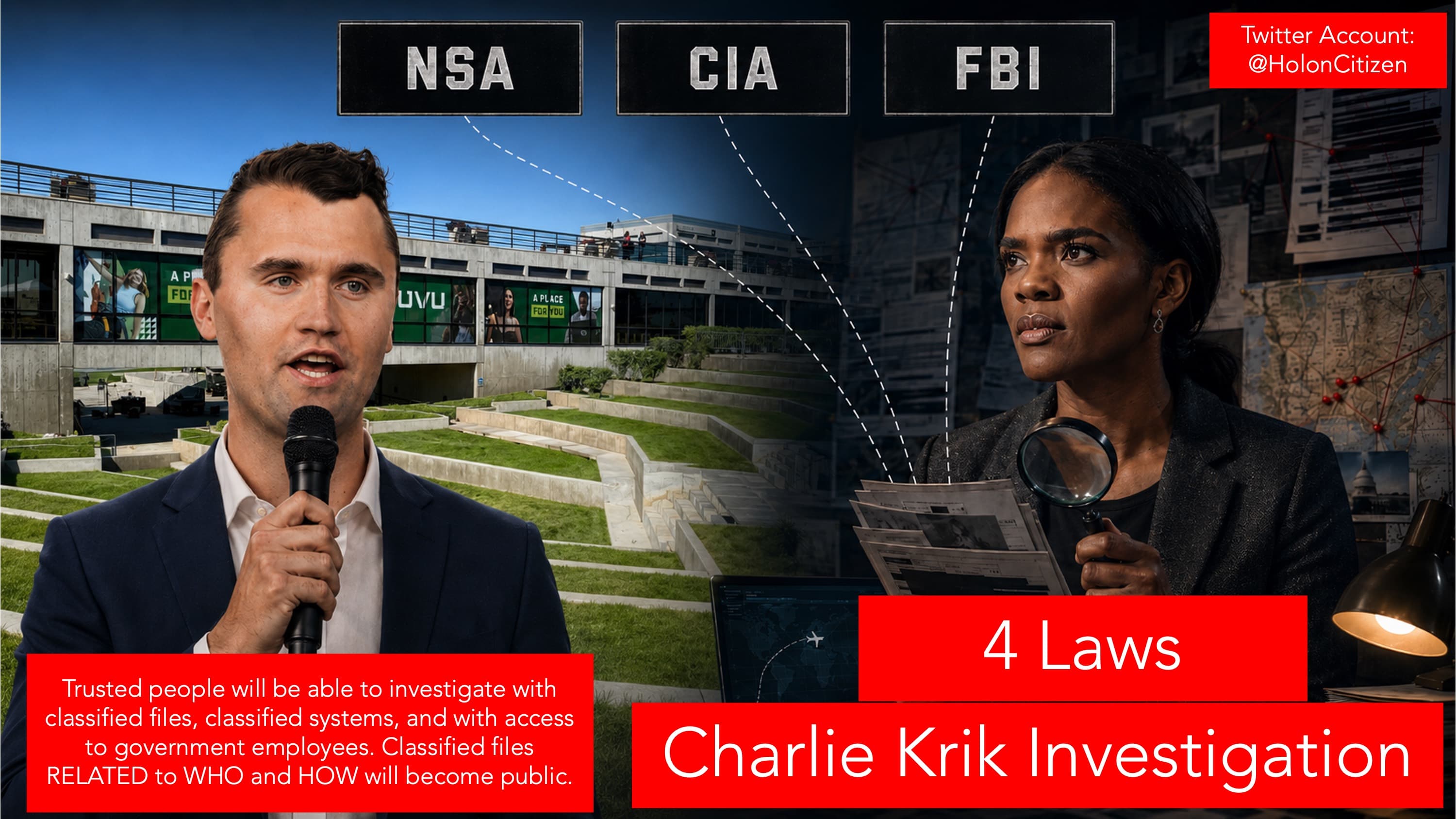
Four federal laws modeled on the Epstein Files Act, drafted to force disclosure and mandate a real investigation. Every unanswered question in the aftermath is downstream of records nobody can compel today.
Read thisThis website's author is @HolonCitizen on X and YouTube/@HolonCitizen. Follow me there.
Interesting
- Managed camera access is why no complete prelim video archive exists.
- An Army-contracted signals-intelligence jet reportedly made two low passes near UVU that day.
- A head-of-state jet's first-ever U.S. landing was at a Nebraska Army base.
Related Areas
- Cover-Up Evidence
- Destroyed & Missing Evidence
- Washington County Sheriff
- Surveillance Cameras Analysis
- Proof Not Tyler
- Censorship of the Investigation