Output Analysis: Law 3 - Require Investigation
This analysis assumes the investigation the law compels would run far wider than the state's prosecution of Tyler Robinson, who is charged rather than convicted, and would not be permitted to close once a suspect is in custody.
Does the Law Meet the Human Requirements?
Requirement: FBI and law enforcement are required to investigate
MET. Section 2 mandates a full investigation with dedicated team, budget, and timeline. "Shall" creates a legal obligation.
Requirement: US intelligence is required to investigate
MET. Section 3 mandates a parallel intelligence assessment directed by the DNI, specifically investigating Schedule A intelligence items.
Requirement: Broadly investigate any and all leads
MET. Section 1(c) defines "good-faith investigation" to include pursuing all leads from Schedule A. Section 2(d) enumerates 8 mandatory investigation categories with specific leads. Section 6(b) gives the monitor authority to direct pursuit of neglected leads.
Requirement: Include the 175 items as mandatory investigation targets
MET. Section 2(d) specifically enumerates leads from the 175 items organized into categories (exploding microphone, foreign intelligence, cover-up evidence, point of origin, financial connections, psychological operations, pre-planning, electronic warfare). Section 8(d) requires each report to address all 175 items.
Requirement: Any government employee may send information
MET. Section 5(a) allows any government employee to provide information to investigation teams, Trusted Investigators, or the public.
Requirement: Illegal to persecute employees for participating
MET. Section 5(b-c) makes retaliation unlawful with criminal penalties, reinstatement, and treble damages.
Key Improvements Over Previous Version
| Feature | Previous | Current |
|---|---|---|
| Scope of investigation | General "all leads" | 175 items as mandatory investigation targets |
| Monitor | Congressional inspector (optional) | Independent external monitor (mandatory) |
| Conflict of interest | Not addressed | Automatic transfer to independent commission (Section 4(c)) |
| Schedule A integration | None | 8 enumerated investigation categories from 175 items |
| Report requirements | General | Must address each of 175 items individually |
| Good-faith definition | General principles | Explicitly includes pursuing all Schedule A leads |
Potential Problems
Problem 1: Self-Investigation Conflict
FBI and intelligence agencies mandated to investigate a case where they may be implicated. Mitigation: Section 4(c) creates automatic conflict-of-interest trigger transferring authority to independent commission. This is a major improvement over the previous version.
Problem 2: Sandbagging
Agencies can technically comply without pursuing the hardest leads. Mitigation: The external monitor (Section 6) has real-time access and authority to direct pursuit of neglected leads. Mandatory Schedule A reporting in Section 8(d) creates accountability.
Problem 3: Predetermined Conclusions
Investigations can be structured to reach desired conclusions. Mitigation: Section 1(c) explicitly prevents predetermined conclusions. Section 4 prohibits directing investigators to exclude theories. Monitor certifies good-faith compliance.
Problem 4: Appropriations
$10M budget and 20-agent team requires appropriations. Recommendation: Include as mandatory appropriation or redirect from existing budgets.
Recommendations
- Consider adding forensic audit requirements for agency systems (coordinate with Law 1)
- Strengthen monitor's authority with subpoena power
- Add provision requiring investigators to specifically address each of the 175 items in Schedule A
- Coordinate with Law 4 so Trusted Investigators can share findings with the investigation team
Interesting In This Area
- Law 3 mandates a full investigation; "shall" creates the obligation, per the requirements.
- Law 4 gives three named investigators two teams each, six teams in total.
- Law 2 limits source protection to active sources only, closing the usual exemption.
- Schedule A grew from 175 items to 208, and one count still needs harmonising.
Interesting In Other Areas
- The Fix section is the plain-language version of what these four bills would force open.
Other Pages In This Section
Law 4: Charlie Kirk Investigation - Trusted Investigators Act
Full text of the trusted investigators act — civilian-led teams embedded inside the FBI and intelligence agencies with full access and their own release authority.
Read thisNotes: Law 2 - US Intelligence Services Forced Disclosure
The research behind Law 2, and its warning. The JFK Records Act ordered release in 1992 and agencies were still withholding in 2025. Intelligence disclosure laws fail on their exemptions, which is why this draft narrows protection to active sources only.
Read this
Four Laws to Force the Truth About Charlie Kirk
The launch article for all four laws in one place: why the Epstein Files Act is the model, and what each bill would force into daylight. Start here if you have never read the statutory text.
Read thisFactual Challenges Analysis — FIXED ITEMS
The fact-check that hardened the drafting. Every contested claim was reframed as a records request rather than an assertion, which is why the bills ask for all records relating to whether, instead of stating conclusions.
Read thisElsewhere In The Investigation
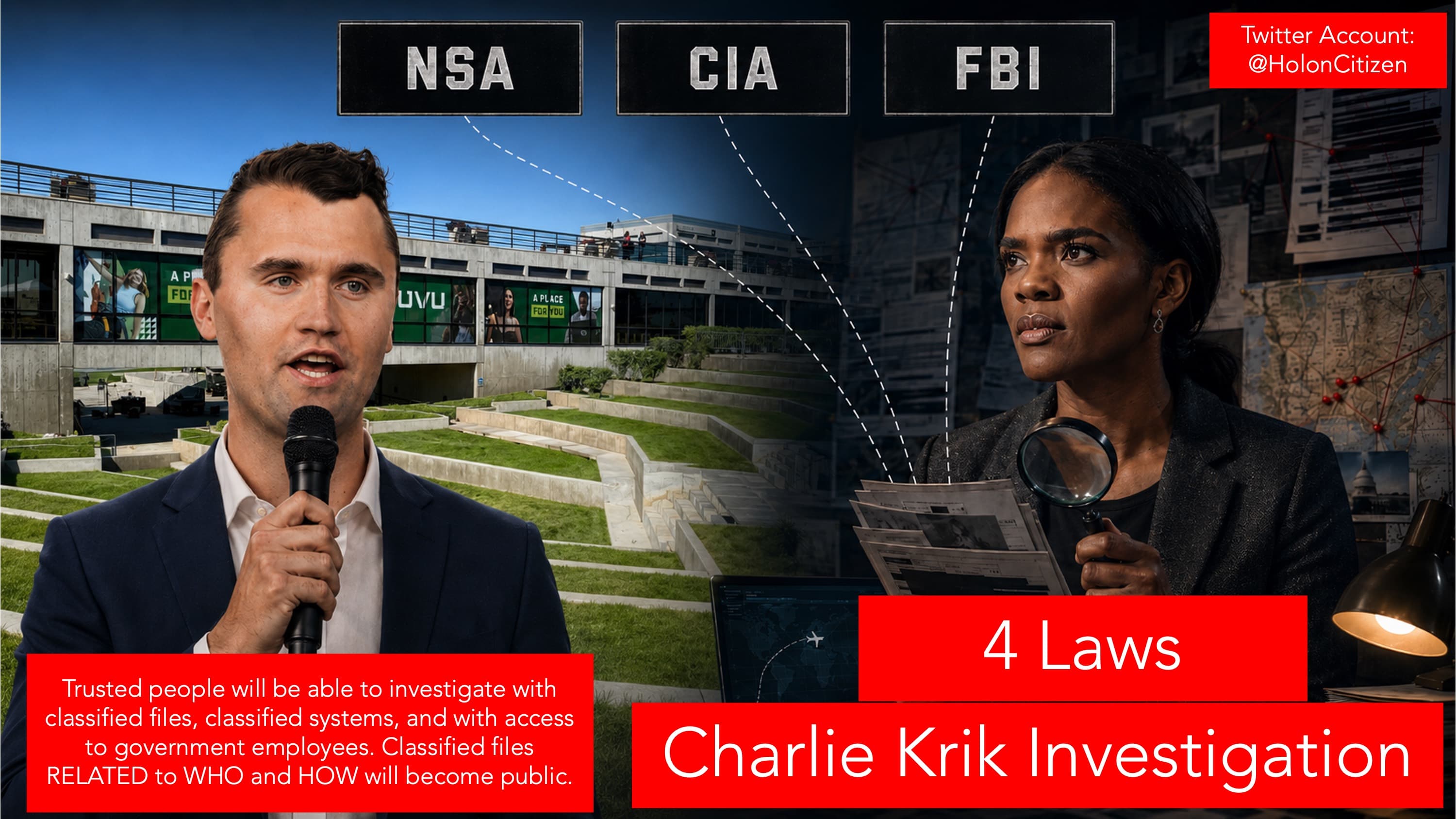
Four federal laws modeled on the Epstein Files Act, drafted to force disclosure and mandate a real investigation. Every unanswered question in the aftermath is downstream of records nobody can compel today.
Read thisThis website's author is @HolonCitizen on X and YouTube/@HolonCitizen. Follow me there.
Interesting
- Retaliating against a discloser brings treble damages under Law 1's terms.
- The chain reportedly dismissed two warning visitors as GOP reps that night.
- A false suspect in custody alert went out 19 minutes after the shot.
Related Areas
- Fix the Charlie Kirk Situation
- Legal Investigation
- (Possible) Cover‑up
- Government Evidence
- Your Actions Fix It
- Government Organizations