Exhibit 11 Analysis: Who Wrote Page 2, and Do the Injuries Point to a Blast?
The pages shown on the Exhibit 11 page are not State's Exhibit 11. They are the 28 pages of the State's Memorandum in Support of Preliminary Hearing Bindover, a brief the prosecutors filed on July 28, 2026. It is a real court filing, and it quotes Exhibit 11, the medical examiner's report, which is still sealed. Each question below is stated first, then answered.
The short answers
| # | The question | The answer |
|---|---|---|
| 1 | Is page 2 a real court document, or did AI write a summary? | A real court filing. The PDF carries the Utah State Courts' digital filing seal, and the seal checks out: not one byte has changed since the court's system stamped it on July 28, 2026. |
| 2 | Is it from the prosecution or the defense? | The prosecution: the Utah County Attorney's Office, signed "/s/ Jeffrey S. Gray". |
| 3 | Is page 2 State's Exhibit 11? | No. Exhibit 11 is the medical examiner's nine-page report. Page 2 is the prosecutors' written argument. |
| 4 | Or is it only referring to State's Exhibit 11? | Yes. It cites the report by page number and quotes pieces of it. The report itself has never been made public. |
| 5 | Is the prosecution putting words in the examiner's mouth? | The public cannot check, and that is the problem. Every "bullet" and every direction word is the prosecutors' own, written outside the quotation marks. Inside the quotation marks they edited the examiner's words in seven places and cut words from his list of injuries. |
| 6 | Is the copy of page 2 on this site AI-written? | No. It is the PDF's own text, re-set for the screen. It matches the filing word for word. |
| 7 | Do the injuries point more to a blast's pressure wave than to a bullet? | As a pattern, yes. The injuries far from the neck (both sides of the chest, around the heart, the top of the brain) and the long stretch of destroyed neck bones are what a pressure wave does, and what a bullet's path through the neck does not reach. The neck damage itself fits either. See the body-part list. |
Question 1: Is page 2 a real court document, or did AI write a summary?
It is a real court filing, not an AI summary. Five separate checks, run on October 13, 2026, all agree:
- The court's own filing seal. Utah's e-filing system stamps every document it accepts with a digital signature. This PDF carries one, from the "Administrative Office of the Courts, Utah State Judicial System, State of Utah", with the reason "Document: Filed with the Utah State Courts", applied in Salt Lake City at 5:03:50 p.m. Mountain time on July 28, 2026. We verified the signature: it is valid, and it covers every byte of the file. Nothing in the document has been altered since the court's system sealed it, and nobody without the courts' private key could have made that seal.
- The same seal is on the rest of the docket. Roughly 300 of the 378 court PDFs in the site's filing archive carry the identical court certificate, from both the prosecution's and the defense's filings.
- The file's own fingerprints. It was written in Microsoft Word, its author field reads "Jeff Gray", and it was saved at 5:00:36 p.m., three minutes before the court sealed it. Its title field still reads "Brief in Opposition - Ct.App.", left over from an older appeals-court brief the office reused as a starting file. Real law-office documents carry leftovers like that. An AI summary does not.
- The defense confirms it exists. In its own brief of August 11, 2026, footnote 5, the defense complains that "The State quoted liberally from the medical examiner's report admitted as State's Exhibit 11 in its public filing" and cites "StBr:2-3", the State's brief at pages 2 and 3, exactly where these quotes sit (defense brief, PDF page 17).
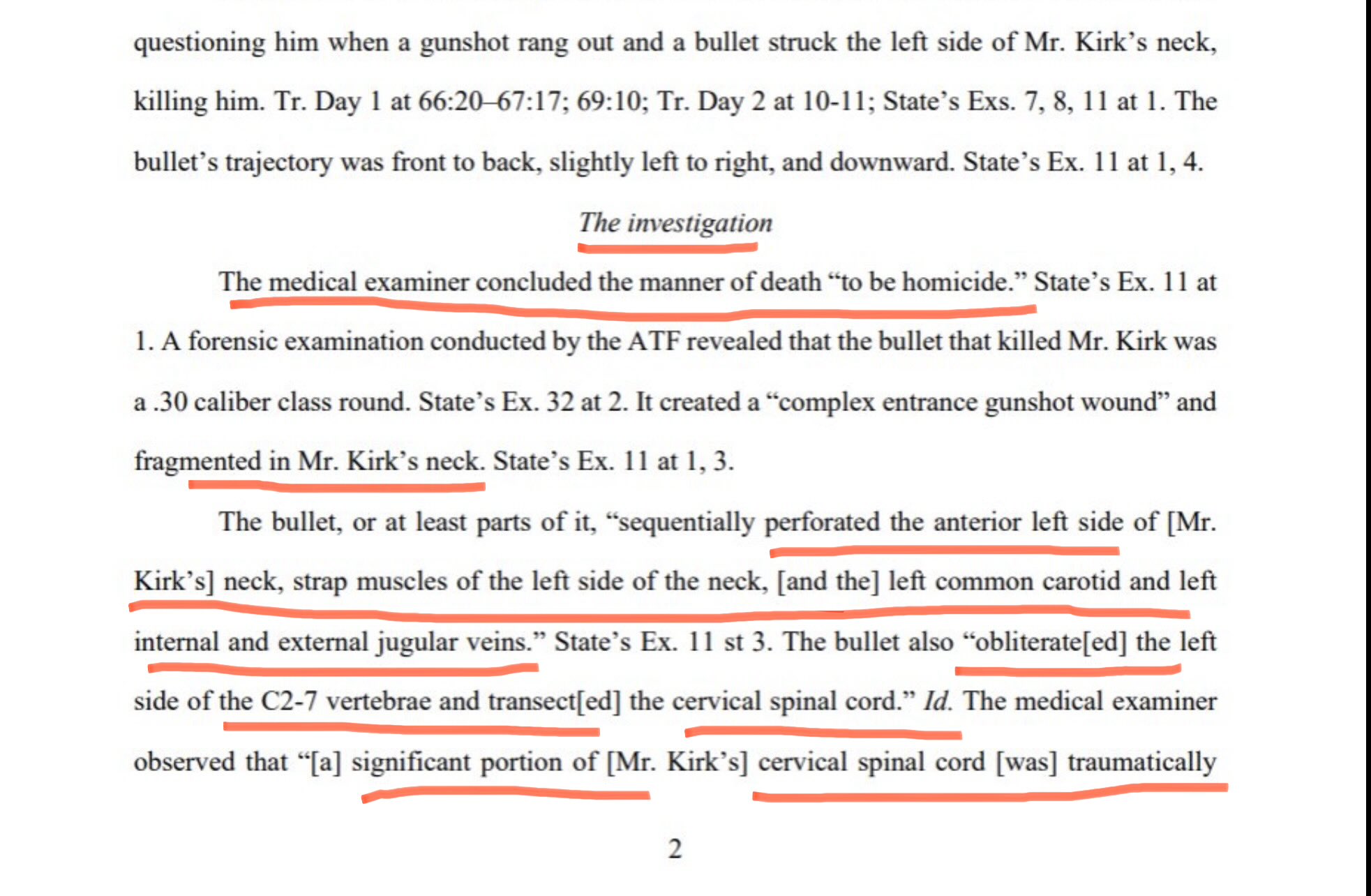
- The picture on X matches the PDF. The page 2 image posted by @matt82704417 on July 30, 2026 (right) matches the sealed PDF line for line, down to the brief's typo "State's Ex. 11 st 3" for "at 3".
Utah's courts do not post this case's filings online. The site's copy came from attorney Andrea Burkhart's public docket index for the case, and the court seal is what proves it came out of the court's own system unchanged (the PDF, how the docket was archived).
Question 2: Is it from the prosecution or the defense?
The prosecution. In a criminal case in Utah, "the State" means the prosecutors. Page 1 of the brief lists the Utah County Attorney's Office: County Attorney Jeffrey S. Gray and Deputy County Attorneys Chad E. Grunander, Ryan McBride, Lauren Hunt, David Sturgill and Christopher D. Ballard. Page 28 is signed "/s/ Jeffrey S. Gray, Utah County Attorney", and the certificate of service is signed "/s/ Christopher D. Ballard" (the PDF, page 28).
"Bindover" is the decision a judge makes after a preliminary hearing: is there enough evidence to send the case to trial? After the five hearing days of July 6–10, 2026, Judge Tony F. Graf, Jr. asked both sides to argue it in writing. This brief is the prosecutors' side, and its job is to persuade. The defense answered on August 11, 2026, and the State replied on August 18 (the court filings archive).
Question 3: Is page 2 State's Exhibit 11?
No. Two different kinds of court paper are involved:
| State's Exhibit 11 | The bindover brief (what page 2 is from) | |
|---|---|---|
| What it is | Evidence: the Utah Office of the Medical Examiner's nine-page "report of examination" for Charlie Kirk. Agent David Hull testified the autopsy was done by Dr. Guajardo | Argument: the prosecutors' 28-page written case for sending Tyler Robinson to trial |
| Who wrote it | The medical examiner's office | The Utah County Attorney's Office |
| How the public got it | It didn't. Admitted July 6, 2026 through Agent Hull, not the doctor, and the judge ordered it not be published (Day 1) | Filed July 28, 2026 as a public court record |
| How it appears on page 2 | Only as citations and short quotes | Every word on the page |
Page 2 sits in the brief's "Facts" section, where the prosecutors tell the story and point to the evidence for each sentence. A citation like "State's Ex. 11 at 1, 4" means "see pages 1 and 4 of Exhibit 11". The Exhibit 11 page shows this brief because it is the only place any words of Exhibit 11 can be read.
Question 4: Or is it only referring to State's Exhibit 11?
Yes, it only refers to it, and quotes from it. Pages 2 and 3 cite Exhibit 11 nine times ("State's Ex. 11 at 1", "at 1, 3", "at 1, 4", "st 3", and "Id.", which means "the same source"). The brief cites it twice more later on, on pages 9 and 18. Words inside quotation marks are the prosecutors' claim of what the report says. Everything outside the quotation marks is the prosecutors' own summary. Neither can be checked against the report, because the report is sealed.
Question 5: Is the prosecution putting words in the examiner's mouth?
What the public cannot know is whether the quotes are accurate, or whether the summaries are fair to the report. What the public can see, from the punctuation alone:
| On pages 2 and 3 | Whose words |
|---|---|
| "a bullet struck the left side of Mr. Kirk's neck" | Prosecutors' (cited to Ex. 11 at 1, with the hearing transcripts and two videos) |
| "The bullet's trajectory was front to back, slightly left to right, and downward." | Prosecutors': the direction is summarized, not quoted (cited to Ex. 11 at 1, 4) |
| "the bullet that killed Mr. Kirk was a .30 caliber class round" | Prosecutors', cited to the ATF's Exhibit 32, not to the examiner. On the stand, the ATF's comparison to the rifle was "inconclusive" (the ATF ballistics record) |
| "fragmented in Mr. Kirk's neck" | Prosecutors' |
| "The bullet, or at least parts of it," and "The bullet also" | Prosecutors', written in front of the examiner's lists |
| "to be homicide"; "complex entrance gunshot wound" | Examiner's, as quoted |
| "sequentially perforated ... jugular veins"; "obliterate[ed] the left side of the C2-7 vertebrae and transect[ed] the cervical spinal cord"; "[a] significant portion of [Mr. Kirk's] cervical spinal cord [was] traumatically absent" | Examiner's, as quoted, edited by the prosecutors |
| "bilateral apical and posterior intercostal hemorrhages, pulmonary apical hemorrhages/hematomas … and multiple disruptions of the thyroid, cricoid, and tracheal cartilages"; "hemopericardium"; "left and right hemothorax"; "the cerebellar vermis and the parietal regions" | Examiner's, as quoted, with words cut at the "…" |
What that shows:
- The word "bullet" never appears inside the examiner's quoted words. Nor does any direction. The only quoted word that names a cause is "gunshot", in "complex entrance gunshot wound", and Agent Hull read the cause of death from page 1 as "A gunshot wound of the neck" (Day 1). So the examiner did call it a gunshot wound. But "bullet", ".30 caliber", "fragmented" and "front to back ... downward" are the prosecutors' words.
- Seven edits inside the quotation marks. Square brackets mark words the prosecutors changed or added: "[Mr. Kirk's]" twice, "[and the]", "[a]", "[was]", and the verb endings in "obliterate[ed]" and "transect[ed]". Those two verbs show that the examiner's own sentence was built differently, most likely around "obliterating" and "transecting", attached to a subject the public cannot see. The prosecutors supplied the subject: "The bullet also".
- Words cut from the injury list. The "…" after "hemorrhages/hematomas" marks words the prosecutors removed. What they were is not public.
- Their own hedge. "The bullet, or at least parts of it" stops short of saying one intact round did the damage.
Brackets and "…" are normal practice when lawyers quote a document. They are not, by themselves, proof that anything was misquoted. What they do prove is that the public is reading a selection the prosecution chose and edited, of a report the public is not allowed to see.
Who kept the report from the public. At the July 6, 2026 hearing, a prosecutor (David Sturgill, according to the defense's citation of the certified transcript, PH1:204) asked the judge that Exhibit 11 "not be published here in the courtroom or that it be published in any fashion or way that the public could see it", citing the Kirk family's wishes. The judge agreed. Three weeks later the same prosecutors quoted the report in a public filing, and the defense objected in footnote 5 that "It would have been a simple matter for the State to redact this private information" (defense brief, page 11). The only version of the examiner's findings the public has read is therefore the version written by the side trying to win the case.
What the defense, which holds the full report, has said. Its August 11, 2026 brief describes the wound as "a projectile on the left side of his neck" (page 11), and on page 17 it also writes: "The bullet traveled at a downward angle and hit Mr. Kirk in the left side of his neck. See PH4:91-92; StEx 11." The defense used that line to argue that the questioner standing in front of Charlie was never in the line of fire (defense brief, page 17). So on "downward", the defense has not disputed the prosecutors, and has leaned on it. Neither side has quoted the report's own description of the wound track in public, and the examiner has never testified. Every quoted line, highlighted: the Exhibit 11 page.
Question 6: Is the copy of page 2 on this site AI-written?
No. The page 2 shown on the Exhibit 11 page is the PDF's own text layer, pulled out by a script and set in a readable layout. Nothing is reworded. On October 13, 2026 we compared all 28 pages against the court-sealed PDF word by word:
- Page 2 matches the filing word for word. The only difference is a line break inside a transcript citation ("65:4–19").
- Across all 28 pages there are no word differences apart from hyphens at line ends and the order of the two caption columns on page 1.
- The yellow highlights, the numbered badges, the introduction box and the top bar are the site's additions. Every page has a "view in PDF" link to the original page.
Question 7: Do these injuries point more to a blast's pressure wave than to a bullet?
The thesis being tested: the explosion of a shaped charge sent a massive pressure wave (a "concussion" wave) through Charlie's body, and that wave, not a bullet, damaged his lungs and heart, wrecked his spine and bled onto his brain.
Three plain-English corrections first:
- "C2–C7" are the bones of the neck, not the back. The neck has seven bones, C1 to C7: C1 sits right under the skull and C7 is the bump at the base of the neck. The filing lists no damage to the spine of the back.
- The brain finding is bleeding on the brain's surface, in the thin space between the brain and its covering, in two places. The filing does not quote any damage inside the brain itself.
- "Collapsed lungs": the filing does not use the medical term for a collapsed lung. It lists blood filling both chest cavities, which presses on the lungs and stops them filling with air, and bleeding inside the tops of the lungs.
How each one injures a body. A bullet damages what it touches, plus a zone around its path: a high-speed rifle round briefly stretches the tissue around its track, which can tear things a few inches away, and it can break bone into flying pieces. It does not normally reach organs well away from its path. A blast pressure wave hits a whole region at once. It does the most damage where air meets tissue (the lungs first, then the eardrums and the gut), it strikes both sides of the chest at the same moment, it can bruise the heart, and the pressure surge through the chest's blood vessels can carry up to the brain, the "thoracic mechanism" described by Courtney and Courtney in 2009 (the Brain page of the Body Tour). A shaped charge adds a narrow jet of metal and pieces of the device, which wound like projectiles.
The injuries at a glance
Each of these can also be seen in 3D, with what a bullet would do and what a shaped charge would do side by side: Body Tour (3D).
| # | Part of the body | Leans | The filing's words | See it in 3D |
|---|---|---|---|---|
| 1 | Heart | Blast | "hemopericardium" | Heart |
| 2 | Both chest cavities | Blast | "left and right hemothorax" | Lungs |
| 3 | Ribs, top and back, both sides | Blast | "bilateral apical and posterior intercostal hemorrhages" | Lungs |
| 4 | Tops of the lungs | Either, leaning blast | "pulmonary apical hemorrhages/hematomas" | Lungs |
| 5 | Brain, top of the head | Blast | "the parietal regions" | Brain |
| 6 | Brain, low at the back | Either | "the cerebellar vermis" | Brain |
| 7 | Neck bones, C2 to C7 | Blast | "obliterate[ed] the left side of the C2-7 vertebrae" | Spine |
| 8 | Spinal cord | Either, leaning blast | "transect[ed] the cervical spinal cord"; "traumatically absent" | Spine |
| 9 | Voice box and windpipe | Either, slight edge to a bullet | "multiple disruptions of the thyroid, cricoid, and tracheal cartilages" | Neck |
| 10 | Big blood vessels of the neck | Either | "left common carotid and left internal and external jugular veins" | Neck |
| 11 | The entrance wound | Mixed | "complex entrance gunshot wound" | Neck |
Each injury, in plain English
- Heart: "hemopericardium". Leans blast.
- What it means: blood collected inside the sac around the heart. Enough of it squeezes the heart so it cannot pump.
- A bullet: only if the round or a piece of it reached the chest, and the quoted path stops at the neck and spine. CPR or hospital procedures can also cause it.
- A blast wave: yes. A pressure wave through the chest bruises the heart and its vessels, a known blast injury.
- Both chest cavities: "left and right hemothorax". Leans blast, because it is both sides.
- What it means: blood pooled around both lungs, left and right. This is what squeezes the lungs down.
- A bullet: the left side could fill from a torn left-neck wound draining down. The right side needs the damage to cross the middle of the body.
- A blast wave: yes. A blast hits both sides of the chest at the same moment.
- Ribs, top and back, both sides: "bilateral apical and posterior intercostal hemorrhages". Leans blast.
- What it means: bleeding in the muscles between the ribs, on both sides, at the top of the chest and at the back.
- A bullet: far from a left-neck path. It would need a second cause, such as a violent jolt of the spine.
- A blast wave: yes. Bruising of the chest wall on both sides is a textbook blast finding.
- Tops of the lungs: "pulmonary apical hemorrhages/hematomas". Either, leaning blast.
- What it means: bleeding, and pockets of blood, inside the very top of the lungs, which rise just above the collarbones at the base of the neck.
- A bullet: yes. They sit close to the neck wound, inside a rifle round's stretch zone.
- A blast wave: yes. Bleeding inside the lungs is the signature blast injury, called "blast lung". If both lungs bled, that leans blast; the quote does not say one or both.
- Brain, top of the head: bleeding around "the parietal regions". Leans blast.
- What it means: bleeding on the surface of the brain at the top and upper sides of the head.
- A bullet: not directly. The top of the head is far from the neck; it would need a separate blow to the head.
- A blast wave: yes. The pressure surge through the blood vessels can reach the brain.
- Brain, low at the back: bleeding around "the cerebellar vermis". Either.
- What it means: bleeding on the middle strip of the cerebellum, the small back part of the brain that sits just above the top of the neck.
- A bullet: yes. A spinal cord cut high in the neck bleeds, and blood can run up into this space.
- A blast wave: yes, by the same pressure surge.
- Neck bones: "obliterate[ed] the left side of the C2-7 vertebrae". Leans blast.
- What it means: the left half of six of the seven neck bones was destroyed: a stretch about four inches tall, from just under the skull to the base of the neck.
- A bullet: a rifle round can shatter a bone and spray bone pieces, but a slightly downward path crosses only one or two of these bones unless it runs nearly straight up or down the neck (the Spine page of the Body Tour).
- A blast wave: yes. A charge below and in front of the neck destroys a long stretch at once.
- Spinal cord: "transect[ed] the cervical spinal cord", a "significant portion" "traumatically absent". Either, leaning blast.
- What it means: the spinal cord in the neck was cut through, and a length of it was missing.
- A bullet: yes. A high-speed round through the spine can cut the cord and pulp a section.
- A blast wave: yes. A long missing length fits a wide zone of destruction (the Spine page of the Body Tour).
- Voice box and windpipe: "multiple disruptions of the thyroid, cricoid, and tracheal cartilages". Either, with a slight edge to a bullet.
- What it means: the Adam's apple, the ring just below it, and rings of the windpipe were broken in several places.
- A bullet: yes. A round crossing the front of the neck can break all three in a line. This is the one finding where Jon Bray's scoring gives the bullet the edge (the Neck page of the Body Tour).
- A blast wave: yes. A blast against the front of the neck crushes them.
- Big blood vessels of the neck: "left common carotid and left internal and external jugular veins". Either.
- What it means: the main artery to the head and two large veins on the left side of the neck were holed.
- A bullet: yes, if its path ran through the left neck.
- A blast wave: yes, by the jet or pieces of the device. The order of the damage runs sideways (the Neck page of the Body Tour).
- The entrance wound: "complex entrance gunshot wound". Mixed.
- What it means: the examiner's label is a gunshot entrance, but "complex", meaning not a small neat hole.
- A bullet: a rifle round normally leaves a small, round entrance. "Complex" happens when it hits something first, tumbles, or breaks up.
- A blast wave: torn, irregular wounds are typical of a blast. The examiner's own word is still "gunshot"; "complex" is what investigators point to.
The count: five of the eleven lean toward a blast (the heart, both chest cavities, the ribs on both sides, the top of the brain, and the six neck bones). Five fit either, two of them leaning blast and one with a slight edge to a bullet. One is mixed.
What the pattern says. A bullet explains the neck damage well on its own: the windpipe, the big vessels, the cut spinal cord. What a bullet does not explain without adding a second cause is the reach of the damage: both sides of the chest, the sac around the heart, the top of the brain, and six neck bones in a row. Those are what a pressure wave does. That is why the thesis holds up as a pattern, and why investigators conclude Charlie Kirk was killed by a charge at the microphone. This reading applies standard blast and gunshot medicine to the quoted words; it is the site's reading, not a pathologist's.
Where resuscitation fits. The government's account would point to CPR and hospital care for some of the chest findings. An Orem Fire captain helped with CPR at the hospital, according to UVU's after-action report, and Frank Turek reportedly gave CPR in the SUV, which a security account disputes (shot to pronouncement: the medical timeline). CPR mainly breaks ribs and the breastbone at the front of the chest, and it does not explain bleeding on the top of the brain. The full report should say which findings came from resuscitation. The quoted lines do not.
What would settle it
All of these are in the sealed report, its photographs, or its X-rays:
- His eardrums. The eardrum is the part of the body a blast bursts most easily. Burst eardrums would support a blast; intact ones would count against a strong pressure wave.
- The surface of both lungs. Blast lung leaves bruises in the pattern of the ribs, on both lungs.
- Burns, soot or embedded powder on the skin of the neck and chest, and on the shirt.
- What every fragment is made of: copper and lead from a bullet, or metal and plastic from a device. The ATF examined five pieces; its examiner was told the medical examiner's photo may show seven (the ATF ballistics record).
- The X-rays and scans, showing where every fragment came to rest.
- Which findings the examiner put down to CPR or surgery, and his own description and diagram of the wound track.
The remedies: an independent pathologist to review the autopsy, testing of the fragments' composition, and public release of the medical examiner's findings.
Where the evidence lives
- State's Exhibit 11: the brief's 28 pages, with every quote of the report highlighted
- The State's bindover memorandum, July 28, 2026 (PDF) — pages 2 and 3 hold every quoted line of Exhibit 11
- The defense's preliminary hearing briefing, August 11, 2026 (PDF) — page 11 and footnote 5; page 17 on the downward angle
- Body Tour (3D) — each injured body part drawn in 3D and tested two ways: as a bullet, and as a shaped charge
- Ballistics: the ATF's inconclusive comparison — the recovered fragments against the rifle
- Autopsy, forensic and medical examiner timeline — the autopsy, the examiner, and the conflicting wound descriptions, in order
- Preliminary hearing, Day 1 — Exhibit 11 admitted through Agent Hull and barred from publication
Nothing on this page claims that any living person, or any private company or organization, knew of, planned, took part in, or covered up the killing of Charlie Kirk. The prosecutors and defense lawyers named here are named for documents they filed, and no one is accused of misquoting the report: the point is that the public cannot check. Tyler Robinson is charged, not convicted, and is presumed innocent. Nothing indicates anyone on Charlie's security team, the AV crew, or TPUSA staff knew of any device.