Who Guarded It — The Forces Around the Serena
The security around the Islamabad Serena Hotel in April 2026 was a joint operation. Pakistan's army, paramilitary Rangers and police held the city and the Red Zone. The U.S. Secret Service held the American part of the building. Every figure below comes from published reporting, and the sources do not always agree.
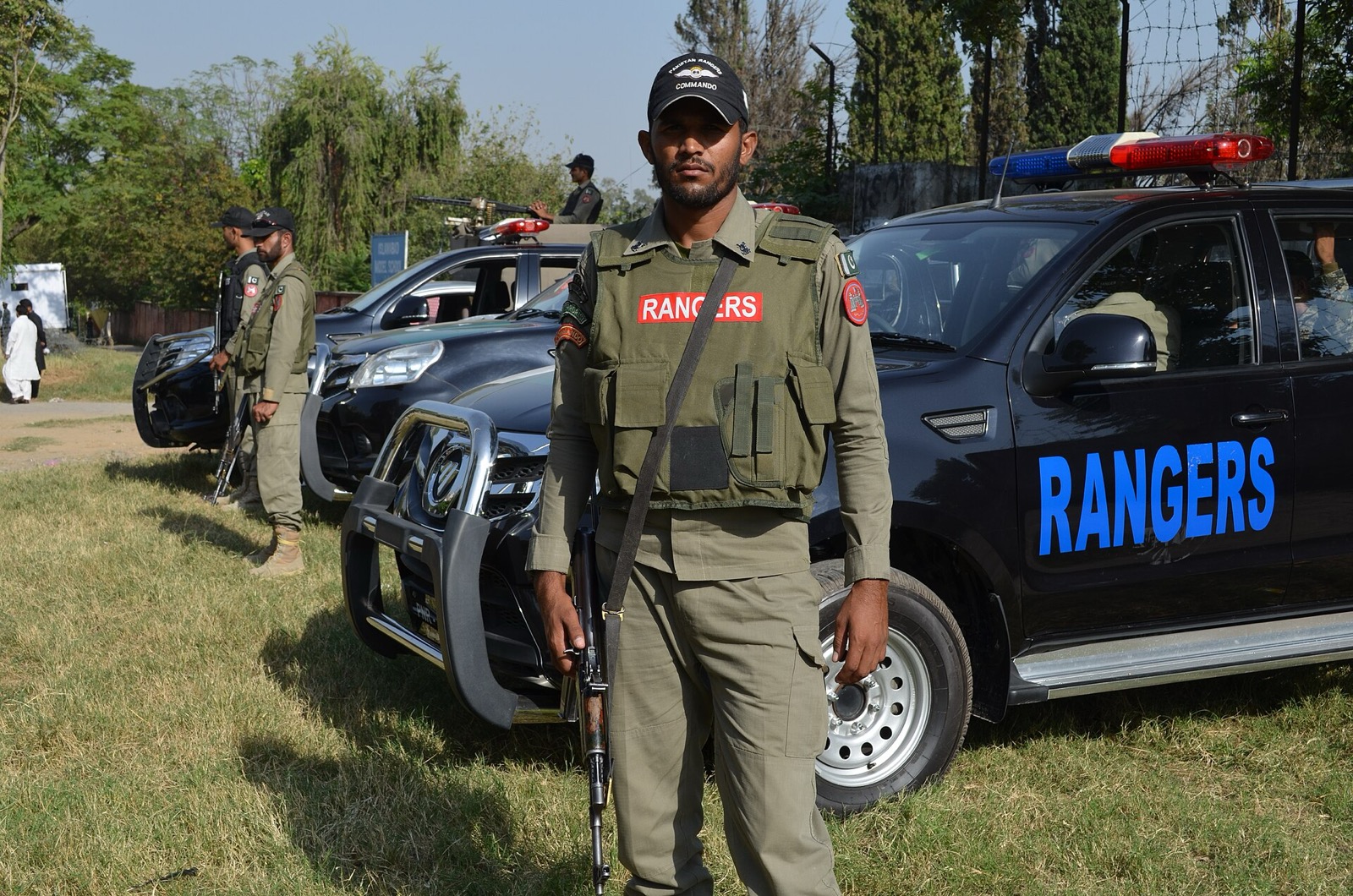
The Rangers are the paramilitary force Pakistan uses to hold streets and checkpoints in the capital. The photo at right shows them on a routine security deployment in Islamabad in 2016, not during the talks.
Photo: Rizwan Aziz, Voice of America, 9 October 2016, public domain — Commons.
Round one, April 9–12
| Force | What it did | Source |
|---|---|---|
| Pakistan Army | Took over security control of the Red Zone, held the 3 km road cordon around the hotel, kept a quick-reaction force on standby, and patrolled outside the building | The Media Line / JPost; The Guardian; The National |
| Army aviation | Helicopters patrolled over the Red Zone | Dawn gallery |
| Pakistan Rangers (paramilitary) | Manned cordoned streets and checkpoints | Dawn gallery; Reuters |
| Islamabad and Punjab police, traffic police, motorway police | Road closures, diversions, riot-police buses on the routes to the Serena | Dawn gallery |
| Hospitals and emergency services | Placed on high alert | Gulf News |
| U.S. advance security team | About 30 people arrived ahead of the delegation | Dawn; Al Jazeera |
| U.S. Secret Service | Controlled the U.S.-secured area and Vance's office inside the hotel | The National |
Total: more than 10,000 police and security personnel under military supervision (Dawn; BBC).
The Media Line reported that a U.S. C-130 landed at Nur Khan Airbase with an advance security and tactical team, and that Secret Service and CIA personnel had arrived (The Media Line / JPost). The smaller outlet Times of Islamabad put the number at "dozens" of Secret Service and CIA agents (Times of Islamabad). That outlet is less reliable than the others, and its count of Pakistani personnel (5,000) is lower than every other source's.
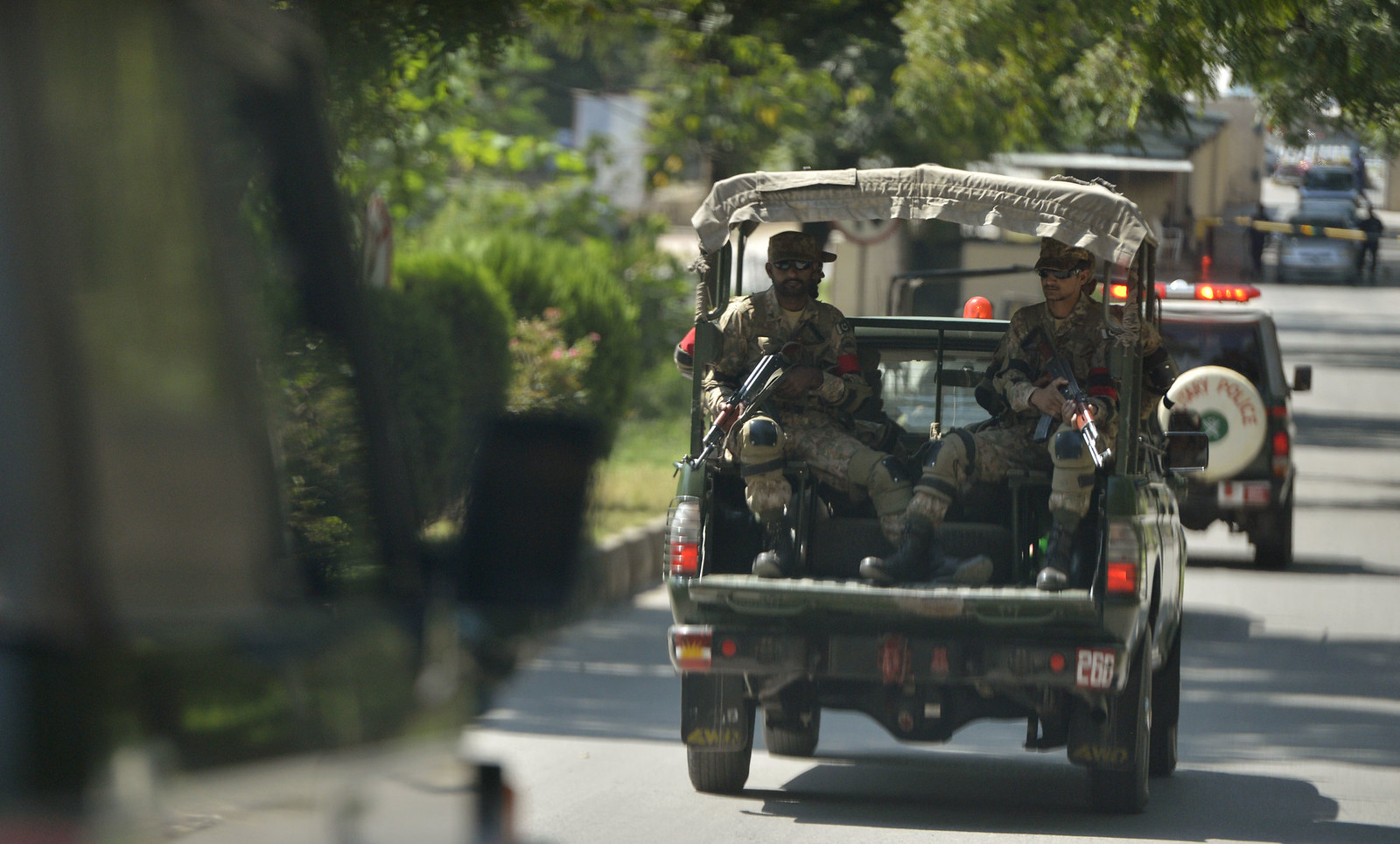
The photo at right shows the escort pattern Pakistan uses for senior U.S. visitors: armed soldiers in a pickup leading the motorcade. It was taken during a 2013 visit by U.S. Deputy Defense Secretary Ashton Carter, not during the 2026 talks.
Photo: Glenn Fawcett, U.S. Department of Defense, 16 September 2013, public domain — Flickr.
In the air
Security did not end at the hotel. Reuters, citing three sources, reported that after the talks broke up the Pakistan Air Force escorted the Iranian delegation home with about two dozen jets, including J-10 fighters, and its airborne early-warning aircraft. The sources said the Iranians feared they might be targeted by Israel on the way back, and that Pakistan offered the same protection for later rounds (Reuters via Jerusalem Post). The Iranian flight into Islamabad had also reportedly turned off its call sign over Pakistan (Al Jazeera).
Between the rounds
By April 16, Xinhua reported that security was being built up again. Special checkpoints went up, and the number of personnel on the road from Nur Khan Airbase to the Serena was "almost doubled" from the more than 10,000 used in the first round, with troops extended to other roads (Xinhua).
Round two, April 19–26
The second round never took place, but the security for it was reported in more detail than the first:
- More than 10,000 police, 400 Elite Force commandos, 100 to 130 snipers, 4,000 Punjab Highway Patrol officers, 200 Dolphin Force officers and 2,800 Rawalpindi police. The capital police, Frontier Corps and riot units each posted about 300 men along the green belts (Dawn, April 20).
- Rangers on 33 rooftops on the east side of the route (Dawn, April 20), with rooftop snipers in radio contact with ground units (Gulf News).
- About 18,000 personnel in total including reinforcements from Punjab. Police on duty were barred from using mobile phones (Pakistan Today).
- At least three U.S. cargo planes landed at Nur Khan (Dawn). A U.S. Air Force C-17 brought armoured vehicles, trucks and pallets of equipment (Pakistan Observer).
More on the second lockdown is on The Second Lockdown.
Who was in charge
Interior Minister Mohsin Naqvi's ministry ran the Pakistani side. He told the U.S. chargé d'affaires, Natalie Baker, that Pakistan had made "extensive arrangements" for "foolproof security" for all international guests (Express Tribune). Prime Minister Shehbaz Sharif inspected the venue with him, according to Times of Islamabad (Times of Islamabad).
What was not reported
We found no published figures for the Iranian security detail, for Pakistan's intelligence services (ISI, IB) or for the Special Security Unit. We also found no report of a mobile-network shutdown, a no-fly order or a Section 144 order tied to the talks. Those gaps are about what was reported, not proof that nothing was done.
Related Areas
This website's author is @HolonCitizen on X and YouTube/@HolonCitizen. Follow me there.