Media Censorship
Overview
This page summarizes claims and concerns about censorship and information suppression related to the Charlie Kirk case.
It draws on publicly available reporting (for example, local court coverage), social‑media posts and videos by commentators such
as Candace Owens, Project Constitution (@ProjectConstitu), and other independent investigators, as well as first‑person accounts
from attendees.
Nothing here asserts that any specific individual, agency, or company has acted unlawfully; instead, it organizes what people have alleged or feared so readers can understand the debate.
Alleged evidence deletion and pressure on witnesses (claims)
Several accounts in the research notes describe participants saying their footage or photos were altered, lost, or deleted:
- Some attendees have claimed on social media that video clips of the Sept 10 UVU shooting, recorded on their phones, were missing or appeared edited by the time they returned home. These stories are anecdotal and have not been independently verified here.
- One widely discussed witness, Ryne Simmons, stated in a public video that he provided close‑range footage to federal investigators and was asked to delete it from his device. He also said he retained a copy anyway. According to research notes summarizing his account, the clip was a close‑up shot recorded in 4K at 60 frames per second, and he described the FBI calling him several times to confirm the video had been deleted. Commentators argue that, if accurate, such requests raise questions about how evidence preservation and transparency are being balanced.
- Critics connect these accounts to a broader narrative that digital traces—videos, social posts, or search results—are vulnerable to quiet removal or de‑prioritization in high‑profile cases.
These items are presented as claims by individuals, not as adjudicated findings about any particular agency.
Court gag orders and information control
Legal restrictions have also shaped what can be said publicly about the case:
- A gag order in the Tyler Robinson proceedings has been reported by local journalists (for example, Ben Winslow and Michael Martin), restricting parties and counsel from speaking to the media.
- Commentary in the research notes states the order was issued by Judge Tony Graf on December 16, 2025 on the court's own motion — that is, neither the prosecution nor the defense requested it. Supporters view on-the-court's-motion orders as routine in high-profile capital cases.
- Supporters of the gag order frame it as a way to protect Robinson’s right to a fair trial and avoid tainting the jury pool in a nationally visible case.
This tension between fair‑trial rights and public transparency is a recurring theme in discussions of “censorship” around the case.
Platform moderation and algorithmic effects (claims)
Citizen‑researchers also raise concerns about how social‑media and video platforms handle content related to the shooting:
- Some users report that clips, threads, or channels discussing alternative theories about the shooting have been demonetized, age‑restricted, or removed for alleged policy violations (for example, graphic content, harassment, or misinformation).
- Others say that search results on major platforms and search engines shifted over time, with some videos or posts becoming harder to find unless directly linked.
- Platform operators generally defend such actions as routine enforcement of community‑guideline and safety rules, not targeted censorship on behalf of any government or private actor.
From a research perspective, these experiences illustrate how content moderation and recommendation systems can shape which interpretations of a high‑profile event are most visible, even without any explicit government directive.
Legislation and policy debates (claims)
One of the most contested topics in the censorship discussion involves state‑level social‑media legislation in Utah:
- Commentators have pointed to proposed or revised bills (described online as updates to SB 194 / HB 464) that aim to increase platform accountability and address harms to minors.
- Critics worry that certain provisions—as described in advocacy posts—could be interpreted to give officials or litigants broader leverage to request removal or restriction of content related to ongoing criminal cases, including posts about the Charlie Kirk investigation.
- Supporters of such legislation typically emphasize online safety, privacy, and parental control, and do not describe the bills as tools for suppressing political speech or investigative commentary.
Because bill text and implementation can change, readers interested in this angle should consult the official Utah legislative website and independent legal analysis for the most current, authoritative information.
Media framing, omissions, and public trust
Beyond direct takedowns or legal orders, many observers focus on how mainstream outlets choose to cover—or not cover—certain angles:
- Some argue that major national outlets have largely echoed official statements about a lone rooftop shooter while giving comparatively little airtime to independent analyses, questions about ballistics, or discussion of aircraft and drone activity.
- Others note that certain details raised in citizen investigations (for example, timing discrepancies, security‑contracting questions, or foreign‑policy context) are mentioned only briefly, if at all, in prominent news coverage.
- Editors and reporters respond that editorial choices reflect verification standards, space limits, and news judgments, not a coordinated effort to hide information.
These dynamics contribute to a perception among some that there is a “soft” form of censorship in which certain narratives are amplified while others are marginalized. Critics note the foreign-nexus angle as a case in point: former NCTC director Joe Kent has said on the record that his center's parallel review of possible foreign ties was ordered to stop before its leads were exhausted, yet that account has received comparatively little mainstream coverage.
Free‑speech, safety, and due‑process considerations
Throughout these debates, it is important to remember that:
- Free‑speech rights are not absolute – Laws against threats, defamation, and doxxing, as well as court orders in criminal cases, can legitimately limit what is shared and how.
- Platforms are private actors – They have their own terms of service and community standards, which may lead to removal of content even when it is lawful.
- Fair‑trial and privacy interests matter – Unrestricted publication of sensitive evidence or speculative accusations can harm victims’ families and defendants, and may complicate future prosecutions.
The central question raised by citizen‑investigators is whether, in this particular case, the balance between openness and control has been struck in a way that builds public trust—or whether reforms are needed. For related discussions about legal and policy changes, see Fix Overview, Law1, and Law2.
Court update: discovery and gag order (reported facts)
Public reporting has also documented several non‑controversial procedural facts about the Robinson case:
- Prosecutors told Utah’s 4th District Court that there is a large volume of discovery; Utah County will produce evidence to the defense.
- Thousands of potential eyewitnesses to the Sept 10 UVU shooting are still being identified; many remain unknown.
- Judge Tony Graf affirmed a broad gag order barring anyone associated with the case from speaking to the media; as witnesses are identified, their information must be conveyed to comply with the order.
- Tyler Robinson, 22, appeared virtually; charges include aggravated murder, obstruction of justice, felony discharge causing serious bodily injury, witness tampering, and committing a violent offense in the presence of a child. Federal charges remain possible.
- The defense team, led by Kathryn Nester, entered a formal appearance; an in‑person hearing was scheduled, and courthouse security was heightened.
- The case has drawn national attention, including comments from President Trump; Judge Graf emphasized an impartial process and the protection of constitutional rights.
- Utah Valley University initiated an independent review of the campus shooting.
Source: Court hearing coverage by Ben Winslow and Michael Martin (Sep 29, 2025).
Laws (Charlie Kirk)
- Records of FBI agents who asked witnesses to delete videos and the remotely-wiped phone footage and the deleted Google search results tied to the case are not public yet; the Charlie Kirk Investigation Laws could bring these powerful truths out.
Additional Citizen Investigator Claims on X
Censorship talk on X now layers three mechanisms: (1) court gag orders limiting parties/witnesses (Judge Tony Graf threads); (2) platform moderation / alleged deboosting of forensic and foreign-nexus posts; (3) institutional PR discipline inside political orgs and legacy outlets that treat alternative ballistics/hospital claims as unpublishable. March 2026 camera-access wins are cited as partial pushback. None of these layers, alone, proves a single coordinated plot — but together they explain why citizens archive to IPFS and long-form video.
Interesting In This Area
- The trial press page tracks how the gag order narrowed courtroom reporting.
- Social platforms are where takedown and demonetisation claims actually accumulate.
- Mainstream and alternative coverage diverge most sharply on evidence-loss claims.
- The media index routes gag orders and takedowns to their own pages.
Interesting In Other Areas
- The gag order issued on the court's own motion, not on either party's.
Other Pages In This Section
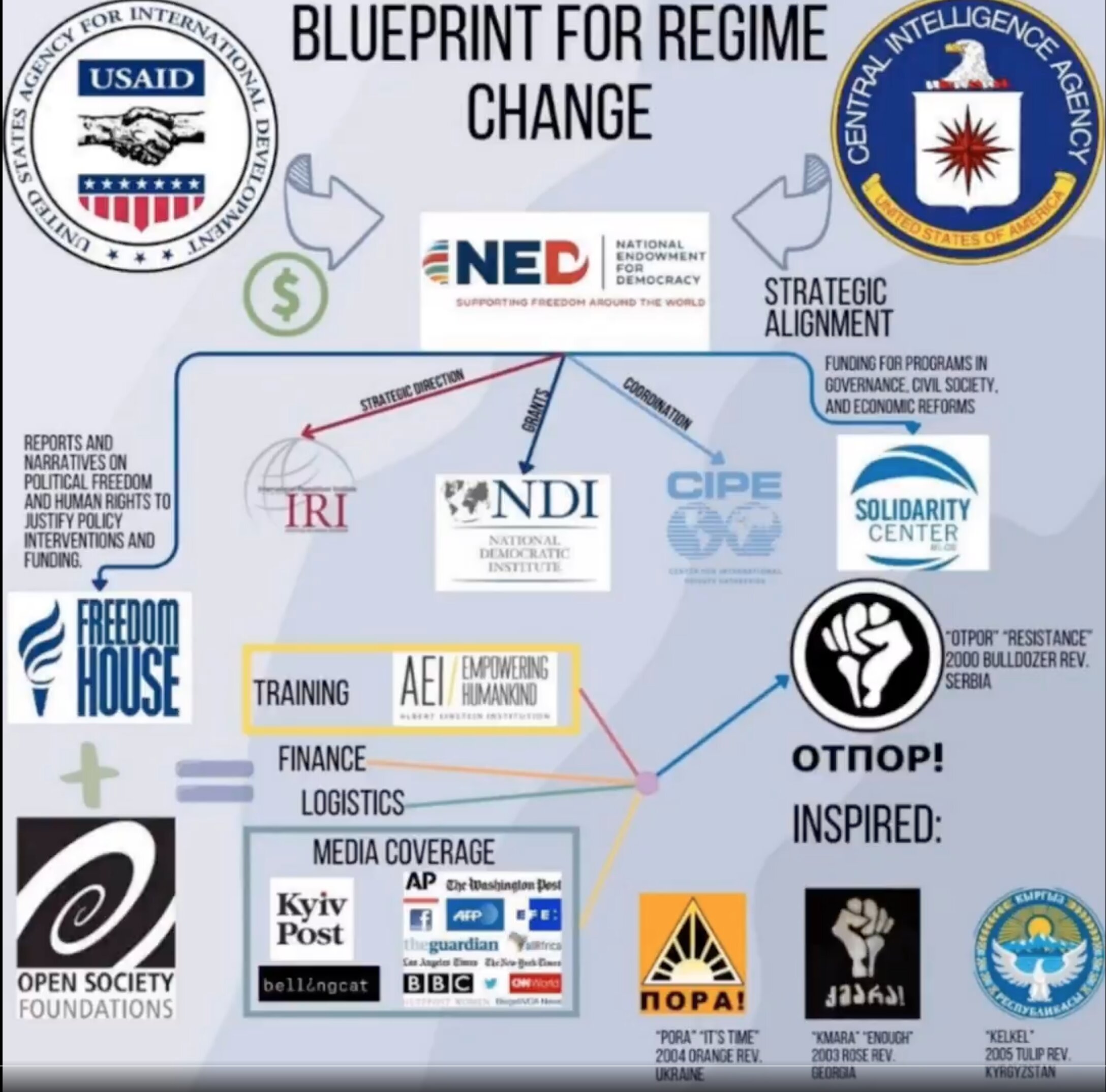
Guardian Coverage of Kirk's Beliefs
How a major international outlet compiled and framed Charlie's public rhetoric after UVU. Useful precisely because it is the version of him most readers outside America received.
Read thisThe press reaction arrived in three waves: manhunt tickers, a political-violence argument, then granular courtroom reporting once the capital case moved. Watching each wave replace the last shows what quietly stopped being asked.
Read this
For most of the world the encyclopedia entry, not a newsroom, is the single-page version of this case. What it consolidates — and what it files under theories — shapes what a first-time reader believes.
Read this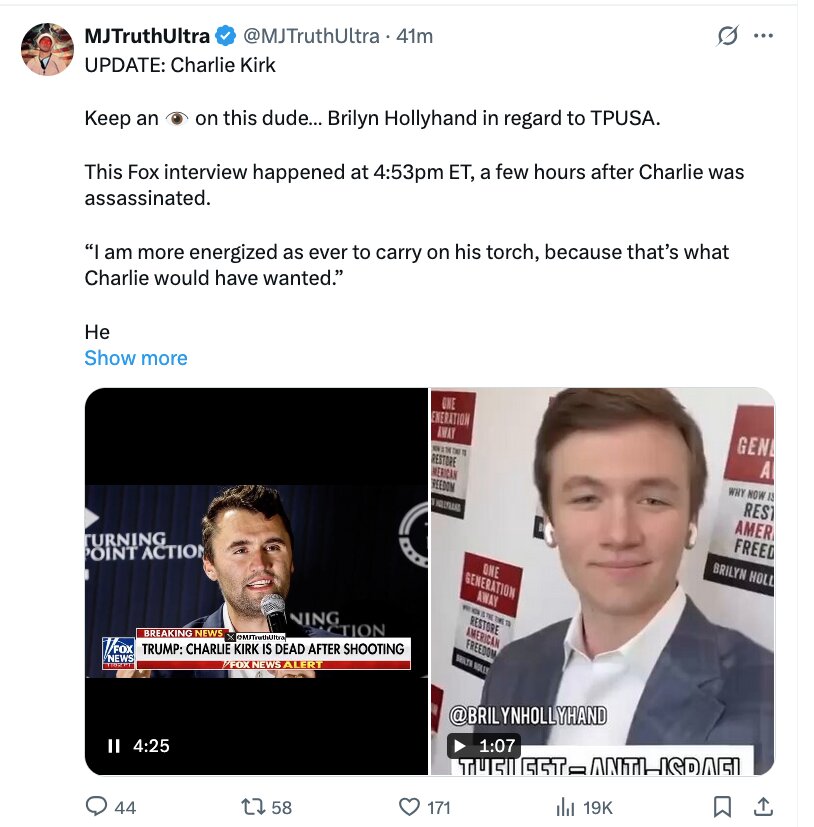
The first forty-eight hours fixed the public template: political assassination, rooftop shooter, national manhunt, suspect named. Almost nobody revised that template when the forensic and timeline disputes arrived later.
Read thisElsewhere In The Investigation
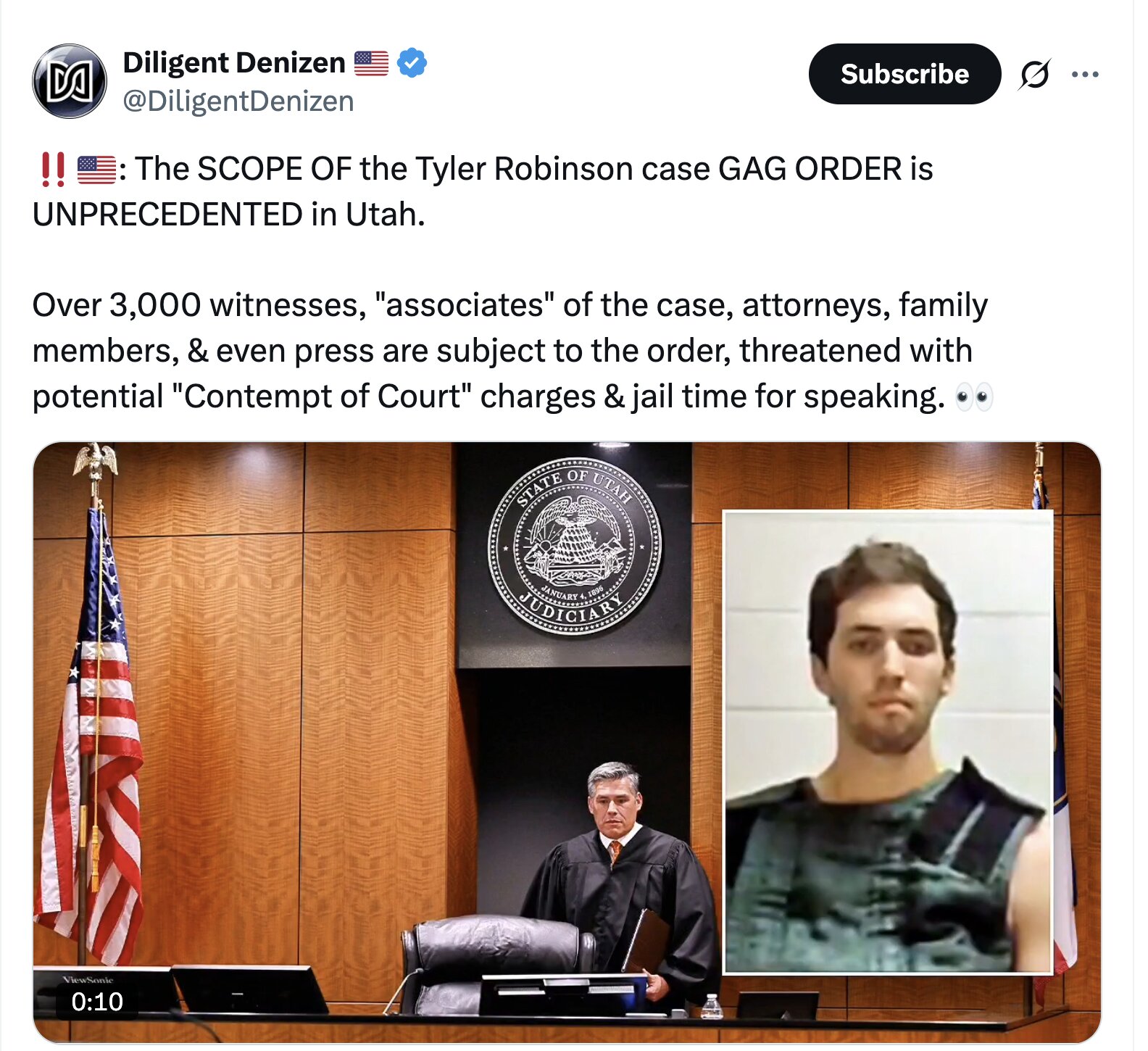
A December 2025 gag order, closed hearings, and a March 2026 motion to seal the inconclusive ATF report — opposed by a media coalition. The public record narrows in stages.
Read thisThis website's author is @HolonCitizen on X and YouTube/@HolonCitizen. Follow me there.
Interesting
- An official "suspect in custody" signal was broadcast, then quietly retracted.
- Joe Kent reportedly says foreign-nexus leads were shut down before being exhausted.
- One proposed law would force a log of destroyed or missing evidence.
Related Areas
- Platform & Speech Censorship
- FBI Asked Witness to Delete Video
- Hospital Security Cameras Removed
- Cover-Up Indicators (Real Killer)
- After — Media Narratives
- Government Evidence Withheld