Your Actions Fix It
Overview
This page provides concrete actions that individuals can take to promote transparency, accountability, and justice in the Charlie Kirk case and to prevent similar incidents in the future. It moves from analysis to activism, offering specific steps that concerned citizens, organizations, and communities can pursue. All suggestions emphasize lawful, constructive engagement rather than harassment or vigilantism. The reason any of it is needed is simple: Charlie Kirk was assassinated in public and the official record still has not answered the basic evidentiary questions, while the Tyler Robinson prosecution proceeds on a narrower theory than the facts appear to support.
Individual civic actions
Every person can contribute to positive change through focused individual actions:
- Stay informed – Regularly review credible sources, cross-check claims, and maintain awareness of developments in the case without spreading misinformation.
- Contact elected officials – Write, call, or visit your representatives at local, state, and federal levels to express support for transparency, independent investigation, and reform.
- Participate in public comment – Attend city council meetings, county commission hearings, and other public forums to raise questions and advocate for accountability measures.
- Support freedom of information requests – Learn about FOIA and state open-records laws, and support organizations that file requests for key documents and evidence.
These foundational actions build pressure for institutional response and demonstrate sustained public interest.
Organizational and community engagement
Working with others amplifies impact and creates sustained momentum:
- Join or form advocacy groups – Connect with organizations focused on government accountability, transparency, or victims' rights, or help establish new groups if none exist in your area.
- Faith community involvement – Encourage churches, synagogues, mosques, and other faith communities to provide moral support, organize peaceful gatherings, and speak out for justice.
- Professional networks – If you work in law, medicine, journalism, security, or related fields, consider how your professional association can contribute expertise or advocacy.
- Educational initiatives – Support efforts to educate others about the case, the issues it raises, and the broader need for reform, through workshops, speakers, or study groups.
Collective action sustains attention and creates accountability when individual voices might be dismissed.
Electoral and political action
Democratic participation offers powerful tools for change:
- Research candidates – Before elections, investigate how candidates have responded to questions about transparency, police accountability, medical examiner independence, and related issues.
- Vote strategically – Support candidates at all levels who demonstrate commitment to openness, rule of law, and institutional accountability. See Politicians for related discussion.
- Ballot initiatives and referenda – Where available, support or create ballot measures that would strengthen public-records laws, reform autopsy procedures, or enhance oversight mechanisms.
- Recall or pressure campaigns – In cases where elected officials actively obstruct transparency, consider whether lawful recall efforts or public pressure campaigns are appropriate and feasible.
Political accountability ensures that officials understand there are consequences for how they handle cases like this one.
Legal and investigative support
Citizens can also support formal legal and investigative processes:
- Contribute to legal funds – If the victim's family or advocacy groups establish legal defense or investigation funds, consider contributing financially.
- Provide information – If you have first-hand knowledge, evidence, or expertise relevant to the case, contact appropriate authorities, defense counsel, or credible investigative journalists.
- Support independent investigations – Encourage local governments, state legislatures, or Congress to establish independent commissions or special prosecutors if conflicts of interest appear to compromise official investigations.
- Expert testimony and analysis – Professionals with relevant expertise (ballistics, forensics, aviation, security) can offer to assist defense teams or independent researchers with technical analysis.
Direct support for legal processes ensures that investigations have the resources and information they need. The need for independent capacity is concrete: former NCTC director Joe Kent has said on the record that his center's parallel review of potential foreign ties was ordered to stop before its leads were exhausted — exactly the kind of gap an independent commission could reopen.
Media and public awareness
Maintaining visibility and accurate information flow is essential:
- Amplify credible sources – Share well-researched articles, documentaries, and analyses that advance understanding without sensationalism or false claims.
- Counter misinformation – Politely correct false narratives when you encounter them, providing links to verified information and encouraging critical thinking.
- Support independent journalism – Subscribe to, donate to, or otherwise support news outlets and journalists who are doing serious investigative work on the case.
- Create and share educational content – If you have skills in writing, video production, graphic design, or other media, consider creating content that explains key issues and promotes constructive engagement.
Public awareness prevents the case from being forgotten and counters attempts to control the narrative.
Institutional reform advocacy
Broader systemic change requires advocacy for specific reforms:
- Promote transparency legislation – Support bills and policies that would strengthen public access to autopsy reports, ballistic evidence, investigative files, and other key documents in high-profile cases.
- Advocate for medical examiner independence – Push for reforms that insulate medical examiners and coroners from political pressure and ensure peer review of controversial findings.
- Support law enforcement accountability – Back measures that enhance oversight of police and security agencies, including body camera requirements, civilian review boards, and whistleblower protections.
- Demand aviation and surveillance transparency – Call for clear rules about disclosure of flight data, drone usage, and other surveillance activities in civilian settings.
These reforms address root causes and help prevent future incidents from being similarly obscured. See How To Fix for detailed discussion of proposed reforms.
Personal preparation and resilience
Finally, sustaining activism requires personal care and realistic expectations:
- Manage information consumption – Avoid burnout by setting boundaries on how much time you spend researching the case, and balance it with other aspects of your life.
- Practice constructive engagement – Focus on actions that build rather than destroy, that unite rather than divide, and that seek truth rather than just confirming existing beliefs.
- Support mental health – Engaging with traumatic material and confronting injustice can be emotionally taxing; seek support from friends, family, counselors, or support groups as needed.
- Maintain perspective – Remember that change often comes slowly, setbacks are normal, and that your efforts contribute to a larger movement even when immediate results are not visible.
Sustained engagement over time is more valuable than intense but short-lived bursts of activity.
How to use this section
This Your Actions Fix It page is designed as a practical action guide:
- Choose actions that fit your skills, resources, and circumstances—not everyone can do everything, but everyone can do something.
- Start with small, achievable steps and build from there as you gain experience and connections.
- Connect with others whenever possible; collective action is more effective and sustainable than isolated individual efforts.
- Review related sections—Fix, Politicians, Vote—for additional context and specific reform proposals.
- Remember that your actions matter: citizen engagement has historically been the driving force behind transparency, accountability, and justice reforms.
Laws (Charlie Kirk)
- The sealed autopsy and ballistics evidence, the foreign-flight and cell-tower data the FBI withheld, and the full list of evidence the government destroyed are not public yet; the Charlie Kirk Investigation Laws could bring these powerful truths out.
Actions Citizen Investigators Highlight on X
- File and litigate GRAMA/FOIA like the UVU paving and warning packages (@CamelotJack1963 / @ProjectConstitu model).
- Push the four Charlie Kirk Laws: FBI/DOJ disclosure, intelligence disclosure, mandate investigation, trusted investigators.
- Preserve and pin primary video (IPFS), refuse to rely solely on compressed social reposts.
- Contact Congress and state legislators with specific record IDs, not vague outrage.
Stay lawful. No doxxing, no threats, no interference with jurors or witnesses.
Interesting In Other Areas
- Four proposed federal laws would force disclosure of the files still sealed.
- Medical examiner independence and whistleblower protection are the two reforms this case keeps demanding.
Images
Elsewhere In The Investigation
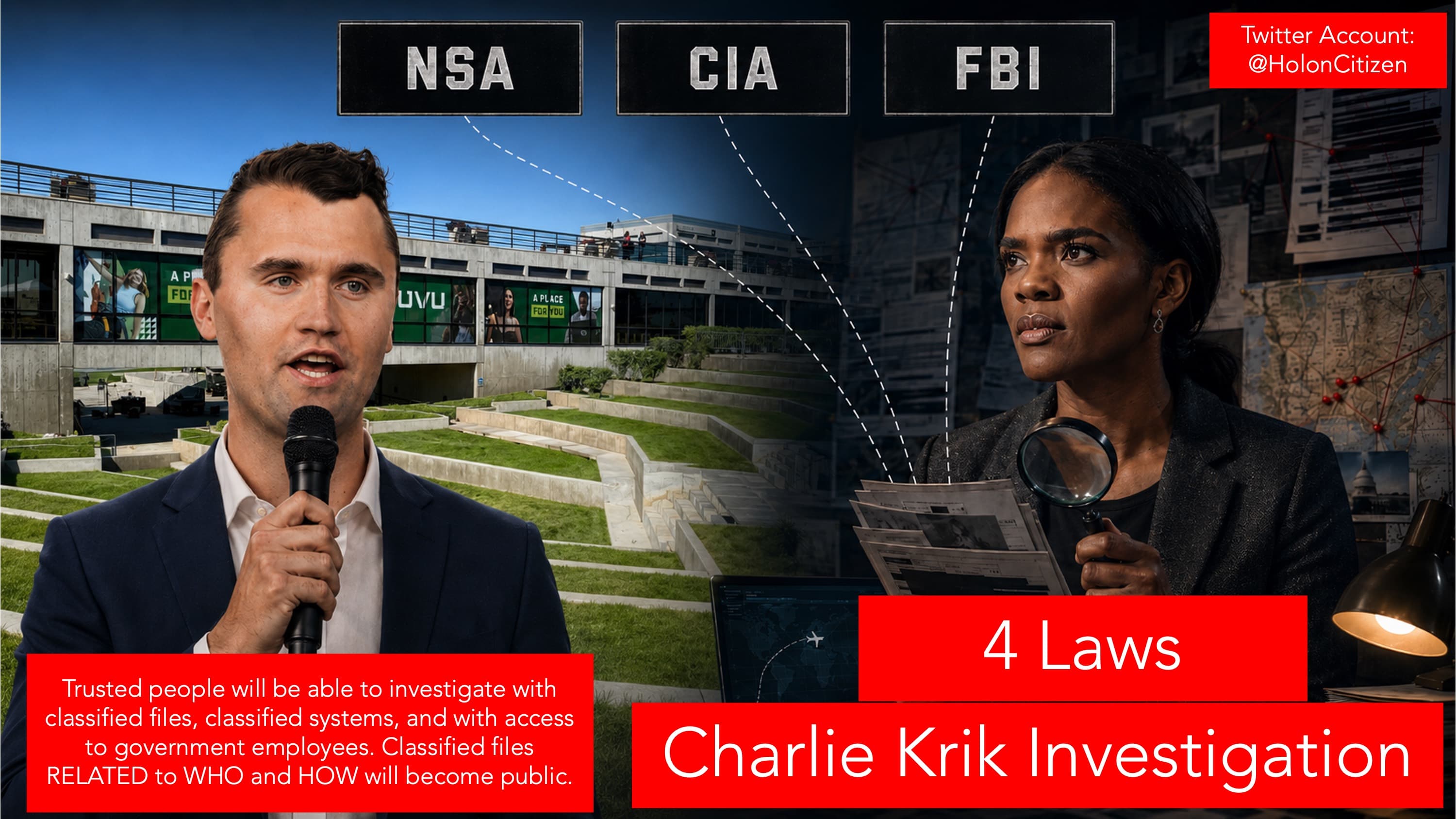
Four federal laws modeled on the Epstein Files Act, drafted to force disclosure and mandate a real investigation. Every unanswered question in the aftermath is downstream of records nobody can compel today.
Read this
Charlie Kirk Files Forced Disclosure -- Summary of Four Proposed Federal Laws
The charter document. All four bills summarised in order, with the agencies each one reaches and the case number they were drafted around. This is the file every compliance audit checks the drafts against.
Read thisThis website's author is @HolonCitizen on X and YouTube/@HolonCitizen. Follow me there.
Interesting
- Foreign aircraft and surveillance flights land in a sequence that reads as advance planning.
- The charged suspect's rifle reportedly does not match the wound.
- A 30-06 Mauser would leave destruction the scene reportedly lacks.
Related Areas
- Censorship
- Media
- Proof Intel Services
Related
- Government Evidence
- Censorship
- Media