Tyler Robinson Trial
The proceeding rests on a premise the site treats as unsettled: that Charlie Kirk was killed by a rifle shot from a rooftop rather than by a device at the lectern, as argued in the explosive-mic analysis.
For the sworn record itself — what witnesses said under oath, who took the stand, and the bench that decides what stays sealed — see Testimony, Who Testified, and The Judges. The full docket hub is Court & Trial; the parallel legal framing is Legal.
Overview
This directory summarizes public reporting and commentary about Tyler Robinson's legal proceedings and trial related to the Charlie Kirk incident. It is not a substitute for official court records or legal advice; readers should consult original filings, transcripts, and orders for authoritative information.
Topic
Topic: Publicly reported features of Tyler Robinson’s legal case, including charges, defense counsel, court procedures, and key controversies.
Charges and basic case posture (as reported)
Major news outlets (such as the BBC, ABC News, and others) report that:
- Robinson has been charged with aggravated murder in connection with Charlie Kirk’s death, along with additional counts including felony discharge of a firearm, obstruction of justice, witness tampering, and committing a violent crime in the presence of children.
- Prosecutors are seeking the death penalty, making this a capital case under Utah law.
- Robinson was taken into custody after a multi‑day manhunt and is being held without bail in the Utah County Jail.
These points summarize what is publicly described in mainstream coverage; readers should consult the underlying charging documents and court records for definitive details.
Defense counsel and representation
Public commentary and legal analyses note that Robinson is represented by an experienced capital‑defense team:
- Lead counsel: Kathryn N. Nester, a Utah‑based defense attorney with decades of experience and prior work on capital or aggravated‑murder cases.
- Co‑counsel: Michael N. Burt, a California‑based attorney known for death‑penalty defense work, and Richard G. Novak, another California‑based lawyer with extensive experience in capital litigation.
Some investigative pieces and social‑media threads highlight a Google Trends spike in searches for Nester’s name traced to foreign IP addresses months before the killing and speculate about what this might mean. While those data points are unusual and raise questions for some commentators, there is no public proof that they reflect improper influence on Robinson’s representation.
Hearings, gag order, and transparency concerns (claims)
Reports and investigative commentary describe several contested aspects of the court process:
- Judge Tony F. Graf is said to have imposed a broad gag order that restricts public and media discussion by parties connected to the case.
- Some preliminary and pre‑trial hearings have reportedly been held behind closed doors, limiting press access and leaving gaps in public knowledge about what evidence has been presented.
- Citizen‑investigator write‑ups describe a transport order for inmate Jaxson Thomas Fox to appear in connection with Robinson’s case, interpreting this as preparation for a potential jailhouse informant witness.
These descriptions come from public commentary and should be verified against official court dockets, orders, and any transcripts that may become available.
Jailhouse informant controversy (claims)
One recurring theme in investigative commentary is concern about the possible use of a jailhouse informant:
- Online reports state that Fox is incarcerated on separate charges unrelated to the Kirk case and that there is no known prior relationship between him and Robinson.
- Commentators argue that bringing Fox into closed hearings suggests an attempt to introduce testimony alleging a jailhouse confession, a tactic that has been controversial in other high‑profile cases.
- Additional speculation focuses on unusual search‑pattern data for Fox’s name from foreign IP ranges, which some see as hinting at external interest or coordination.
These points remain speculative until corroborated with official filings and sworn testimony; they are included here because they are widely discussed in public analyses of the trial.
Judge Tony Graf — appointment context (reported)
Judge Tony F. Graf, Jr. was appointed to Utah's Fourth District Court by Governor Spencer Cox in May 2025 and, per commentary, was sworn in on or about August 4, 2025 — reportedly around the same time that FBI Salt Lake City field-office head Mehtab Syed was replaced by Robert Bohls. Robinson's case is described as the first high-profile case for both Graf and Bohls. Before the bench, Graf served as a Deputy Utah County Attorney prosecuting felonies and, per one account, earlier as a special assistant to the U.S. Attorney in Washington, D.C. The vacancy Graf filled followed the retirement of Judge Robert Lunnen, effective August 1, 2025. Commentators note that Cox — who selected Graf — is the same governor who ordered the crime scene paved over; that observation is framed as a question about optics, not proof of misconduct.
Prosecution team and case number (as filed)
Public filings and project research identify the prosecution as the Utah County Attorney's Office: Jeffrey S. Gray (Utah County Attorney), Chad E. Grunander (Deputy / Chief Deputy County Attorney), Ryan McBride, Lauren Hunt, David Sturgill, and Christopher D. Ballard. The matter is docketed as Case No. 251403576. Robinson is held at the Utah County Jail (Booking #460956).
Sealed ATF report and the fight to unseal (reported)
A News Media Supplemental Memorandum filed March 10, 2026 opposing Robinson's motion to seal describes a 4-page ATF report comparing a bullet-jacket fragment from Charlie Kirk's autopsy to a rifle recovered by law enforcement — and states the ATF comparison was "INCONCLUSIVE." The defense reportedly characterizes this as exculpatory, citing the Trombetta/Youngblood line of cases. A coalition of news organizations — Deseret News, Salt Lake Tribune, AP, New York Times, Fox News, and CBS, among others — is reported to be fighting to unseal the material, arguing that if the defense calls the evidence exculpatory there is no basis to withhold it. Verify against the actual docket.
Discovery dispute and the stalled hearing (reported)
Project research describes a discovery fight in which the defense sought a continuance because the ATF and FBI had not turned over files held since September, including DNA data and chain-of-custody records tied to videos the prosecution planned to present. Commentary states the prosecution opposed the delay and intended to object to some discovery requests, framing the dispute as a reason the case "stalled in April." These are contested procedural claims that should be checked against the court's orders.
Alleged prosecutor conflict of interest (reported)
According to a defense motion summarized in project research, the Chief Deputy County Attorney's 18-year-old daughter was present at the UVU rally — reportedly about 85 feet from Kirk when the shot was fired — heard the gunfire, texted her father real-time details, and received brief law-enforcement protection afterward. The defense argues this creates an inherent bias and asked the court to appoint an outside special prosecutor to screen the conflict; Utah County Attorney Jeff Gray reportedly testified that no conflict exists and that he was at a budget meeting in Layton (Davis County) at the time. The conflict question is contested and unresolved in these summaries.
Gag order and closed hearings (detail)
Beyond the broad gag order noted above, commentary states the order was issued on the judge's own motion (sua sponte) — meaning neither the defense nor the prosecution requested it — and that a preliminary hearing and subsequent hearings were closed to press and public, with no transcripts released. Observers also cite the projected cost of the case: roughly $750,000+ for the defense alone and a projected $1.3 million total, borne by Utah taxpayers. These figures and characterizations come from public commentary and should be verified against court records.
Open questions and need for primary records
Key questions repeatedly raised by observers include:
- What is the full evidentiary basis for the charges (ballistics, digital evidence, witness statements), and how is it being presented in court?
- How do gag orders and closed hearings affect public oversight of a capital homicide case with national implications?
- What safeguards are in place to ensure that any jailhouse informant testimony is scrutinized for reliability and potential incentives?
Because the case is ongoing and some proceedings are restricted, this page can only summarize what has been publicly reported and alleged. For any definitive understanding of Robinson’s trial and legal posture, readers must rely on official court documents, filings, and future judgments.
Timeline of Arrest & Legal Events
- Tyler Robinson: Sept 8–13 — Hour-by-Hour — Complete minute-by-minute timeline of Robinson’s movements Sep 9–12, the shooting, the flight south, surrender, and formal booking at 4:00 AM Sep 12.
- Tyler Robinson Timeline — Overview — Multi-day summary spanning Sep 9 through Sep 16 with charges and case details.
- Mirandizing — Legal Analysis — Verbatim Miranda transcript (Bates 003996-R2); four-step legal reasoning establishing that Robinson was Mirandized on September 11 at 6:25 PM, not September 12.
- Mirandizing — Court Evidence Documents — Primary evidence documents, exhibits, and AI analysis related to the Miranda timing question.
Laws (Charlie Kirk)
- The full evidentiary basis under the gag order and closed-hearing transcripts and sealed orders and foreign-IP searches for defense counsel are things that the Charlie Kirk Investigation Laws may result in powerful truths coming out that aren't out yet.
Trial-Process Commentary on X and Hearings
As preliminary hearings progressed into 2026, X focused on:
- Screwdriver / DNA / Bagley bodycam — claim that the first roof responder’s bodycam died on arrival; unnamed second badge-holder; mixture DNA with partner (investigative-hearing commentary).
- Discovery stall claims — citizen accounts allege slow state production across many agencies (CK_FILE notes 28 agencies in addendum commentary).
- Confession authentication — Jul 2026 text-screenshot dumps vs. formal Mirandized statements.
Court process facts belong in filings; X amplifies both scrutiny and speculation. No verdict is substituted here.
Interesting In This Area
- Two prosecuting offices granted Lance Twiggs use-immunity before his sworn statement.
- The state reportedly will not offer forensic extractions of the seized electronics.
- Coleman says the parents never made the witness list.
- Miranda timing sits at 6:25 PM, before the confession timestamp.
Interesting In Other Areas
- The sealed ATF report was called exculpatory by the defense.
- Evidence sealing and DOJ secrecy run through the 2026 docket.
- The gag order is tracked as censorship of the record.
- ATF inconclusive ballistics is the pillar the sealing fight covers.
Other Pages In This Section
Tyler Robinson Surrender — September 11
The reported September 11 surrender at the Washington County Sheriff's Office — the Brooksby timeline, the 6:25 PM Miranda, the missing bodycam, the 33-hour manhunt framing. Everything the surrender video would settle.
Read thisBaron Coleman — Family Denies the Confession
Coleman says on the Julian Dorey podcast that Robinson's family does not believe he did it and denies he confessed to them, and notes the parents were absent from the preliminary-hearing witness list.
Read this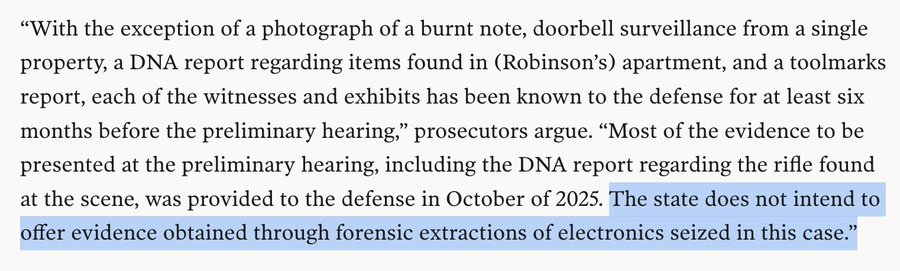
The State Says It Will Not Offer Forensic Extractions
A filing says the state does not intend to offer evidence from forensic extractions of the seized electronics. That removes the one path that could authenticate any of these logs.
Read this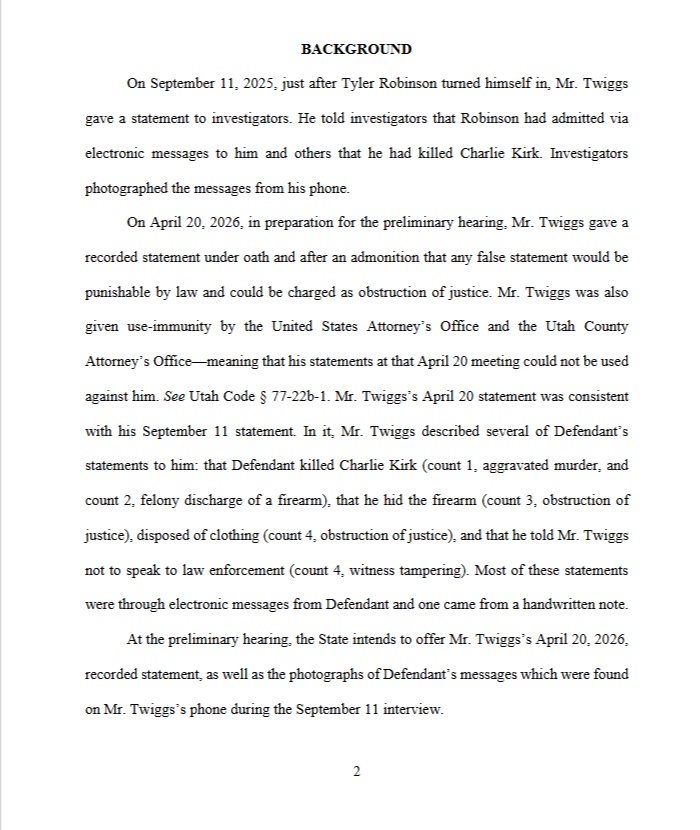
Lance Twiggs: Immunity and Two Statements
A statement on September 11, a sworn statement in April 2026, and use-immunity from two prosecuting offices. Lance Twiggs has never been charged with anything.
Read thisElsewhere In The Investigation
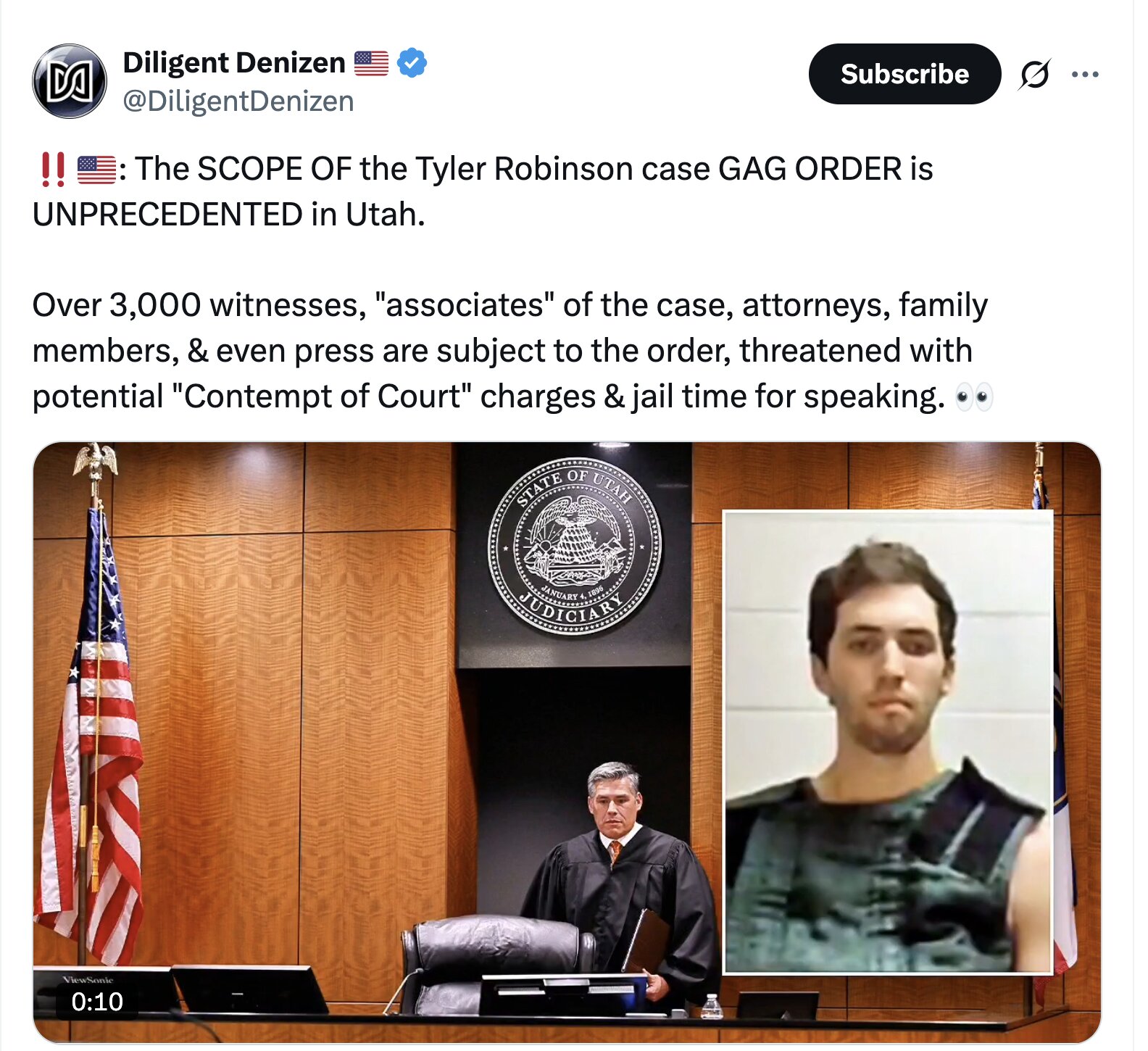
A December 2025 gag order, closed hearings, and a March 2026 motion to seal the inconclusive ATF report — opposed by a media coalition. The public record narrows in stages.
Read thisDOJ Prosecution and Evidence Secrecy
The public record on the charges and evidence handling, plus the sealing questions commentators raise. Digital-forensics warrants were reportedly sealed well into 2026, limiting outside review.
Read thisA gag order issued on the court's own motion, requested by neither side, restricting what parties and counsel may say. Lawful censorship, and a shaping force on everything published since.
Read thisThe prosecution's physical case needs the autopsy fragment tied to the seized rifle, and the state's own lab could not do it. Rifling consistent with numerous makes and models is a class description, not an identification.
Read thisThis website's author is @HolonCitizen on X and YouTube/@HolonCitizen. Follow me there.
Interesting
- Nine months of address searches before the event are logged in Tyler Robinson before the event.
- The silence order was reportedly entered by the court itself — see the December 16 gag order.
- The defense moved to seal an ATF report it called exculpatory — see gag orders and sealing.