Maps
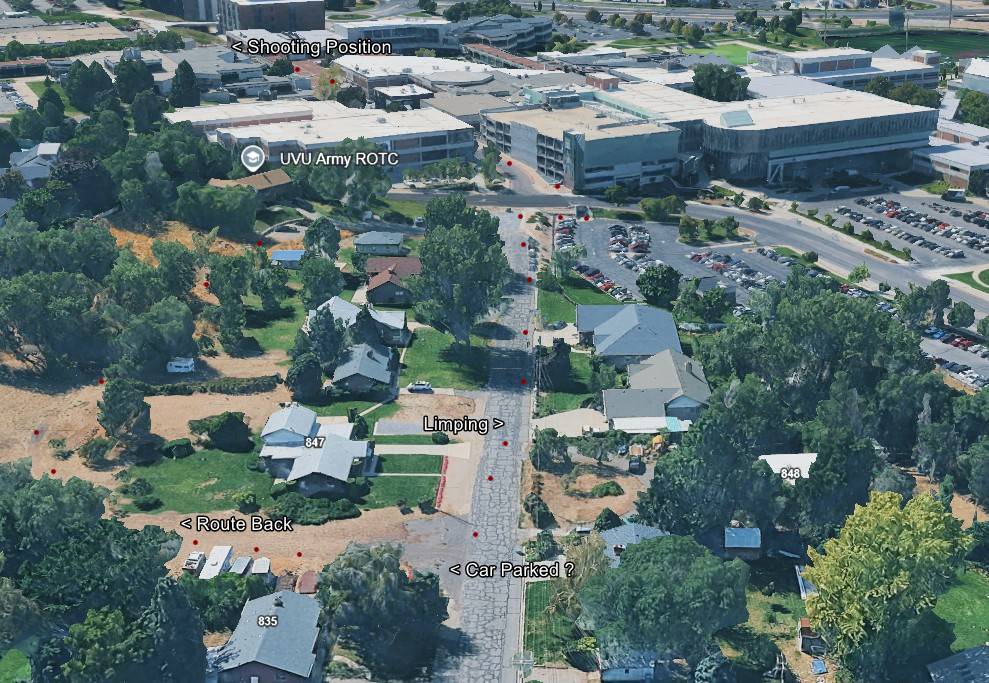
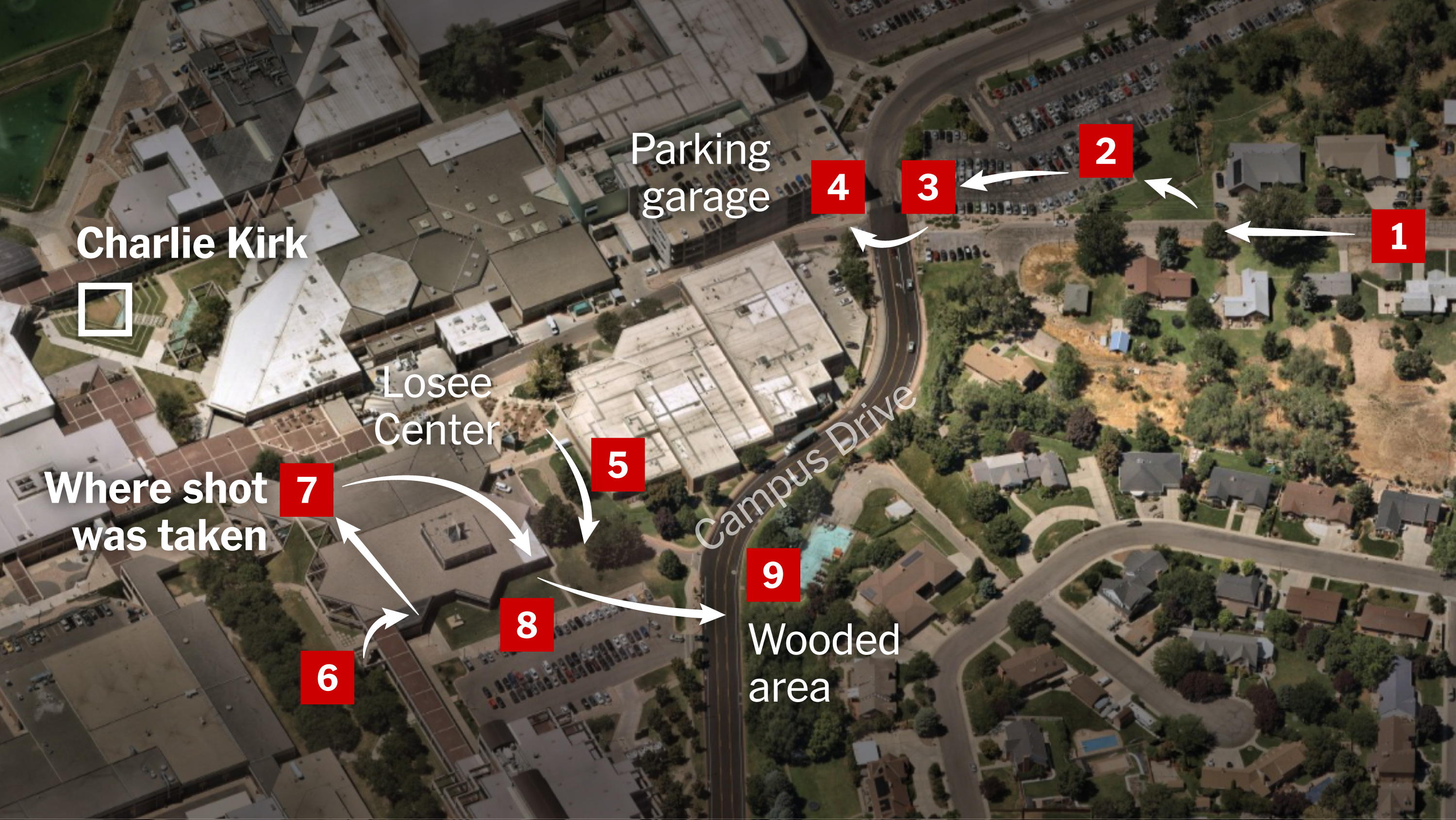
UVU's 158-page After-Action Report never once mentions the house UVU owns on the hill above the construction site, 691 W 925 S, even though the rooftop man's exit path ran right beside it and the rifle was found at the base of that hill. Who was in that house on September 10, and whose vehicles were parked in front, may be the single fastest way to crack open who really carried out Charlie Kirk's assassination. UVU holds the keys, the approvals, and the records, so we all need to ask UVU to release a "UVU House / Charlie Kirk Report".
Overview
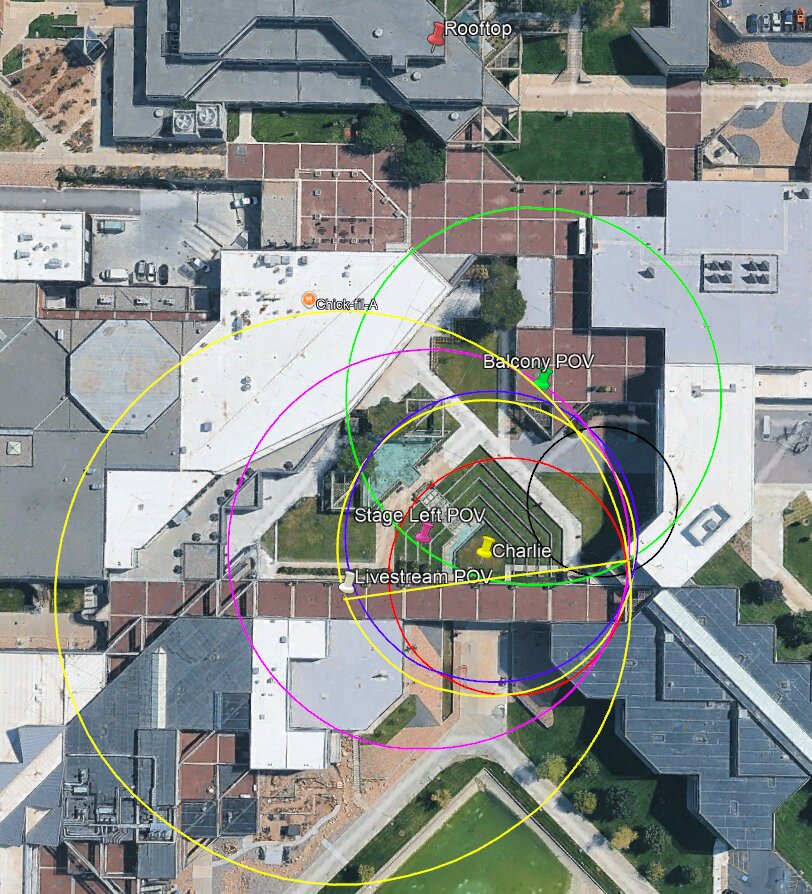
This page explains how maps and spatial analysis are used in the investigation of the Charlie Kirk case. It focuses on key locations (such as the UVU campus, surrounding buildings, and relevant airports), movement paths, and how visualizing these elements helps clarify timelines and theories about shooter locations, flight paths, and travel logistics. Every map on this site is anchored to one point on the UVU campus — the tent where Charlie Kirk was assassinated — and geometry drawn from that point is what drives the cause-of-death analysis.
In this section
Key locations and site layout
Mapping the physical environment is essential for understanding what was possible on the day of the event. Important locations include:
- The UVU event site – the tent, stage, audience area, and nearby structures such as tunnels, stairwells, and adjacent buildings.
- Rooftops and elevated positions – areas from which a shot could have been fired according to various theories, including the official rooftop narrative and alternative balcony or building perspectives.
- Approach routes and parking areas – paths used by attendees, security, and vehicles that appear in footage or are referenced in timelines.
Spatial layouts help investigators test whether proposed shooter positions, line‑of‑sight claims, and movement timelines are physically plausible.
Movement patterns and travel routes (claims)
Maps are also used to visualize movement before and after the event, such as:
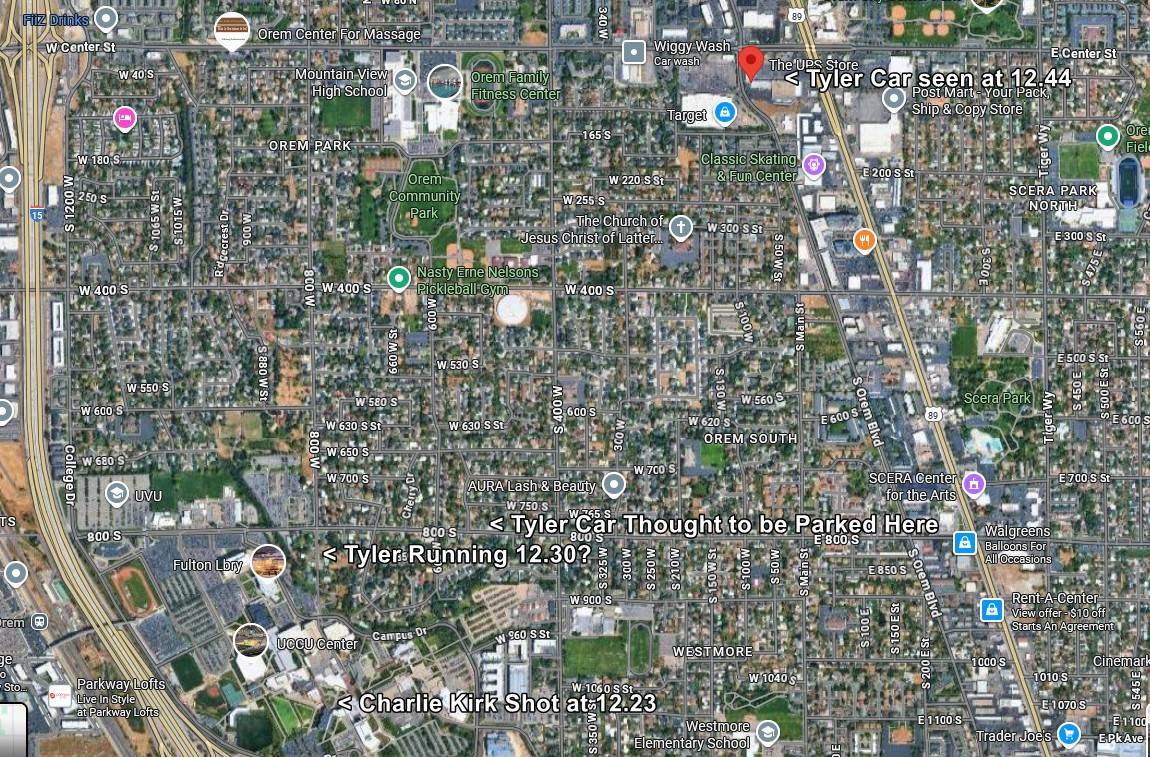
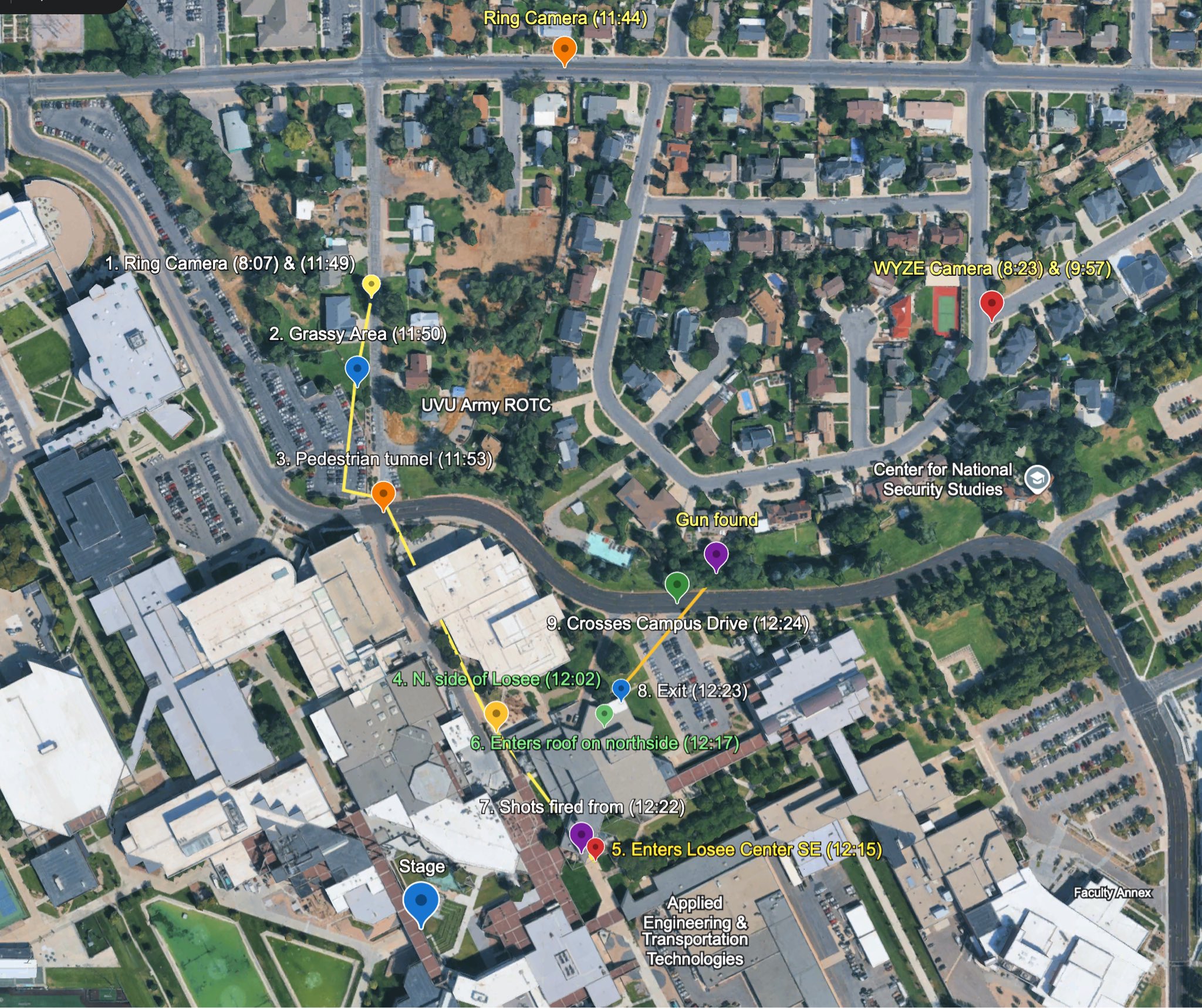
- Tyler Robinson's reported walking and driving routes on September 10, including camera locations where he was seen and the distances between them.
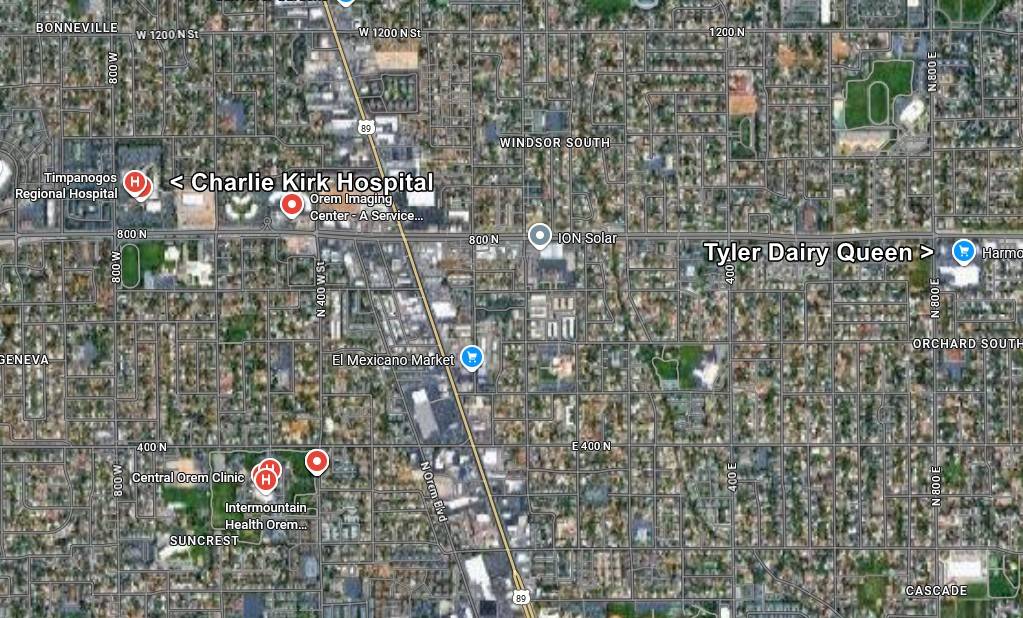
- The route and timing between UVU and other sites, such as hospitals or the Dairy Queen mentioned in some accounts, to evaluate whether proposed timelines are realistic.
- Paths taken by key vehicles (for example, vans or private jets) that appear in flight and travel analyses.
These mapped routes support questions about whether there was enough time for certain actions to occur as described, but they do not by themselves prove or disprove any theory.
Flight paths and regional context
Beyond the immediate campus, maps help situate:
- Flight paths of aircraft like N1098L and various Egyptian‑registered planes, including their proximity to UVU and the broader region.
- Regional geography, such as distances between airports, cities, and other points of interest that appear in the research file.
For detailed discussion of specific aircraft and their movements, see Planes and related pages.
Video: Erika Kirk's Name Searched in Hebrew While Egyptian Jets Sat on the Ground
Stew Peters claims Hebrew-language searches for "Erika Lane Frantzve" — Erika Kirk's maiden name — plus Tyler Robinson's apartment address, the Losee Center, and preloaded Orem SIM cards, cluster on dates an Egyptian military jet was on the ground in the United States. Search-trend data cannot show who searched or why, and being the subject of a search is not participation in anything — the same data would be consistent with her being looked up by strangers. Recorded as an attributed claim. Full framing: Planes and Google Searches.
Stew Peters, 5 August 2026 (3m40s). Source: @realstewpeters on X. Mirrored to IPFS by this investigation so it survives deletion.
How to use this section
Readers can use the Maps section to:
- Orient themselves to the physical layout of key sites and routes.
- Cross‑check narrative claims against distances and travel times.
- Understand how different shooter‑location or travel theories fit—or fail to fit—the geography.
As more diagrams, screenshots, or 3D reconstructions are added, they can be linked from this page to provide visual context for the analysis in sections like Timeline, Shooting Locations, Tyler Robinson, and Planes.
Citizen Investigator Claims on X (Spatial OSINT)
(Attributed public claims and geolocations — not court findings.)
Spatial analysis is one of the most active citizen-investigator lanes after September 10, 2025:
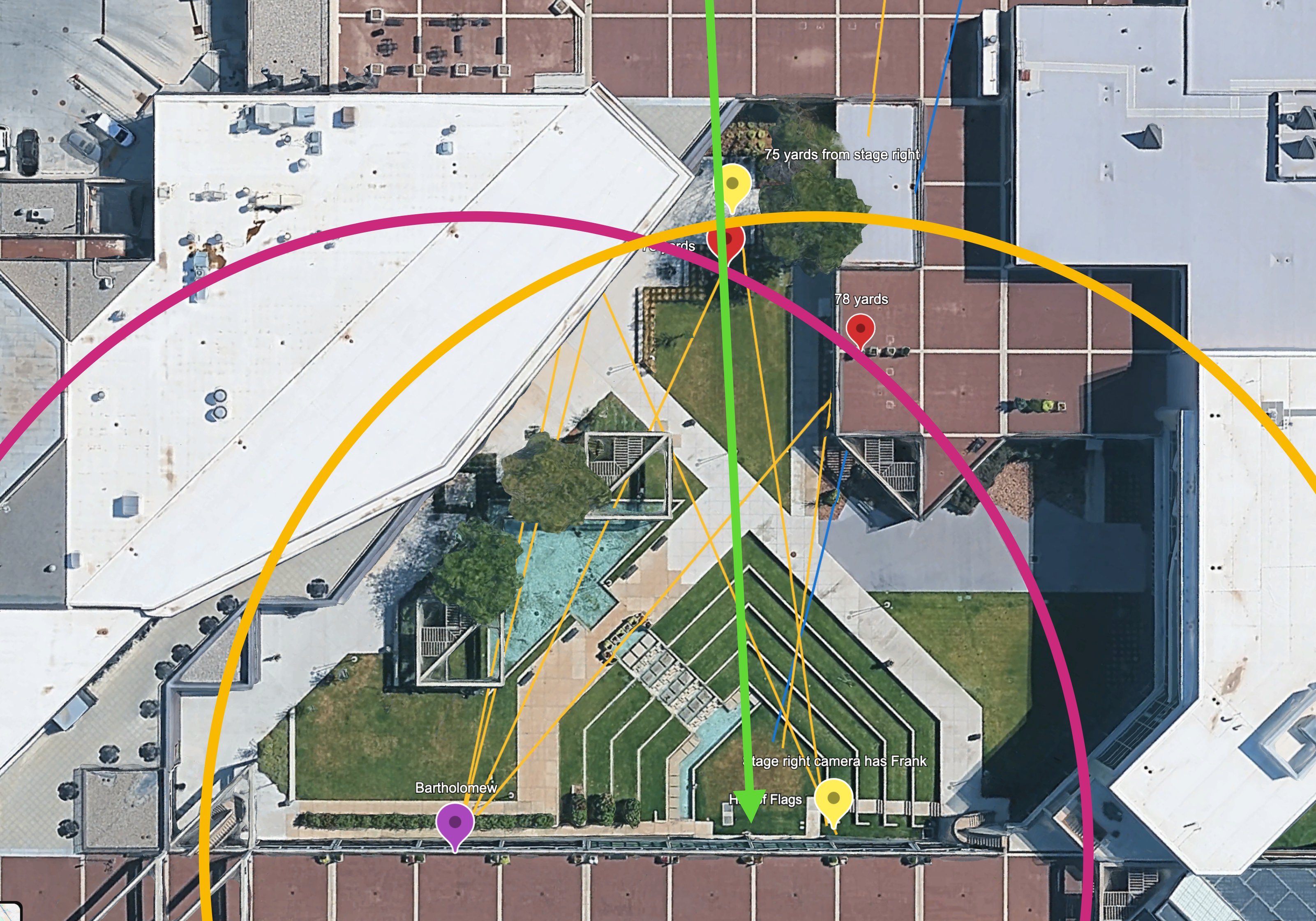
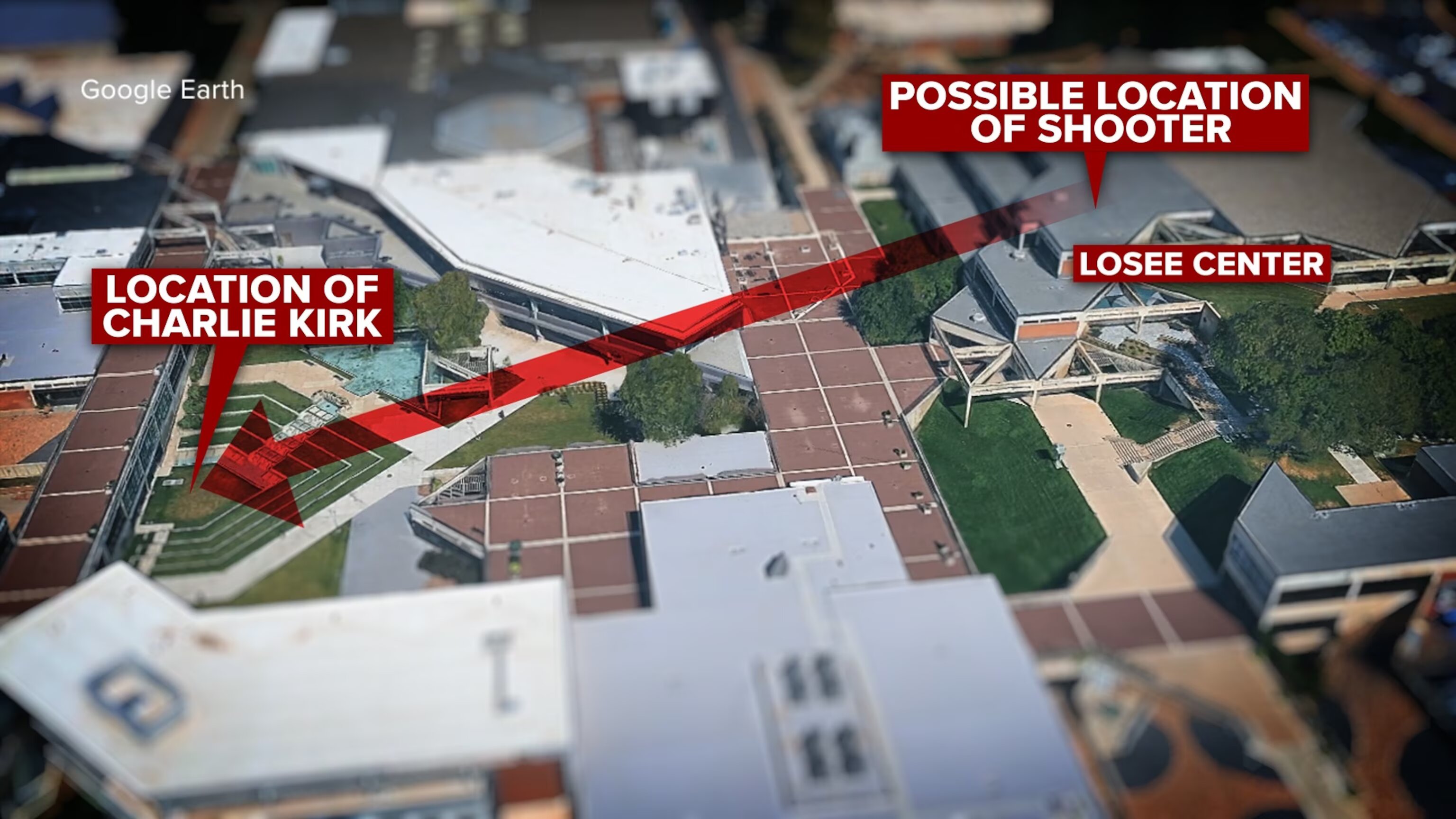
- @AMK_Mapping_ (11 Sep 2025) geolocated pre-shot footage to the roof of the Career Development Center at approximately 40.278201, -111.7127806, with Kirk's seated position near 40.277531, -111.714015, yielding an approximate ~128 metre shot length. That figure is an OSINT estimate, not a ballistic report.
- @Farm1945A published a Google Earth schematic combining civilian video with points from the local PD / press-conference walkthrough (including figures associated with the federal briefing narrative). The schematic tracks an approach path, stairwell assumption, roof firing point, drop from roof, wooded rifle-disposal assumption, and later reappearance points.
- @ProjectConstitu released multi-part campus walk-throughs (early October and mid-December 2025) arguing: roof access is "embarrassingly easy," camera coverage has surprising gaps, the tunnel / 800 Street / woods escape corridor is downhill and fast, and a detailed minute-by-minute map from parking north of campus → tunnels → roof → shot (~12:23 PM) → woods → return to vehicle looks hard to reconcile with a perfectly sealed lone-actor story — while still matching some official path points. Those are commentary arguments, not convictions.
- Other posters circulate maps labeled to the Losee Center / gravel rooftop "sniper pad" narrative used in court-adjacent discussion (elbow/knee impressions, palm prints — as reported in trial commentary). Readers should treat building names carefully: citizen maps do not always agree on which roof was which.
What maps settle vs. what they do not: Distances and line-of-sight can falsify impossible geometries. They cannot by themselves prove intent, identify who ordered anything, or resolve what role, if any, Tyler Robinson (charged, not convicted) played. Rooftop geometry also assumes the government's rifle narrative; most citizen investigators have concluded Charlie Kirk was killed by an explosive at his microphone, which no rooftop sight line explains. Cross-check every map against UVU Campus Maps, Possible Shooter Locations, Planes, and Timeline.
Official Narrative vs Competing Spatial Claims
| Theme | Official / prosecution-aligned commentary | Competing citizen claims |
|---|---|---|
| Cause of death | A single .30-06 round from the roof (the government's narrative) | Most investigators conclude an explosive at the microphone killed him |
| Firing point | Rooftop prone position with sightline to tent | Same roofs mapped; debate over which structure and whether a second origin exists |
| Shot distance | Consistent with high-powered rifle narrative | ~128 m OSINT estimate vs "200 yards" commentary — numbers diverge by source |
| Escape | Jump from roof, woods, rifle wrap, later arrest path | Full-circle return to car + camera gaps raise "how unseen?" questions |
| After action | Scene released, then campus construction | Paving / landscaping after release treated by some as evidence destruction — disputed timing |
Laws (Charlie Kirk)
- Geofence warrants mapping every phone at UVU, cell tower data for Robinson's reported walking and driving routes, and flight manifests for N1098L over the UVU region are not public yet; the Charlie Kirk Investigation Laws could bring these powerful truths out.
This website's author is @HolonCitizen on X and YouTube/@HolonCitizen. Follow me there.
Interesting
- K-9 teams missed it, yet the rifle in the woods surfaced within a short walk of the shot position.
- Kirk's usual protection was reportedly swapped for a last-minute security vendor wearing no bodycams.
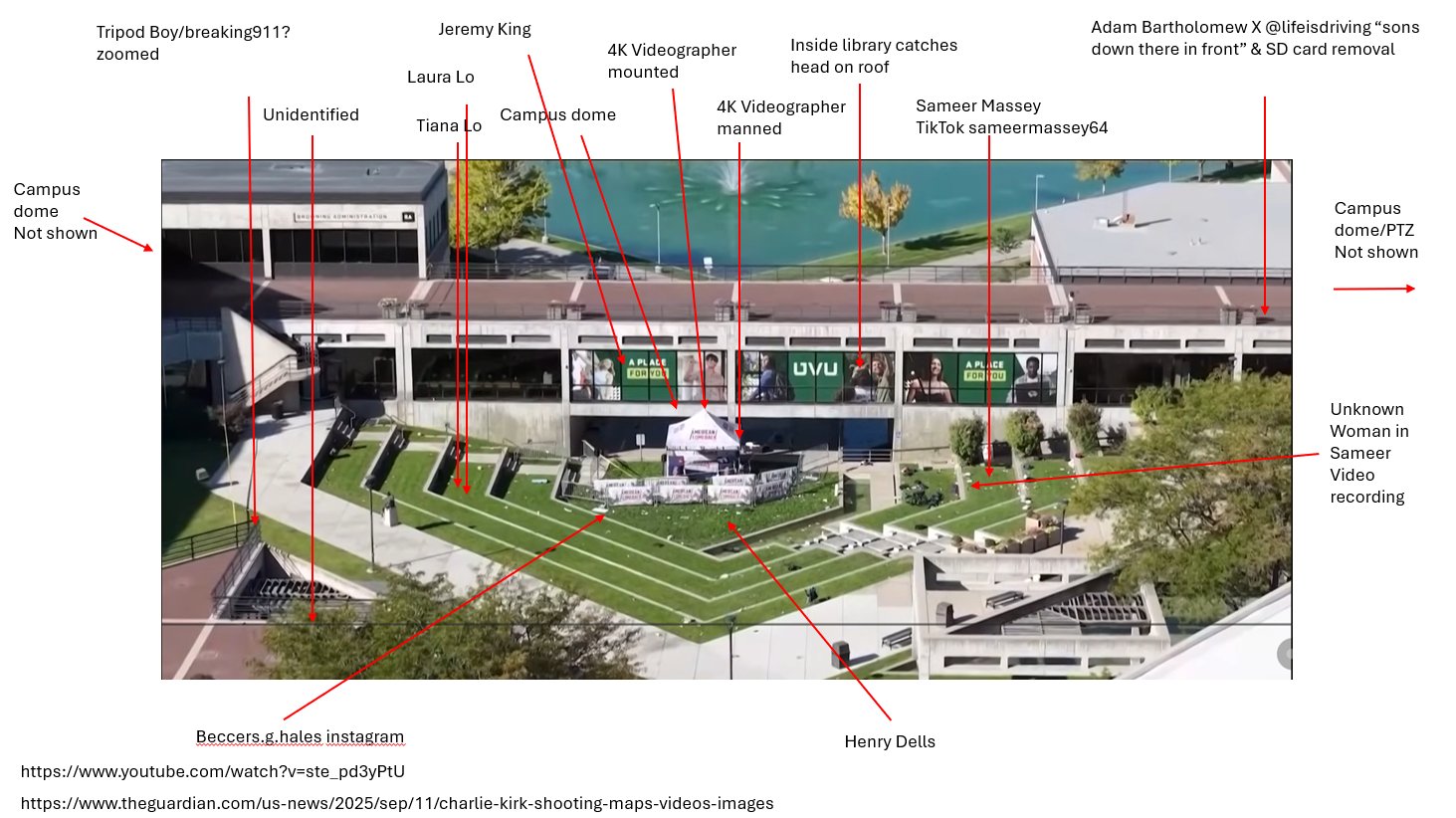
- X posters allege event camera SD cards left the scene before any evidence seal.
X.com posts:
Related Areas
- Locations
- Planes
- UVU
- Suspects
- Tent
- Timeline Overview
Related
- UVU Campus Maps
- Locations
- Possible Shooter Locations
- Planes
- UVU Courtyard
- Tent
Images