Planes
What the flight data actually shows
On 10 September 2025 — the day Charlie Kirk was killed at Utah Valley University — two Egyptian-registered government jets were on the ground at Provo Municipal Airport, about 5 miles from Orem, the event city. SU-BTT and SU-BND are put there by primary ADS-B position data, not by a reading of a tracking website: closest fixes 1.23 km and 1.29 km from KPVU. SU-BTT had been parked on that ramp since 4 September, six days before, and lifted off at 07:14 MDT that morning. SU-BND did not move at all that day — its first and last fixes are the same Provo position — and it stayed until 13 September.
Of the 29 claimed overlap rows that primary position data can actually decide, 25 put the aircraft at the field the claim names. Three are refuted. A widely-quoted X audit of the same spreadsheet scored two rows in three as wrong and three in five as on the wrong continent. Where that audit can be checked against position data — 5 of its 44 negative verdicts — it is wrong on 3 and right on 2.
N102DZ, the aircraft reported as Charlie Kirk's, had its FAA registration certificate re-issued on 16 October 2025 — 36 days after the assassination — to a Cheyenne, Wyoming holding company, with a further registry action on 23 December 2025. It is the only case-central aircraft whose registration moved after 10 September 2025. Certificate re-issues are ordinary events — sale, transfer between owner LLCs, renewal, address change — and are not evidence of anything by themselves.
The counts, and where each one opens up
| Count | |
|---|---|
| Claimed overlap rows reconstructed, each with its own page | 85 |
| Rows primary position data can decide either way | 29 |
| Of those, aircraft at the field the claim names | 25 |
| Of those, refuted — the aircraft was tracked somewhere else | 3 |
| Aircraft-days of primary position data recovered | 1,831 |
| Trace files held on disk, 308 MB, from 4 independent archives | 3,619 |
| Recorded ground visits at Provo (KPVU), all tracked aircraft | 135 |
| Days after the assassination N102DZ's registration was re-issued | 36 |
Every claimed overlap primary position data can decide
One row per occurrence. Confirmed first, closest approach first within that; the same-metro and refuted rows are at the bottom because that is where the evidence puts them, not because they are hidden. The date opens that single occurrence's own page; the airport, the tail and the city each open their own record.
| Date | City | State | Airport | Tail | What the data shows | Who was claimed there |
|---|---|---|---|---|---|---|
| 23 Apr 2024 | Provo | UT | KPVU | SU-BTT | AT_CLAIMED_AIRPORT — transmitting from on the ground, 0.00 km | Charlie Kirk (unresolved), TPUSA event (unresolved) |
| 23 Apr 2024 | Salt Lake City (event) / Provo (aircraft) | UT | KPVU | SU-BTT, SU-BND | AT_CLAIMED_AIRPORT — transmitting from on the ground, 0.00 km | Charlie Kirk, Erika Kirk, TPUSA event (unresolved) |
| 23 May 2025 | Provo | UT | KPVU | SU-BND | AT_CLAIMED_AIRPORT — transmitting from on the ground, 0.03 km | Charlie Kirk, Erika Kirk, TPUSA event (unresolved) |
| 23 May 2025 | Provo | UT | KPVU | SU-BND | AT_CLAIMED_AIRPORT — transmitting from on the ground, 0.03 km | Charlie Kirk, Erika Kirk, TPUSA event (unresolved) |
| 19 Apr 2024 | Provo | UT | KPVU | SU-BND | AT_CLAIMED_AIRPORT — transmitting from on the ground, 0.05 km | Erika Kirk, TPUSA event (unresolved) |
| 4 Sep 2025 | Provo | UT | KPVU | SU-BTT | AT_CLAIMED_AIRPORT — transmitting from on the ground, 0.16 km | Charlie Kirk, TPUSA event (unresolved) |
| 9 Feb 2024 | Omaha / Lincoln | NE | KOMA | SU-BTT | AT_CLAIMED_AIRPORT — closest approach 0.31 km | TPUSA event |
| 1 Apr 2023 | St. Louis | MO | KSTL | SU-BTT | AT_CLAIMED_AIRPORT — closest approach 0.41 km | TPUSA event |
| 17 Aug 2025 | Omaha / Lincoln | NE | KOMA | SU-BTT | AT_CLAIMED_AIRPORT — closest approach 0.50 km | Erika Kirk, TPUSA event (unresolved) |
| 20 Apr 2023 | Wilmington | DE | KILG | SU-BTT | AT_CLAIMED_AIRPORT — transmitting from on the ground, 0.56 km | Erika Kirk, TPUSA event (unresolved) |
| 13 Sep 2025 | Provo | UT | KPVU | SU-BND | AT_CLAIMED_AIRPORT — closest approach 0.62 km | Erika Kirk, TPUSA event (unresolved) |
| 14 Feb 2024 | Wilmington | DE | KILG | SU-BTT | AT_CLAIMED_AIRPORT — closest approach 0.82 km | Erika Kirk, TPUSA event (unresolved) |
| 10 Sep 2025 | Provo then Wilmington | UT/DE | KPVU | SU-BTT | AT_CLAIMED_AIRPORT — transmitting from on the ground, 1.23 km | Charlie Kirk, Erika Kirk, TPUSA event |
| 10 Sep 2025 | Orem (event) / Provo (aircraft) | UT | KPVU | SU-BTT, SU-BND | AT_CLAIMED_AIRPORT — transmitting from on the ground, 1.23 km | Charlie Kirk, Erika Kirk, TPUSA event (unresolved) |
| 10 Sep 2025 | Provo | UT | KPVU | SU-BND | AT_CLAIMED_AIRPORT — transmitting from on the ground, 1.29 km | Charlie Kirk, Erika Kirk, TPUSA event (unresolved) |
| 20 Jul 2025 | Omaha / Lincoln | NE | KOMA | SU-BTT | AT_CLAIMED_AIRPORT — closest approach 1.33 km | Erika Kirk, TPUSA event (unresolved) |
| 3 Apr 2024 | Wichita / Lawrence | KS | KICT | SU-BTT | AT_CLAIMED_AIRPORT — closest approach 1.43 km | Charlie Kirk (unresolved), TPUSA event (unresolved) |
| 3 Apr 2024 | Lawrence (event) / Wichita (aircraft) | KS | KICT | SU-BTT | AT_CLAIMED_AIRPORT — closest approach 1.43 km | Charlie Kirk, TPUSA event (unresolved) |
| 28 Apr 2024 | Wilmington | DE | KILG | SU-BTT | AT_CLAIMED_AIRPORT — closest approach 1.56 km | Erika Kirk, TPUSA event (unresolved) |
| 6 Apr 2023 | Wilmington | DE | KILG | SU-BTT | AT_CLAIMED_AIRPORT — closest approach 1.63 km | Erika Kirk, TPUSA event (unresolved) |
| 10 Sep 2025 | Wilmington | DE | KILG | SU-BTT | AT_CLAIMED_AIRPORT — closest approach 1.75 km | Erika Kirk, TPUSA event (unresolved) |
| 29 Mar 2024 | Wichita | KS | KICT | SU-BTT | AT_CLAIMED_AIRPORT — closest approach 1.83 km | Charlie Kirk, TPUSA event (unresolved) |
| 3 May 2023 | St. Louis | MO | KCPS | SU-BND | AT_CLAIMED_AIRPORT — closest approach 2.07 km | Erika Kirk, TPUSA event (unresolved) |
| 25 Feb 2023 | St. Louis | MO | KSUS | SU-BTT | AT_CLAIMED_AIRPORT — closest approach 2.22 km | Erika Kirk, TPUSA event (unresolved) |
| 20 Jul 2025 | Lincoln | NE | KLNK | SU-BTT | AT_CLAIMED_AIRPORT — closest approach 7.20 km | Erika Kirk, TPUSA event (unresolved) |
| 14 Apr 2023 | Wichita | KS | KICT | SU-BTT | SAME_METRO_WRONG_FIELD — 27.6 km from the named field | Erika Kirk, TPUSA event (unresolved) |
| 9 May 2023 | St. Louis then Goose Bay | MO | CYYR | SU-BND | ELSEWHERE — refuted, 1,063 km away | Erika Kirk, TPUSA event (unresolved) |
| 12 May 2023 | St. Louis | MO | KSTL | SU-BND | ELSEWHERE — refuted, 7,034 km away | Erika Kirk, TPUSA event (unresolved) |
| 18 Jun 2025 | Omaha / Lincoln | NE | KOMA | SU-BTT | ELSEWHERE — refuted, 10,140 km away | Erika Kirk, TPUSA event (unresolved) |
The limit is the same size as the number, and it belongs right under the table. Every row above locates an aircraft. Not one of them puts Charlie Kirk, Erika Kirk or any other person aboard anything — no manifest for any leg has been published by anyone, and Erika Kirk's flight logs are reported erased. The other 56 rows of the register are undecidable, not hidden: an empty archive response means a volunteer network heard nothing that day. Provo and Lincoln are both Duncan Aviation fields and Wichita is a Falcon service centre, and Duncan has held the Egyptian Air Force's maintenance account since 1999 — a jet on a maintenance ramp is what a maintenance visit looks like. The full argument on both sides is further down this page and on Following Charlie or Erika.
Best understanding of when this happened
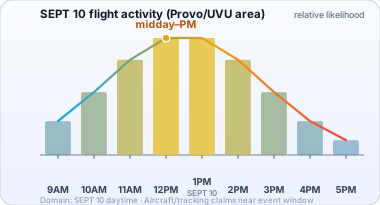
Best understanding: flight-tracking discussions focus on SEPT 10 daytime relative to the UVU window (not a multi-month axis).
Date range (working model): SEPT 10 daytime flight-tracking window
The chart below is not a government finding. Bar height is relative likelihood from public claims. Domain is trimmed to non-trivial likelihood.
Aircraft and flight-path evidence around UVU on September 10, 2025 — from the N1098L ISR passes and Egyptian armada to SAM VIP flights and transponder gaps. Start with the investigation index, then open the tail number or timeline that matches your question.
- Planes Investigation Index
- Aircraft Costs — what every plane costs new
- TPUSA Aircraft — what Turning Point actually owned
- Charlie's & Erika's Aircraft
- Following Charlie or Erika
- Following: location by location
- TPUSA Events + Aircraft
- Erika Flight Logs Erased
- X posts: flight data reported erased
- Which Flight Records Were Deleted — And Whose — the four suppression hypotheses (Egyptian tails, Erika, Charlie, the event dates), each tested against controls
- Flight Data Recovery — what came back
- Per-Aircraft Recovery Status — one row per tail, every source
- Overlap Recovery — all 69 alleged following-flights, tested
- What A 403 Actually Means — the control test, and the removal claim it retracted
- Investigating Deleted Flights — how much of the data we actually hold, as a percentage, and which archive produced it
- Erika Kirk's flights
- Sept 10 Flight Timeline
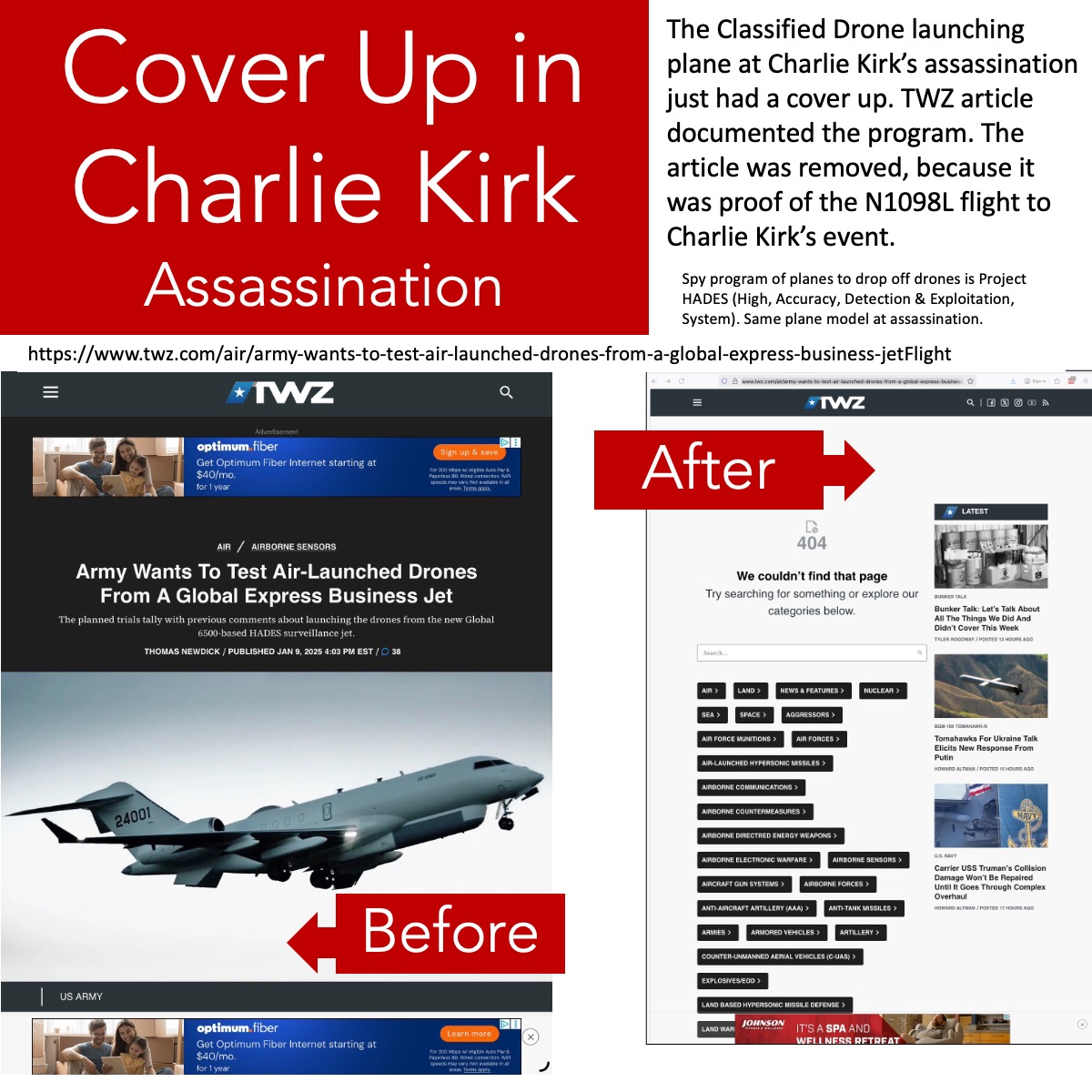
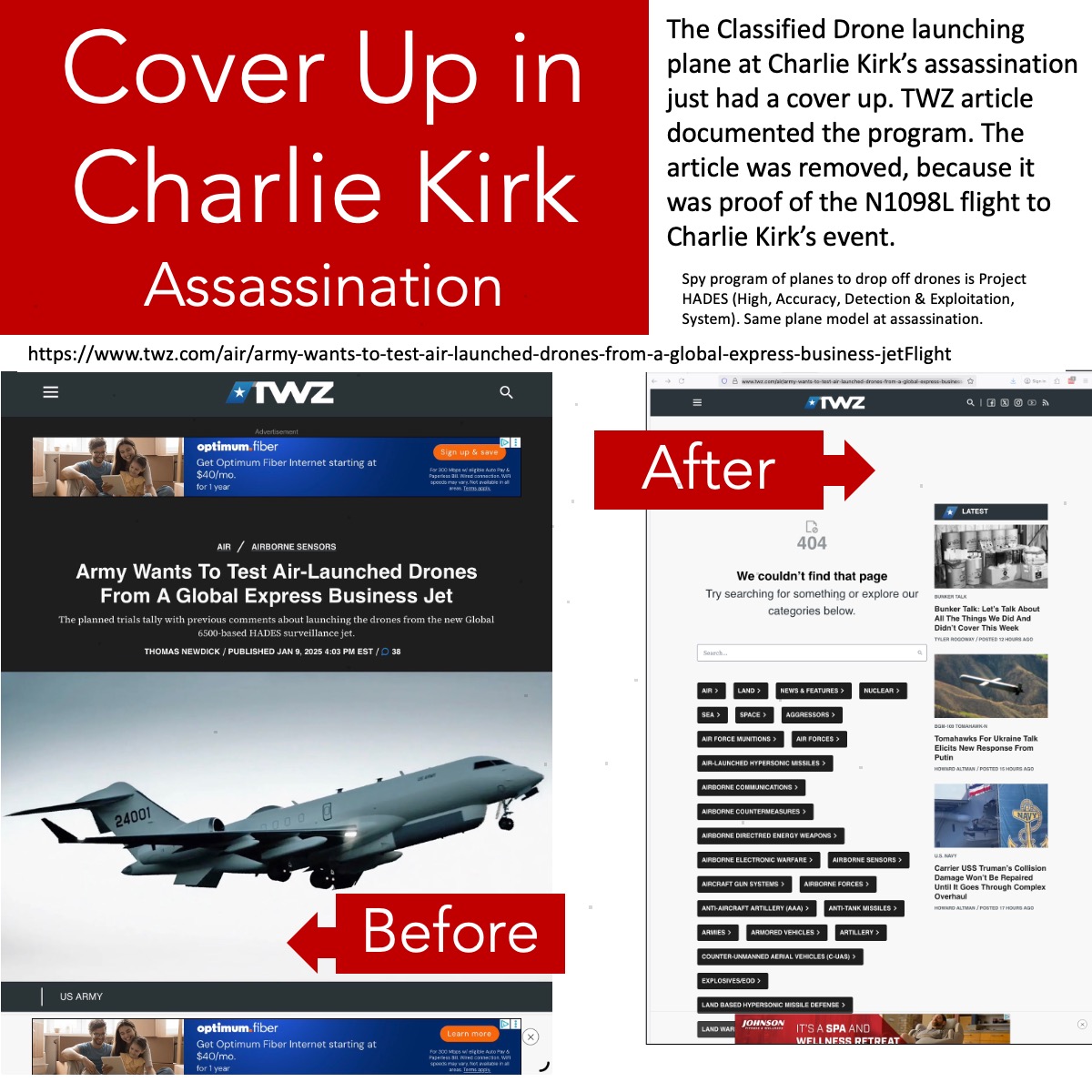
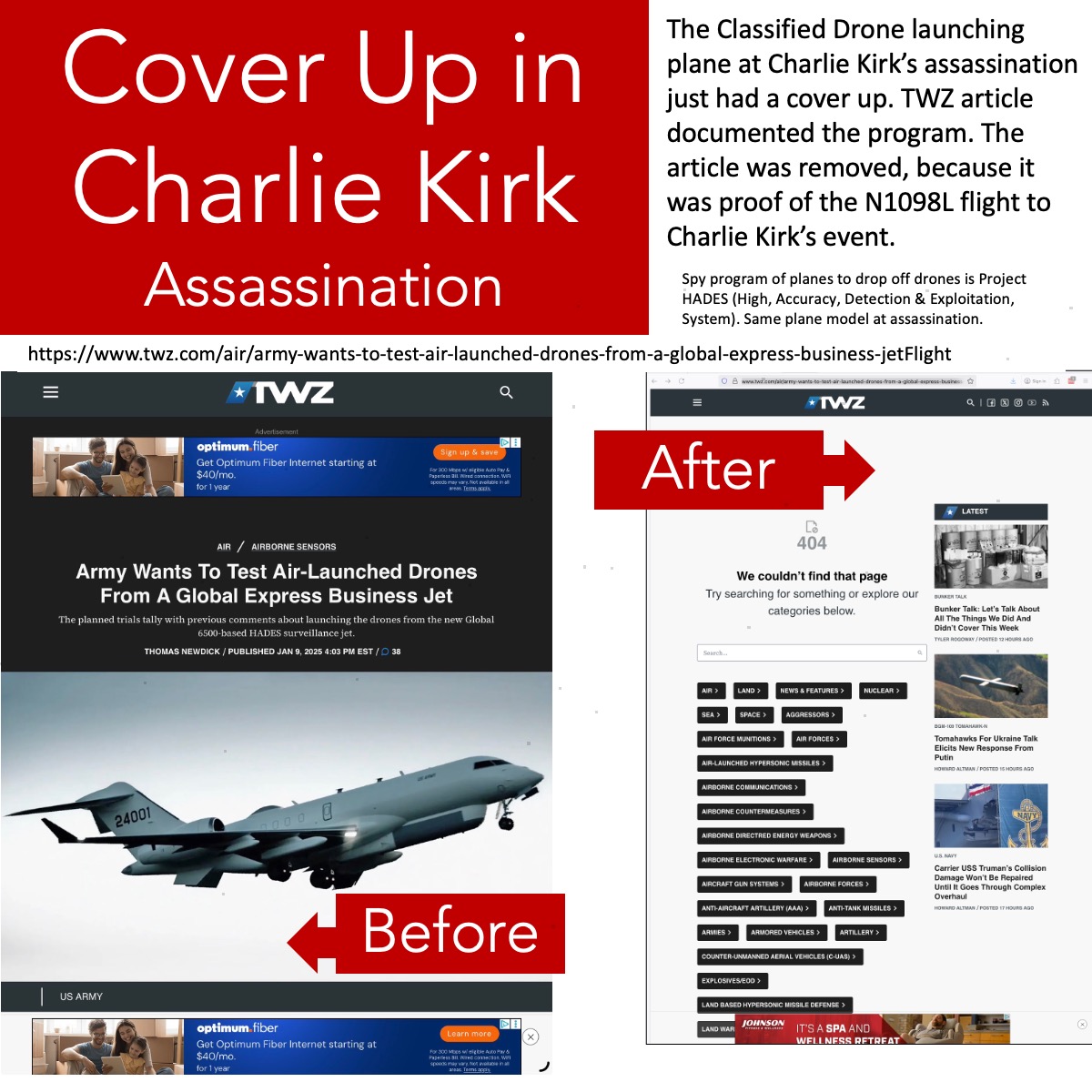
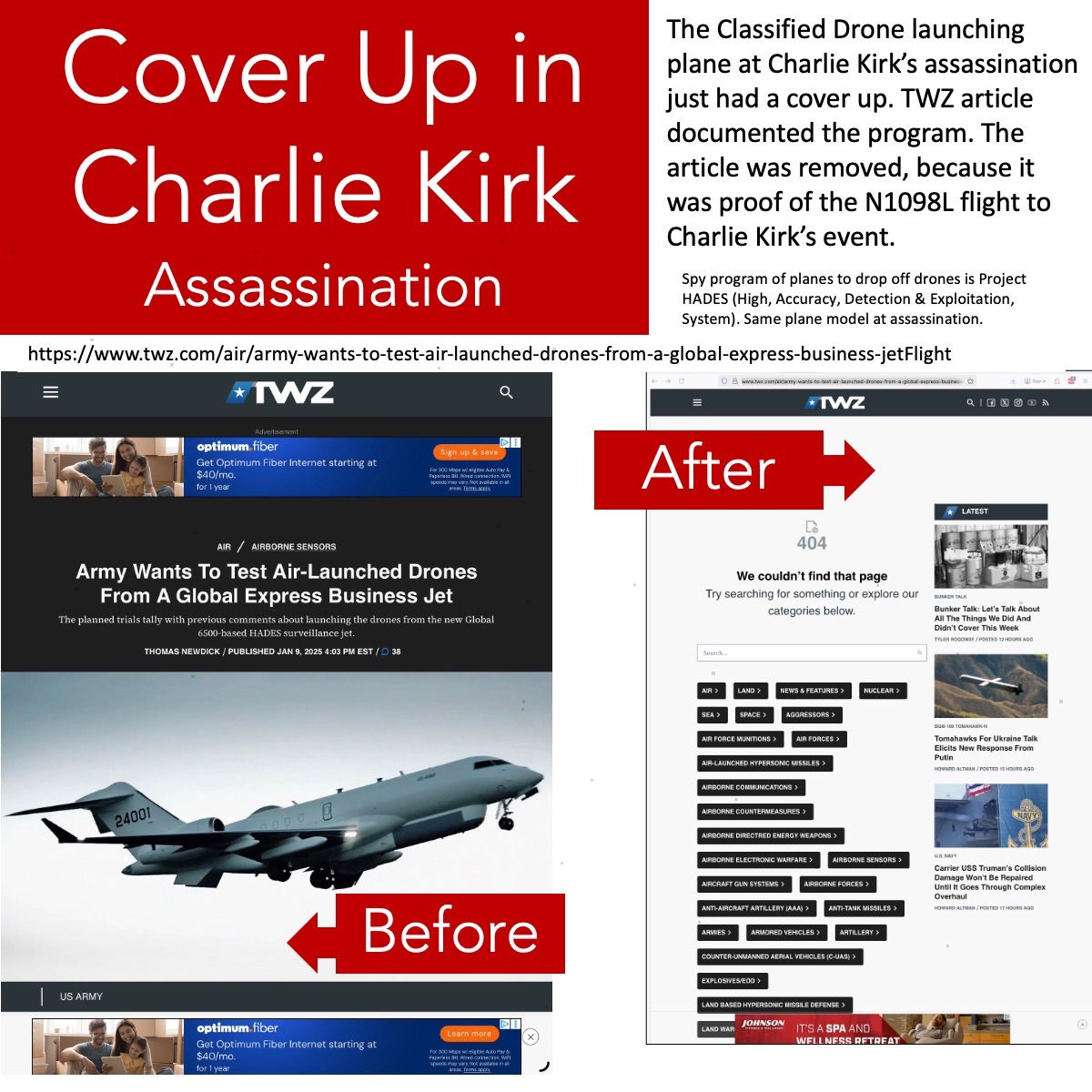
- N1098L Spy Plane
- ISR Program Context
- N2100L LASAI Sister Ship
- N59906 MARC Survey Plane
- N888KG Wendover Vanish
- N102DZ Kirk's Plane
- N560TW Scottsdale Jet
- N40JD Provo Arrival
- N872RA Provo Arrival
- LASAI Aviation Fleet
- N155TV KSL Chopper 5
- N708JH DOJ Gulfstream
- N885LS Sands BBJ
This section catalogs aircraft whose movements deviate from routine civilian patterns near UVU in September 2025: a US Army HADES ISR jet making low passes, five Egypt-registered VIP jets cycling through Provo, US government SAM flights touching Fort Huachuca the day before the shooting, and private jets with transponder gaps or tight timeline conflicts. The area matters because flight data is primary-source-adjacent — ADS-B is public — yet manifests and mission tasking remain sealed.
Several patterns recur. N1098L looped at low altitude the day of the event; SU-BTT was on the ground Sept 4–10 with competing departure narratives; the armada allegedly shadowed Kirk travel for years per Candace Owens; SAM 99-0404 stopped at Fort Huachuca Sept 8–9. The Sept 10 timeline page merges transponder windows with hospital-timing claims. Each thread has innocent explanations (training, MRO contracts, VIP logistics) documented on the per-tail pages.
New readers should start with Planes Investigation Index for the full map. For foreign-intel framing go SU-BTT → Israel Planes; for US military ISR go N1098L; for command-and-control go SAM 99-0404. Ground truth requires manifests the Fix Laws seek to compel. The foreign-aircraft threads cataloged here are also the kind of leads former NCTC director Joe Kent says his center's parallel foreign-nexus review was ordered to abandon once Tyler Robinson was in custody.
Video: Tyler Robinson's Address Googled in Hebrew from the Egyptian Jet
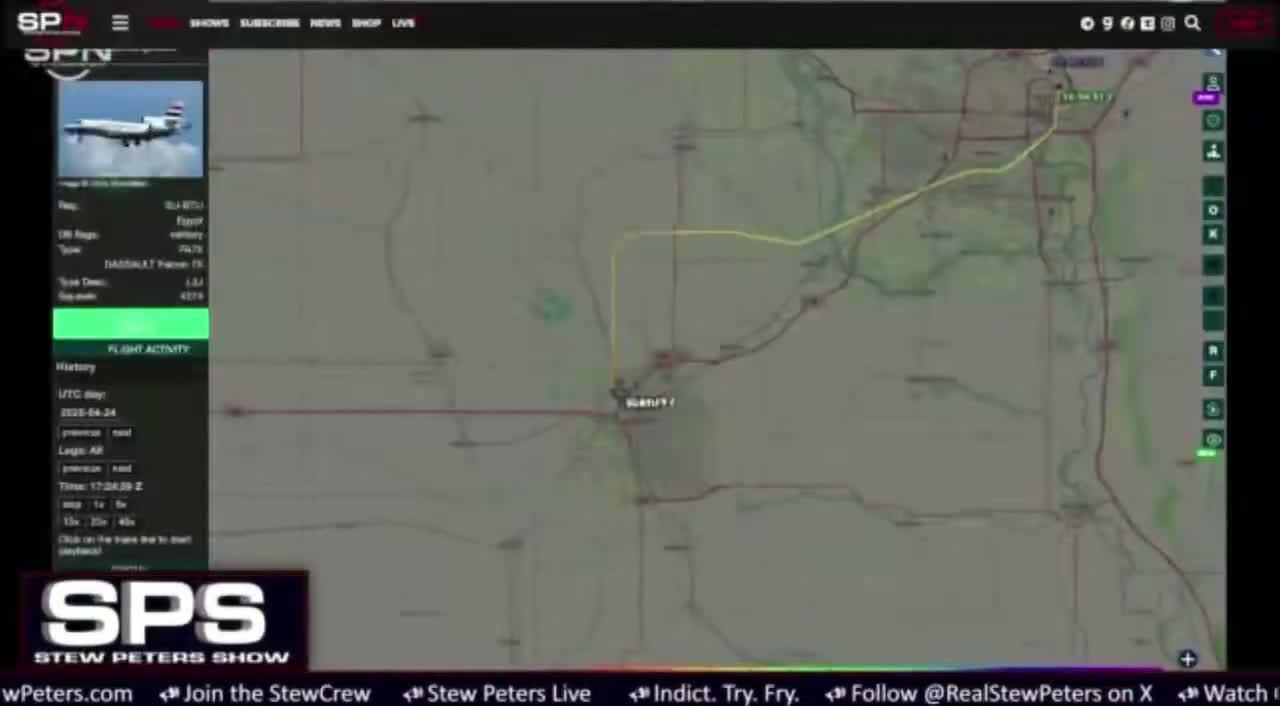
A researcher interviewed by Stew Peters reports that Tyler Robinson's exact apartment address — down to the unit number — was Google-searched in Hebrew on April 29, 2025, while an Egyptian-registered jet tracked by investigators sat parked in Lincoln, Nebraska. Full analysis and transcript: Stew Peters: Tyler Robinson's Address Googled in Hebrew.
Laws (Charlie Kirk)
N1098L tasking, Egyptian manifests, SAM logs, and hotel guest records are among the truths the Charlie Kirk Investigation Laws may force into public view.
Citizen Investigator Claims on X
(Aircraft OSINT and attributed claims — not findings that any pilot, passenger, or official ordered or carried out the assassination.)
- HADES / N1098L: X users (e.g. @Josh89220 and amplifiers) cite FAA/transponder logs of an Army HADES-class ISR jet making low-altitude passes near UVU/Orem before and after the shooting — correlation claims documented under N1098L, not proven operational culpability.
- Egyptian VIP tails: Candace Owens and citizen trackers map SU-BTT / SU-BND (and related armada entries) overlapping Kirk/TPUSA travel and a ~Sept 4 Provo window; critics argue the theory was debunked or re-aimed at Erika-tracking tallies. See Egyptian Armada and Following Charlie or Erika.
- SAM / Fort Huachuca: Pre-event VIP traffic (SAM-702 / 99-0404 cluster) fuels meeting-day narratives and defamation litigation over Huachuca claims — distinguish carefully from the Sept 11 casket flight on 99-0004.
- Competing tallies and “debunk” cycles continue; flight logs ≠ intent. Demand manifests via FOIA/GRAMA and the Fix Laws rather than treating X threads as verdicts.
The Following Planes — the biggest open question in this whole section
Foreign-registered aircraft repeatedly landing at the same airports Charlie Kirk, Erika Kirk and TPUSA events used is the single largest allegation anywhere in the Planes investigation, and it is the one this section treats as most important. It is bigger than any one tail number and bigger than any one day, because it is the only claim here that, if it holds, describes a sustained operation rather than a coincidence on 10 September 2025. It is also the claim most likely to be dismissed wholesale if it is presented sloppily — which is why it now has its own section, organised the way it is actually testable: one page per airport, and one page per claimed overlap.
→ Following: the location-by-location log — the main page for this issue.
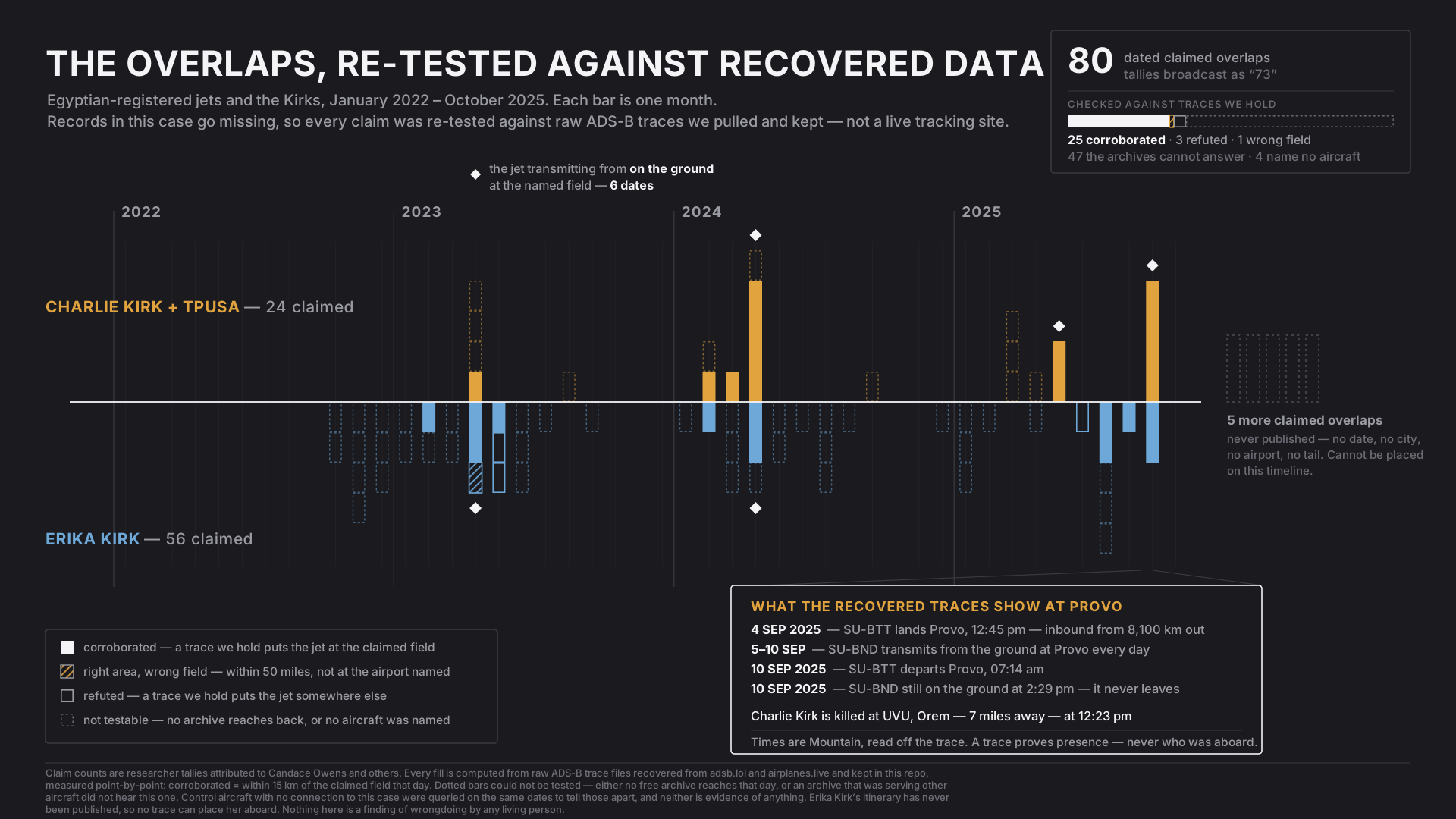
Each bar is one month. Height is how many claimed overlaps the compilers logged that month; the fill is what a raw ADS-B trace this investigation pulled out of the archives and kept says about that aircraft on that date — solid where a trace we hold puts the jet at the field the claim names, hollow where it puts it somewhere else, dotted where no surviving archive can answer. The long, busy, mostly dotted lower trace is the Erika Kirk count — 56 of the 80 dated rows, and the side with no published itinerary behind it. The shorter upper trace is more than half solid and carries no hollow bars at all. Diamonds mark the six dates the jet is transmitting from on the ground at the named field. Plotted directly from this directory’s overlap register, so the chart moves when the data does; every count, the sourcing and the counterargument are printed in the chart’s own footer. A trace proves presence — never who was aboard.
The numbers, in one place
Every claimed overlap has been reconstructed from the compilation that produced the "73 times" figure. 78 rows. Each one has its own page.
| Rows | |
|---|---|
| Total claimed overlaps with an Egyptian-registered jet | 78 |
| Overlaps with Charlie Kirk, Erika not claimed with him | 13 |
| Overlaps claiming both Kirks | 1 (10 Sep 2025 — and it puts them 2,000 miles apart) |
| Overlaps involving Charlie at all | 14 |
| Overlaps involving Erika at all | 61 |
| Overlaps at a TPUSA event with neither Kirk claimed present | 4 |
| Attributed to SU-BTT, the yellow plane | 54 |
| Attributed to SU-BND, the blue plane | 16 |
| Rows where even the tail number is unresolved | 8 |
| Aircraft position confirmed accurate by hostile audit | 18 |
| Aircraft position found wrong, usually another continent | 44 |
| Dates that survive a same-day test at a shared field | 6 |
Erika Kirk's presence is not established on any of the 61 rows that rest on her. Her flight logs are reported erased, no dated itinerary for her has ever been published, and the sheet's Erika Location column names a whole US state on 42 rows, two states at once on 11, and nothing at all on 8 — reaching a city or venue on two rows out of sixty-one. Applying the ordinary standard used everywhere else on this site — where presence cannot be established, treat the person as not there — leaves zero established Erika overlaps, 14 Charlie ones, and 4 Turning Point events with no Kirk at them. Of the six dates that survive at a shared field, three are Charlie Kirk, two are a TPUSA event with neither Kirk, and two of the three Charlie dates are in Utah.
That is a narrower claim than the broadcast one and a far harder one to dismiss. Full working: Following overview.
Every claimed overlap has now been tested against primary ADS-B position data
On 24 August 2026 all 85 rows of the overlap register were checked against raw position traces from two independent free archives — the claimed date and the day either side, measured as the aircraft's closest approach in kilometres to the claimed field. This is the first time the sheet has been tested against position data rather than against another reading of a tracking website.
| Verdict | Rows |
|---|---|
| At the claimed airport — corroborated | 25 |
| Same metro, wrong field — neither | 1 |
| Elsewhere — refuted | 3 |
| Not heard / no archive coverage — undecidable | 47 |
| No aircraft or no date named in the source row | 9 |
Of the 29 rows that primary position data can decide, 25 are corroborated, 1 is same-metro-wrong-field and 3 are refuted. This corrects a figure this site itself published. A first pass reported 24 corroborated and 12 refuted; reading every position fix in every recovered trace shows 9 of those 12 refutations were wrong — six scored against the wrong calendar day, two scored off the shorter of two archives while the longer one had the aircraft climbing out of the airport it was said to be 1,853 km from. Published audits of this sheet put roughly two rows in three in the wrong place; against primary position data it is not close — the wrong-place rate on decidable rows is 10%. Full working on Overlap Recovery, cross-tabulation on Following Charlie or Erika.
The limit is the same size as the number. A confirmed position confirms the aircraft half of a pairing. It does not put Charlie Kirk or Erika Kirk anywhere. The Kirk half is unchanged — thin for Charlie, close to empty for Erika, whose flight logs are reported erased. A confirmed aircraft is not a confirmed overlap. And the 47 undecidable rows are holes: an empty archive response means the archive had nothing, not that the aircraft was hidden or absent. Counterargument, unchanged and carried on every page below: Duncan Aviation's Egyptian Air Force maintenance account dates to about 1999, and a Falcon on a Duncan ramp is what a maintenance visit looks like.
Three other results from the same run, each argued in full on the page named:
- The 2022 wall is broken. This site published that no free archive reaches 2022 and that every 2022 claim rested on a screenshot. A free monthly full-day sample reaches back to 2016, and it puts SU-BTT on the ground at Wilmington, Delaware on 1 June 2022 and at Wichita, Kansas on 1 September 2022, and SU-BTU on final approach into St Louis, Missouri on 1 December 2022 — three of the five claimed clustering states, now with primary position data behind them instead of a tally. Sampling caveat, mandatory every time: one day per month, the first. It shows the aircraft was in the United States in 2022; it says nothing about how often. → Following overview
- 152 aircraft-days were recovered from a backup network that the primary archive does not hold, across 12 aircraft — and the run's control result matters more than the headline: over 1–16 September 2025, the fortnight the case turns on, the two archives agree on 74 of 75 days. There is no scrubbing in the critical window. → Flight Data Recovery
- 153 flight legs were recovered from archived tracking pages that a previous run had recorded as zero. The zeros were a parsing failure, not an absence of evidence. Anything on this site that rested on them has to be re-read. → Overlap Recovery
The top issues inside that section, and where each is argued
The count itself, and who it is really about — Following overview opens with the breakdown above. The row-by-row reconstruction of the sheet is The 73 overlaps, and every claimed overlap has a page under Overlap dates.
Where the numbers came from, layer by layer. They started on air with the Candace Owens broadcasts — the 68-that-became-73, the 0.000000001% probability offered without a model, the second-level transponder timings. They spread as posts, collected on X Discussions of the Following Planes, which also carries the Liz Wheeler and KanekoaTheGreat audits that cut the count apart. They were written up by a dozen outlets that all summarised one broadcast — Press coverage. And they now reach most of the public through AI assistant answers, where twelve citations resolve to a single note page.
Where Charlie and TPUSA actually were. TPUSA events with the aircraft record beside them lines up 139 sourced appearances against the flight record date by date; each has its own page under Speaking events. Four of the 139 put an event and a foreign jet in the same state on the same day. None put them in the same city.
Where the aircraft actually were, field by field. Provo is the centre of gravity — the whole fleet, 113 continuous days of parked foreign aircraft, and the September window that survives every audit aimed at it. Lincoln is Duncan Aviation's main plant and the strongest counter-explanation in the case. Omaha is a customs stop scored as a destination — every arrival is followed within twenty minutes by a hop to Lincoln. Wichita is a Falcon service hub where nine claimed overlaps put the plane in Egypt. Wilmington is the most-visited field of all and appears on the outbound leg only, twenty-one times, for three years. St. Louis is three metro airports counted as three visits. Minot is where US customs actually happened — and nobody has requested those records. Detroit is an entry point with no Kirk pairing offered by anyone. Cairo is the home field every rotation begins and ends at. Sharm el-Sheikh is SU-BTT beside Air Force One — no Kirk, no overlap, but it does rule out "some charter operator sent a jet."
The innocent explanation, which every page there carries. Duncan Aviation has held the Egyptian Air Force's maintenance account since 1999, with its main plant at Lincoln and a facility at Provo. Four of the five clustered states resolve to a maintenance or clearance function. Utah is the one that does not, and that is where the remaining work is.
The date-by-date table for all of it is near the bottom of this page.
How to check any claim on these pages in five minutes
Every dispute in this section reduces to one of four things, and each has a fast test.
1. Match on the hex code, never the registration. The ICAO 24-bit Mode S address is what raw ADS-B archives index on and it does not survive retyping the way a tail number does. The identifiers for the aircraft in this investigation are collected in the investigation index.
| Tail | Hex | Type |
|---|---|---|
| SU-BTT | 0101D3 | Falcon 7X |
| SU-BTU | 0101D0 | Falcon 7X |
| SU-BTV | 0101D1 | Falcon 7X |
| SU-BND | 01003E | Gulfstream 4SP |
| SU-BGM | 010070 | Gulfstream IV |
| N888KG | AC3C75 | Challenger 300 |
| N59906 | A7C14D | Piper PA-31 (1974) |
| N1098L | A0299E | Global 6500 |
2. Convert at the right offset. Utah was on UTC−6 on September 10, 2025 — Mountain Daylight Time. Arizona is UTC−7 year-round and does not observe daylight saving. More false claims in this investigation come from this single error than from any other. It generated the "time zone mistake" attack on the Owens presentation, and it was independently conceded and corrected by an analyst sympathetic to the investigation.
3. Ask what kind of gap it is. "Off the tracker" has at least four ordinary causes and they are not the same thing: an owner's LADD privacy block (a legal FAA opt-out that hides an aircraft from FlightAware and Flightradar24 while it keeps broadcasting normally — this is what N888KG has); terrain and receiver coverage gaps in mountain valleys; radar service termination on approach to a non-towered field, which is a controller action, not a transponder action; and an actual transponder switch-off, which is the only one that would be illegal. Only the last supports any inference.
4. Ask whether a maintenance relationship already explains it. Duncan Aviation has held the Egyptian Air Force's aircraft maintenance account since 1999, under a five-year direct contract announced in October 2015, with its main plant at Lincoln, Nebraska and a facility at Provo, Utah. That single documented fact accounts for the Omaha→Lincoln hops, the Wichita visits, the recurring six-to-eight-day dwells, and the Provo relationship — which between them are most of the "overlap" entries in the shadowing spreadsheets. See SU-BTT for the press release in full.
What has recently been established, and what has not
Stating both halves, because the section is only as strong as its weakest claim.
Established from primary records:
- The full Flightradar24 flight histories for all five Egyptian-registered aircraft, leg by leg, with aircraft serial numbers, hex codes and operator entries.
- SU-BTT at Provo 4–10 September 2025, departing for Wilmington at 07:14 local, reaching Cairo on 11 September. Confirmed by the hostile audit of the overlap sheet as well as by the export — and now settled to the second from raw ADS-B traces held by two independent archives that agree to within 10 milliseconds: first fix on the ground at Provo (KPVU, 1.37 km) 13:07:53.66 UTC = 07:07:53 MDT, first airborne fix 13:14:03.82 UTC = 07:14:03 MDT (the last on-ground fix is 13:13:16 UTC, so rotation falls inside a 47-second window ADS-B cannot narrow), last tracked on approach to Wilmington, Delaware (KILG, 1.75 km) 16:50:37.53 UTC = 12:50:37 EDT. The three competing departure narratives this section carried are resolved: the "~07:08" figure is the day's first fix, not a second departure, and the Dugway-origin reading does not survive. SU-BTT was on the ground in Delaware roughly ninety minutes before the shooting. → Sept 10 Flight Timeline
- SU-BND did not move on 10 September 2025. Its first and last fixes that day are the same Provo position, 1.29 km, 16:05:35 UTC; it is also recorded on the ground at Provo at 20:03:33 UTC on 9 September and 16:48:52 UTC on 12 September. A claim that previously rested on a broadcast reading of a tracker is now primary data.
- The 2022 window has position data behind it for the first time. SU-BTT on the ground at Wilmington, Delaware on 1 June 2022 and at Wichita, Kansas on 1 September 2022; SU-BTU on final approach into St Louis, Missouri on 1 December 2022; SU-BND at 41,000 ft over Indiana on 1 September 2022. One day per month, the first — a sample, never a rate.
- Twenty-four of the 85 claimed overlaps are confirmed and twelve refuted from primary position data, with 42 undecidable. A confirmed aircraft is not a confirmed overlap — the Kirk half of every one of the 24 is unchanged.
- 152 aircraft-days recovered from a backup ADS-B network the primary archive does not hold, and 153 flight legs re-extracted from archived tracking pages a previous run had recorded as zero.
- SU-BND at Provo 23 May – 13 September 2025 — 113 days, with exactly two flights in all of it, both Provo→Provo round-robins.
- Two Egyptian jets at Provo simultaneously in April 2025 (SU-BTU and SU-BGM) — five months before the assassination, and not previously recorded here.
- N59906's five survey passes at 11:01, 11:09, 11:18, 11:26 and 11:35 — five, not four — at 19,000 ft under a discrete ATC squawk on a 2h39m closed loop out of Provo.
- Derek Maxfield's N888KG statement in full, with times to the minute that disagree with the tracker record at both ends.
- The Duncan Aviation / Egyptian Air Force contract, from a 2015 trade press release.
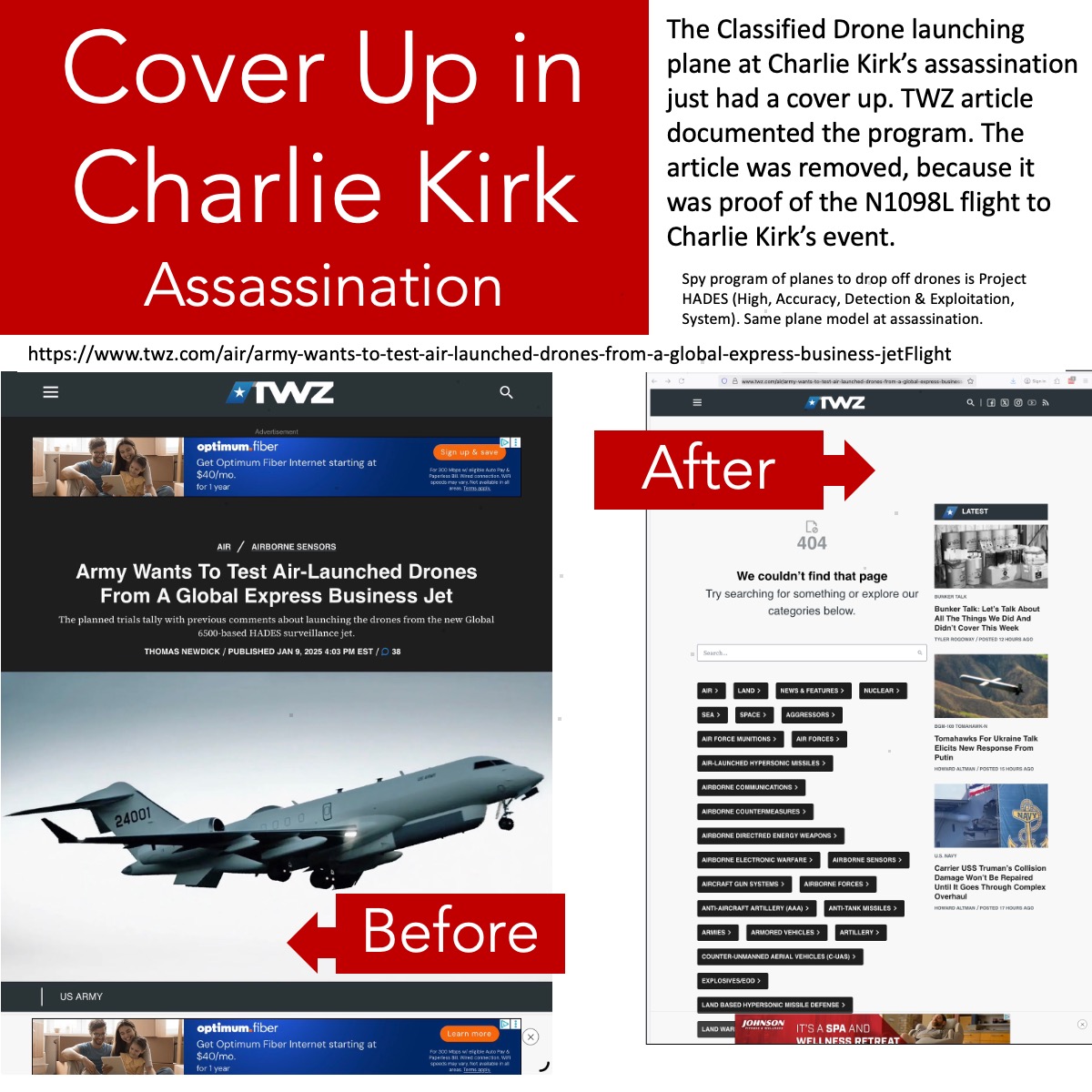
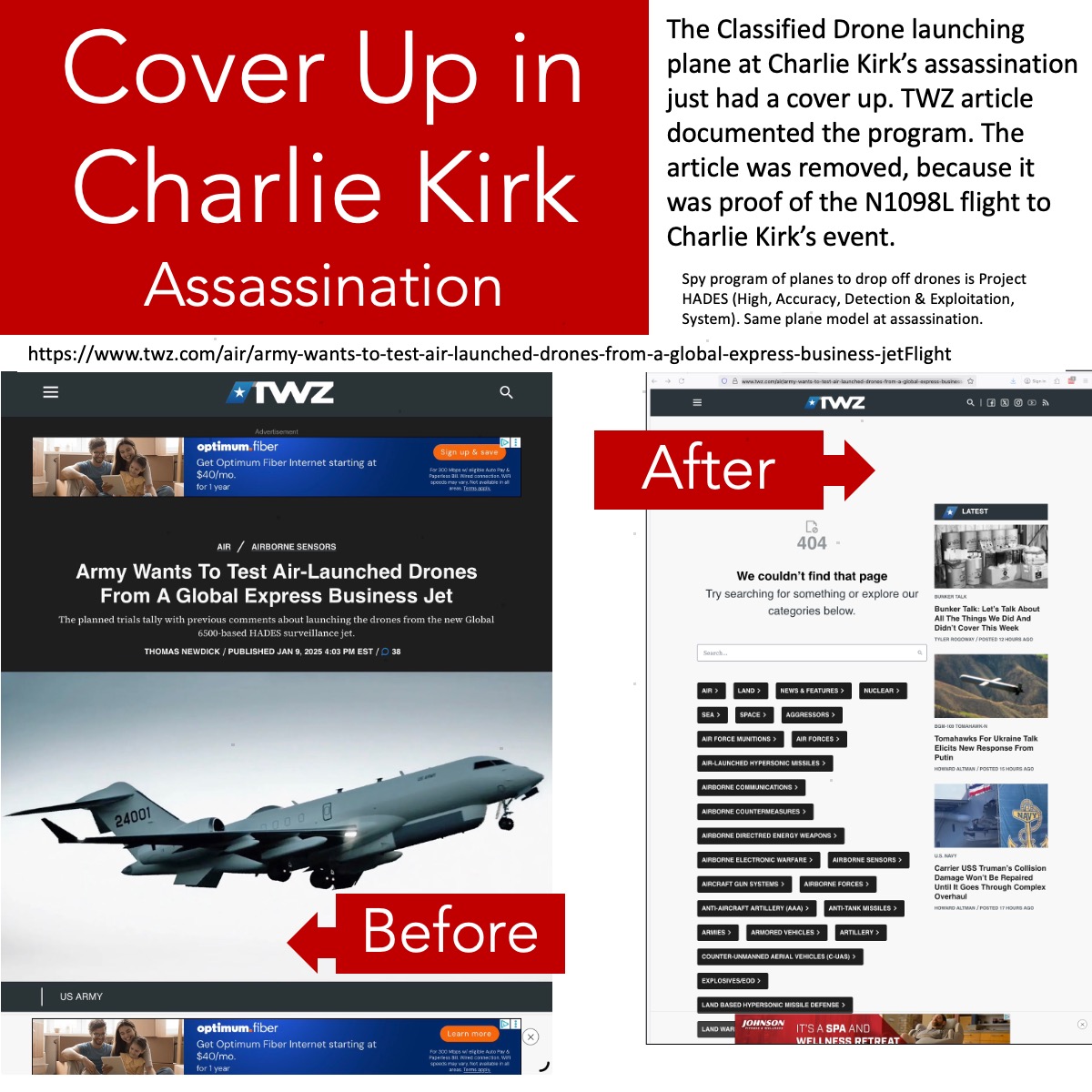
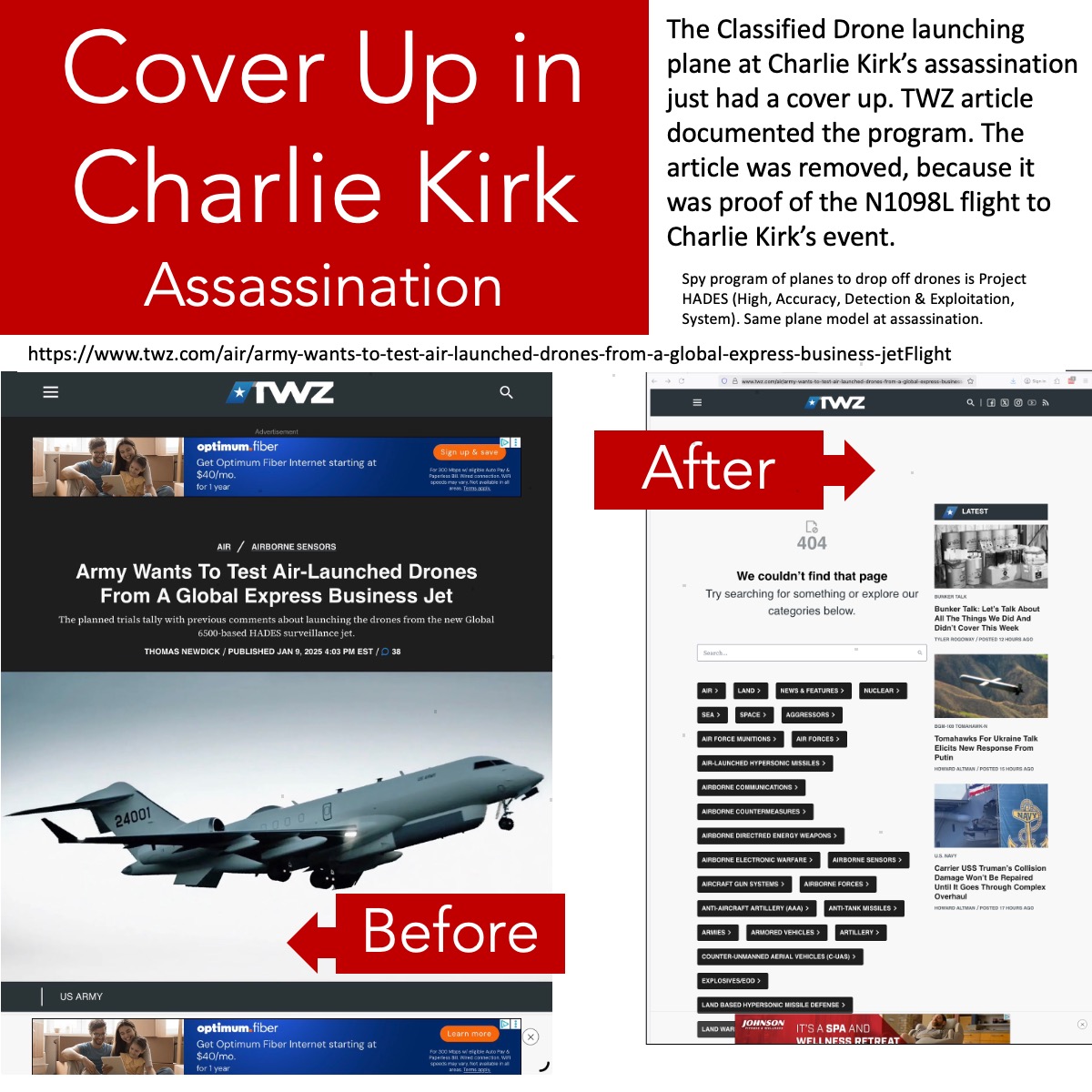
- The reported FlightRadar24 removal of N102DZ is REFUTED, and that refutes a claim this site once published. Opened in a real logged-out browser on 24 August 2026 the page returns HTTP 200 with its full identity block — title
N102DZ - Gulfstream V [555] - Flightradar24, MODE S A00C85, TYPE CODE GLF5 — and nothing on it says removed, blocked or restricted. Sixteen case tails and four unrelated controls all returned 200, and an independent second browser session the same day reproduced it across six more probes. The empty history table is FlightRadar24's seven-day free-tier window: the unrelated control N628TS prints the identical "could not find data for specified flight" message at 53,318 bytes against N102DZ's 53,310. Nothing was taken down. → What A 403 Actually Means
Not established, and stated as unresolved:
- Whether the AXL10 low passes happened as described. No raw ADS-B track has been published for the single most consequential claim in this section.
- Which aircraft was actually at Provo on 27 May 2025 — the export says SU-BTV, the Owens account says SU-BTU, and a named-passenger inference rests on the answer.
- Whether N59906's registration is genuinely "In Question" on the FAA registry, as alleged. No registry screenshot has been produced.
- Who was aboard any of these aircraft. No manifest for any leg has been published by anyone. Note that these aircraft cleared US customs at Minot, North Dakota — not at Provo — so the entry records are North Dakota records.
- What the N102DZ FlightRadar24 page displayed in May 2026. The removal claim itself is refuted — see the established list above; the page is present and complete. But a page that loads today cannot testify about a table's contents eight months ago. "The page was taken down" is refuted; a narrower purge-and-restore claim is beyond this method in either direction, and no page on this site may assert it. A logged-out free tier is also the weakest view FlightRadar24 offers — a paid tier shows 90 days to 3 years and we have not looked through one. Separately, the HTTP 403 our scripts get from FlightRadar24 is site-wide bot protection and says nothing about any aircraft: all 13 case tails, seven unrelated controls, the aircraft index and FlightRadar24's own home page returned 403 with the same ~5,877-byte body. Meanwhile the aircraft-side data was recovered anyway: 66 days of N102DZ position trace, 2022 to 2026, including 35 days inside the window the removal was reported for. → What A 403 Actually Means and Erika Flight Logs Erased
- Where Erika Kirk was on any of the claimed dates. Zero recovered aircraft-days produce an itinerary for a person. No dated Erika Kirk itinerary has been published by anyone, and of 139 sourced Kirk and Turning Point appearances, exactly one places her at an event before 10 September 2025 with a firm date. This is the gap the largest number in the investigation is measured against, and none of the recovery work narrows it.
- Whether any archive gap is suppression. Two long gaps in the primary free archive — a 403 band from 12 October 2025 and a 404 stretch running into mid-2026 — return the same result for unrelated control aircraft with no connection to this case. They are archive-wide conditions. They must never be reported as scrubbing, and the one band that happens to cover dates of interest is the one most likely to be misreported that way.
Interesting In This Area
- N1098L ran low and slow near campus; no tasking order has appeared.
- SU-BTT sat near Provo from September 4 and left on the tenth.
- SAM 99-0404 touched an Army intelligence base two days before the killing.
- N888KG lost its signal mid-flight an hour afterwards, then came back.
Interesting In Other Areas
- N1098L over UVU is the intelligence reading of the same passes.
- US Army HADES explains what that airframe is built to do.
- Israel foreign leads carries the foreign-nexus thread these tails feed.
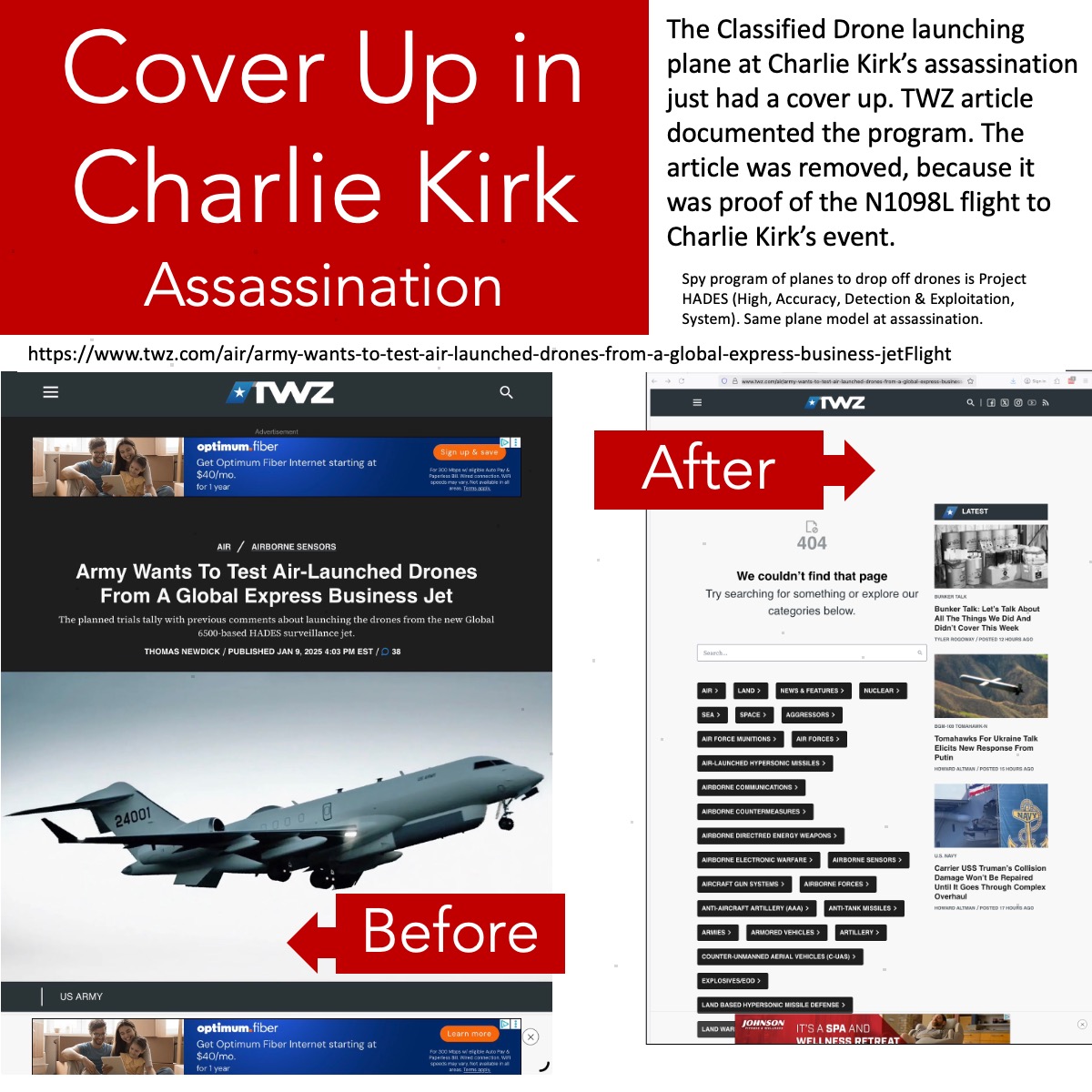
- Air-launched drones claim the ISR jet carried more than sensors.
Other Pages In This Section
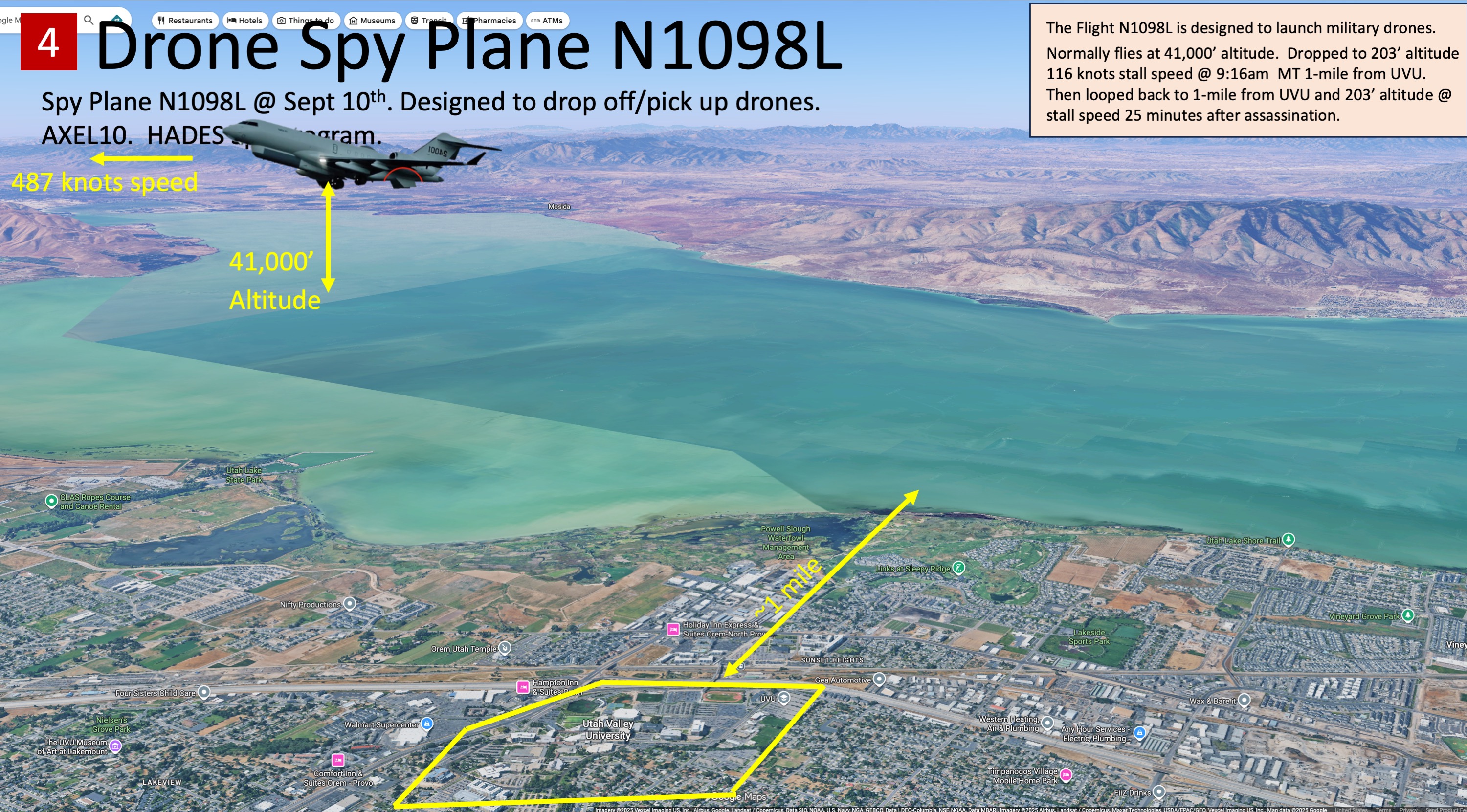
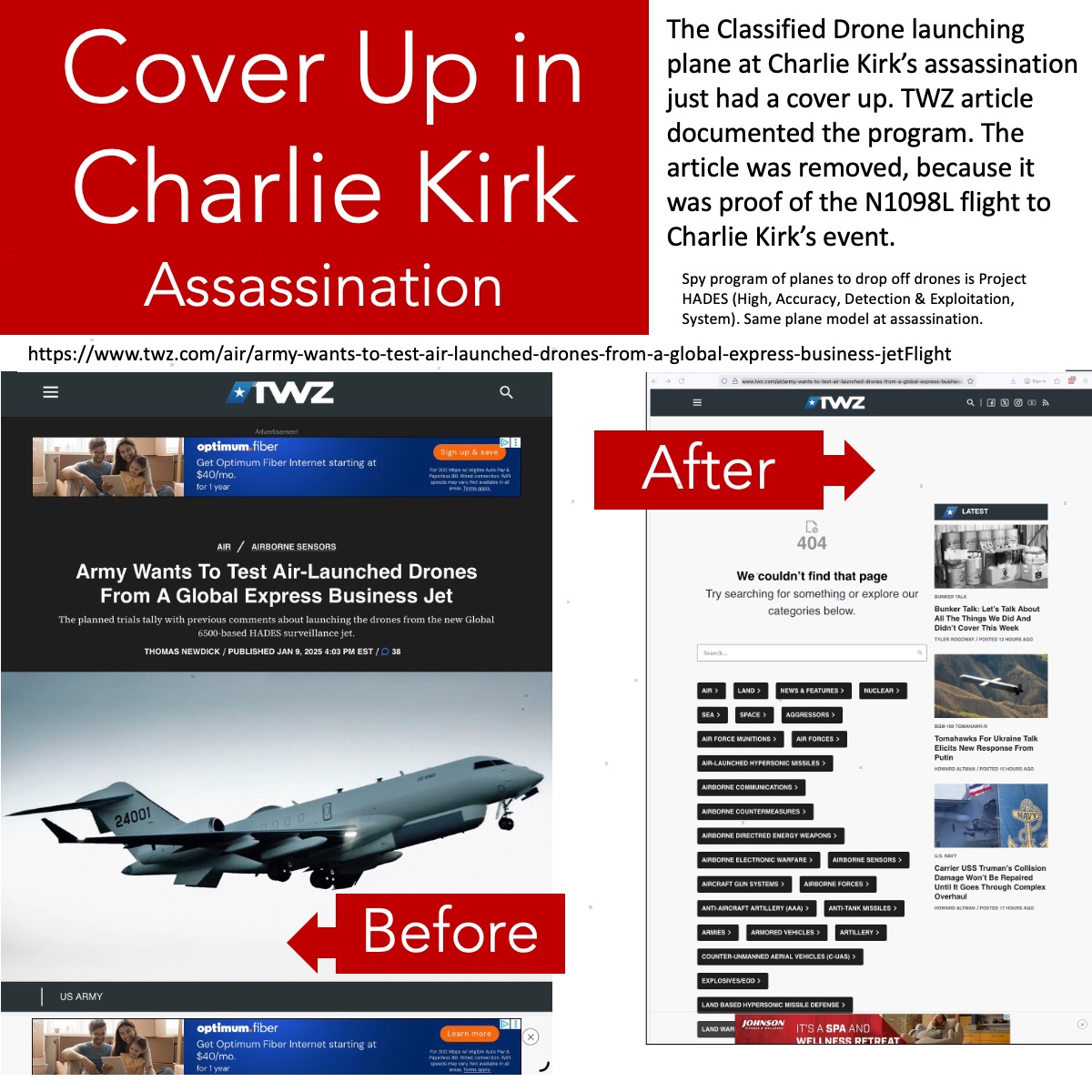
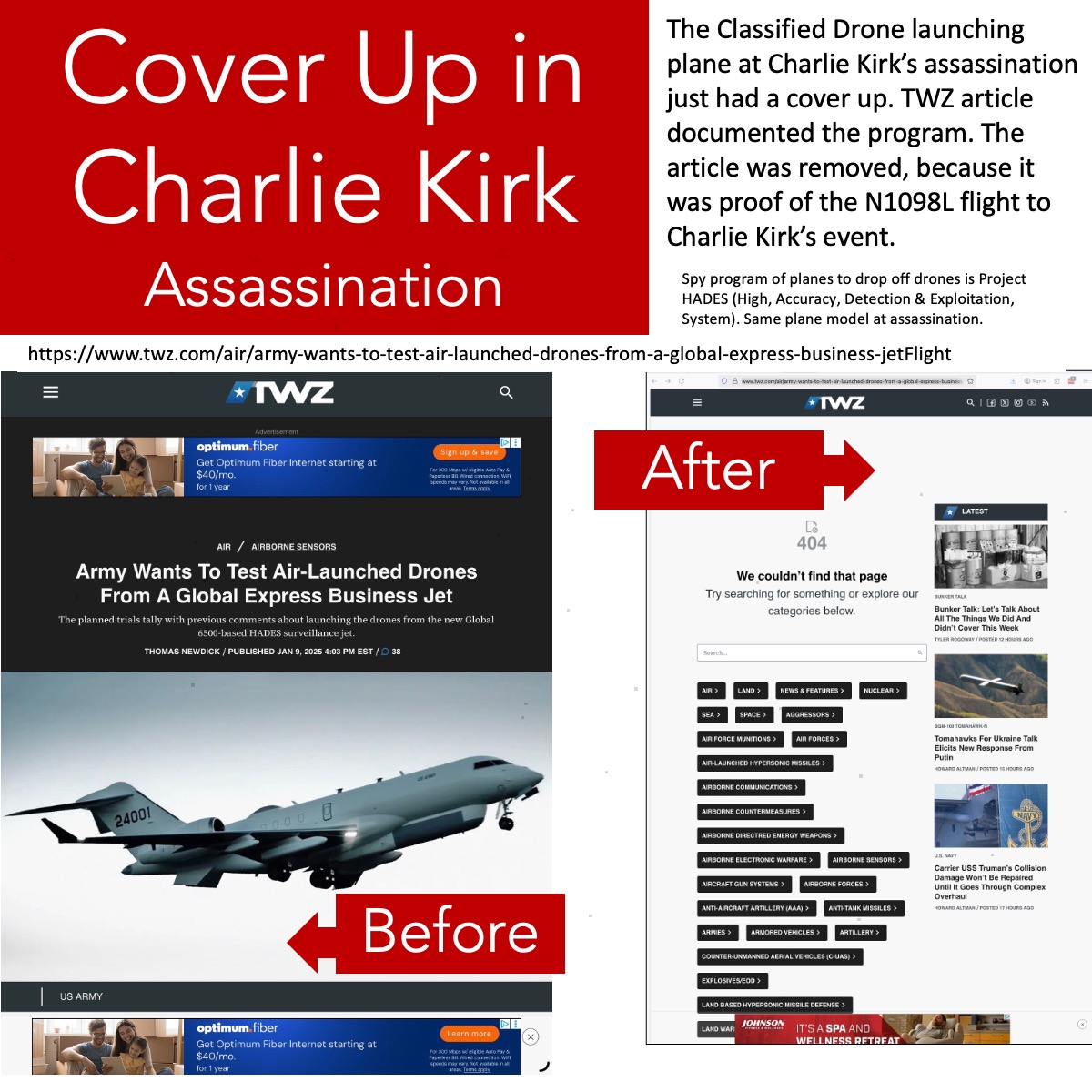
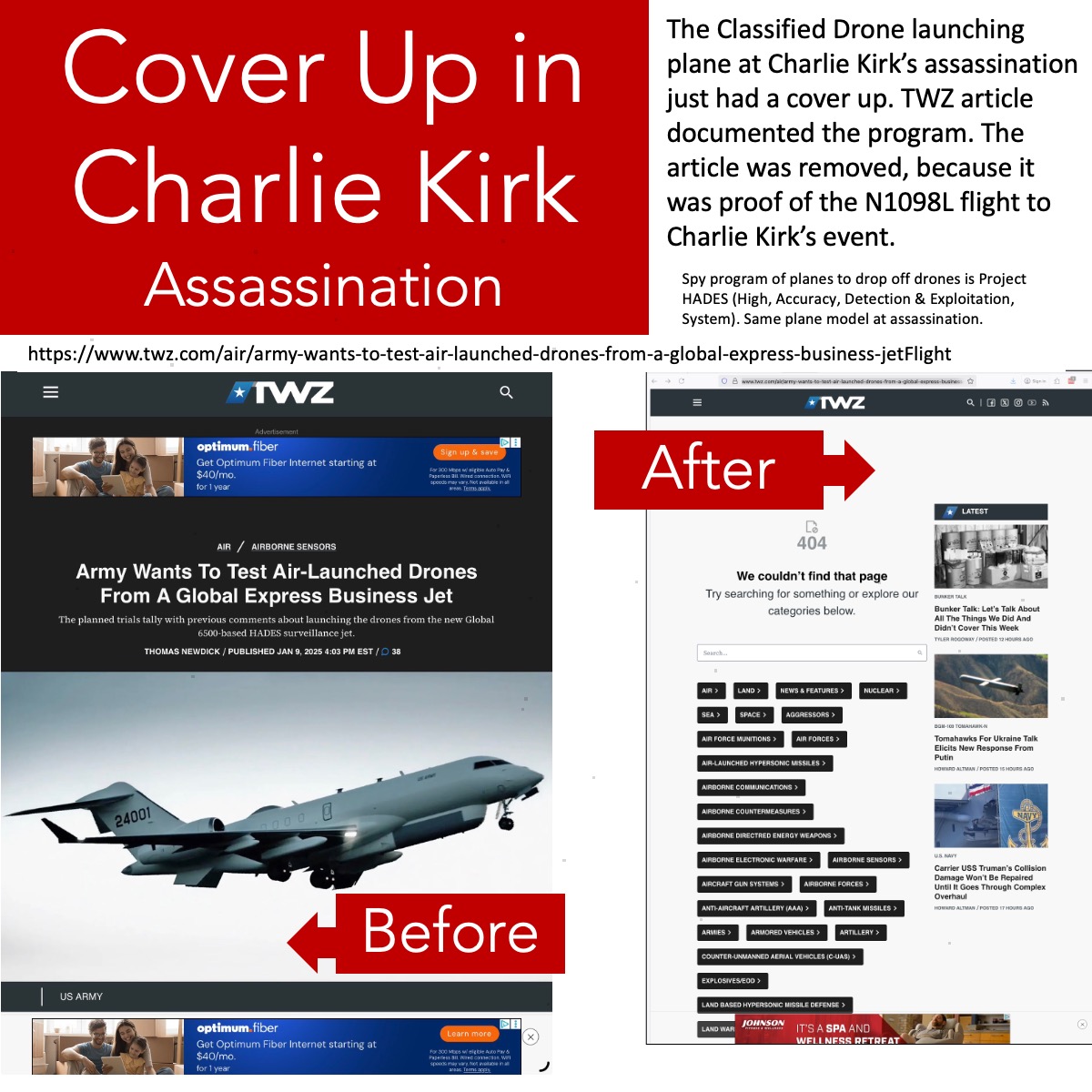
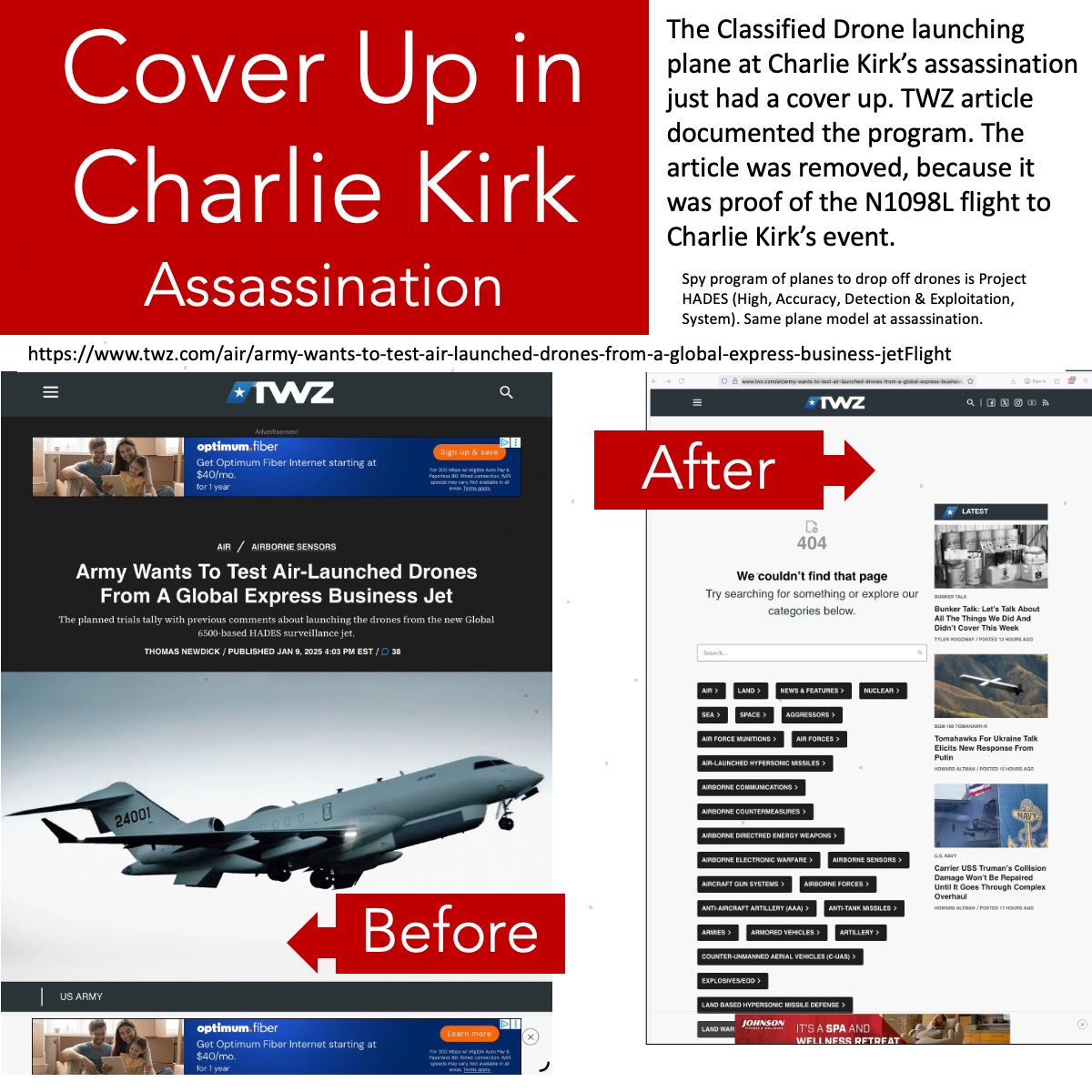
A Bombardier Global 6500 flown by an Army ISR contractor, callsign AXLE10, ran an unusual low and slow profile near Orem on September 10. No track, tasking order, or sensor product from it has appeared in the prosecution.
Read this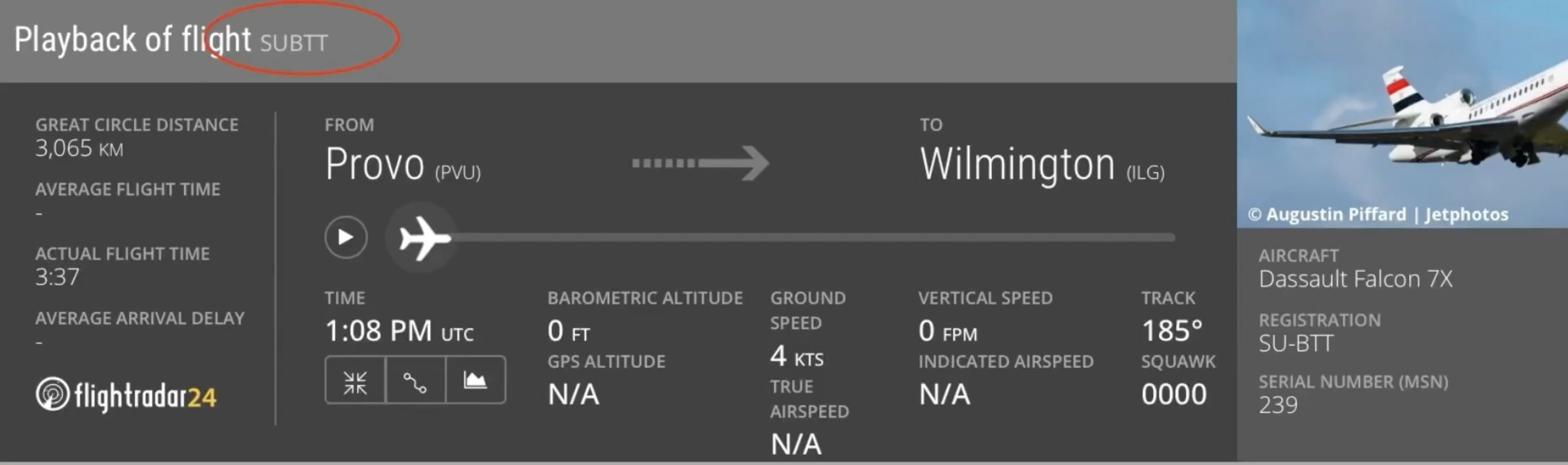
A C-37A Gulfstream tracked into Fort Huachuca two days before the shooting, tied by an anonymous tipster to a reported meeting of about twelve lieutenant colonels. The flight is public record; the meeting is not.
Read thisThe working memo for the aircraft angle — ISR passes, the Egyptian fleet, shadowing counts, SAM movements and transponder gaps, each with the record that would settle it. Start here if you want the questions rather than the tails.
Read thisElsewhere In The Investigation
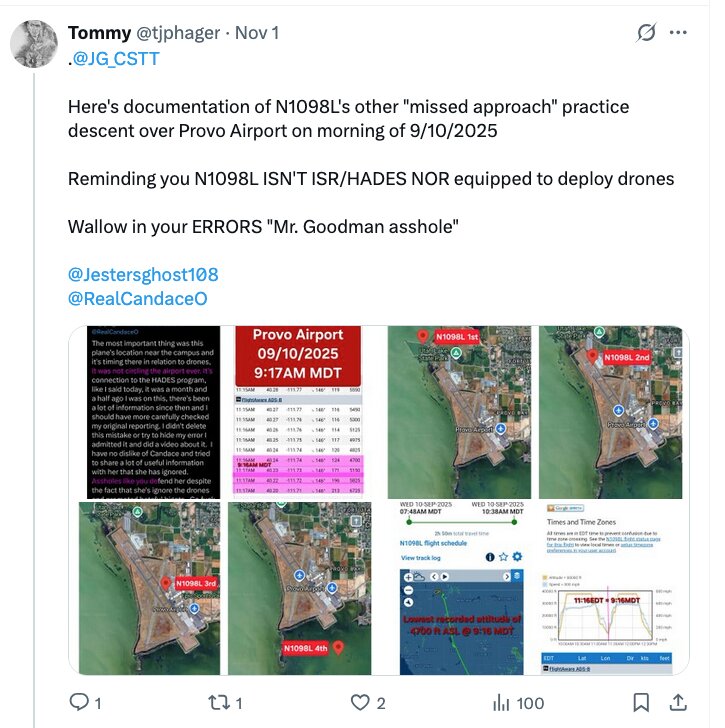
Public ADS-B puts an Army HADES jet in extremely low, slow passes near UVU before and after 12:23 PM. The master file's summary of it runs to four words: it was ours.
Read this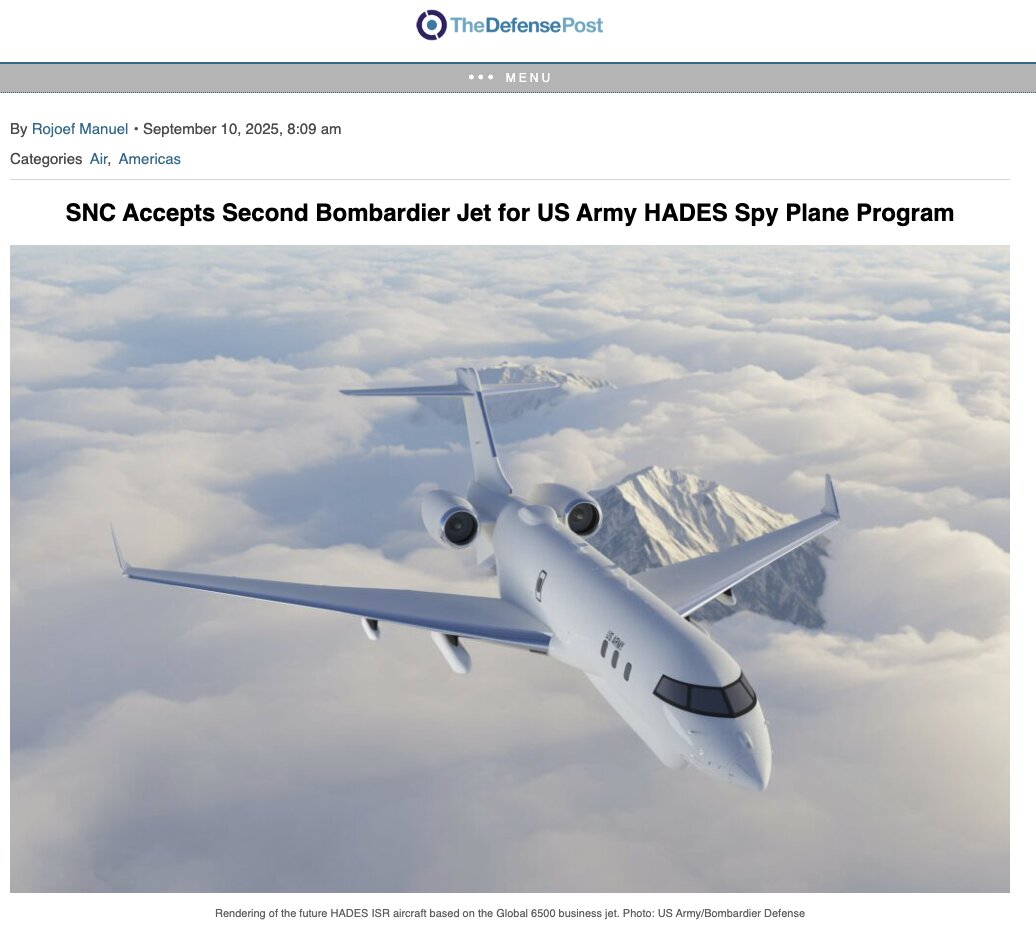
US Army HADES (Drone Launching Planes)
HADES is a real, publicly contracted Army ISR program built on the same Global 6500 airframe as N1098L. Defense-trade reporting separately describes Army interest in launching drones from that airframe.
Read this
The leads pointing outside the United States — phones, travel, SIGINT, search patterns — and the prior question of whether the government ran any of them down at all.
Read thisThis website's author is @HolonCitizen on X and YouTube/@HolonCitizen. Follow me there.
Interesting
- A C-32A of the same type reappeared the next day, carrying Kirk's casket.
- Callsign AXEL10 reportedly flew at 204 feet and near-stall speed with no stated mission.
- One single-screen date table stacks the Egyptian departure, spy passes and the shot.
Related Areas
The Following Planes — every date, plane and city
Every documented ground presence by an Egypt-registered aircraft on U.S. soil in the following-plane record: 63 stays, five tail numbers, eight airports, November 2022 to October 2025. One row per stay, in date order. The tail number links to that aircraft's page; the last column links to the airport page carrying the full arrival log, the Kirk / TPUSA side, the timings and the counterargument.
This is a record of where the aircraft were, and nothing more. It is not a list of overlaps and it does not assert that anyone was followed. Most of these rows have no Kirk or TPUSA event anywhere near them, which is the point of printing all of them: the Following overview carries the same table with the nine claimed pairings interleaved, and TPUSA events carries the 139 sourced events with the aircraft record beside each one. The counts these dates are used to support are researcher tallies read from public ADS-B history, not verified records, and they conflict with each other.
| Date | Plane | City | State | Airport | Covered on |
|---|---|---|---|---|---|
| 13 Nov 2022 | SU-BTT | Wichita | KS | KICT | Wichita |
| 17 Nov 2022 | SU-BTT | Wilmington | DE | KILG | Wilmington |
| 20 Dec 2022 | SU-BTT | St. Louis | MO | KSTL | St. Louis |
| 21 Feb 2023 | SU-BND | St. Louis | MO | KSTL | St. Louis |
| 25 Feb 2023 | SU-BTT | St. Louis | MO | KSUS | St. Louis |
| 2 Mar 2023 | SU-BTT | Wilmington | DE | KILG | Wilmington |
| 1 Apr 2023 | SU-BTT | St. Louis | MO | KSTL | St. Louis |
| 6 Apr 2023 | SU-BTT | Wilmington | DE | KILG | Wilmington |
| 14 Apr 2023 | SU-BTT | Wichita | KS | KICT | Wichita |
| 20 Apr 2023 | SU-BTT | Wilmington | DE | KILG | Wilmington |
| 3 May 2023 | SU-BND | St. Louis | MO | KSTL | St. Louis |
| 9 Feb 2024 | SU-BTT | Omaha | NE | KOMA | Omaha |
| 9 Feb 2024 | SU-BTT | Lincoln | NE | KLNK | Lincoln |
| 14 Feb 2024 | SU-BTT | Wilmington | DE | KILG | Wilmington |
| 29 Mar 2024 | SU-BTT | Wichita | KS | KICT | Wichita |
| 3 Apr 2024 | SU-BTT | Wilmington | DE | KILG | Wilmington |
| 19 Apr 2024 | SU-BND | Provo | UT | KPVU | Provo |
| 23 Apr 2024 | SU-BTT | Provo | UT | KPVU | Provo |
| 28 Apr 2024 | SU-BTT | Wilmington | DE | KILG | Wilmington |
| 26 Nov 2024 | SU-BTU | Omaha | NE | KOMA | Omaha |
| 26 Nov 2024 | SU-BTU | Lincoln | NE | KLNK | Lincoln |
| 1 Dec 2024 | SU-BTU | Wilmington | DE | KILG | Wilmington |
| 8 Dec 2024 | SU-BTV | Wichita | KS | KICT | Wichita |
| 10 Dec 2024 | SU-BTV | Wilmington | DE | KILG | Wilmington |
| 17 Jan 2025 | SU-BTU | Omaha | NE | KOMA | Omaha |
| 17 Jan 2025 | SU-BTU | Lincoln | NE | KLNK | Lincoln |
| 23 Jan 2025 | SU-BTU | Wilmington | DE | KILG | Wilmington |
| 3 Feb 2025 | SU-BTV | Detroit | MI | KDTW | Detroit |
| 3 Feb 2025 | SU-BTV | Lincoln | NE | KLNK | Lincoln |
| 9 Feb 2025 | SU-BTV | Wilmington | DE | KILG | Wilmington |
| 16 Feb 2025 | SU-BTU | St. Louis | MO | KSTL | St. Louis |
| 22 Feb 2025 | SU-BTU | Wilmington | DE | KILG | Wilmington |
| 17 Mar 2025 | SU-BTV | Omaha | NE | KOMA | Omaha |
| 17 Mar 2025 | SU-BTV | Lincoln | NE | KLNK | Lincoln |
| 23 Mar 2025 | SU-BTV | Wilmington | DE | KILG | Wilmington |
| 30 Mar 2025 | SU-BTV | Detroit | MI | KDTW | Detroit |
| 30 Mar 2025 | SU-BTV | Wichita | KS | KICT | Wichita |
| 3 Apr 2025 | SU-BTV | Wilmington | DE | KILG | Wilmington |
| 8 Apr 2025 | SU-BTU | Minot | ND | KMOT | Minot |
| 8 Apr 2025 | SU-BTU | Provo | UT | KPVU | Provo |
| 10 Apr 2025 | SU-BGM | Provo | UT | KPVU | Provo |
| 14 Apr 2025 | SU-BTU | Wilmington | DE | KILG | Wilmington |
| 24 Apr 2025 | SU-BTU | Omaha | NE | KOMA | Omaha |
| 24 Apr 2025 | SU-BTU | Lincoln | NE | KLNK | Lincoln |
| 30 Apr 2025 | SU-BTU | Wilmington | DE | KILG | Wilmington |
| 23 May 2025 | SU-BND | Minot | ND | KMOT | Minot |
| 23 May 2025 | SU-BND | Provo | UT | KPVU | Provo |
| 27 May 2025 | SU-BTV | Minot | ND | KMOT | Minot |
| 27 May 2025 | SU-BTV | Provo | UT | KPVU | Provo |
| 2 Jun 2025 | SU-BTV | Wilmington | DE | KILG | Wilmington |
| 20 Jul 2025 | SU-BTT | Omaha | NE | KOMA | Omaha |
| 20 Jul 2025 | SU-BTT | Lincoln | NE | KLNK | Lincoln |
| 26 Jul 2025 | SU-BTT | Wilmington | DE | KILG | Wilmington |
| 30 Jul 2025 | SU-BTV | Wichita | KS | KICT | Wichita |
| 17 Aug 2025 | SU-BTT | Omaha | NE | KOMA | Omaha |
| 17 Aug 2025 | SU-BTT | Lincoln | NE | KLNK | Lincoln |
| 23 Aug 2025 | SU-BTT | Wilmington | DE | KILG | Wilmington |
| 4 Sep 2025 | SU-BTT | Minot | ND | KMOT | Minot |
| 4 Sep 2025 | SU-BTT | Provo | UT | KPVU | Provo |
| 10 Sep 2025 | SU-BTT | Wilmington | DE | KILG | Wilmington |
| 5 Oct 2025 | SU-BTV | Omaha | NE | KOMA | Omaha |
| 5 Oct 2025 | SU-BTV | Lincoln | NE | KLNK | Lincoln |
| 11 Oct 2025 | SU-BTV | Wilmington | DE | KILG | Wilmington |
The innocent explanation, on this page as on every page in that section. Duncan Aviation has held the Egyptian Air Force's maintenance account since 1999, with its main plant at Lincoln and a facility at Provo; Wichita's Yingling Aviation is an FAA Part 145 Dassault Falcon service centre; Wilmington, Omaha, Minot and Detroit are customs stops. Four of the five clustered states resolve to a maintenance or clearance function. Utah is the one that does not resolve cleanly, and that is where the remaining work is.
Images
Videos
Footage related to this page. Each card opens that clip's own page, with the video, the full write-up, and its source.
Flight-record pages for what is on this page
This investigation keeps one page per airport and one page per recorded ground contact, built directly from the recovered ADS-B traces. These are the ones this page touches.
Airports named on this page:
- KPVU — Provo Municipal Airport, Provo, UT — 135 recorded ground visits, 13 tracked aircraft
- KILG — Wilmington Airport / New Castle Airport, Wilmington, DE — 28 recorded ground visits, 3 tracked aircraft
- KLNK — Lincoln Airport, Lincoln, NE — 2 recorded ground visits, 2 tracked aircraft
- KMOT — Minot International Airport, Minot, ND — 2 recorded ground visits, 2 tracked aircraft
- KICT — Wichita Dwight D. Eisenhower National Airport, Wichita, KS — 1 recorded ground visit, 1 tracked aircraft
- KSTL — Lambert-St. Louis International Airport, St. Louis, MO — 2 recorded ground visits, 1 tracked aircraft
- KDTW — Detroit Metropolitan Wayne County Airport, Romulus, MI — 1 recorded ground visit, 1 tracked aircraft
- KSUS — Spirit of St. Louis Airport, Chesterfield, MO — 1 recorded ground visit, 1 tracked aircraft
- KCPS — St. Louis Downtown Airport, Cahokia, IL
- KOMA — Eppley Airfield, Omaha, NE
Aircraft named on this page:
- N102DZ — full recovered movement record, every airport and every leg
- N1098L — full recovered movement record, every airport and every leg
- N2100L — full recovered movement record, every airport and every leg
- N40JD — full recovered movement record, every airport and every leg
- N560TW — full recovered movement record, every airport and every leg
- N582MM — full recovered movement record, every airport and every leg
- N59906 — full recovered movement record, every airport and every leg
- N708JH — full recovered movement record, every airport and every leg
- N872RA — full recovered movement record, every airport and every leg
- N888KG — full recovered movement record, every airport and every leg
- SU-BGM — full recovered movement record, every airport and every leg
- SU-BND — full recovered movement record, every airport and every leg
- SU-BTT — full recovered movement record, every airport and every leg
- SU-BTU — full recovered movement record, every airport and every leg
- SU-BTV — full recovered movement record, every airport and every leg
The two indexes:
- Every airport in this investigation — 292 fields, each with its complete recovered ground-visit and flight-leg record
- Every interesting date, all aircraft — 147 ground contacts near a sourced event, across 110 pages
- Investigating Deleted Flights — how the data was recovered, how much of it we hold, and where it is still missing
Where this page fits
Everything the aircraft angle knows hangs off this index — the tail-by-tail working memo, the minute-by-minute correlation for 10 September, the 18-month following claim, the Army ISR jet that flew the low passes, the Egyptian armada that sat on the Provo ramp, and the recovery sweep that went hunting for the records people say were erased. Aircraft are only evidence because of what happened underneath them: Charlie Kirk was killed at Utah Valley University on 10 September 2025, the FBI's foreign-nexus leads were reportedly shut down once a suspect was in custody, and the manifests that would settle who was aboard anything are not public for any private jet in America. If you read one page off this index, make it What A 403 Actually Means — five unrelated control aircraft returned the identical HTTP 403 from the identical script, which is how this site caught and retracted its own removal claim.