TSUSA: Ethically Aligned with Charlie Kirk
Overview
This page collects reform and governance ideas that commentators have proposed for organizations like Turning Point USA (TPUSA) in light of Charlie Kirk’s death. In the project’s shorthand, “TSUSA” refers to a version of TPUSA that is explicitly aligned with the values many associate with Charlie’s public statements: integrity, courage, concern for ordinary supporters, and a commitment to truth.
Nothing here alleges that TPUSA or any of its leaders conspired in the killing or engaged in criminal conduct. Rather, this page asks: If an organization wants to honor Charlie’s legacy and avoid even the appearance of conflicts or cover‑ups, what kinds of internal reforms might it consider?
Themes from compiled sources
In compiled research notes—drawing on public material such as social‑media commentary by Candace Owens, investigative threads by accounts like Project Constitution (@ProjectConstitu), long‑form analyses by writers on platforms like Substack and YouTube, and reporting from outlets including The Grayzone and the Daily Mail—commentators raise a variety of concerns and questions about organizational dynamics, including:
- Tension between donor preferences and Charlie’s evolving public positions on sensitive issues.
- Questions about security contracting and event protection at the UVU event and similar gatherings.
- Speculation about internal oversight of finances, such as references to committees tasked with reviewing financial flows or potential irregularities.
These are presented as claims and questions, not as established fact. The reform ideas below are framed in general, so they can apply to any organization facing similar issues.
Governance and financial transparency
One cluster of suggestions focuses on strengthening governance and reducing the risk (or appearance) of improper influence:
- Independent audit and oversight – Regular, genuinely independent audits of finances and major contracts, with summarized findings shared with the board and, where appropriate, publicly.
- Clear donor‑influence boundaries – Written policies that separate programmatic and editorial decisions from direct donor control, so that speakers and event lineups cannot be easily dictated by a small group of funders.
- Internal review committees – Ethics or compliance committees that can investigate concerns about spending, conflicts of interest, or retaliation, with direct reporting lines to the board rather than to any single executive.
These kinds of steps are common best practices in non‑profit governance and do not depend on any particular theory about what happened in Utah.
Security, risk management, and after‑action review
Given the intense focus on event security in the Charlie Kirk case, a “TSUSA” model would also take seriously:
- Standardized security protocols – Clear, documented procedures for venue assessment, perimeter protection, and coordination with local law enforcement, scaled appropriately to the risk and profile of each event.
- Transparent contracting and vetting – Robust vetting for security contractors and subcontractors, with clear conflict‑of‑interest and foreign‑influence policies.
- Independent after‑action reviews – In the wake of any serious incident, commissioning an external review of what worked, what failed, and what should change—sharing non‑sensitive findings with supporters and, where possible, the public.
Commentators in the corpus argue that such reviews can both improve safety and help rebuild trust after a tragedy.
Culture, communication, and whistleblower protection
Another reform theme relates to organizational culture:
- Encouraging internal dissent and questions – Staff and contractors should feel safe raising concerns about security, finances, or messaging without fear of retaliation.
- Whistleblower channels – Confidential, well‑advertised pathways (possibly through third‑party ombuds services) for reporting suspected misconduct, with protections against retaliation.
- Careful public communication after crises – Training leaders to avoid premature certainty when facts are still emerging, and to acknowledge uncertainty rather than closing off legitimate questions.
These steps are aimed at making it less likely that serious issues will be ignored or minimized internally.
Honoring Charlie’s stated values
The corpus includes references to Charlie’s reported frustrations about donor pressure, his desire to protect free expression, and his concerns about corruption or undue influence. A “TSUSA” approach to his legacy might:
- Reaffirm a commitment to intellectual honesty, even when it conflicts with powerful interests.
- Emphasize service to members and students, rather than to any narrow faction of donors or political actors.
- Publicly support transparent investigations into his killing, including full lawful disclosure of security contracts, footage, and cooperation with independent inquiries.
Again, these are aspirational ideas, not accusations about any particular person or organization.
Connection to other “Fix” topics
This page complements other reform discussions:
- TPUSA – broader background on the organization’s role in Charlie’s life and in the investigation.
- Fix Overview – high‑level summary of legal, policy, and institutional reforms suggested by commentators.
- Politicians and Churches – civic and community‑level approaches to accountability.
Together, these ideas invite readers to think about how organizations, not just governments, can adopt structures and habits that reduce the risk of injustice and help maintain public trust when tragedies occur.
Why Citizen Investigators Say This Reform Matters (X Context)
X and independent coverage of the Kirk case repeatedly surface gaps this page's policy concept would address:
- Security after-action transparency demands from former TPUSA-adjacent voices (Benny Johnson-class).
- Donor/Israel-pressure meeting threads (Hamptons) discussed by Elijah Schaffer and others—attributed commentary.
- Need for independent audits and whistleblower paths inside large political nonprofits without implying org guilt for the murder.
These are policy responses to documented transparency gaps, not findings that any living person committed a crime.
Interesting In This Area
- Whistleblower protection is the internal version of what Law 2 does to agencies.
- Event security after-action review is exactly what an organisation should publish itself.
- Foreign funding disclosure applies to non-profits, not only to registered agents.
- Victim-family treatment and board transparency are the two governance tests here.
Other Pages In This Section
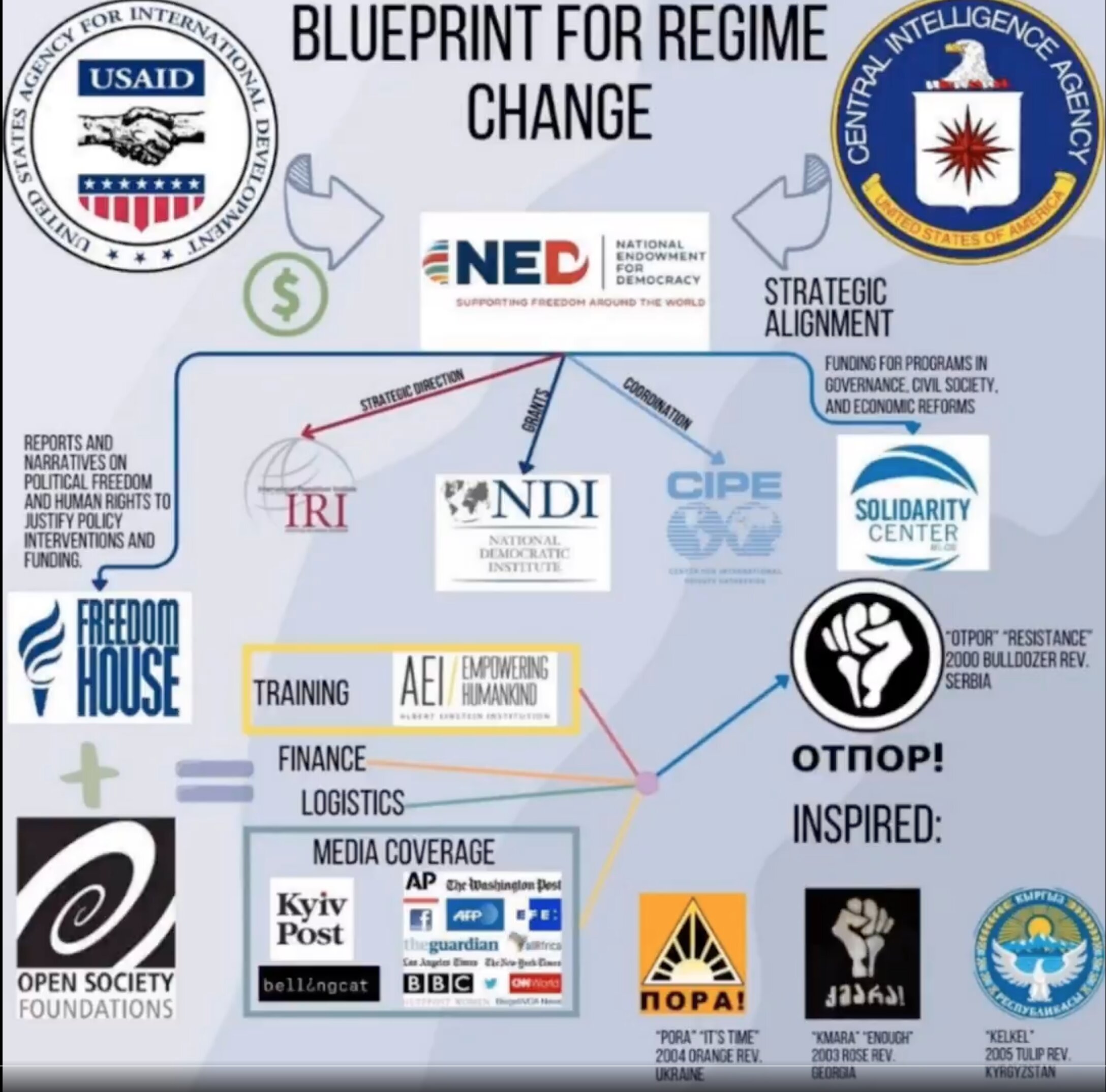
Kirk's relatives have followed the state's case largely through the same filings any reporter can read. This proposal gives families a named liaison, timely forensic briefings, and a voice in charging decisions.
Read this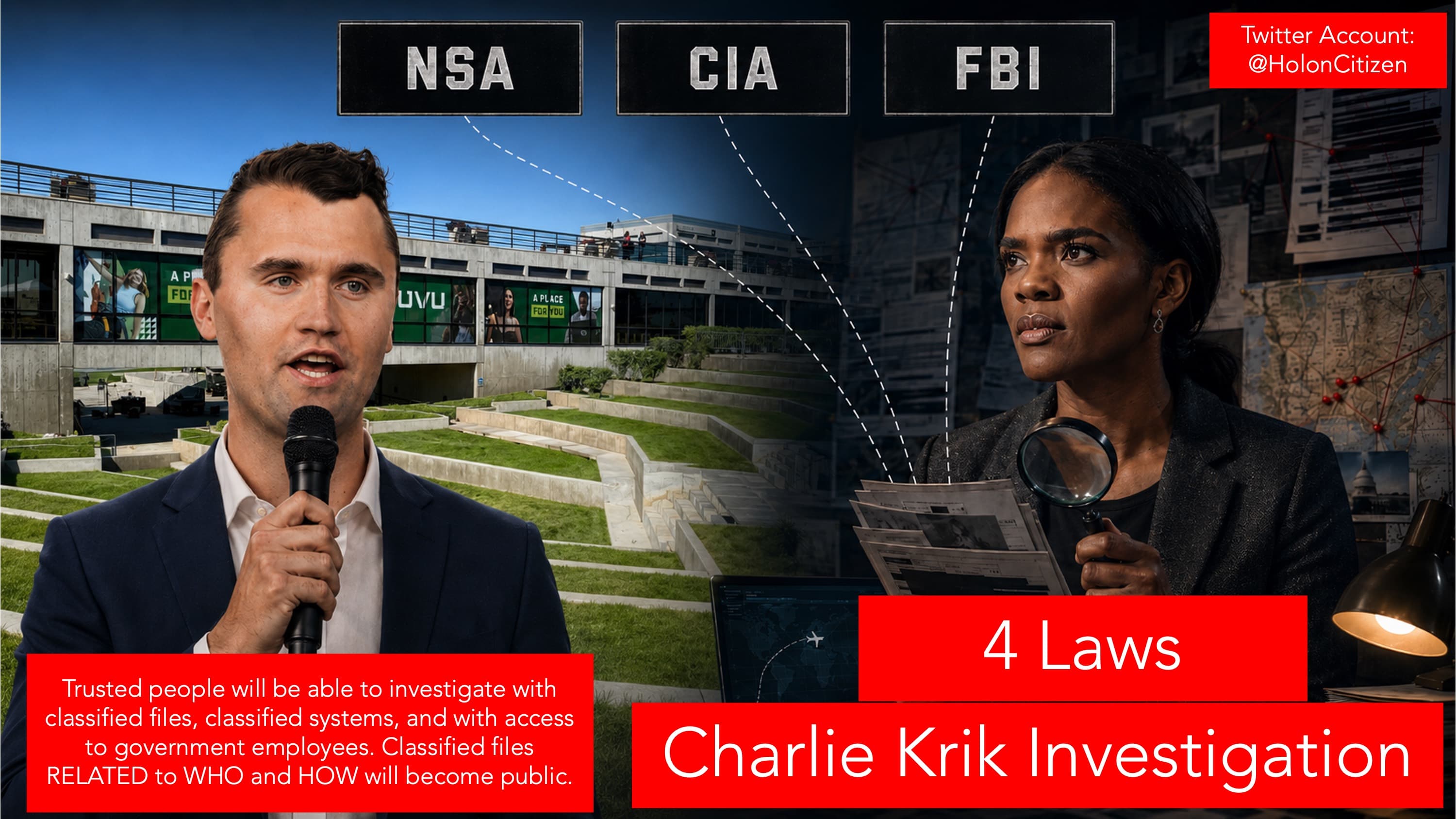
Four proposed federal laws plus twelve companion reforms — disclosure, mandatory investigation, trusted civilian investigators, and the practical fixes underneath them. Start here to see how the pieces fit together.
Read this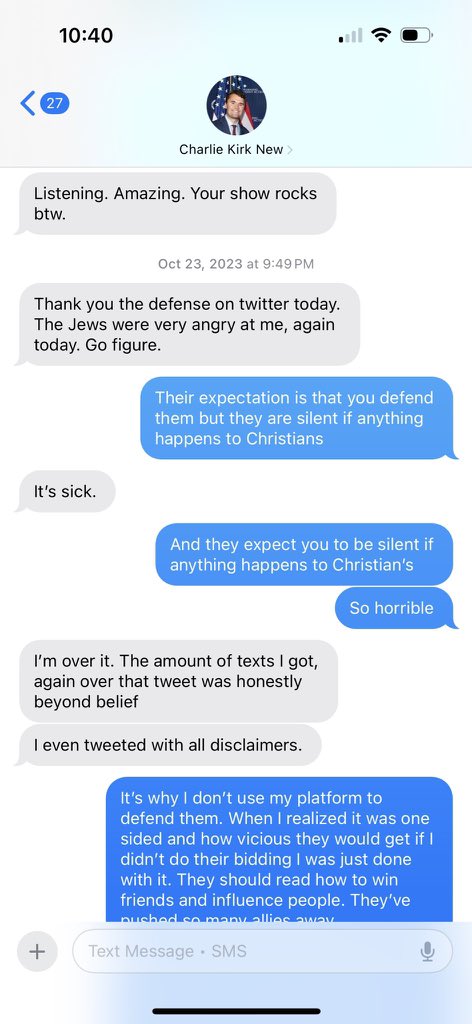
Foreign Influence Transparency
FARA was written for a slower century. Modernised registration and proportionate enforcement would make foreign money visible — which protects the innocent as much as it exposes the concealed.
Read thisDisclosure reform fails if the people closest to the evidence cannot speak. Protected channels, a rebuttable presumption of retaliation, mandatory reinstatement and treble damages — extended to intelligence contractors, who are usually left out.
Read thisElsewhere In The Investigation
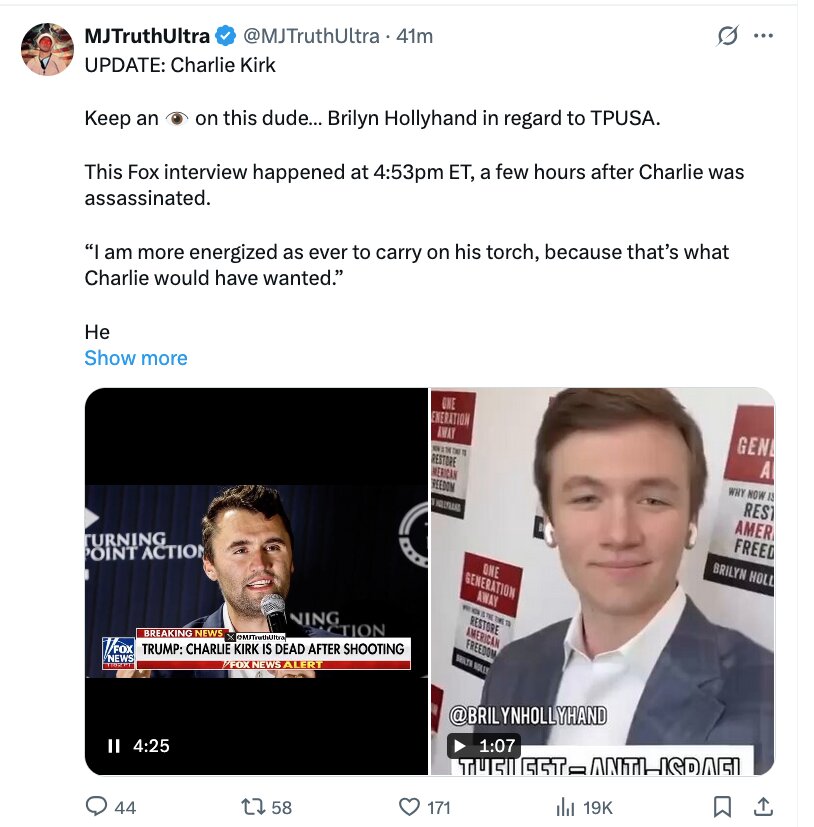
TPUSA Replacement — Fox Interview Timing
A replacement figure appeared on Fox within hours of the killing. Logged here as succession optics worth noting, explicitly not as proof of foreknowledge.
Read thisThis website's author is @HolonCitizen on X and YouTube/@HolonCitizen. Follow me there.
Interesting
- Churches hosting memorials reportedly cannot verify the paving timeline from primary sources.
- Falcon 7X SU-BTT reportedly departed Provo the morning of the killing; a second jet never took off.
- An analyst reportedly logged 44 foreign-registered phones in the kill zone.
Related Areas
- TPUSA
- Organizations & Groups
- People
- Charlie Kirk
- Vote
- Your Actions Fix It