Google Searches
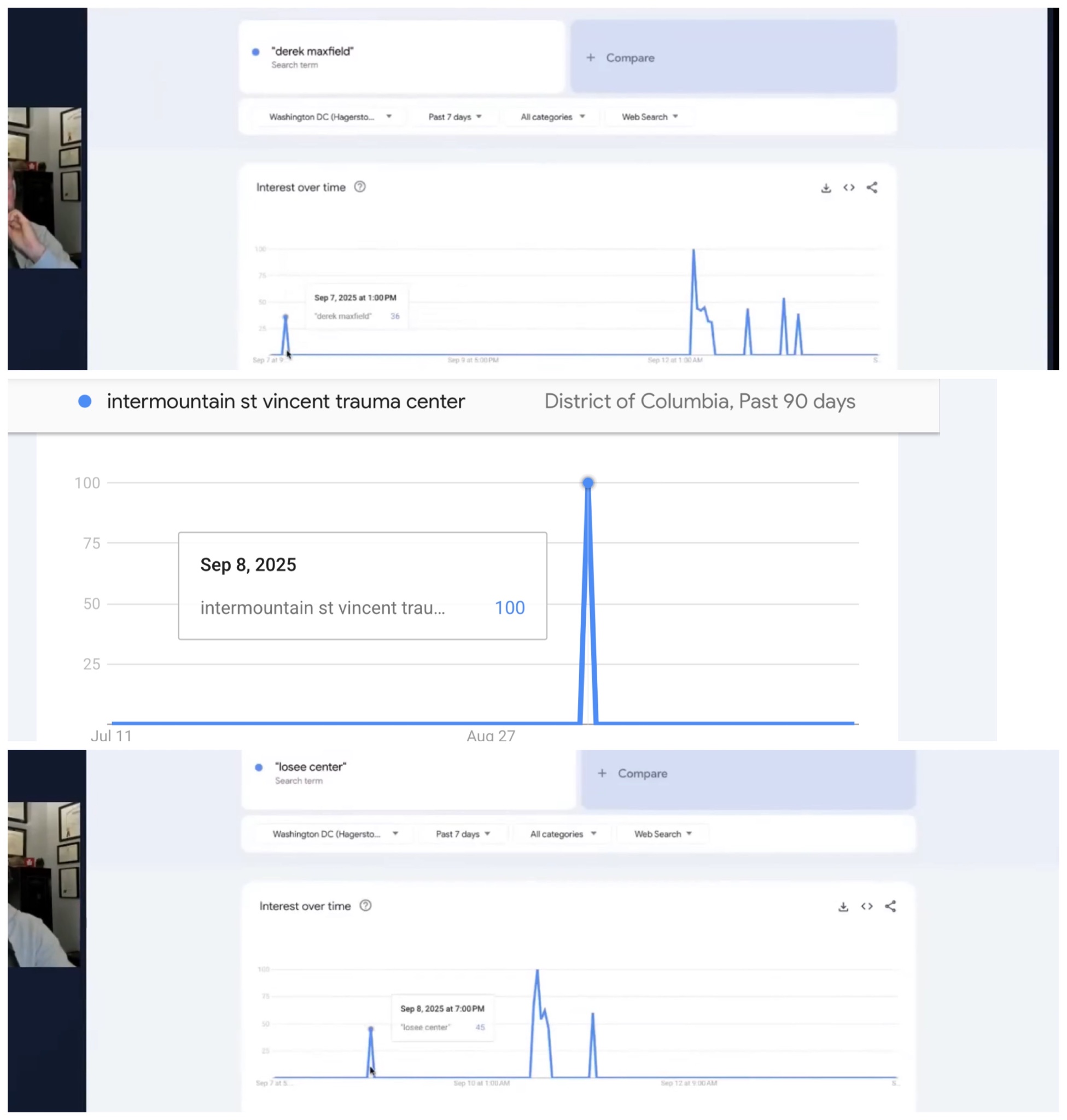
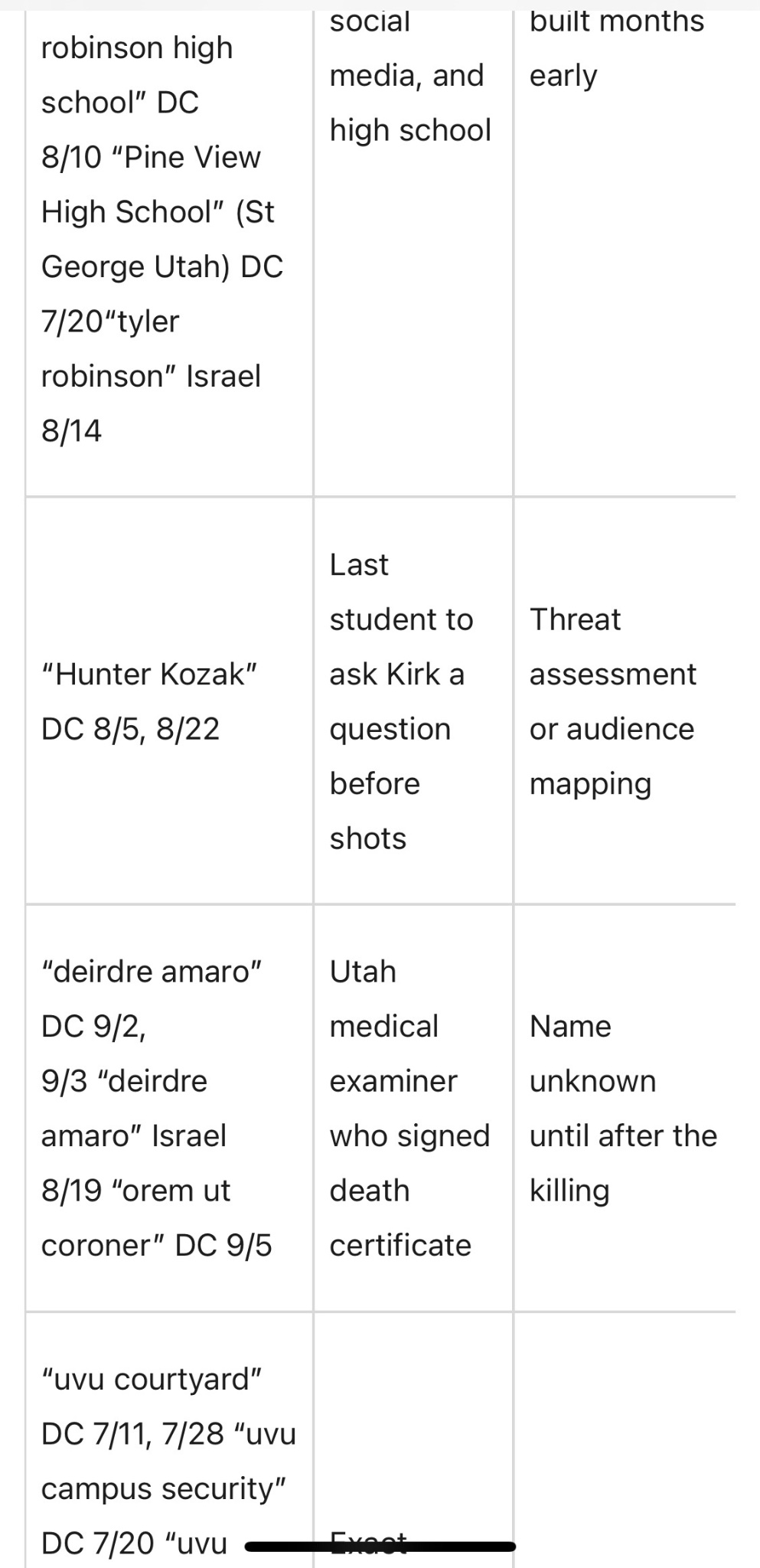
Start with the Investigation Index. Citizen researchers compiled Google Trends screenshots alleging Israel, Washington D.C., and federal-corridor search interest in case people, places, and planes before September 10, 2025. Trends cannot prove who searched or why — treat every entry as a lead pending subpoena-grade data.
- Timpanogos & Medical
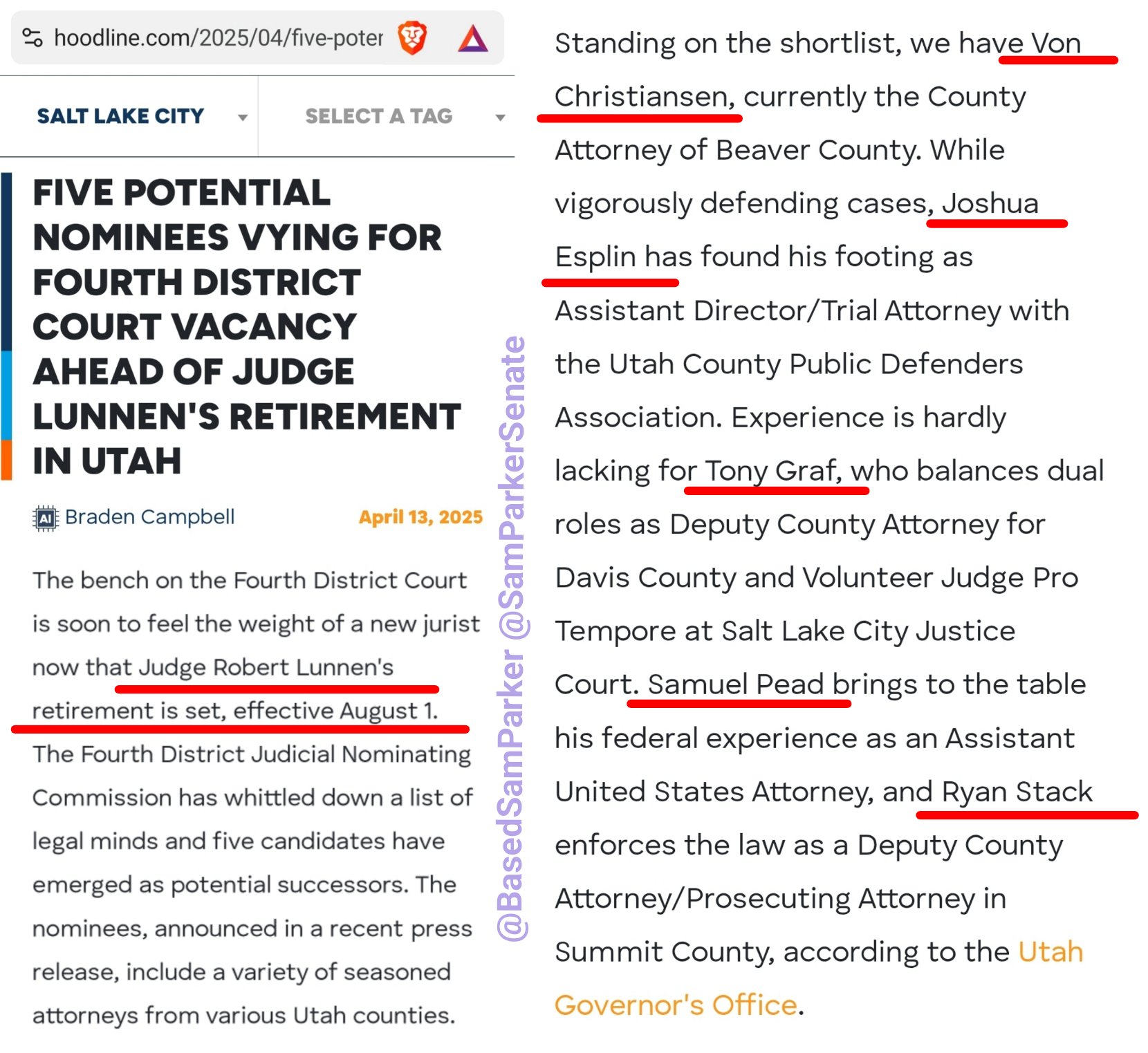
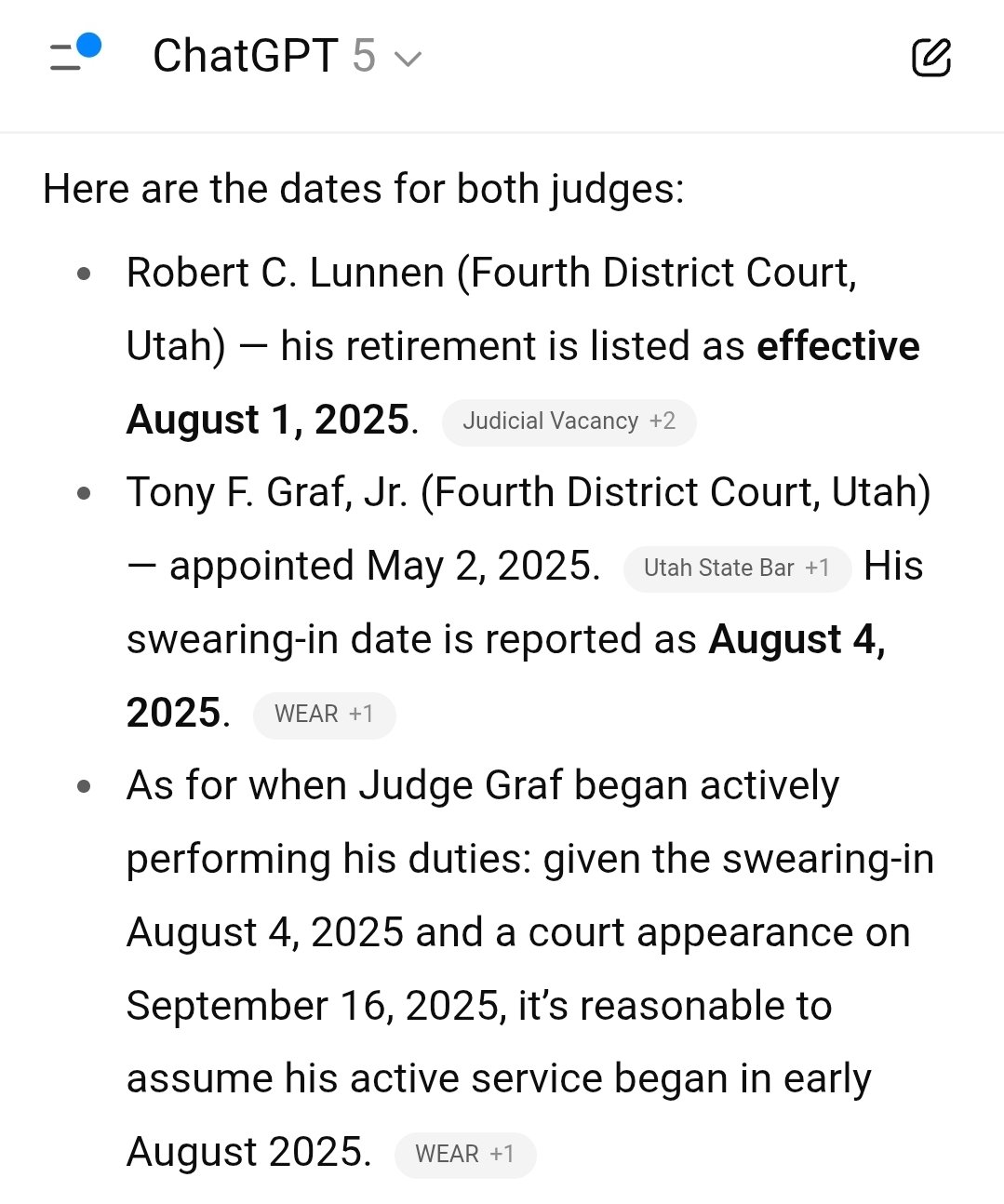
- Judges Graf & Lunnen
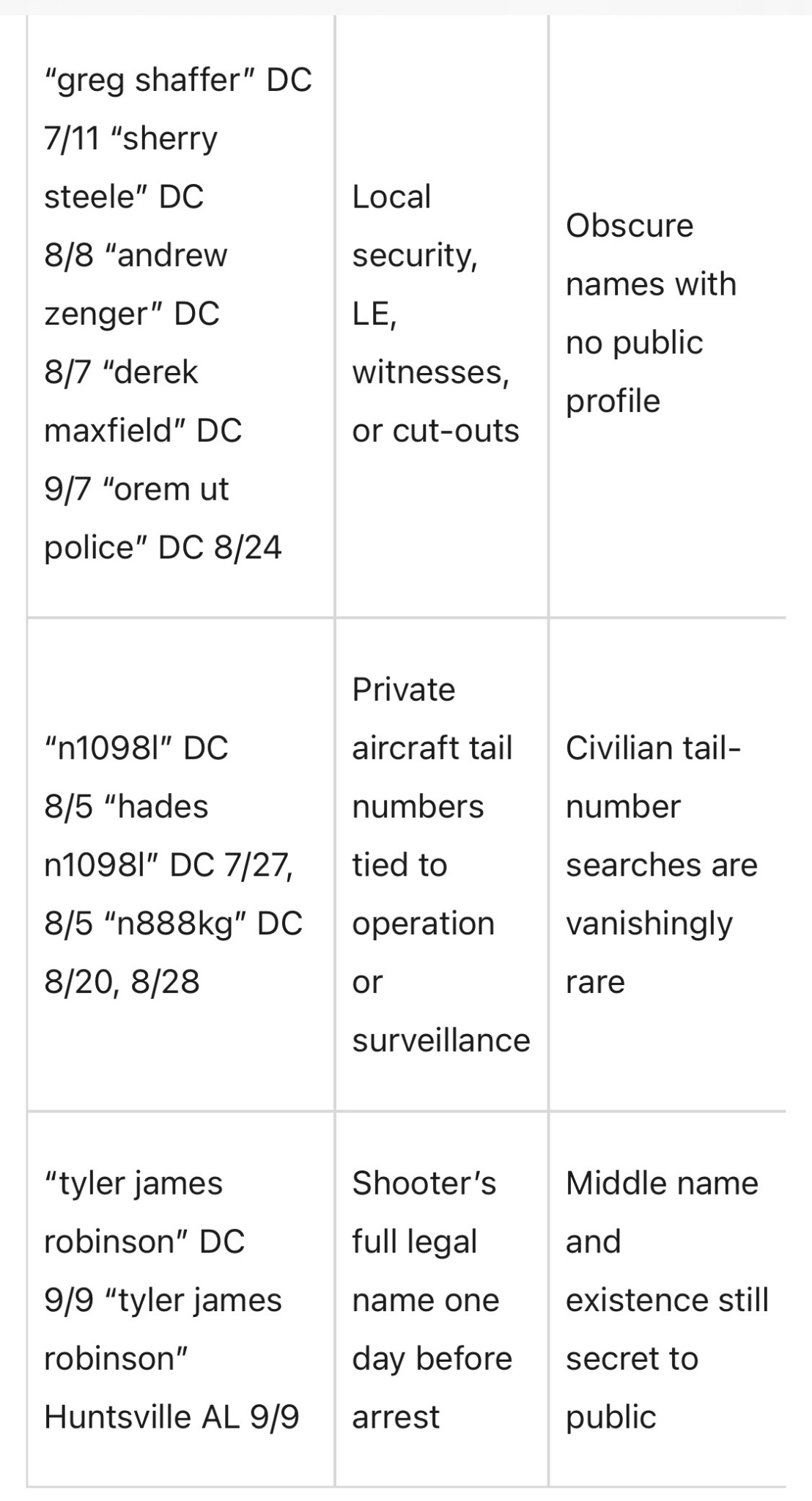
- Planes N1098L & N888KG
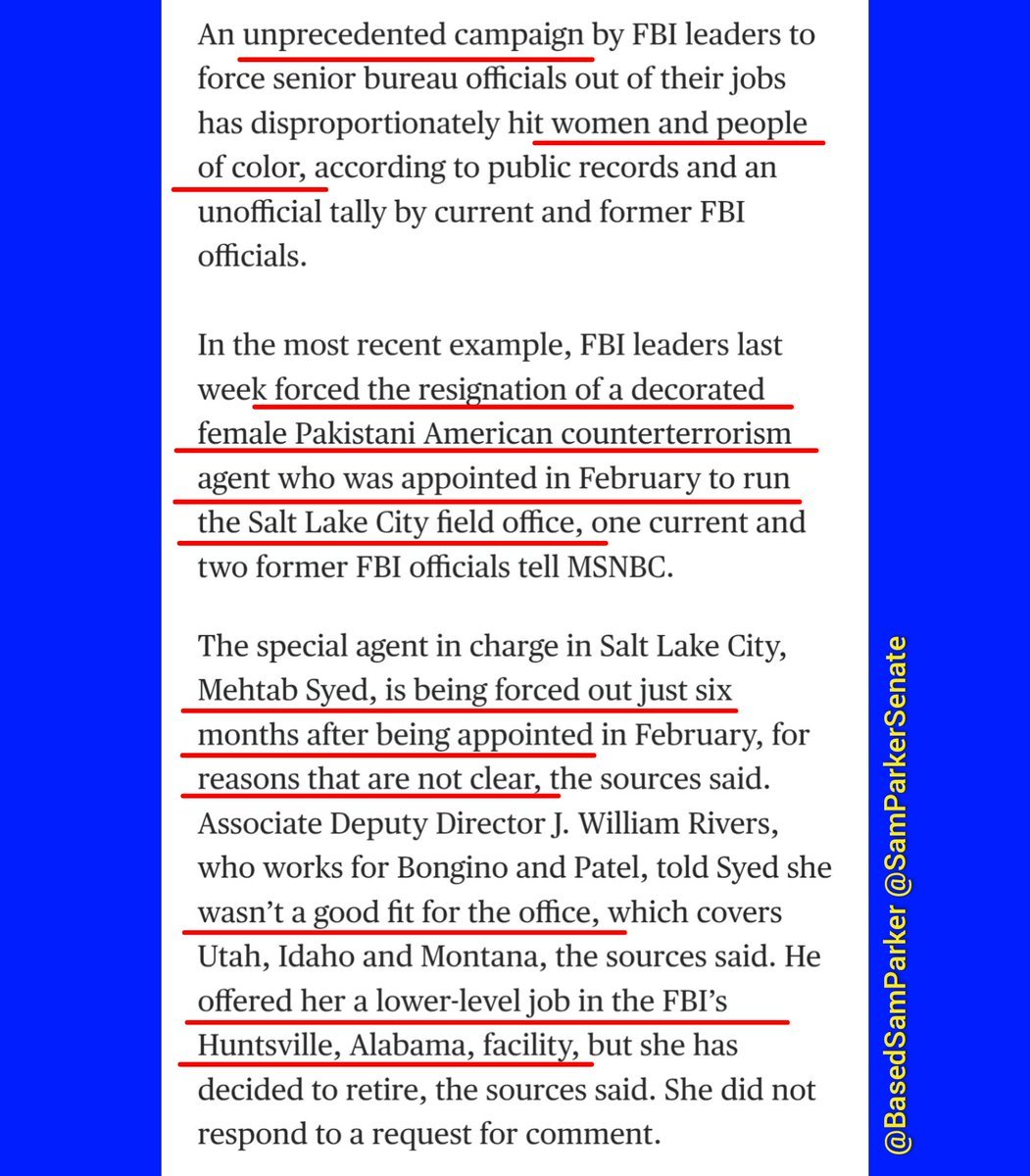
- FBI & DPS
- TPUSA & Political
- Misc Figures
- Israeli Tech in the Case
- Butch Hibbs — Person Page
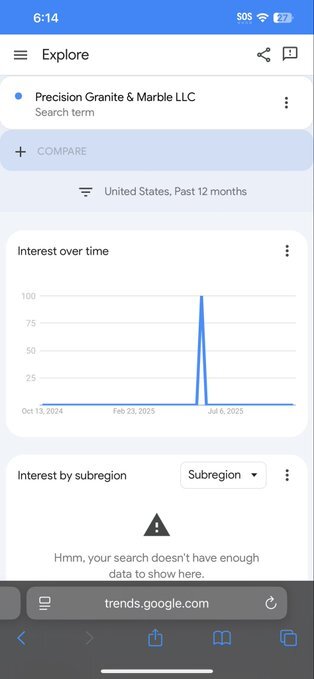
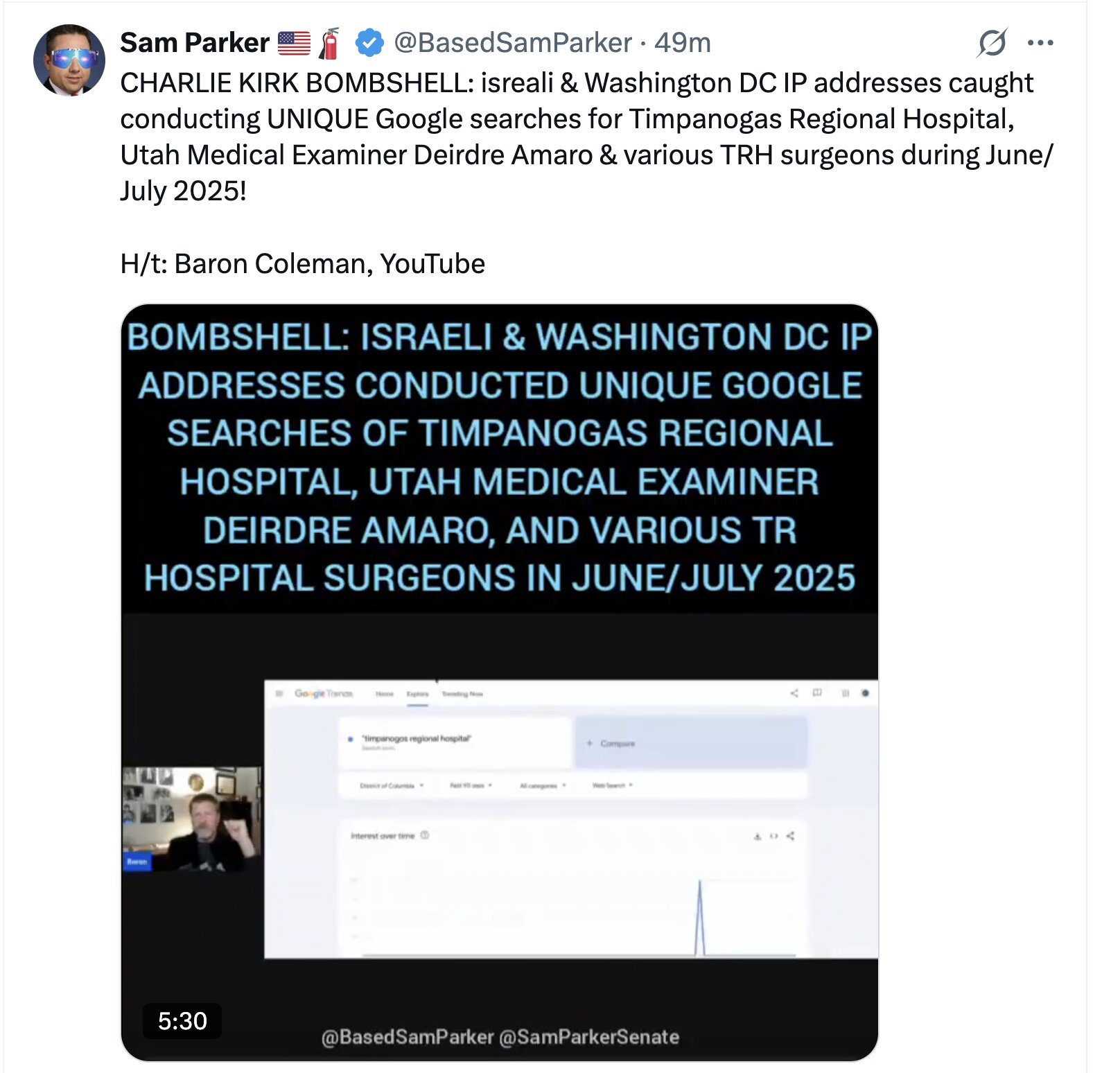
Search-pattern work exploded after Sept 10 because aggregate Trends geographies appeared to front-run names that only later mattered in court — Kathryn Nester (Dec 2024 Israel band), Lance Twiggs’s St. George address (Dec 2024–Sept 2025), N1098L (Aug 2025 Israel), judges with zero Utah pre-search in one viral post. Commentators anchor many July–August spikes on July 20, 2025 — the same week as AMFEST/Tucker, SU-BTT Omaha routing, and Timpanogos surgeon query frenzies. DC metro claims emphasize Timpanogos (June–July + Sept 9 day-before), Beau Mason (July 16), and Tyler Robinson (July 20 blip).
Virginia rarely appears as its own Trends bucket; Northern Virginia enters mainly via DC hospital/doctor speculation (Medical — DC phone call). The stronger anomaly — if screenshots hold — is foreign-geography interest with absent local Utah interest on judges and medical staff. Deletion claims allege Terms vanish after virality — archive screenshots early. Disclosure laws may force subscriber identities behind geographic buckets.
Read Investigation Index → July 20 + Israel / DC geography split, then subject pages matching your lead (Tyler, UVU, planes, FBI). Companion: Before — Pre-Event Searches, Medical Israel searches.
What Citizen Investigators Emphasize on X
The Google Searches section is defined by a fight over method: Baron Coleman-class investigators publish pre-event Trends screenshots (hospital, judges, planes, Israel geos); critics (@paramounttactcl, Tim Pool-class, @MaxNordau) say Trends cannot identify searchers and is statistical noise. This overview keeps both sides and routes to topic pages. Nothing here asserts a foreign state ran pre-event Google queries as operational planning. Worth noting: former NCTC director Joe Kent has cited online pre-knowledge of the assassination as one reason he says "more than likely there's something else at play" — and says his center's parallel foreign-ties review was halted before such leads were exhausted.
The Fort Huachuca image-search cluster (July 2026)
A newer thread shifts from Trends to image search. On July 14, 2026, Stew Peters aired the original claim that Sierra Vista/Fort Huachuca geography showed pre-Sept 9 image-search spikes for DIA, CENTCOM, Crane, and Kirk comms figures. On July 16, 2026, he claimed that image results for people his show named around Fort Huachuca were "completely wiped" the next day — grouping them under DIA, CENTCOM, Crane, and Kirk security figures — while unnamed people's results persisted. The named-vs-unnamed contrast is the only control offered; there is no archived before-state, and removal requests by private individuals explain the same appearance. These four pages record the claim and its limits; none of them allege wrongdoing by any named person.
Video: Erika Kirk's Name Searched in Hebrew While Egyptian Jets Sat on the Ground
On 5 August 2026 Stew Peters posted a three-minute-forty segment claiming that Hebrew-language Google searches for "Erika Lane Frantzve" — Erika Kirk's maiden name — appear in search-trend data on the same dates that an Egyptian-registered military aircraft was on the ground inside the United States. It is recorded here as an attributed claim, alongside what the segment does and does not actually demonstrate.
What the segment shows. Peters displays search-trend results split by language — English, Yiddish and Hebrew — and points to the Hebrew entries. He names 11 July 2025 and 24 July 2025 (Omaha, Nebraska), plus an image search he reads as "Erika Lane Frantzve Scottsdale." He then lists further Hebrew-language searches he places in the same windows: Tyler Robinson's home address down to the apartment number, the parking lot where the white SUV was seen circling, the Losee Center address, area traffic, and preloaded U.S. SIM cards for Orem, Utah. His argument is an analogy — a cruise ship in port produces a burst of the passengers' language in local search data, so a Hebrew burst co-located with a parked Egyptian jet implies Hebrew speakers arrived on it. All the dates he names are before 10 September 2025.
What it does not show. Search-trend data reports interest in a term. It does not identify who searched, from what device, or why — the standing caveat on every page in Google Searches. More importantly, being the subject of a search is not participation in anything. A search for "Erika Lane Frantzve" makes her the object of someone else's query and carries no implication that she knew of it, consented to it, or had any connection to whoever ran it. On its face the data Peters shows would be equally consistent with Erika Kirk being looked up by strangers. Co-location in time between a search burst and an aircraft on the ground is a correlation; the segment offers no manifest, no device attribution and no subscriber record tying the two together. Erika Kirk has not responded publicly to this specific claim, and no agency has confirmed any element of it.
Stew Peters, 5 August 2026 (3m40s). Source: @realstewpeters on X. Mirrored to IPFS by this investigation so it survives deletion.
Interesting In This Area
- Kathryn Nester in December 2024 is the earliest dated claim in this section.
- Judges and tail numbers are the most specific strings anyone has published here.
- A 2026 image-search cluster is a different dataset, and its before-state is gone.
- Only one claim here reproduces on demand; the rest are single screenshots.
Interesting In Other Areas
- Cellebrite is the Israeli tool that actually reached testimony, unlike any screenshot here.
Images
Other Pages In This Section
Google Searches — Investigation Index
The router for the whole section, and the only page that puts the methodology limits ahead of the claims. Aggregate geography is not a list of searchers, and post-event hindsight makes any earlier spike look predictive.
Read this
One midsummer week carries the AMFEST Tucker Carlson booking, an Egyptian jet's reported first American trip, a new Utah DPS commissioner and a two-week surgeon search frenzy. Commentators use it as a synchrony anchor, not a proven planning date.
Read this
Israel IP Search Patterns (Claims)
The largest bucket in this research is a Trends country filter, not a list of workstations — and the page concedes that in its first paragraph. What survives is a dated list running from August 2024 campus layouts to a September 1 FBI name.
Read this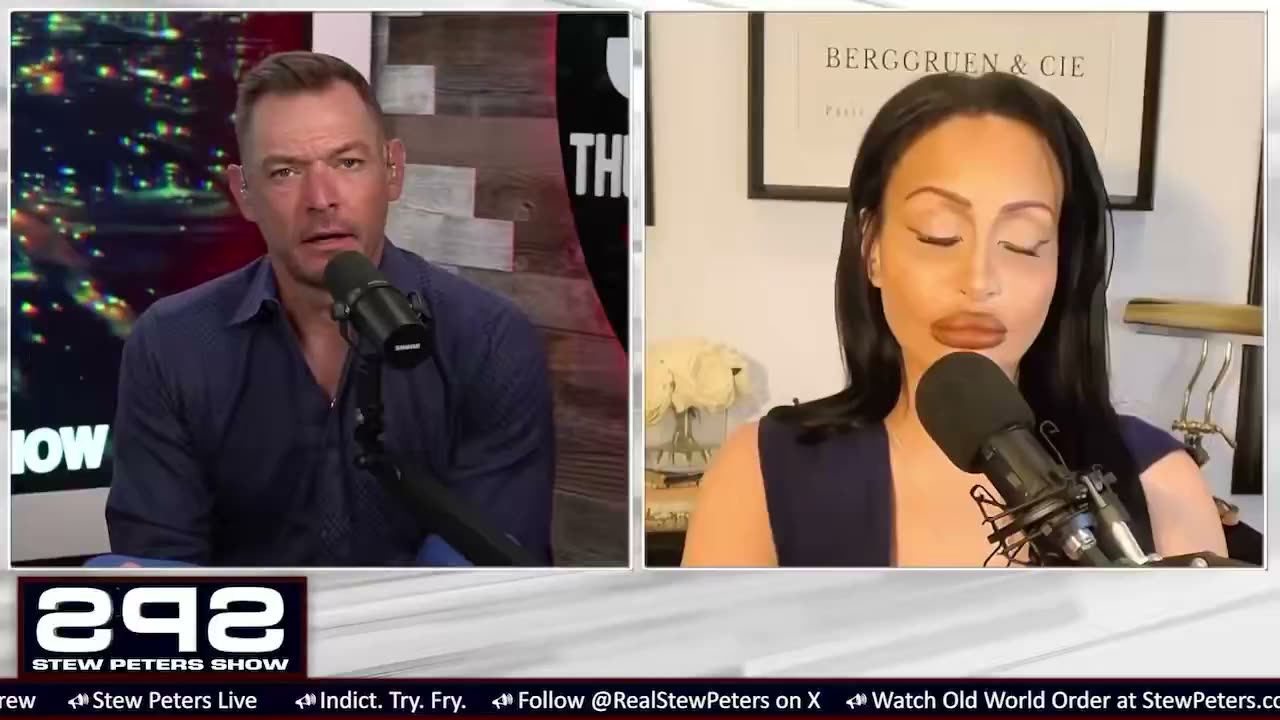
Fort Huachuca 9/9/2025 — Pre-Sept 9 Search Spikes (Claims)
A former Army OPSEC instructor argues junior soldiers routinely image-search VIPs before escorting them onto post — so the claimed anomaly is not the searching but who was searched, and when. The reported cluster runs from mid-July to the morning of September 9.
Read thisThis website's author is @HolonCitizen on X and YouTube/@HolonCitizen. Follow me there.
Video: Tyler Robinson's Address Googled in Hebrew from the Egyptian Jet
A researcher interviewed by Stew Peters reports that Tyler Robinson's exact apartment address — down to the unit number — was Google-searched in Hebrew on April 29, 2025, while an Egyptian-registered jet tracked by investigators sat parked in Lincoln, Nebraska. Full analysis and transcript: Stew Peters: Tyler Robinson's Address Googled in Hebrew.
Interesting
- A Navy contract bought miniaturized demolition charges sixteen days before Kirk was killed.
- UVU's 2019 CIA drone-ethics lecture page, dated September 10, now returns 404.
- Carlson says he told a senior official they are being blackmailed by intel agencies.
X.com posts:
Related Areas
- Before
- Israel
- Medical
- Planes
- Censorship
- US Intelligence