Videos
Video Clusters
The video archive holds 387 clips filed into 39 concept clusters. Open a cluster to see its clips and its sub-areas; every clip has its own page with the footage and a write-up.
- Aircraft and Flight Evidence — 13 videos
- Ballistics and the Gun — 22 videos
- Before Events — 2 videos
- Cause of Death — 11 videos
- Censorship — 7 videos
- Charlie Kirk — 7 videos
- Court and Legal Proceedings — 7 videos
- Cover Up (Possible) — 6 videos
- Owens On The Public-Figure Argument In The Harpole Civil Suit (1:03)
- Distraction People — 16 videos
- Drones — 21 videos
- FBI — 10 videos
- Google Searches — 7 videos
- Gov Mind Control — 8 videos
- Influencers — 5 videos
- Intelligence Services — 7 videos
- Iran War — 2 videos
- Israel — 18 videos
- Israel Main Suspect — 3 videos
- Fifteen Minutes Inside The Police Scanner Traffic (15:08)
- Maps — 4 videos
- Media — 2 videos
- He Has a Pulse: A Broadcast Report From the First Hours
- Other — 2 videos
- People — 10 videos
- Security Team — 17 videos
- Surveillance Cameras — 3 videos
- A Meme Clip Mislabelled As "The Real Shooter Escaping" (0:21)
- TPUSA (Turning Point USA) — 4 videos
- The Exploding Microphone — 18 videos
- The Real Killer — 4 videos
- The Tent — 8 videos
- The UVU Venue — 103 videos
- Theories — 2 videos
- Timeline Overview — 3 videos
- Tyler Robinson — 18 videos
- US Intelligence — 7 videos
- US Intelligence Assisted — 2 videos
- Witnesses — 3 videos
Also in this section: Buckley Carlson on the "Valhalla" comment.
Overview
This page explains the role of video evidence and analysis in the Charlie Kirk investigation. It covers the main types of footage—official production feeds, security cameras, drone footage, and eyewitness videos—and how they are used to evaluate timelines, shooter‑location theories, and claims about site changes and censorship.
Types of video sources
Key categories of video material include:
- Event production and TPUSA cameras – Professional footage from cameras set up near the stage and within the tent, which capture angles on Charlie, the crowd, and the immediate surroundings.
- Security and surveillance cameras – Campus or nearby cameras positioned around UVU that may record entrances, rooftops, tunnels, and movement before and after the event.
- Drone footage – Overhead shots from drones, where present, showing crowd layout, structures, and movement patterns.
- Eyewitness and bystander videos – Phone recordings from attendees, often providing unique perspectives and audio that are not captured by fixed cameras.
Together, these sources form a mosaic of how the event unfolded from different vantage points.
Uses of video in analysis
Investigators and commentators use video evidence for purposes such as:
- Timeline reconstruction – Aligning events (arrival, speech segments, shot, response) with precise timestamps.
- Shooter‑location testing – Comparing visual angles, muzzle flashes, and sound timing to proposed shooter positions in Shooting Locations and Tent.
- Movement and behavior analysis – Examining the movements of specific individuals, vehicles, or security personnel before and after the shot.
- Site‑change documentation – Comparing pre‑ and post‑incident footage to identify alterations in structures, landscaping, or equipment.
These uses make video central to both official and independent lines of inquiry.
Access, release, and censorship concerns (claims)
Public commentary raises several concerns about how video has been handled:
- Claims that some high‑quality institutional footage has not been fully released, or has only been shared in edited form.
- Reports of eyewitness videos being deleted or requested to be deleted, with some individuals stating they retained copies despite such requests.
- Allegations that certain online postings of video were removed or limited by platforms, intersecting with issues discussed in Media Censorship and Censorship.
These points remain allegations unless and until corroborated by formal records or official statements.
Related sections
- Security Cameras Overview and UVU Security Cameras – for security‑system specifics.
- Shooting Locations, Tent, and UVU Courtyard – for how video informs spatial and trajectory analysis.
- Media and Cover-up – for discussions of how video release and non‑release affect public understanding.
As more footage is authenticated and released, this section can be expanded to incorporate clearer references and links to specific video sources.
Video Pages
| Video | Description |
|---|---|
| Buckley Carlson: Kash Patel Valhalla | Buckley Carlson dismantles FBI Director Kash Patel over the "Valhalla" comment and suspicious FBI press conference conduct |
Laws (Charlie Kirk)
- The unreleased UVU security-camera and TPUSA production footage and drone video feeds and their recipients and records of witnesses asked to delete videos are things that the Charlie Kirk Investigation Laws may result in powerful truths coming out that aren't out yet.
Public commentary
Widely discussed video and audio threads in public commentary include:
- Canon XA55 uncompressed audio — @jonaaronbray (Apr 2026) three-event timing model.
- Eyewitness mobiles — Bednarz IPFS original; Ryne Simmons 4K; delete-pressure claims.
- Witness behavior clips — Cooper Brown / Jeb Jacobi confrontation; chest/heart early interviews.
- Political video essays — Buckley Carlson on Patel; Alex Jones on intel-scope shut-downs.
This website does not assert as fact that any living person named here committed a crime, did anything wrong or illegal, or had any knowledge of or involvement in the assassination. Names appear only in the context of public discussion. Nothing here is a finding by this website.
This website's author is @HolonCitizen on X and YouTube/@HolonCitizen. Follow me there.
Marjorie Taylor Greene Questions the Narrative
Former U.S. Rep. Marjorie Taylor Greene said on camera (August 3, 2026) that she is "very much compelled by the lapel-mic stories," that having shot a .30-06 herself "it's hard for me to go along with the traditional narrative," and that the SD-card collection and the paving of the scene two days later are "very questionable."
Source: @SenseReceptor on X. Full quotes and transcript: her profile · archived video page: MTG Questions the Charlie Kirk Narrative.
Tyler Robinson's Address Googled in Hebrew from the Egyptian Jet
Stew Peters posted an interview clip (August 4, 2026) in which a researcher claims Tyler Robinson's exact apartment address — down to the unit number — was Google-searched in Hebrew on April 29, 2025 from Lincoln, Nebraska, while an Egyptian-registered jet tracked by investigators sat parked there. "If the hypothesis were true, that it were Mossad agents — well, they would have a Hebrew keyboard and they would likely be Googling that way."
Source: @realstewpeters on X. Full transcript and write-up: Hebrew Search from the Egyptian Jet.
Related Areas
Related
Images
Videos
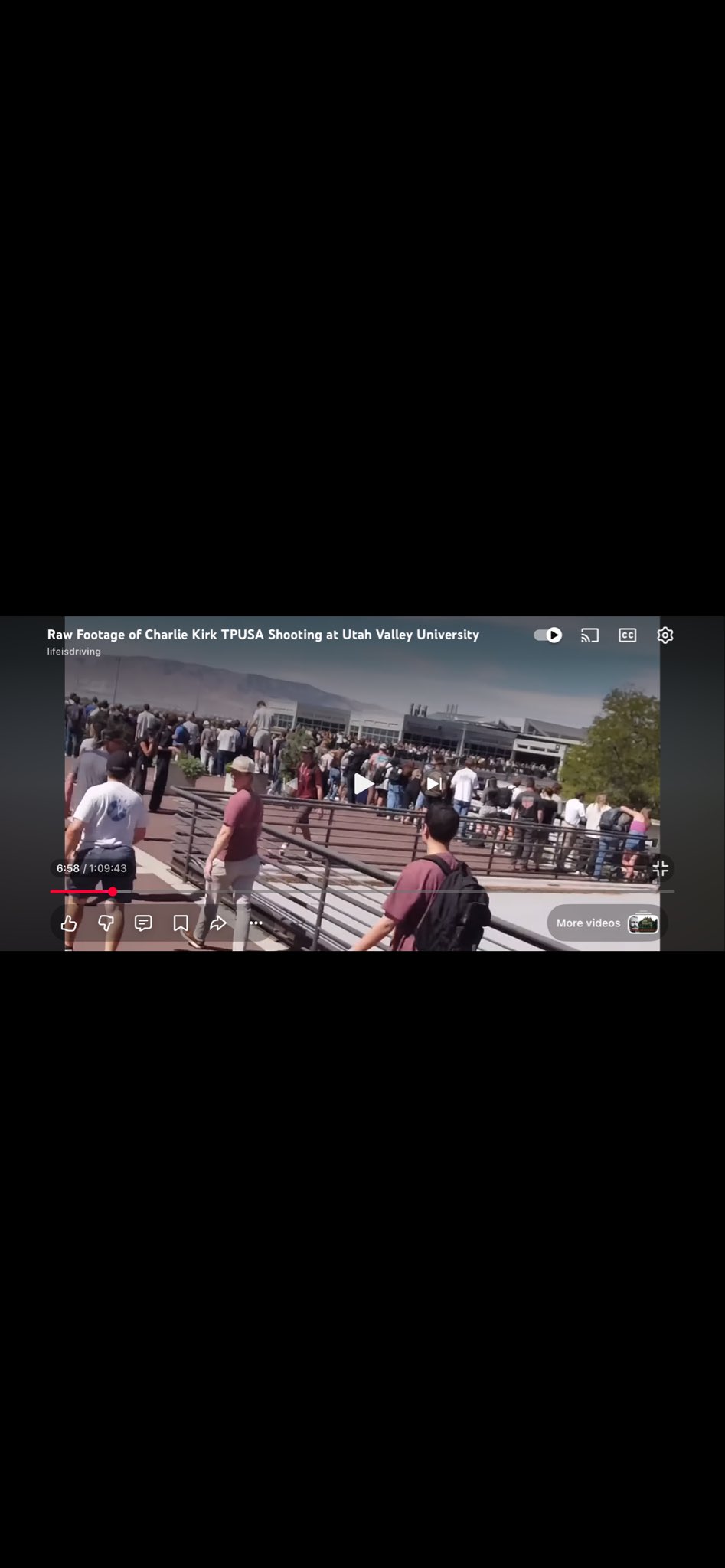
Footage related to this page. Each card opens that clip's own page, with the video, the full write-up, and its source.